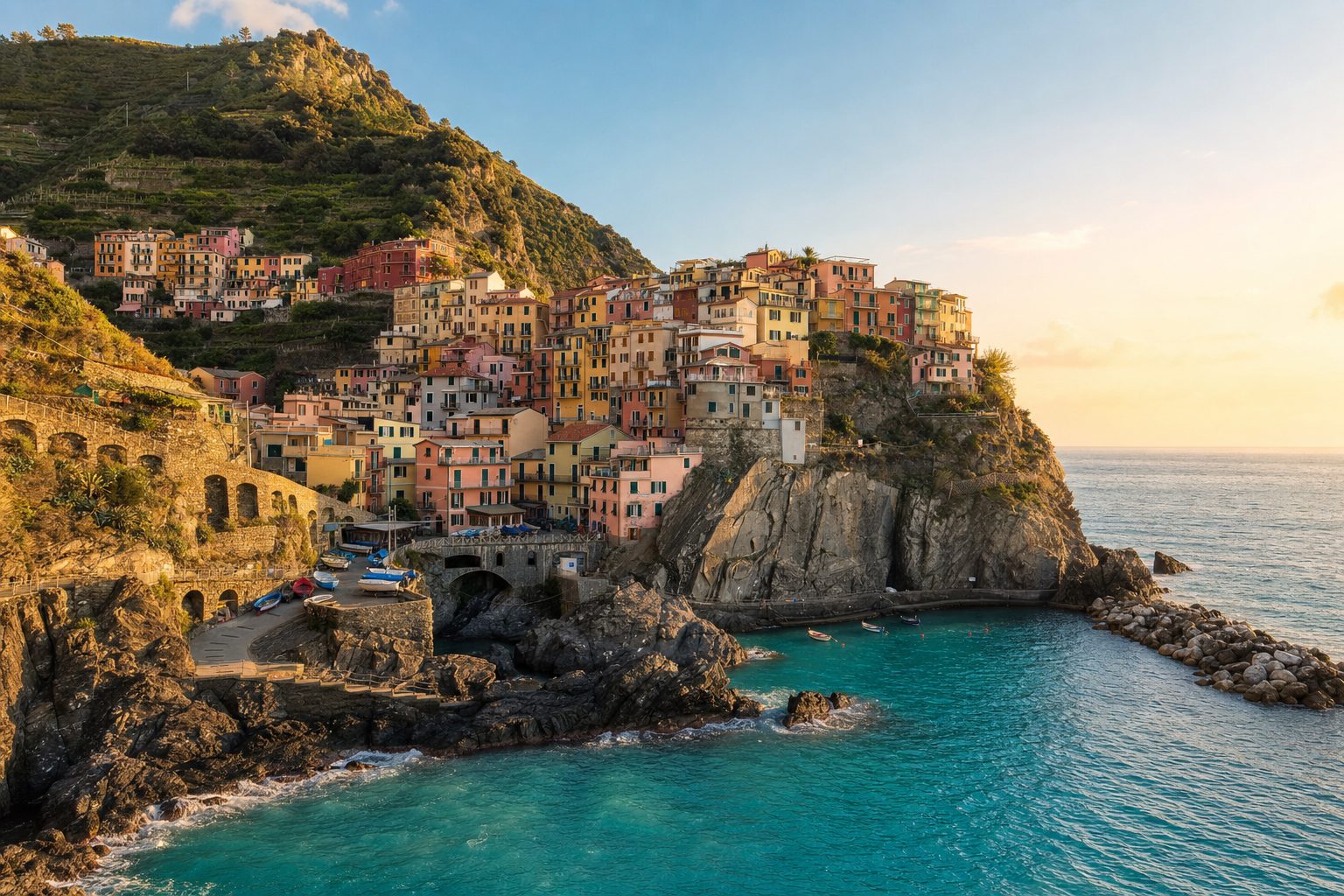

The single most useful mental shift for an American planning a European trip is to stop thinking "which flights?" and start thinking "which trains?" Europe’s cities are close together and its rail network is dense, fast, and drops you in the centre rather than an hour out at an airport. Flights, ferries and cars all have their place — but rail is the default, and the others are the exceptions.
Trains are the backbone

Eurail is the rail pass for residents of the Americas, Asia, Africa and Oceania (Europeans buy Interrail instead), and a Eurail Global Pass covers travel in up to 33 countries. [1]
A pass is not automatically the cheapest option, though. Seat reservations are extra and often required on high-speed and night trains, and advance point-to-point tickets can undercut a pass on a simple two-city trip. Do a quick compare on the route you actually want before buying. For city pairs under about four hours — Paris–Lyon, Madrid–Barcelona, Rome–Florence — the train beats flying door-to-door almost every time.
Eurostar’s fastest journeys run London–Paris in 2h16, London–Brussels in 1h53, London–Amsterdam in 4h19, and Amsterdam–Paris in 3h20. [3]
Night trains buy you a day
On longer hops where a daytime train would eat a whole day, the ÖBB Nightjet network runs sleeper cabins, couchettes and seats across Austria, Germany, Italy, Switzerland and beyond. Vienna–Rome or Paris–Vienna overnight means you travel while you sleep and skip a hotel bill — book the sleeper class early, as berths are limited.

Flights, and your rights when they go wrong
Under EU air passenger rights (EC 261), cancellations and long delays can trigger compensation of €250, €400 or €600 depending on distance, unless the airline proves extraordinary circumstances. [5]
Low-cost carriers make long geographic jumps and one-way "open-jaw" routings cheap, but the sticker price hides strict cabin-bag fees, far-flung secondary airports, and transfers that can erase the saving. Compare on total, door-to-door cost and time — not the headline fare — and know your EC 261 rights if things go sideways.
Ferries and rental cars
Ferries are essential for the Greek islands and scenic across the Adriatic and Baltic. Cars, meanwhile, shine exactly where trains are thin: rural regions, wine country, and scenic drives such as the Norwegian Scenic Routes.
An International Driving Permit is recognised in 150 countries and is issued in the US by AAA for $20 to holders of a valid US license. [6]
Get the IDP before you leave home, reserve an automatic if you cannot drive a manual, and keep cars out of dense historic centres — Italy’s ZTL limited-traffic zones and scarce parking make them a liability there.
Which mode, when
- Two major cities, under four hours apart: high-speed rail.
- A long overnight hop where you want to save a day: night train.
- Small towns, scenery, or maximum flexibility: regional rail or a rental car.
- Getting around within a city: metro, tram and walking, plus a city card if it pays off.
- A long jump, an island, or a one-way route: a low-cost flight or a ferry.
Once you know how you’ll move, the routing writes itself. See our 7, 10 and 14-day itineraries, get the entry rules straight in the first-trip planner, or browse the Getting Around collection.