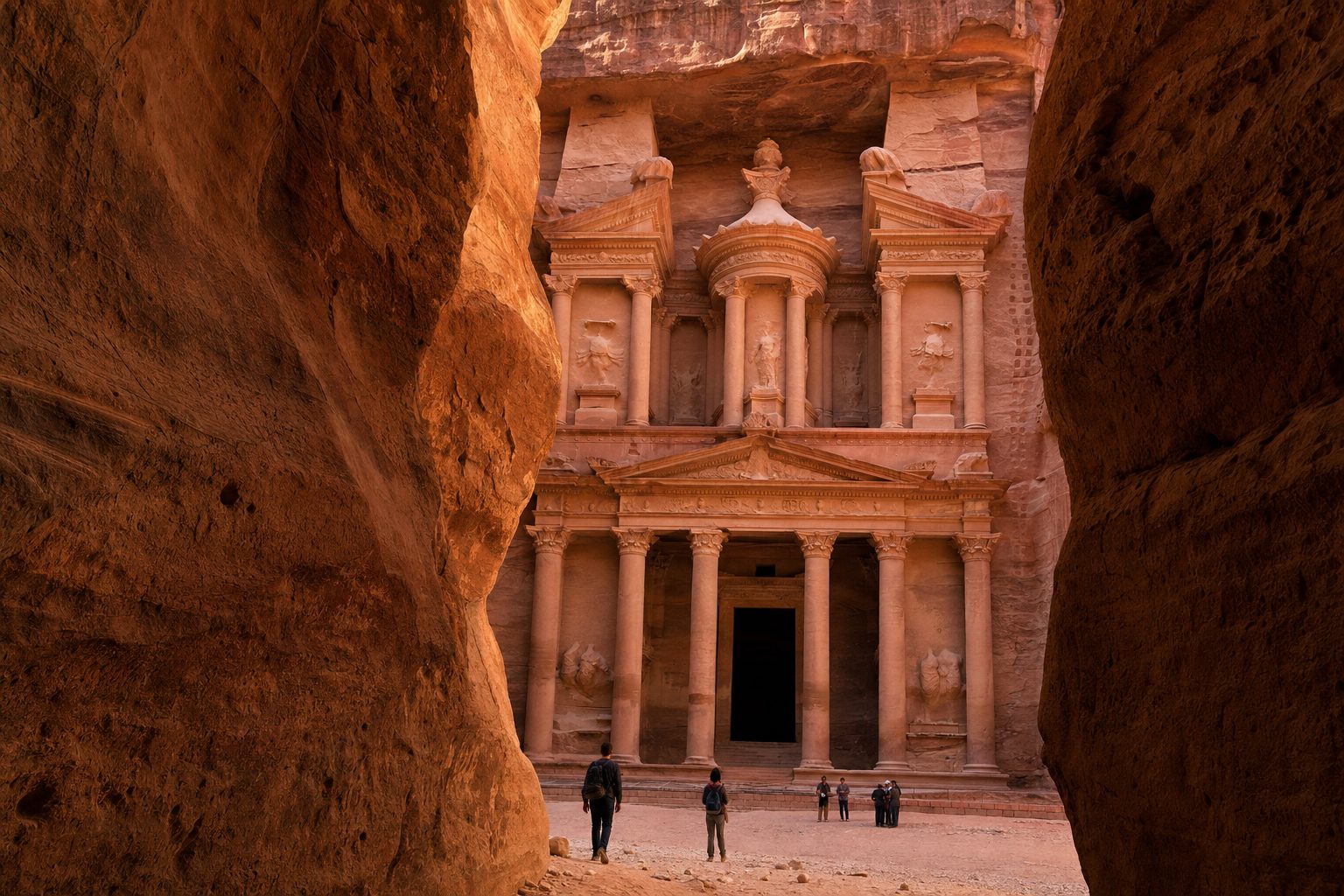
The Petra that dominates reels is usually one framed moment: the Treasury appearing at the end of the Siq, its rose sandstone façade briefly clear of people. That image is real, but it leaves out the decisions that shape a first visit. Petra is a large archaeological landscape, not a single viewpoint, and the useful questions are practical: whether to spend one or two days, where to stay, how much walking is realistic, whether a guide adds value, and whether the evening event is worth a separate ticket.
Start with the overnight. A visitor who treats Petra as a border-crossing day trip can pay far more than someone sleeping in Jordan, while a visitor who arrives too late from Amman may have only a short window for a site that rewards an unhurried pace. This guide uses the official ticket and trail information checked in August 2026, with the Treasury as an opening rather than the entire plan.
Choose the ticket around your nights in Jordan
The first price distinction is not a discount code; it is whether you are an accommodated visitor. Petra Development and Tourism Region Authority defines that as someone who stays at least one night in Jordan. For that group, the one-, two- and three-day tickets cost 50, 55 and 60 JD. The multi-day tickets are strikingly close in price, but they must be used on consecutive days, so buy the second or third day only if the dates are genuinely protected in the itinerary.
As checked in August 2026, PDTRA’s official online ticketing lists Petra entry at 50 JD for one day, 55 JD for two consecutive days and 60 JD for three consecutive days for accommodated visitors; a one-day ticket for a non-accommodated visitor is 90 JD. Children under 12 enter free during daylight hours. [1]
That 90-JD category is the expensive mistake behind many rushed Petra plans. It applies to a one-day visit by a non-accommodated visitor, including a visitor whose first day in Jordan is the Petra day. A night in Wadi Musa, the town at Petra’s entrance, is therefore more than a convenience: it gives a dawn start and makes the lower accommodation-based price applicable. Keep the passport used to buy the ticket with you, and buy only through PDTRA’s online ticket office or the official ticket desk rather than an unauthorised reseller.
Do the Jordan Pass calculation before buying standalone entry
The Jordan Pass simplifies the arithmetic if Petra is part of a longer Jordan route. Its three tiers differ chiefly by Petra days: Wanderer costs 70 JD and includes one day; Explorer is 75 JD for two consecutive Petra days; Expert is 80 JD for three. Each includes entry to more than 40 attractions, so the decision should be made against the whole trip, not just the Treasury. It also covers standard Petra admission, but not the separate Petra by Night show, transport inside the site, private guiding, food or accommodation.
The official Jordan Pass price page lists Wanderer at 70 JD with one Petra day, Explorer at 75 JD with two consecutive Petra days and Expert at 80 JD with three consecutive Petra days. The tourist visa fee is waived only when the pass is bought before arrival and the traveller stays a minimum of two nights, or three days, in Jordan. [3]
For a two-day Petra plan, Explorer’s 5-JD step up from Wanderer is easy to justify: the extra day is where the Monastery, Royal Tombs or a longer guided route fits without turning the first day into a march. The visa provision is conditional, however, and nationality and entry route can affect what you would otherwise pay. Check the current rules on the Jordan Pass site before buying, especially if arriving through Aqaba or staying fewer than the required nights. The independent cost analysis is useful as a sense-check, not a substitute for the official conditions.
Make the Treasury the start of the walking day
A one-day visit is viable when it is deliberately narrow. Walk from the Visitor Centre through the Siq to the Treasury, then continue past the Street of Façades, theatre, Royal Tombs and colonnaded street as energy and heat allow. The official Main Trail is the simple reference line: it runs from the Visitor Centre to Qasr al-Bint, while everything higher or further out is an add-on. Do not promise yourself a Monastery climb, a High Place of Sacrifice route and a leisurely return through the Siq on the same ticket unless fitness, heat and daylight all genuinely allow it.
Petra is half built and half carved into rock, with its monuments, water systems and sacred high places set within red sandstone mountains, passages and gorges rather than concentrated in a compact museum district.
— Paraphrased from the UNESCO World Heritage listing for Petra
That scale explains why a second day is not indulgent. Use the first for the main corridor and the atmosphere of the Siq; keep another for the Monastery, an official trail, Little Petra or the Royal Tombs at a calmer pace. UNESCO identifies the Siq as a particular congestion point and notes the pressure of tourism on the site, which is a good reason to treat the early walk as a timing choice rather than a race for a perfect empty photograph.
- Carry more water than the short approach to the Treasury suggests, plus sun cover, grippy shoes and a layer for the temperature drop after sunset.
- Set one non-negotiable aim for each day: the main corridor, the Monastery, a guided high route, or Little Petra, rather than trying to complete every landmark.
- Start with the Siq early and leave the Treasury after the first viewing; the monuments beyond it deserve the same attention as the reveal.
- Keep the ticket, passport and Jordan Pass QR code accessible offline or on paper, as the official terms allow e-tickets to be scanned from a phone but require identification when requested.
- Use marked routes and an official guide for serious ascents; do not accept an invitation to an unmarked viewpoint as an informal substitute for trail planning.
Pay for a guide or transport only when it changes the day
The main archaeological route is navigable independently, so a guide is a choice for context and route confidence rather than an automatic requirement. The official fee schedule gives useful benchmarks: a Main Trail guide is 50 JD; combining it with the High Place of Sacrifice or the Monastery is 100 JD; and the Al-Khubtha route from the Royal Tombs to a viewpoint is 50 JD. These are guide prices, not entry fees, and they should be agreed through the Visitor Centre with the scope and return plan clear before setting off.
As checked in August 2026, the Jordan Tourism Board lists a 50-JD Main Trail guided tour, 100 JD for Main Trail plus either the High Place of Sacrifice or Monastery, and 50 JD for the Al-Khubtha and Little Petra guided trails. The same official guidance lists the Visitor Centre–Treasury club car at 15 JD one way or 25 JD return. [4]
The club car makes sense for visitors with limited mobility or anyone preserving energy for the lower city, but it should not be confused with a tour: it covers the four kilometres between the Visitor Centre and Treasury. There are further paid club-car links beyond the theatre. Horses, carriages and informal offers can be part of the approach to the site, but prices and expectations vary; PDTRA’s visitor terms specifically warn that a ride described as free is not free, advise agreeing the price in advance, and identify the club car as the legal vehicle service to the Treasury. Treat animal welfare and the safety of the route as part of the decision, not an afterthought.
Treat Petra by Night as an evening event, not extra entry time
Petra by Night has a distinct mood: a return through the Siq after dark to the Treasury, with candlelight and a staged programme. It is not the same as being able to roam the archaeological park at night, and it needs a separately purchased ticket even if you hold a daytime pass. Because the walk is still substantial in darkness, it works better after a lighter daytime plan, or on the evening between two Petra days, than after an attempt to climb every stair to the Monastery.
The Jordan Tourism Board lists Petra by Night at 30 JD for visitors aged 10 and over, with under-10s free; it runs Sunday to Thursday from 8:30pm to 10:30pm and requires a valid daylight Petra ticket or Jordan Pass in addition to the night ticket. [4]
Decide on it for atmosphere, not a second chance to sightsee. The daytime ticket is the better value for monuments, trails and orientation; the night show is a concentrated experience of the Siq and Treasury. If buying a 50-JD or 30-JD daytime ticket, the tourism board says an entry extension can be bought for an additional 5 JD at the Visitor Centre, but availability and event arrangements can change, so verify current details there rather than building the entire evening around an assumed extension.
Arrive with enough time, and keep the plan flexible
Wadi Musa is Petra’s practical gateway. From Amman, the official tourism board estimates roughly three hours by the Desert Highway or four to four-and-a-half on the more scenic King’s Highway; its daily JETT service from Amman is scheduled to reach Petra around 10:00–10:30am after 6:30am and 7:00am city departures. That can still make a useful first afternoon, but it is not an argument for compressing Petra into an Amman day trip. Times, weather and site operations can change, and the official ticketing terms allow PDTRA to alter access for weather, crowding or other exceptional events.
Check opening hours shortly before travel rather than relying on a screen shot: PDTRA’s online ticketing currently says the archaeological site opens daily, with seasonal closing differences and ticket sales ending 45 minutes before closure. Flash-flood risk in the Siq is a serious operational consideration in wet weather, and the site’s rules also prohibit climbing monuments and entering closed areas. Respecting the boundaries is both basic safety and a way of protecting a landscape where erosion and visitor pressure already challenge the carved sandstone.
Leave room for the rest of southern Jordan
Petra rewards a plan that is spacious rather than maximal. Stay in Wadi Musa, buy the ticket that matches real nights and real walking capacity, keep the main route and a longer trail on separate days where possible, and add Petra by Night only for the after-dark atmosphere it actually offers. From here, the next natural contrast is a desert night and guided four-wheel-drive travel in Wadi Rum, about one-and-a-half to two hours away by road according to the Jordan Tourism Board. For a wider comparison in navigating historic places where guides, etiquette and logistical choices matter, Meridian’s Marrakech medina guide makes a useful next read.
Sources & further reading
- 1. PDTRA Online Ticketing
- 2. Visit Petra: Petra Fees
- 3. Jordan Pass: Packages and Prices
- 4. Jordan Tourism Board: How Much Does It Cost to Go to Petra
- 5. UNESCO World Heritage Centre: Petra
- 6. Jordan Tourism Board: How to Get to Petra
- 7. Along Dusty Roads: Petra Entrance Fees and Tickets
- 8. Jordan Spirit: Jordan Pass 2026 Cost Analysis