Two flights a week. As checked in September 2026, that is the entire scheduled air link between the outside world and Socotra, a Yemeni island in the Arabian Sea that is closer to the Horn of Africa than to its own mainland. Everything else about planning a trip here flows from that number. You cannot shorten a visit to a long weekend, you cannot book the flight yourself, and the island's rhythm is set by an Airbus A320 that arrives from Jeddah on Tuesdays and Thursdays and leaves again the same afternoon.
What waits at the other end is a landscape with few reference points: dragon blood trees in umbrella-shaped groves on a limestone plateau, white dunes leaning against sea cliffs, a saline lagoon behind a sand spit at the island's western tip. UNESCO inscribed the archipelago as a natural World Heritage property in 2008, and a large share of its plants and reptiles exist nowhere else. This guide is organised around the decisions a first-time visitor has to make: whether the security picture is acceptable to you, when to go, how to get a seat and a permit, how much cash to carry, and how to behave in a place with almost no infrastructure.
First decision: weigh the official advice before anything else
Socotra is administratively part of Yemen, and Western governments do not carve out an exception for the island. The UK Foreign, Commonwealth & Development Office advises against all travel to the whole of Yemen; as checked in September 2026, its page was last updated on 31 July 2026 and notes that consular support is severely limited and that travelling against the advice may invalidate your insurance. Read the current wording yourself at gov.uk and, if you are American, at travel.state.gov, which keeps Yemen at Level 4, its highest tier.
Tour operators will tell you, accurately, that the island has been spared the fighting on the mainland and that tourism has run for years without incidents against visitors. Both things can be true at once. The practical consequences of the advisory are about paperwork and contingency: you will need a specialist insurer that explicitly covers Yemen, you should assume no consular help if something goes wrong, and you should accept that flights can stop at short notice. The U.S. Mission to Yemen recorded exactly that on 2 January 2026, when a state of emergency on the island temporarily closed all ports of entry and flights were cancelled or diverted.
The UK FCDO advises against all travel to Yemen, including Socotra, citing unpredictable security conditions; the advice was still current on 9 September 2026 and last updated on 31 July 2026. British Embassy services in Sana'a are suspended and all diplomatic staff have been withdrawn. [4]
When to go: a season shaped by the monsoon
The travel season runs from roughly October to April, with some operators stretching it into early May. From June to September the south-west monsoon brings sustained high winds, dangerous seas and a hazy, oppressive heat; camping is miserable, snorkelling is unsafe and the Jeddah flights do not operate at all, so the island is effectively closed in summer.
Within the open season there are trade-offs. October and November are green after the rains, with settling winds and occasional showers. December to February brings the coolest temperatures and clearest skies, but also the busiest camps, and a jacket is needed for nights on the plateau. March and April offer the calmest seas and best underwater visibility off Dihamri, while the bottle trees are in flower.
Getting there: why you cannot book this flight yourself
As checked in September 2026, the only reliable route is Yemenia Airways from King Abdulaziz International Airport in Jeddah, Saudi Arabia. The outbound flight leaves Jeddah at 11:00 and lands at Socotra Airport, on the north coast near the capital Hadibo, at 14:30. The return departs at 14:45 and includes a technical stop of roughly 45 minutes in Mukalla on the Yemeni mainland to refuel, because Socotra's airport has no fuel infrastructure; passengers stay on board and there are no entry formalities. The earlier Air Arabia service from Abu Dhabi, for years the standard way in, was discontinued at the end of 2025.
These are not seats you can buy on a booking site. Yemenia's Socotra flights do not appear on the standard platforms; tickets are allocated through licensed Socotran travel companies, which reserve them in your name once the schedule for a given window is released, often only two to three months ahead. Operators quote the Jeddah return at roughly USD 900 to 1,100 per person, payable in full at confirmation. The sequence therefore matters: choose an operator and dates first, wait for the Socotra flight to be confirmed, and only then book your international flight into Jeddah. Arrive the day before, sleep near the airport and be at Terminal N early.
As of July 2026, Yemenia Airways operates the Jeddah–Socotra route twice a week, on Tuesdays and Thursdays, with an Airbus A320: departing Jeddah 11:00 and arriving Socotra 14:30, returning at 14:45 via a 45-minute refuelling stop in Mukalla to land in Jeddah at 19:10. Flights run October to May only. [6]
One more piece of paperwork: because you will spend a night in Saudi Arabia, most nationalities need a Saudi e-visa or visa on arrival, obtainable at visa.visitsaudi.com. If two visas and an overnight stop feel like a lot for one island, the same hubs open up Wadi Rum and Petra as a companion leg.
Permits, operators and the end of independent travel
There is no independent tourism on Socotra in any meaningful sense. The tourist entry permit, a stamped sheet of paper rather than a full Yemeni visa, is issued to your licensed operator on your behalf; you supply a passport scan and the operator does the rest, usually in the last two or three weeks before departure because permits are valid for a short window. As checked in September 2026, operators quote the government fee at between USD 150 and USD 200 per person, either itemised or folded into the tour price, and it is not valid for onward travel to mainland Yemen. Your passport needs at least six months' validity.
The operator is not just a formality. There are no hire cars, no taxis by the day and no marked campsites; the sites that make the island worth the effort are reached on rough plateau tracks that need a 4x4 and a driver who knows them. A typical package bundles permit, vehicles, driver, English-speaking guide, cook, tents and meals for the week, with eight-day all-inclusive trips quoted at roughly USD 1,950 to 2,500 per person before flights. Because you will live with these people for a week, choose on the quality of their answers, their waste policy and how clearly they explain the flight risk, not on price alone.
Socotra is described as globally important for biodiversity because of its exceptional level of endemism across both land and sea, with the Committee warning that unsustainable tourism and invasive species are potential future threats that need to be monitored and minimised.
— Paraphrased from UNESCO World Heritage Committee Decision 32 COM 8B.5 (2008)
What you are actually going to see
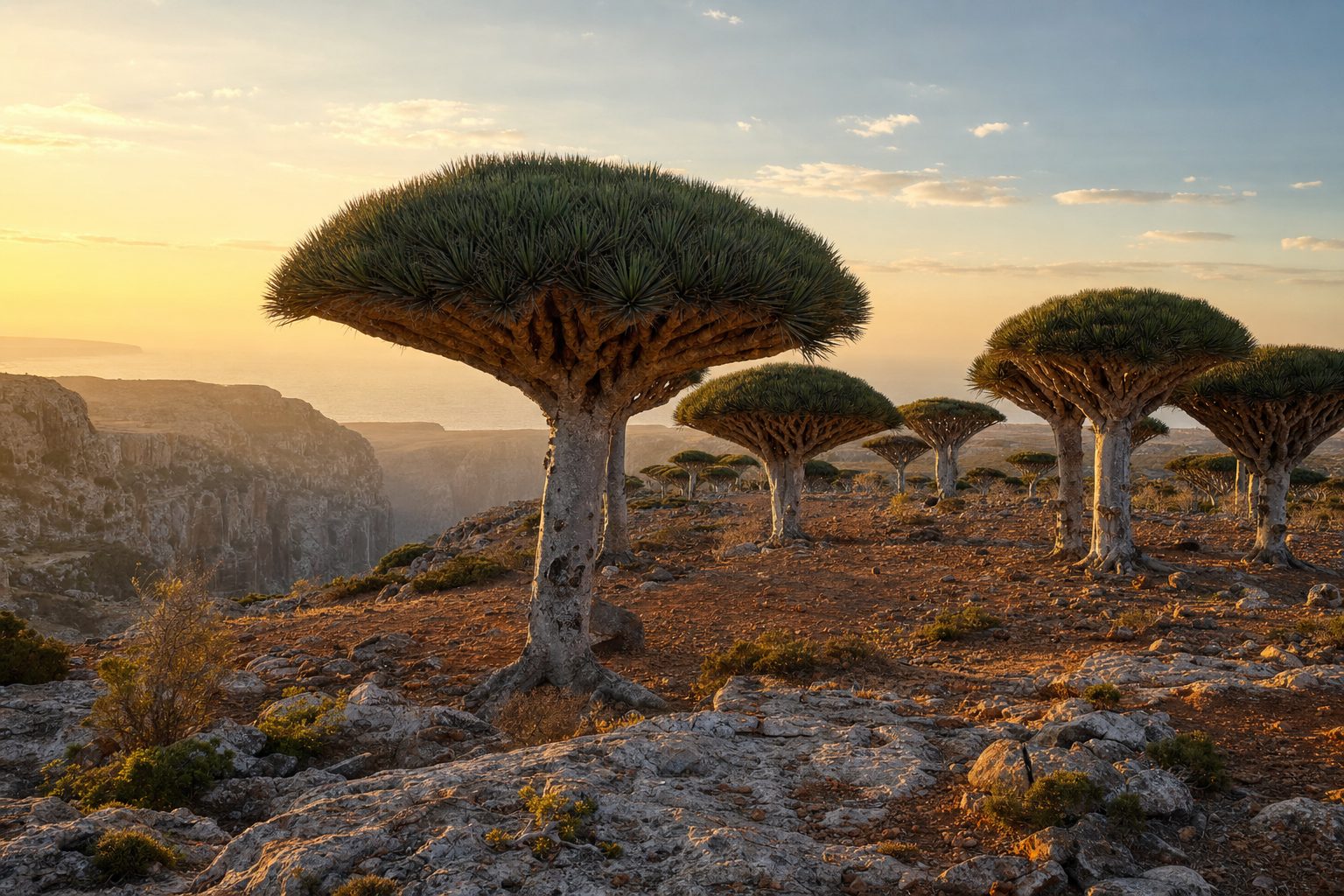
Most weeks begin or end with the dragon blood trees, Dracaena cinnabari, whose densest stands are on the Diksam plateau and in the Firmihin forest at around a thousand metres above sea level. The trees grow slowly, seedlings struggle against goat grazing, and the groves you will photograph at golden hour are hundreds of years old; stay on tracks and do not cut bark for the red resin that gives the tree its name.
The coast is the other half of the story. Detwah Lagoon, near the fishing town of Qalansiyah at the western tip, is a shallow saline lagoon separated from the Gulf of Aden by a long spit of pale sand. From Qalansiyah, boats run along the north-west cliffs to Shoab beach, with dolphins often seen on the way. In the north-east, the Arher dunes have piled white sand against the cliffs to remarkable heights; Zahek, on the south coast, has a second dune field with nobody on it. Hoq Cave, a steep walk of about an hour and a half from the coast, extends some two kilometres into the mountain, and visitors typically walk the first kilometre. Dihamri, east of Hadibo, is the reliable snorkelling site; treat the small local dive operations with caution.
UNESCO records 825 plant species on Socotra, of which 307 (37%) are endemic; 90% of its reptile species and 95% of its land snail species occur nowhere else. The property covers about 75% of the archipelago's land area and has been called the 'Galápagos of the Indian Ocean'. [1]
- Diksam plateau and Firmihin forest: the classic dragon blood tree groves, best at dawn and dusk; overnight on the plateau if your operator offers it.
- Detwah Lagoon and Qalansiyah: saline lagoon, sand spit and the boat trip to Shoab beach; the best sunset camp on the island.
- Arher and Zahek dunes: white sand banked against cliffs in the north-east, a quieter dune field on the south coast.
- Hoq Cave: a 90-minute climb to a two-kilometre cave system; bring a head torch and grippy shoes.
- Dihamri marine protected area: the dependable snorkelling stop, with mask and fins hired locally for about USD 10.
Camping, cash and comfort: what daily life involves
Socotra is not a hotel destination. Hadibo has a handful of basic hotels and one expensive one, but every operator will steer you toward sleeping in tents at the sites themselves, and they are right to. Expect a dome tent per person or couple with a thick mattress, pillow and blanket, and a cook producing fish, rice, flatbread and fruit. Some camps have simple toilets and a cold shower; others have nothing, and most itineraries reach running water at least every other day. Sockets at camps rarely work, so bring a large power bank, spare camera batteries and a car charger for the 4x4.
The economy runs on cash, and for visitors that means US dollars. Cards are useless on the island; exchange offices in Hadibo will change dollars into Yemeni rials for small purchases, and your guide will take you to one on arrival. Because the tour is prepaid, day-to-day spending is modest: snorkel hire, soft drinks, a few souvenirs at the Hadibo bazaar and, at the end of the week, tips for the driver, cook and guide, for which USD 40 to 60 per traveller is a reasonable starting point. Bring more cash than you think you need, in small denominations. Connectivity is patchy 3G at best; treat the week as largely offline.
How to behave: etiquette on a conservative island
Socotra's roughly 60,000 residents are Sunni Muslim, speak Soqotri as well as Arabic, and until the 1970s lived largely by goat herding and fishing. Tourism has arrived quickly, and the island's tolerance of visitors is real but should not be mistaken for indifference. Outside the water, cover shoulders and knees; a modest swimsuit is acceptable at the beach when your group is alone, and a T-shirt over it is a courtesy when fishermen or families are near. Ask before photographing people.
Environmental rules matter more here than almost anywhere. UNESCO's inscription flagged roading, overgrazing and invasive species as threats and warned that tourism itself could become one, and the island's waste system is rudimentary. Carry out everything you carry in, refuse plastic bottles when your operator provides a refill dispenser, never ask to be driven off existing tracks, and do not take shells, plants, seeds or resin: the Environment Protection Authority forbids the export of biological material without a research permit. Drones can attract a fee at the airport; ask your operator for the current position first.
The Socotra Archipelago was inscribed on the World Heritage List by the Committee's 32nd session in 2008 under natural criterion (x), with the decision calling for enhanced management of roading, grazing and invasive species and for controls on their entry at ports and the airport. [2]
Is Socotra right for you, and what to read next
The honest test is not whether you can afford it, though at roughly USD 3,000 per person before international flights it is not cheap. It is whether you are comfortable travelling against your government's advice with no consular safety net, sleeping in a tent for a week without reliable power or connectivity, and accepting that a cancelled aircraft could strand you for days. If the answer is yes, Socotra offers something increasingly rare: a landscape that has not been arranged for visitors. If the answer is no, that is a perfectly good decision too.
For readers weighing similar trade-offs elsewhere, our guide to off-the-beaten-path destinations still worth visiting compares places where scarcity of access is part of the appeal, and the solo travel safety and planning guide covers the insurance and contingency thinking a trip like this demands. Whichever way you decide, verify the flight schedule, permit fee and travel advice again before you book: as checked in September 2026, all three have changed within the past year.
Sources & further reading
- 1. UNESCO World Heritage Centre — Socotra Archipelago (listing and Outstanding Universal Value)
- 2. UNESCO World Heritage Committee — Decision 32 COM 8B.5, inscription of the Socotra Archipelago (2008)
- 3. UNESCO Man and the Biosphere Programme — Socotra Archipelago Biosphere Reserve
- 4. UK Foreign, Commonwealth & Development Office — Yemen travel advice
- 5. U.S. Mission to Yemen — Security Alert: Disruption of Commercial Airlines in Socotra Island (2 January 2026)
- 6. Socotra.eu — Flights to Socotra (Jeddah–Socotra schedule, as of July 2026)
- 7. Traveling Socotra — Traveling to Socotra in 2026 (permits, season, camping)
- 8. Against the Compass — Socotra travel guide (money, etiquette, sites)