Most famous hikes ask for your legs and your patience. Angels Landing asks for your luck. The final half mile of Zion's best-known trail — a sandstone fin with chains bolted into the rock and drops of hundreds of metres on either side — can only be hiked with a permit, and permits are not sold. They are won, by lottery, on Recreation.gov. That single fact should shape your whole Zion plan: which dates you aim for, when you sit down to apply, and what you will do if your name does not come up.
The good news is that the system is more forgiving than it first appears. There are four seasonal lotteries a year plus a daily day-before draw, the application costs $6 for a group of up to six, and the trail as far as Scout Lookout — most of the climbing, including the famous switchbacks — needs no permit at all. This guide sets out how the lotteries work, what the odds-friendly strategies are, how the shuttle system dictates your morning, and how to decide whether the chained section is for you.
What the permit actually covers
The permit applies to one specific stretch: the half-mile chained ridge between Scout Lookout and the summit of Angels Landing. According to the National Park Service, everyone who hikes that section needs a permit, in every season, checked by rangers at the Grotto trailhead, at Scout Lookout and anywhere along the trail. Portions of the ridge are less than three feet (about a metre) wide, with steep drop-offs on both sides, which is why the park caps numbers rather than letting the queue self-regulate on the chains.
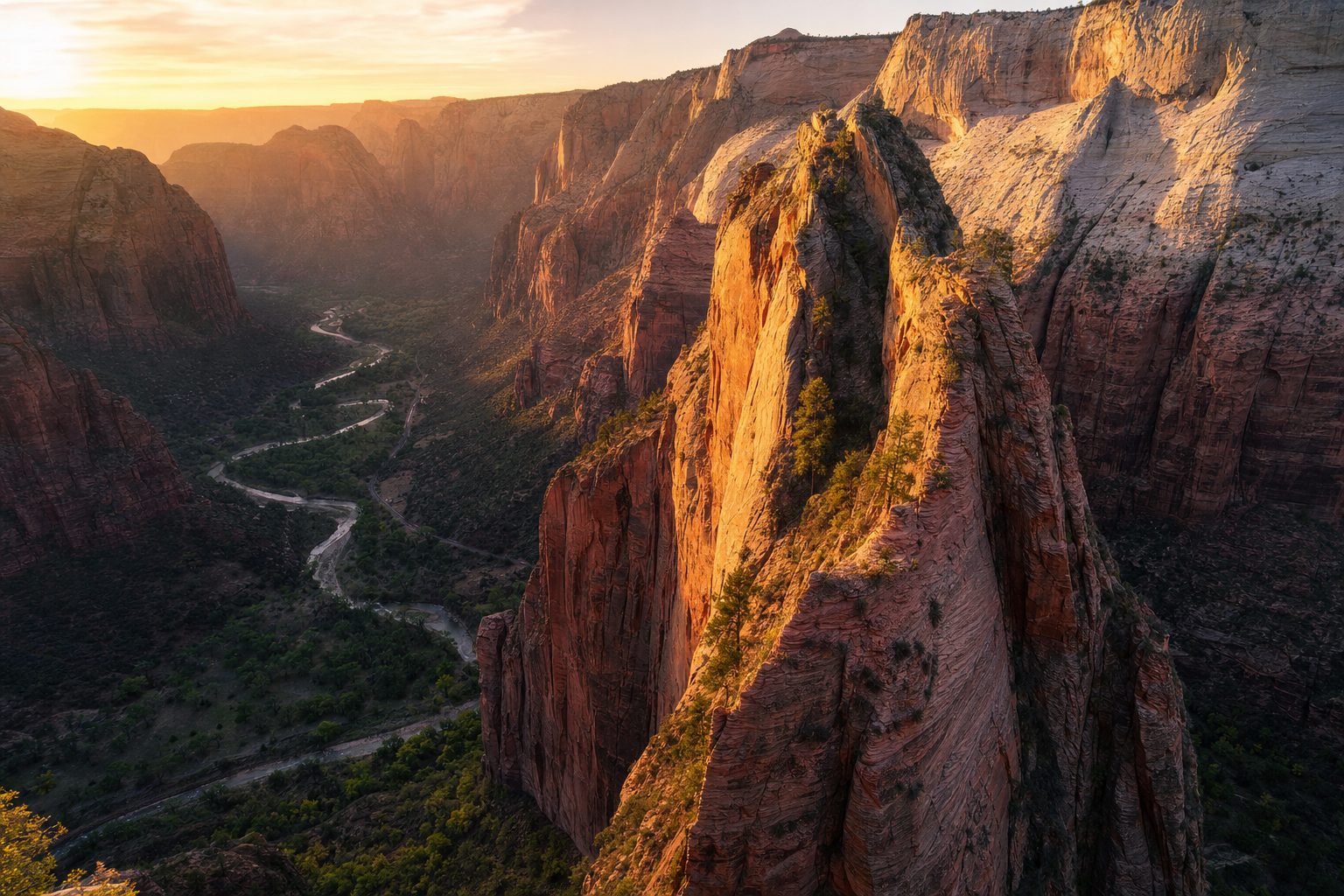
Everything below the chains is open to all. You can walk the West Rim Trail from the Grotto, climb the paved switchbacks of Walter's Wiggles and stand at Scout Lookout — roughly 2.25 miles and 1,000 feet (305 metres) of ascent each way — without entering any lottery. The lookout has a full view down Zion Canyon, and for many hikers, particularly anyone uneasy with exposure, it is a satisfying summit in its own right.
The full Angels Landing hike is 5.4 miles (8.7 km) round trip with 1,488 feet (454 metres) of elevation gain, and most hikers take around four hours. No permit is needed as far as Scout Lookout; the permit covers the final chained half mile to the summit. [1]
The seasonal lottery: four windows a year
Zion runs four seasonal lotteries annually, each covering three months of hike dates and each closing roughly a quarter in advance. For 2026, the park confirmed the pattern in a February news release: the spring lottery (hikes 1 March–31 May) ran from 13 to 25 February; the summer lottery (June–August) from 1 to 20 April; the autumn lottery (September–November) from 1 to 20 July; and the winter lottery (1 December 2026–28 February 2027) runs from 1 to 20 October, with permits issued on 25 October. As checked in August 2026, the next open window is that October draw — confirm exact dates on the NPS page before you apply.
An application costs $6, is non-refundable and covers up to six people including you. You rank up to seven choices of days and start times, or ranges of days, and the lottery works through them in order — so put the date you genuinely want first, not the one you think is least popular. If you are drawn, Recreation.gov charges a further $3 per person and your confirmation email becomes the permit itself. Submitting more than one application gets all of them cancelled without refund, and permits are non-transferable: the named permit holder or their pre-declared alternate must be on the trail with photo ID.
Zion issues more than 200,000 Angels Landing permits each year through the seasonal and day-before lotteries, and the 2026 spring seasonal lottery opened on 13 February 2026. [2]
The day-before lottery: a second chance at 4 p.m.
If the seasonal draw does not go your way, or your Zion dates only firm up late, the day-before lottery runs every day of the year. Applications open at 12:01 a.m. and close at 3 p.m. Mountain Time on the day before you want to hike, with results and permits issued at 4 p.m. the same afternoon. Hiking on a Tuesday means applying in that window on Monday. The fees are the same — $6 to apply, $3 per person if drawn — but nothing about a day-before permit can be changed and none of it is refundable.
Two practical consequences follow. First, plan at least two nights near the park if Angels Landing is the point of the trip: you need to be applying the day before, and you want a fallback day in case the first draw fails. Second, cancelled seasonal permits roll into the day-before pool, so the daily draw is not a token gesture — it is a genuine second market, and midweek dates outside the spring and autumn peaks are the softer targets.
The permit system exists to reduce congestion on the narrow, exposed section between Scout Lookout and the summit, where the route is less than three feet wide in places and chains are fixed to the rock to assist hikers.
— Paraphrased from the National Park Service's 2026 Angels Landing lottery announcement
Getting to the trailhead without a car
The hike starts at the Grotto, shuttle stop 6 on the Zion Canyon Scenic Drive — and for most of the year you cannot drive there. From early March to late November, and again between 26 December and 2 January, the Scenic Drive is closed to private vehicles and access is by the free park shuttle from the Zion Canyon Visitor Center. In high summer the first bus leaves at 7 a.m., which is precisely the one to be on: visitor-centre parking fills early, the canyon heats up fast, and your permit start time is the time you are expected at the Grotto.
If the visitor centre lot is full, park in Springdale, the town at Zion's south entrance, and ride the free Springdale Line to the pedestrian entrance, paying the park fee as you walk in. As checked in August 2026, entry costs $35 per private vehicle or $20 per person on foot, valid for seven days, and non-US residents aged 16 and over pay a further $100 unless they hold an America the Beautiful annual pass — check current rates on the Zion fees page. In the depths of winter, when shuttles stop, you drive to the Grotto yourself and park on the pavement — a small compensation for hiking in the coldest season.
During shuttle season, private vehicles are barred from the Zion Canyon Scenic Drive; free shuttles run every 5–10 minutes from the visitor centre, and in peak season the last bus leaves the Temple of Sinawava at 8:15 p.m. Missing it can mean a walk of eight miles or more back down the canyon. [3]
What the hike itself involves
From the Grotto footbridge, the West Rim Trail climbs steadily above the Virgin River on a paved path, cuts into the cool slot of Refrigerator Canyon, then tackles Walter's Wiggles — 21 tight, engineered switchbacks — before levelling out at Scout Lookout. Budget around two hours to this point at an unhurried pace. This is where the permit checkpoint sits, where the sandy flat offers the last easy resting place, and where the character of the route changes completely.
The final half mile follows the spine of the fin itself: sections of bare slickrock, carved steps and chained scrambles, with the canyon floor roughly 1,000 feet below on either side. It is not a technical climb, but it demands unhurried footwork, both hands free and a tolerance for exposure that no amount of fitness substitutes for. Traffic is two-way on a route that is single-file in places, so much of your time on the chains is spent waiting, communicating and letting others pass at the wide spots. Grippy footwear matters; so does leaving the summit before you are tired rather than after.
- Apply in the seasonal lottery the quarter before your trip; fall back on the daily 12:01 a.m.–3 p.m. MT day-before draw.
- Ride the first shuttle of the day from the visitor centre — parking, heat and chain congestion all reward a 7 a.m. start.
- Carry more water than feels reasonable: around three litres per person in summer, plus salty snacks.
- Save an offline copy of your permit email and bring the permit holder's photo ID.
- If storms threaten or rock is icy, stop at Scout Lookout — the view is superb and requires no permit.
When to go, and when to turn back
Spring and autumn are the sweet spots: long daylight, moderate temperatures and firm rock. Summer works if you start at first light — Zion Canyon regularly reaches severe heat by mid-morning, and the exposed fin offers no shade — but the monsoon, from roughly mid-July into September, brings afternoon thunderstorms that make a chained ridge the last place you want to be. Winter permits are the easiest to win for a reason: ice on the north-facing sections of Refrigerator Canyon and the Wiggles can make the route hazardous, and the park is blunt that a permit is no guarantee conditions will allow the hike.
Zion's own guidance notes that day and night temperatures can differ by more than 30°F (17°C), so a February dawn start and a February noon on the ridge are different propositions — layer accordingly and check the forecast for Zion Canyon specifically, not St George or Las Vegas. Whatever the season, the honest test at Scout Lookout is simple: if the chains are wet, the sky is building, or your nerve is not there, turning around is the experienced hiker's move. The summit has stood for a long time; it will wait for a better lottery ticket.
Angels Landing rewards the traveller who treats the lottery as part of the itinerary rather than an obstacle to it. Build your Zion days around the draw, keep Scout Lookout as a proud plan B, and fold the park into a bigger south-west loop — pair it with the slot canyons in our Antelope Canyon guide, or go north with our Yellowstone and Grand Teton road trip. And if winning a hike has whetted your appetite for earned summits, there are more where this came from in our adventure travel bucket list.
Sources & further reading
- 1. US National Park Service — Angels Landing Permits & Hiking, Zion
- 2. US National Park Service — Zion announces 2026 Angels Landing permit lotteries
- 3. US National Park Service — Zion Canyon Shuttle System
- 4. Recreation.gov — Angels Landing permit lottery
- 5. US National Park Service — Zion Fees & Passes
- 6. US National Park Service — Zion Weather and Climate
- 7. USA Guidebook — Zion National Park: shuttle, permits and hikes