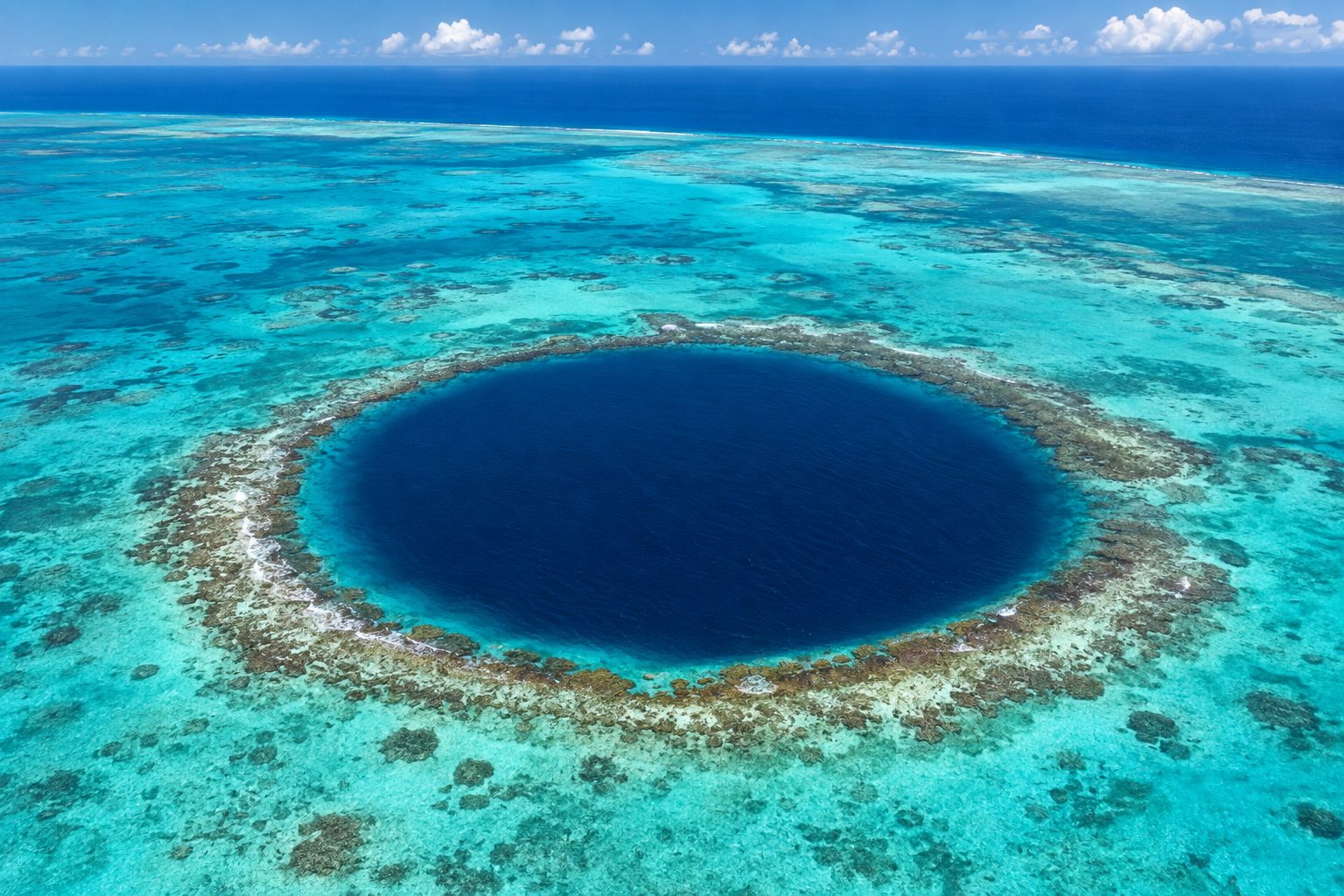
From the window of a six-seat aircraft it looks like a drop of ink on a pale blue plate: a near-perfect circle of navy water, roughly 318 metres across and 124 metres deep, set in the turquoise shallows of Lighthouse Reef Atoll about 70 kilometres off the Belize coast. The Great Blue Hole is a flooded cave that collapsed when the last ice age ended, and it is large enough to pick out from orbit. That image is why most people come, and the first decision is how.
There are three honest answers. You can dive it: a full day at sea, a deep and short guided descent to about 40 metres, and qualifications the operator will check. You can snorkel it, which puts you on the coral rim looking down into blue rather than inside the cavern. Or you can fly over it in an hour and see the shape the divers never do. This guide sets out what each involves, what it costs, when the weather cooperates and how to behave inside a natural monument.
What the Great Blue Hole is, and what it is not
Belize has three atolls beyond its barrier reef. Lighthouse Reef is the furthest out, some 80 kilometres east of the mainland, and the Blue Hole sits near its centre, ringed by a shallow reef that keeps the water flat around it. The shaft is a limestone cave system that formed above sea level during the glacial periods; as the ice melted and the sea rose, the cavern flooded and its ceiling fell in, leaving vertical walls with an hourglass cross-section. The stalactites and flowstone on its overhangs could only have formed in air, which is how geologists know the rock once stood well above the waves.
Jacques Cousteau filmed the first major exploration here in the early 1970s and lifted a stalactite for study; analysis of those samples puts the last transition from dry cave to seawater between 11,500 and 10,200 years ago. Since 1996 the hole has been protected as Blue Hole Natural Monument, one of seven areas that make up the Belize Barrier Reef Reserve System World Heritage Site, co-managed by the Belize Audubon Society with the Forest Department. It is not a reef dive: the walls below the rim carry little life beyond algae and sponges, and the draw is geology, scale and the Caribbean reef sharks that patrol the blue. Every visit is by boat or aircraft, and every boat visit is a day's expedition.
The 2017–2021 management plan lists Blue Hole Natural Monument at 1,023 acres (414 hectares), created by Statutory Instrument 96 of 1996, IUCN Category III, co-managed by the Belize Audubon Society with the Forest Department. It gives the sinkhole a rim diameter of approximately 320 metres, an estimated depth of 124 metres and features of past exposure to air down to 97 metres. [4]
Three ways to see it: dive, snorkel or fly
The Belize Tourism Board lists all three as legitimate ways in, and the choice is less about budget than about what you want to experience. The dive delivers the stalactites, the sharks and the sensation of hanging in a 40-metre-deep blue room; it also demands a dawn start, two and a half hours of open-water crossing each way, and certification and recent experience that not every holiday diver has. The snorkel trip uses the same boat and the same long day, but your time at the hole is spent on the rim, where the reef is healthy and the drop-off shows as a colour change from turquoise to ink. The flight is the only option that shows the circle whole, and the only one that fits into a spare morning.
A useful rule: if you hold an Advanced Open Water card and have dived within six months, dive it. If you snorkel but do not dive, the boat gives you Half Moon Caye and a look into the hole; the flight gives you the photograph. Many visitors with a week do both.
Diving the Blue Hole: the day, the profile and who qualifies
Day boats run from San Pedro on Ambergris Caye and from Caye Caulker, with pick-ups between about 5:15 and 6:00 in the morning and a return in the late afternoon; operators describe the trip as roughly 11 hours, with about two and a half hours of crossing each way depending on sea state. Liveaboards out of Belize City build a Blue Hole day into their weekly itineraries.
The dive is deep and brief. You drop from the reef rim at around 10 metres down the inner wall to a guided maximum of about 40 metres (130 feet), where the largest stalactites and overhangs hang at roughly 33 to 40 metres. Bottom time is 25 to 30 minutes because of no-decompression limits, then a slow ascent and safety stop. Water is a few degrees cooler in the hole than at the surface, which sits around 26 to 29°C for much of the year, and a torch helps under the overhangs. The boat then moves to Half Moon Caye Wall and Long Caye Aquarium, both wall dives of 15 to 18 metres, with lunch on Half Moon Caye between them.
On qualifications, read the fine print. PADI lists Advanced Open Water and Deep Diver as the useful training for the site, and the monument's management plan states that dive groups in the Blue Hole are to consist of Advanced Divers or above. Operators apply this with some discretion: Belize Pro Dive Center in San Pedro, as checked in September 2026, requires at minimum an Open Water certification, a logged dive within the previous six months, recent experience to at least 24 metres and a minimum age of 15, strongly recommends Advanced Open Water, and reserves final approval to its dive team. If you have not dived recently, expect to be asked to do a local check-out dive first.
Costs are quoted in US dollars and rarely all-in. As checked in September 2026, Belize Pro Dive Center advertises its three-dive Blue Hole day at US$285, to which 12.5 per cent General Sales Tax (US$35.63) and a US$40 marine park fee payable in cash are added, for an itemised US$360.63 per diver before optional gear rental at US$33.75 a day. Amigos del Mar, also in San Pedro, lists its Lighthouse Reef trip from US$215 plus tax and fees. Confirm what is included when you book.
Snorkelling the rim, and the rest of Lighthouse Reef
Snorkellers join the same dive boats rather than a separate excursion, and the day is worth having even though the hole is, from the surface, a colour rather than a cavern. The reef rim holds the fish life the sinkhole lacks, and floating at the edge of the drop-off, watching the sand fall away into darkness, is its own kind of vertigo. Groups are capped at eight per certified guide, with no standing on coral and no touching, feeding or chasing anything.
The second half of the day is Half Moon Caye, the atoll's other natural monument and, for many snorkellers, the better part of the trip. The island has been protected in some form since 1928 for its colony of white-phase red-footed boobies, estimated at around 3,700 birds, with magnificent frigatebirds nesting alongside; a platform looks over the canopy, and the ranger station here is where park fees are collected. For how other island nations ration and price their reefs, see our guides to Palau and the Similan Islands.
UNESCO inscribed the Belize Barrier Reef Reserve System in 1996 as a serial property of seven protected areas, including Blue Hole Natural Monument, covering 12 per cent of the reef complex. It describes the system as the second-largest in the world, with three offshore atolls, Turneffe, Lighthouse Reef and Glover's Reef, and some 450 sand and mangrove cayes. [3]
The scenic flight: the one-hour option for everyone else
The Belize Tourism Board is candid that the Blue Hole is at its most photogenic from the air, and two national airlines run flyovers in light aircraft from San Pedro, Caye Caulker and Belize City's municipal airstrip. Maya Island Air flies a one-hour tour four mornings a week and circles the hole twice on each side of the aircraft. Tropic Air's scheduled tour leaves at 1 pm from the same three points, also for about an hour, with a window seat for every passenger; it sells private charters daily and suggests 10 am to 2 pm as the best light.
The route is part of the point: you cross the barrier reef, pass Turneffe Atoll and a rusting freighter wreck on the Lighthouse Reef flats, and watch the water shift through several blues before the circle appears; the Tourism Board's own account describes the pilot banking each way and descending to around 100 feet above the sinkhole. As checked in September 2026, neither airline prints a fare on its tour page; the price appears when you choose a date, and you should expect a figure in the low hundreds of US dollars per seat. Reservations are asked for 24 hours ahead, and flights are rescheduled or refunded when weather closes in.
Maya Island Air lists its Great Blue Hole tour as a one-hour flight for a maximum of 11 passengers, departing Belize City at 8:30 am, Caye Caulker at 8:45 am and San Pedro at 9:00 am on Sunday, Monday, Wednesday and Friday, with two revolutions on each side of the aircraft around the Blue Hole. Reservations are recommended at least 24 hours before the flight, cancellations must be made 24 hours ahead, and flights may be cancelled in inclement weather. [6]
When to go: dry season, storms and the state of the sea
Belize has two seasons and the boat day lives or dies by them. The National Meteorological Service puts the dry season from November to May, with April the driest month, and the rainy season from June to November, when tropical waves, storms and hurricanes move westward through the Caribbean. Late November to May is the safest bet for a flat crossing and clear water; it is also high season, and boats fill around Christmas and Easter.
The wet season is not a blanket no. Rain often falls in short bursts, August brings a lull Belizeans call the Mauga, and operators run whenever the sea allows. The real hazard is September and October, when the record shows the great majority of storms and cancelled crossings are common; if you must travel then, keep the Blue Hole flexible and insured.
The National Meteorological Service of Belize states that most rainfall occurs from June to November, the rainy season, while the dry season runs from November to May with April the driest month. Tropical storms and hurricanes peak in September and October; the service's storm chart shows 17 systems in September against 9 in October and none between January and May. [5]
- Carry US$40 in cash for the two park fees (Blue Hole US$30, Half Moon Caye US$10, as listed by operators in September 2026); rangers collect it on Half Moon Caye.
- Bring your certification card and logbook, seasickness tablets, a rash guard or 3 mm suit and reef-safe sunscreen; the crossing is long and exposed.
- Book boats and flights before you arrive for December to April and around Easter, and leave a spare day for weather.
- Re-check the airline and operator pages in the week you travel; days of operation and prices change between seasons.
Fees, rules and behaving inside a natural monument
Every visitor to the two monuments pays a fee set by the management authority, collected by Belize Audubon Society rangers at Half Moon Caye, usually through your guide. As checked in September 2026, San Pedro operators list it as US$30 for the Blue Hole and US$10 for Half Moon Caye, a combined US$40 in cash on top of tour price and tax; verify the figure with your operator, since the co-managers can change it. The money funds rangers, moorings and monitoring.
The management plan's rules are short. Tour boats must tie to recognised moorings rather than anchor, follow marked access routes and slow down entering and leaving the hole. There is no fishing, no chumming or feeding of sharks, no touching of marine life and no removal of anything, living or dead, from the water. Dive groups need an approved leader and ratio, gloves are discouraged because they encourage divers to hold coral, and everything you carry in, including rubbish, leaves with you. Book only a licensed operator, as the Tourism Board advises.
UNESCO describes the Belize Barrier Reef Reserve System as an outstanding natural system of offshore atolls, sand cayes, mangroves, lagoons and estuaries, protected under Belize's constitution and parks and fisheries law, in which the Blue Hole stands as one of the unique geological features left by the rise and fall of sea level over millennia.
— Paraphrased from the UNESCO World Heritage listing for the Belize Barrier Reef Reserve System
The Great Blue Hole rewards a clear decision. Divers with the card and a recent logbook should commit to the boat and the dawn start; everyone else should take the flight and, if the week allows, the snorkel day for Half Moon Caye. Go between late November and May, and carry the park fee in cash. For more Caribbean water with a different character, read our Dominica guide; for another deep, cold-blue swim between rock walls, see Silfra in Iceland; and for the Pacific's most closely guarded reefs, start with Raja Ampat.
Sources & further reading
- 1. Belize Tourism Board (Travel Belize) — The Great Blue Hole attraction page
- 2. Belize Tourism Board (Travel Belize) — Exploring the Great Blue Hole from above
- 3. UNESCO World Heritage Centre — Belize Barrier Reef Reserve System
- 4. Belize Audubon Society / Forest Department — Half Moon Caye and Blue Hole Natural Monuments Management Plan 2017–2021 (PDF)
- 5. National Meteorological Service of Belize — Climate Summary
- 6. Maya Island Air — The Great Blue Hole Tour (scenic flight schedule and conditions)
- 7. Tropic Air — The Great Blue Hole Tour (scheduled and private flyovers)
- 8. Belize Pro Dive Center — Blue Hole Diving from San Pedro (prices, requirements, itinerary)