Jaguars hunt in the open here. Across most of their range, from Mexico to Argentina, the largest cat in the Americas is a presence you infer rather than see — a track in the mud, a camera-trap frame, a guide's shrug. The Pantanal inverts that. In this vast seasonal wetland in western Brazil, the forest thins to gallery strips along slow rivers, and in the dry months the jaguars come down to the banks in daylight to stalk capybara and ambush caiman while boats sit quietly mid-river and watch. Nowhere else in the Americas can a first-time visitor plan a trip around seeing a wild jaguar and reasonably expect it to work.
Planning one comes down to a short list of decisions. Which end of the wetland: the northern Pantanal, where the Cuiabá River around Porto Jofre delivers the sightings and collects the bills, or the cheaper ranch country of the south. When to go, in a region where the difference between July and January is the difference between dust and floodwater. Where to sleep — roadside lodge, working fazenda or a boat moored on the river itself. And how many days on the water to pay for. This guide takes those in order, with prices as checked in October 2026.
Why the Pantanal, not the Amazon
The Amazon has more species; the Pantanal shows you more animals. The reason is structure. Rainforest wildlife lives in a dense canopy sixty metres of foliage away from your binoculars, while the Pantanal is an open mosaic of grassland, scattered woodland and water that floods and recedes with the calendar. In the dry season the shrinking channels and lagoons concentrate everything that swims, wades or drinks along the remaining water, where it is visible from a boat or a bridge rather than hidden behind leaves. Caiman gather in their thousands, capybara graze the banks in herds, and the density of large, watchable wildlife feels closer to East Africa than to anywhere else in South America.
UNESCO describes the Pantanal as one of the world's largest wetlands, covering around 14,000,000 hectares, and lists the Pantanal Conservation Area — a 187,818-hectare cluster of four protected areas in western central Brazil — as World Heritage, noting its jaguar population is probably the biggest in the entire Pantanal region. [1]
The wetland sprawls across roughly 140,000 to 180,000 square kilometres of Brazil, Bolivia and Paraguay, with the great majority inside the Brazilian states of Mato Grosso and Mato Grosso do Sul. Only a small fraction is formally protected — the World Heritage property covers about 1.3 percent of the Brazilian share — and most of the rest is private cattle country that has doubled as wildlife habitat for two centuries. That coexistence is imperfect but real, and it is why tourism money matters here: a live jaguar watched from a boat now earns the region more than a cattle-killing jaguar costs it.
How a jaguar boat safari actually works
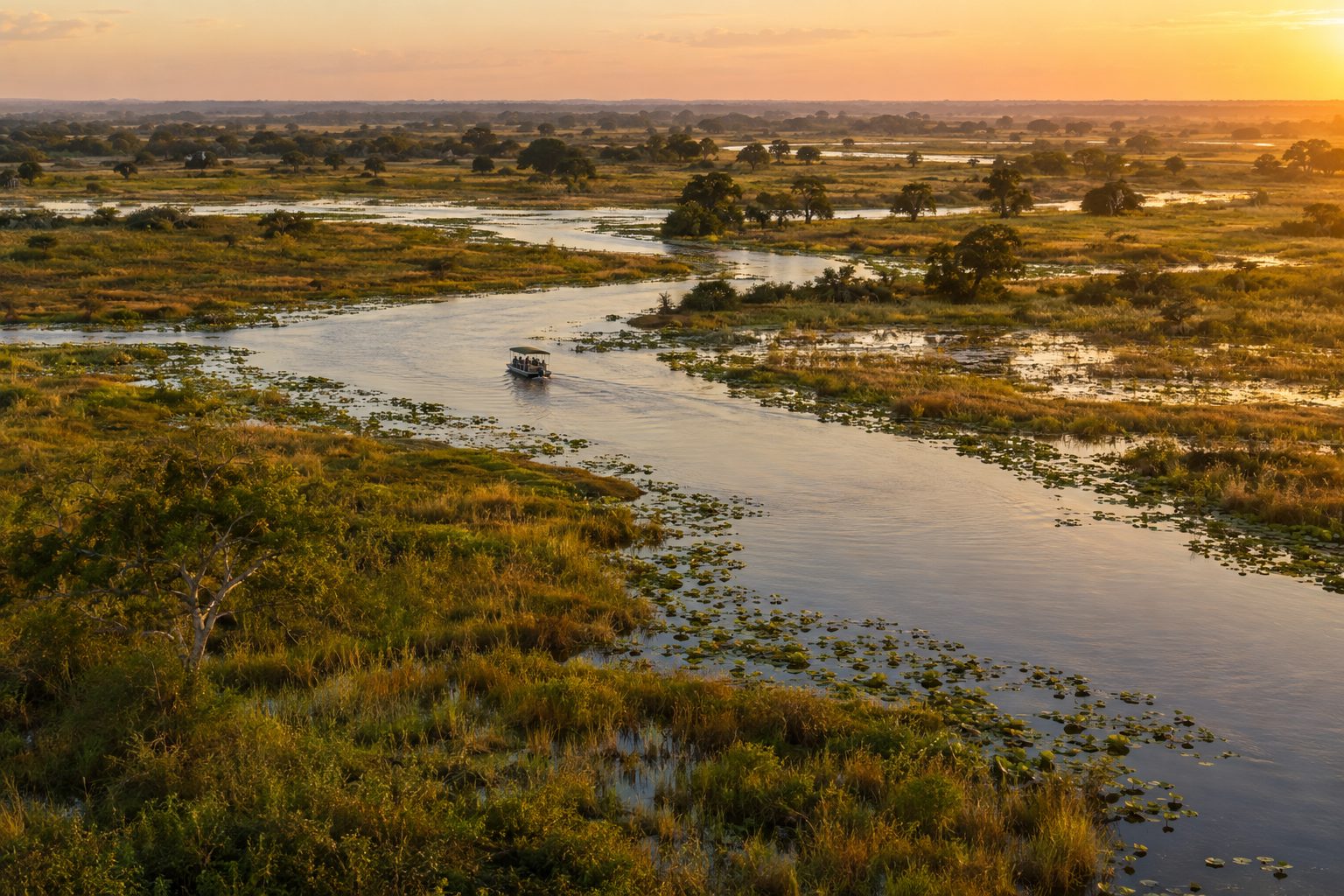
The engine of the whole experience is the Cuiabá River and its tributaries in the far northern Pantanal, reached from the river port of Porto Jofre. Mornings start early: boats leave the lodges and moorings around first light, when the air is cool and the cats are active, and work the riverbanks at idle speed while guides scan the beaches, driftwood and overhanging vegetation. Sightings are mostly of jaguars doing unhurried, visible things — padding along a sandbar, flat out asleep on a log, swimming a channel, or dropping into a crouch above a caiman. Boats gather when a cat is found, word travels by radio, and a good sighting can last an hour at thirty metres' range.
The rhythm is two sessions a day, morning and late afternoon, with a retreat from the midday heat — or, with the more committed operators, a full day on the water with lunch delivered to the boat so you are present during the hours most visitors miss. Expect long, hot days on open water, basic plumbing ashore, and bathroom stops that involve a riverbank rather than a door. The reward for that discomfort is a success rate no other jaguar destination approaches: with a competent guide and two or three days on the river in season, seeing at least one jaguar is the expected outcome, and seeing several different individuals is common.
The jaguar density around the Cuiabá–Piquiri confluence is exceptional by any measure: the Jaguar ID Project's camera-trap grid in Encontro das Águas State Park — a 108,900-hectare reserve created in 2004 where the rivers meet near Porto Jofre — documented 139 individual jaguars across its 2024 and 2025 survey seasons in an initial study area of just 311 square kilometres. [6]
That density is why the boats cluster where the Cuiabá meets the Piquiri. Much of the river frontage you will work is inside or alongside Encontro das Águas State Park, and many of the cats are known individuals with catalogue entries and names. It is also why the etiquette matters — more on that below — because the same handful of river beaches can hold a dozen boats at the peak of the season.
The Transpantaneira: the drive is part of the safari
Porto Jofre is not somewhere you pass through; it is where the road ends. Access runs from Cuiabá, the state capital of Mato Grosso, with daily flights from São Paulo and other hubs, then south by road through the town of Poconé to the start of the Transpantaneira — a raised dirt road that runs dead straight into the wetland and stops at the river.
The Transpantaneira (MT-060) runs 147 kilometres from Poconé to Porto Jofre and crosses no fewer than 122 wooden bridges, with wildlife watching along the road itself — especially in the dry season, when the roadside pools concentrate caiman and waterbirds. [4]
Treat the drive as a game drive, because it is one. The borrow pits beside the embankment hold water into the dry season, and every bridge crossing becomes a wildlife hide: caiman stacked along the margins in their hundreds, jabiru storks working the shallows, capybara, hyacinth macaws in the palms, and — with luck — a tapir or an ocelot at dusk. Most itineraries break the journey at a lodge partway down the road before continuing to Porto Jofre, which turns a dusty transfer into two days of wildlife viewing. The surface is passable in an ordinary car in the dry months but rough, corrugated and slow; in the wet season sections flood and the wooden bridges demand respect at any time of year.
Porto Jofre or the cheaper south
The honest cost hierarchy of the Pantanal is simple: jaguar safaris at Porto Jofre are the expensive option, and everything else is cheaper. Boat fuel, remote logistics and compressed demand in a short season put the Cuiabá River at the top of the price list — but it is also, by a distance, the most reliable place on Earth to see the cat. If the jaguar is the point of the trip, go north and pay; a very good chance of sightings within a day or two on the river is what the money buys.
The southern Pantanal, reached from Campo Grande in Mato Grosso do Sul along the Estrada Parque, is a different and gentler proposition: working cattle fazendas that take guests, Pantaneiro cowboy culture, horseback safaris, superb birdlife and giant otters, at nightly rates far below the northern jaguar camps. Jaguars live there too, and some southern reserves track them well, but sightings are a bonus rather than a plan. A sensible rule: south for the wetland at ranch pace on a moderate budget, north for the jaguar itself. Travellers with time and money do both, flying into Cuiabá and out of Campo Grande or the reverse.
When to go, month by month
The Pantanal runs on water, not temperature. The rains fall roughly from October–November to March–April, flooding vast areas and dispersing wildlife across a drowned landscape; the dry season from May–June to September–October pulls the water back into the river channels and concentrates the animals along them. For jaguars specifically, the prime window on the Cuiabá River is July to September, when bare banks, low water and maximum concentration make daily sightings routine; the broader June-to-November span is quoted by some guides as the workable jaguar season, with the shoulder months a little less certain.
- July–September — peak jaguar season at Porto Jofre: lowest water, most sightings, highest prices, boats and lodges booked out months ahead.
- June and October–November — shoulder months: still a strong jaguar window with fewer visitors; October turns hot and humid before the rains break.
- December–March — the flood: much of the wetland accessible only by boat or small plane, dispersed mammals, spectacular birdlife and greenery, lowest prices.
- April–May — the recede: landscapes still green, water dropping, wildlife regrouping along the channels; a quiet, good-value time for the lodges, before the jaguar circus begins.
Heat is the other variable. Late dry season days regularly pass 35°C with strong sun off the water, and the open boats offer little shade beyond their canopies; by October the humidity builds and the insects thicken. If you are choosing between a scorching October week and a cool July one at the same price, take July — but July is exactly when everyone else wants to be there, so the real trade is between comfort and availability.
Where to stay: lodges, fazendas and flotels
Accommodation sorts into three types. Along the Transpantaneira, pousadas and converted fazendas offer rooms, meals and activity programmes — drives, walks, horses, small-boat trips — and work well as the first and last nights of a northern itinerary. At Porto Jofre itself, a handful of hotels and camps provide simple, air-conditioned rooms a few minutes from the boat moorings; expect rustic comfort rather than safari-lodge polish, with buffet meals and generators. The third option is the flotel — a houseboat moored on the river among the jaguar beaches — which eliminates the daily run from Porto Jofre to the sighting grounds and puts you on the water for first light. Flotels are the most expensive beds in the Pantanal and the most convenient for serious jaguar time.
In the south, the fazenda is the experience: family-run ranches around Miranda, Aquidauana and the Estrada Parque with a tradition of hosting, where the programme is horses, boats, night drives and the rhythm of a working ranch. Across the whole wetland, remoteness means full board is standard and independent travel is genuinely hard — there is effectively no public transport inside the Pantanal, so nearly everyone travels on a package with transfers included, booked through the lodge or an operator in Cuiabá or Campo Grande.
Costs, booking and how to behave around a jaguar
Numbers, as checked in October 2026. Editorial estimates put guided jaguar-safari costs at roughly US$200–500 per person per day depending on operator and group size, and entry-level lodge-and-safari packages in the wider Pantanal start around US$100 per person per day, typically with a multi-day minimum. At the dedicated jaguar end, scheduled small-group departures for the 2026 season illustrate the range: a five-night Transpantaneira-plus-Porto-Jofre itinerary from about US$2,800 per person, six nights focused on the state park from about US$3,560–4,390 with different operators, and many peak-season dates already sold out. Book peak July–September river time six months or more ahead; shoulder dates are far easier.
Panthera, which runs a jaguar research base at Fazenda Jofre Velho in the northern Pantanal, estimates that jaguar-oriented tourism generates US$8–9 million a year in the Brazilian Pantanal — a direct economic argument for keeping the Near Threatened cat alive on ranchland. [5]
The Pantanal Conservation Area shelters an abrupt meeting of wetland and mountain unique in the region, sustains around 80 mammal, 650 bird, 50 reptile and 300 fish species, and holds what is probably the largest jaguar population in the entire Pantanal.
— Paraphrased from the UNESCO World Heritage listing for the Pantanal Conservation Area
Behaviour on the river matters, because the model only works if the cats keep tolerating the boats. The conventions responsible operators follow are consistent: approach slowly and at an angle rather than head-on, hold a respectful distance and cut the engine to an idle, keep voices down, never box a swimming jaguar between boats, and leave a hunting cat to hunt — a blown ambush is a meal taken from the animal you came to admire. Choose operators who talk about this unprompted; several of the best fund identification and monitoring work, and your boat fee is part of the conservation budget. The same logic travellers meet with Churchill's polar bears applies on the Cuiabá: predictable, well-regulated viewing is what converts a predator from liability into asset.
The Pantanal makes a quiet, persuasive case that the great wildlife spectacles are not always the famous ones: a dirt road, a slow river, and the biggest cat in the Americas hunting in full view at three in the afternoon. If planning around a single charismatic animal appeals, the same logic drives the mountain-gorilla economy an ocean away: our guide to gorilla trekking in Rwanda's Volcanoes National Park walks through that version of the trade — permits, rules and one unforgettable hour — and pairs naturally with a week on the Cuiabá for a year of seeing the rarest things wild.
Sources & further reading
- 1. UNESCO World Heritage Centre — Pantanal Conservation Area (official listing)
- 2. Wikivoyage — Pantanal travel guide
- 3. Rough Guides — How to visit Brazil's Pantanal
- 4. Wikipedia — Transpantaneira (MT-060)
- 5. Panthera — Jaguar (species and Pantanal programme page)
- 6. Jaguar ID Project — Project GRID, Encontro das Águas State Park
- 7. Pantanal Jaguar Safaris — 2026 small-group tours and rates
- 8. Journey With Jaguars — Read this before you book (Porto Jofre practicalities)