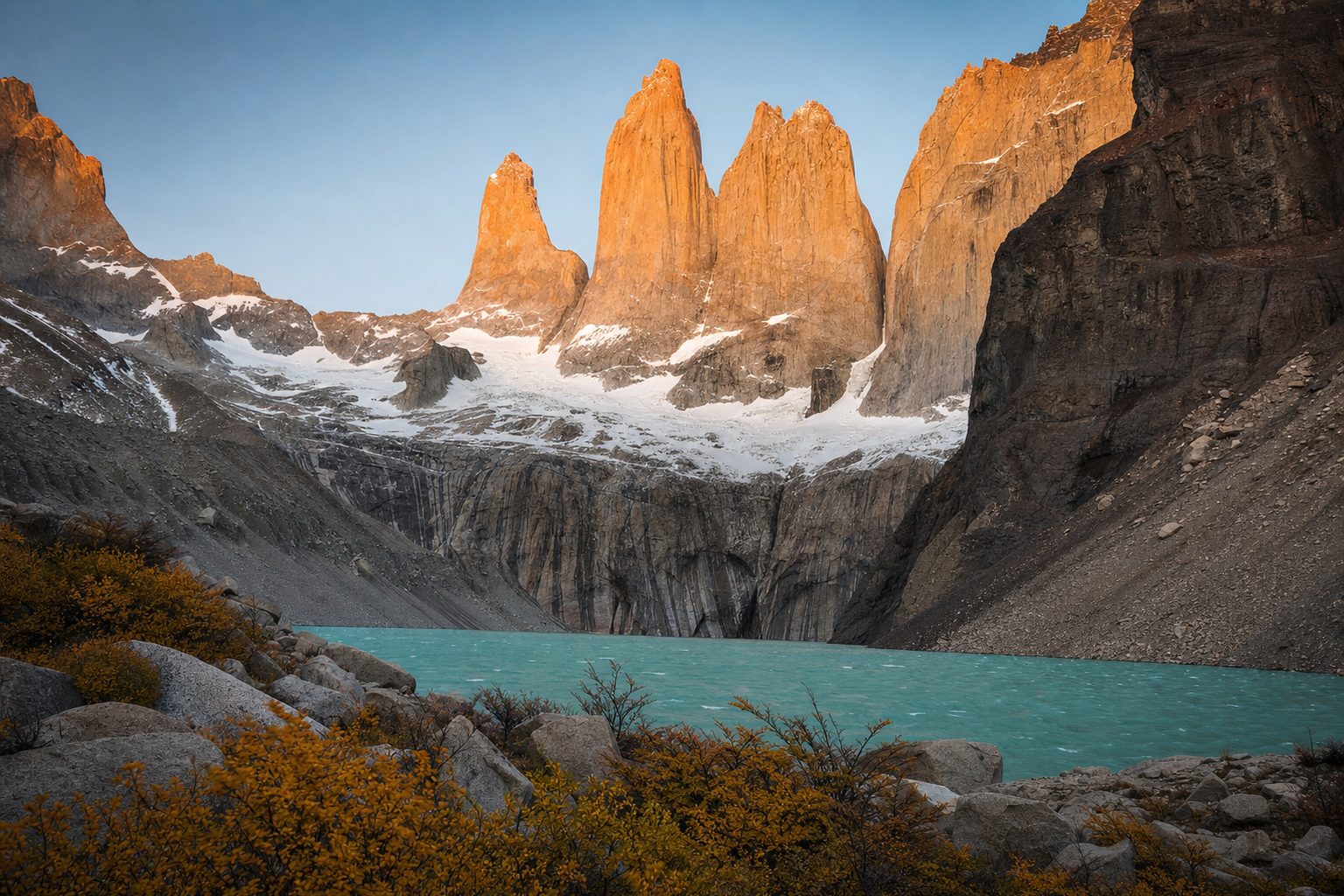
The reel that brings most people here shows a line of granite towers turning orange at dawn, and a caption that sounds like an exaggeration: every campfire in this park is illegal. It is not an exaggeration. In Torres del Paine, lighting any fire — a campfire, a barbecue, a cigarette, even a gas stove outside a designated cooking shelter — is a criminal offence under Chilean law, a rule written in the ash of wildfires that visitors themselves started. Understanding why that rule exists, and the booking system built around it, is most of what separates a smooth trip from a turned-away-at-the-gate one.
This guide works through the decisions in order: the fire rules you are agreeing to, how and when to buy the entry ticket, which months suit which trip, whether to walk the W or the full O circuit, and how far ahead the refugios and campsites really book out. Torres del Paine rewards planners; almost nothing here can be arranged on arrival.
Why every campfire here is illegal
Torres del Paine has burned three times in living memory, and every fire was started by a visitor. In February 2005 a trekker's gas stove, used in an unauthorised grassland area, set off a blaze that destroyed roughly seven per cent of the park; the restoration project that followed ran for five years and replanted 180,000 lenga trees. In February 2011 a campfire lit outside permitted areas caused another fire, contained largely thanks to rain. Then, in late December 2011, a visitor attempting to burn used toilet paper ignited the most destructive fire in the park's history.
The fire that began on 27 December 2011 destroyed more than 17,606 hectares of the park — around 43,500 acres — forced its closure for several weeks, and was not fully brought under control by CONAF until 8 March 2012. [8]
The response was legal, not advisory. Under Law 20.653, using any heat source inside the national park is prohibited, and the park authority states plainly that offenders are handed over to Carabineros, Chile's national police. Slow-growing lenga forest does not recover on human timescales, which is why the penalties are severe and enforced.
Lighting any heat source in the park — fires, barbecues, gas burners or cigarettes — is prohibited under Law 20.653 and can be punished with fines of up to 2,000,000 Chilean pesos or up to three years in prison; CONAF adds that foreign offenders face expulsion from the country. [3]
In practice the rules are workable: cooking is allowed only in the signed cooking shelters at each campsite or refugio, using stoves that do not burn wood or other vegetable matter. Smoking is banned throughout the park, camping is permitted only at established sites, and rangers do check. Treat the whole park as a no-flame zone and you will not go wrong.
Camping is permitted exclusively in the designated areas, overnighting anywhere else is strictly forbidden, and stoves may be used only in the specially equipped zones of each campsite — everywhere else any heat source is an offence under Law 20.653.
— Paraphrased from the Torres del Paine National Park list of unauthorised activities
Entry tickets: buy online, at least 24 hours ahead
There is no ticket window improvisation at Torres del Paine. The park administration requires entry tickets to be purchased at least 24 hours before you arrive, through the official CONAF platform pasesparques.cl. You receive a PDF with a QR code, shown on paper or a phone alongside your passport at the gate; tickets are not sold for cash inside the park.
As checked in September 2026, the official 2026 tariff for foreign adults (18–59) is 32,400 Chilean pesos for a day pass and 48,500 pesos — roughly USD 50 — for a stay of more than two days; children under 12 enter free, and Chilean adults pay 9,400 or 14,200 pesos. [1]
Two details catch people out. First, the multi-day pass is the one trekkers need: a day pass will not cover a W or O itinerary. Second, opening hours are seasonal — in the summer season, October to April, gates operate daily from 07:00 to 21:00, while in winter, May to September, hours shrink to 08:00 to 18:30, with schedules subject to weather. Verify current tariffs and hours on the official park site before you commit to dates.
When to go: the season in three acts
The trekking season runs from October to April — spring to early autumn in Patagonia. Early season, October to mid-November, brings flowers, fewer people and leftover snow on high sections; parts of the W may still require an accredited guide in October, so check conditions before booking. High season, mid-November to February, offers the fullest services, up to 17 hours of daylight and daytime highs around 15–20°C, along with the biggest crowds and the strongest wind: January is at once the warmest, windiest and busiest month. March to April is the quiet act — golden lenga forests, softer light, cooler nights and often steadier weather.
Winter is a different regime, not a shoulder season. As checked in September 2026, CONAF requires an accredited specialised guide for the Base Torres trail and the W circuit from 27 April to 15 September 2026 while winter conditions persist, and the full circuit closes altogether. Day visits around the lakes remain possible, but independent trekking effectively pauses from May to September.
Whatever the month, pack for four seasons in a day. Wind is the park's signature: even in high summer, sunshine, sideways rain and gale-force gusts can rotate through a single afternoon, and itineraries with a spare day absorb weather far better than tight ones.
Choosing between the W and the O
The W trek is the park's classic: roughly 80 kilometres over four to five days, tracing three valleys — Grey with its glacier, the Valle Francés amphitheatre, and the walk up to the Base de las Torres viewpoint beneath the towers themselves. It can be walked in either direction, with refugios or campsites each night, and suits first-time visitors who want the headline scenery with a bed and hot food at day's end.
The O circuit adds the wilder back side of the massif: about 136 kilometres over seven to nine days, looping over the John Gardner Pass with its long view across Glaciar Grey. It is more demanding, more remote and more weather-exposed, and it operates on a shorter season — typically November to the end of March, while the W usually runs from October to late April.
The Paine Massif circuit — the O — is closed for the winter and, as checked in September 2026, remains closed until 31 October 2026, with reopening subject to CONAF's assessment of weather and safety conditions. [4]
If you have neither the time nor the bookings for a multi-day trek, the park still delivers as a base-and-day-hike destination: the Base Torres trail can be walked in a long day from the Central sector, and the Pehoé and Grey lakeshores are reachable by road. For a wider view of how the park fits into a longer journey through the region, see our guide to trekking Patagonia across Chile and Argentina.
Booking refugios and campsites months ahead
Here is the rule that shapes every Torres del Paine itinerary: to enter the mountain circuits at all, you must hold accommodation reservations for every night. The park's reservation policy is explicit — without booked refugios or campsites along the W or the Paine Massif circuit, you will not be admitted to the mountain sectors. Only the day trails, such as Base Torres, and the roadside campsites at Serrano and Pehoé are exempt.
Two private concessionaires run the trekking accommodation, and there is no unified booking system. Vértice Patagonia operates the western and northern sectors — Paine Grande, Grey, Dickson and Los Perros — via vertice.travel, while Las Torres Patagonia handles the eastern sectors, including Central, Chileno and Cuernos. A complete W or O itinerary almost always means stitching together reservations from both companies, matched night by night to realistic walking distances.
Book early. High-season berths are commonly reserved five to six months out, and bookings for each season open in the middle of the preceding year — Vértice, for instance, opened its 2026–27 season with W departures from October 2026 and O departures from November 2026, with package options from around USD 490 for a camping-equipped W. December to February dates go first; November and March are the forgiving months for late planners.
- Fix your route and direction first: refugio-to-refugio distances decide where you must sleep each night.
- Book Vértice and Las Torres sectors together, checking each night lines up before paying either.
- Buy the park entry ticket on pasesparques.cl at least 24 hours before arrival — after the beds are confirmed.
- Reserve buses from Puerto Natales and the Pudeto–Paine Grande catamaran once trek dates are locked.
- Carry the QR ticket, passport and booking confirmations; rangers check them at control points.
Getting there, and moving around the park
The gateway is Puerto Natales, a small town about two hours by road from the park, itself reached by bus from Punta Arenas and its airport. Regular buses run from Puerto Natales to the park entrances — Laguna Amarga for the eastern trailheads and the Pudeto stop for the catamaran across Lago Pehoé to Paine Grande, the western start of the W. The catamaran costs around USD 35 one way, and connections are timed loosely to bus arrivals; where you get off depends entirely on your route, so match transport bookings to your itinerary rather than the other way round.
Most trekkers spend a night in Puerto Natales on either side of the park to buy stove fuel (which cannot fly with you), rent gear and catch the early bus. Driving is an alternative for day-based visits — park roads reach the Pehoé, Grey and Central sectors — but a car is no help mid-trek.
Wind, wildlife and how to behave
The park's other rules follow the same logic as the fire ban: this is managed wilderness, not a resort. Walk only on marked trails and only in daylight; off-trail travel is prohibited because human contact alters wildlife behaviour. Guanacos graze in herds near the eastern entrances and Andean condors ride the ridgelines — both are easy to see and neither may be fed or approached. Pumas thrive here too, which is why solo cycling is restricted and rangers advise moving in company in some sectors. Recreational drones are banned outright, and all rubbish leaves the park with you, on pain of fines.
None of this is onerous once you accept the premise: the towers, the turquoise of Lago Pehoé and the lenga forests survive on visitor discipline. The trekkers who struggle here are the ones who arrive expecting flexibility — no ticket, no bookings, a lighter in the pocket. The ones who thrive booked their beds in the southern winter, bought the ticket the day before the bus, and packed for every season at once.
If Torres del Paine is the start of a bigger Andean appetite rather than the end of one, two natural next reads: our route through Machu Picchu and the Inca heartland, and the full adventure travel bucket list for the trips that ask this much planning — and repay it.
Sources & further reading
- 1. Parque Nacional Torres del Paine — Tarifas y horarios 2026
- 2. Parque Nacional Torres del Paine — Sistemas de reservas
- 3. Parque Nacional Torres del Paine — Actividades no autorizadas
- 4. CONAF — Parque Nacional Torres del Paine
- 5. Pases Parques — Torres del Paine National Park (official ticketing)
- 6. Vértice Patagonia — Book Online
- 7. Torres Hike — Everything You Need to Know Before You Go
- 8. Horizon Guides — Forest Fires in Torres del Paine