Only 100 people may stand ashore at any Antarctic landing site at one time. That single rule, agreed by the Antarctic Treaty Parties and enforced day to day by the tour industry's own association, explains almost everything about how a visit to the white continent works: why the ships are small, why your day runs on a rotation of inflatable boats, and why two voyages at very different prices can deliver very different amounts of Antarctica.
An Antarctic trip is therefore less about choosing a cabin and more about understanding a system. The decisions that matter are made months before you board: how many passengers your ship carries, whether you cross the Drake Passage by sea or fly over it, which month of the short austral summer you travel in, and how much buffer you build around a journey that weather can rearrange at will. This guide works through those choices in order.
The rules that shape every itinerary
Antarctica has no government and no border control; what it has is the Antarctic Treaty of 1959 and its Environmental Protocol, under which every tourist activity must be assessed and permitted before a ship sails. The Antarctic Treaty Secretariat compiles the rules for visitors, and nearly all operators belong to the International Association of Antarctica Tour Operators (IAATO), which turns them into practice: operators notify their national authorities in advance, file environmental impact assessments, and apply for permits every season. No visa is needed for Antarctica itself, though you may need one for Argentina or Chile, where most voyages begin.
The Antarctic Treaty Parties' General Guidelines for Visitors state that a maximum of 100 passengers may be ashore from a vessel at any one time unless site-specific rules require fewer, that only one ship may visit a site at a time, and that a guide-to-passenger ratio of at least 1:20 must be maintained during landings. [2]
The 100-person ceiling is why expedition leaders exchange itineraries across the fleet, booking landing sites like theatre slots so that two ships never converge on the same beach. Some sites are capped lower still: IAATO's own site guidelines limit Gourdin Island, Hydrurga Rocks and the Yalour Islands to 50 visitors at a time, and at Hannah Point passengers must stay in guided groups of 20. Expedition staff do not count against the 100, which is how every landing still has guides at the 1:20 ratio.
IAATO and the Antarctic Treaty Parties do not allow vessels carrying more than 500 passengers to land anyone in Antarctic waters — these ships are cruise-only. Traditional Category 1 expedition ships carry 13–200 passengers; Category 2 vessels carry 201–500 and may land only under tighter restrictions of time and place. [1]
Scale matters to the system as a whole, too. Antarctic tourism has grown from a few hundred visitors a summer in the early 1990s to a six-figure industry, which is exactly why the landing rules have hardened rather than relaxed.
According to the Antarctic Treaty Secretariat, Antarctic tourism now exceeds 100,000 passengers annually, roughly 98 per cent of voyages concentrate on the Antarctic Peninsula during the seven-month October-to-April austral summer, and more than 20 sites each receive over 15,000 visitors a season. [4]
Ship size decides how much of Antarctica you touch
Put the rules together and ship size becomes the most consequential line in any brochure. On a vessel carrying under 100 passengers, everyone can be ashore at once. On a 190-passenger ship, landings run in two waves. On a 450-passenger Category 2 ship, you wait through rotations of 100 and the vessel is barred from many of the most-visited sites in the first place. And on anything over 500 passengers you will see Antarctica only from the rail: those ships, as IAATO's FAQ puts it, are cruise-only.
This is why most true expedition ships cluster well under the 200-passenger line. Among voyages AFAR surveyed for the 2026–27 season, Atlas Ocean Voyages' ships carry 190, National Geographic Resolution 138, Aurora Expeditions' Sylvia Earle about 126, and Terra Nova Expeditions averages 98 a sailing — numbers chosen so the whole ship, or close to it, can be ashore within a single rotation. More passengers on board means fewer landings per person per day; the fare per night is only half the price.
Crossing the Drake — or flying over it
The classic route leaves from Ushuaia, at the foot of Argentine Tierra del Fuego, and sails south across the Drake Passage; Punta Arenas in Chile and, occasionally, Montevideo serve as the other South American gateways. The crossing is the toll the Southern Ocean charges for the Peninsula, and it is also where the first albatrosses appear and the ship's lecture programme earns its keep.
The Drake Passage spans roughly 800 kilometres between Cape Horn and the South Shetland Islands, and a conventional crossing takes about 48 hours each way. Odds are roughly one in three of a calm 'Drake Lake', one in three of a 'Drake Shake' with swells of three to six metres, and the rest somewhere in between. [5]
The alternative is the fly-cruise: a charter flight from Punta Arenas — or, on some itineraries, from Santiago via Puerto Williams — to the gravel strip on King George Island in the South Shetlands, where you join the ship having skipped the Drake entirely in about two hours of flying. It suits short holidays and uneasy stomachs, but it carries its own costs: fares run higher for fewer days, fog and wind can delay the flights in either direction, and you give up the slow southward build that many travellers count among the best parts of the voyage. Operators build slack days around the flights for a reason; treat that slack as essential rather than optional.
Month by month: reading the season
The cruise season runs from November to March, the austral summer, with some sailings starting in late October and the 2026–27 season expected to stretch from late October to late March. Outside those months the sea ice closes in, temperatures on the Peninsula fall well below −20°C and the darkness returns. Within the season, each month sells a different continent, as the month-by-month guides from Antarctica Tourism Guide and Cruise Critic both set out.
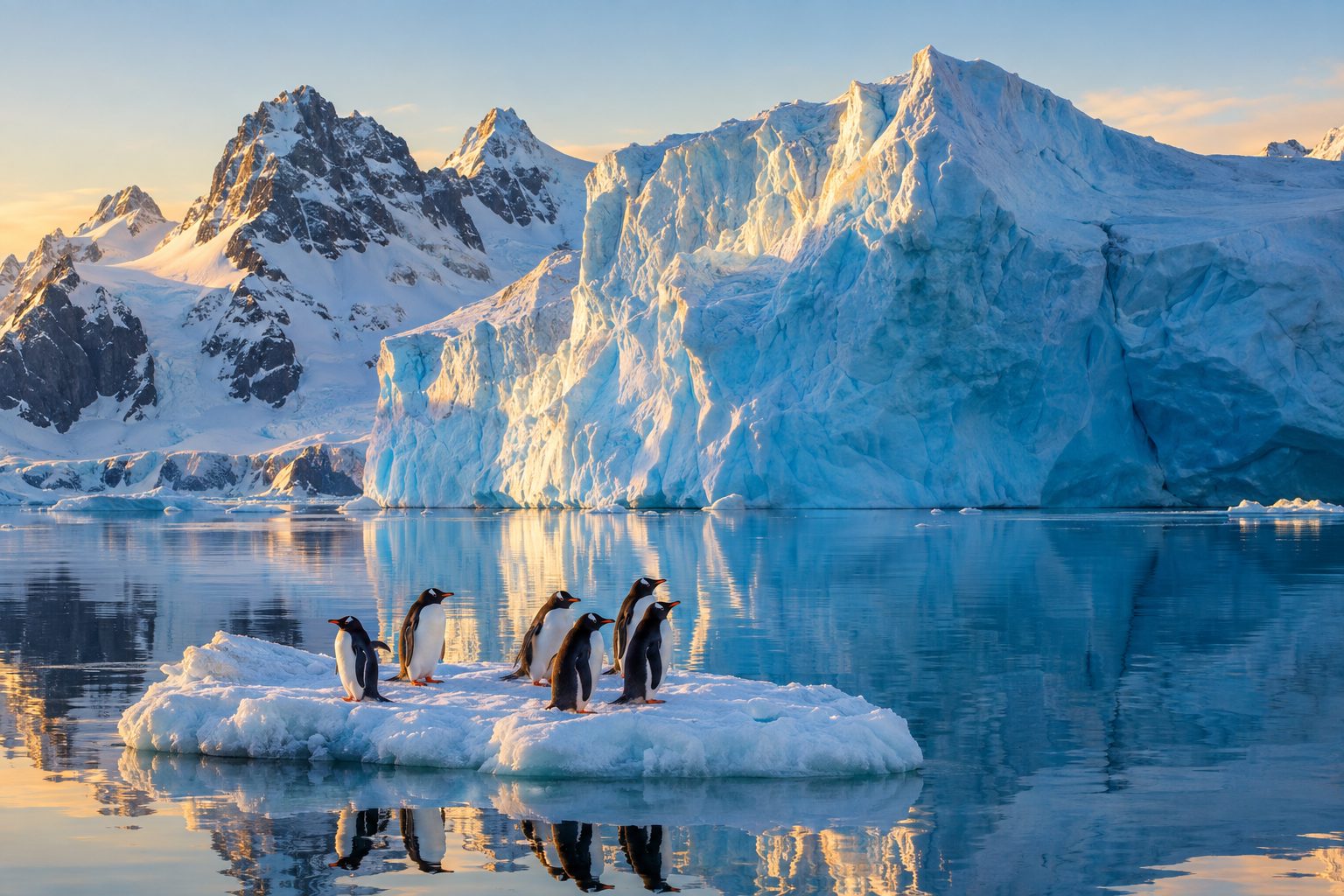
November is the pristine month: heavy sea ice, enormous bergs, fresh unmarked snow, and penguins courting and nest-building. Ships may have to push through pack ice and some landing sites stay blocked, but shoulder-season fares typically run 10–20 per cent below the December–January peak. December and January are the 'warmest' months — Peninsula averages of about −1°C to +3°C — with daylight stretching to 20 hours or more around the solstice. The first chicks hatch in mid-to-late December, and January brings peak chick activity, the most reliable Antarctic Circle crossings and the calmest conditions for kayaking. It is also the most expensive stretch of the season.
February and March belong to the whales. Krill blooms peak, humpbacks bubble-net feed, minkes and orcas work the channels, and sightings of ten or more humpbacks in a day are plausible. Penguin colonies turn muddier and smellier as chicks fledge, the nights return and bring sunsets that last for hours, and sea ice starts reforming in March. It is the quietest and cheapest end of the season: operators sometimes discount remaining March berths by 30–40 per cent in the final weeks.
What a landing day actually looks like
A typical Peninsula day aims at two excursions, morning and afternoon. The expedition team scouts the site first, then calls groups in rotation to the gangway, where you step into a Zodiac — a rigid inflatable taking roughly ten passengers — for the short run ashore. Ashore you move within flagged routes between the colony margins, with guides posted at the 1:20 ratio, and after an hour or two you rotate back so the next group can land within the 100-person ceiling. Cruise-only time in the Zodiacs, nosing along ice fronts and among bergs, fills the slots when a landing is not possible.
Weather, not the brochure, writes the final programme. Expedition teams make the day's call on wind, swell, visibility and ice; in winds above about 30 knots Zodiac operations are usually suspended and the ship repositions to find shelter. Itineraries are explicitly 'captain's choice', and seasoned operators still usually find a window for at least one outing even on rough days. Optional kayaking, snowshoeing or camping on the ice need calm conditions and sell out early — book them with the voyage, not on board.
Booking and cost realities
As checked in October 2026, realistic entry fares for a classic 10-to-14-day Peninsula voyage on an expedition ship start around US$8,800–11,000 per person — HX's late-October 2026 departure from US$8,830 and Terra Nova's 13-day science sailings from US$10,980 are representative — while luxury ships, fly-cruises and long South Georgia combinations run from roughly US$15,000 to beyond US$50,000. Silversea's six-night fly-cruise, for instance, starts at US$31,400. Verify current fares with operators, as these move season to season.
Demand has risen sharply over recent seasons, so the standard advice is to book 12–18 months ahead for a choice of dates and cabins, especially for December–January. The counter-play is the late deal: March berths, and sometimes February ones, are discounted when ships would otherwise sail with empty cabins — workable if you can fly to Argentina at short notice. Either way, insure the trip properly; operators require cover that includes emergency evacuation.
Biosecurity and behaving ashore
Antarctica's defences against introduced species are procedural, and you are part of them. Before the first landing, expedition staff run a decontamination session: outer clothing vacuumed, pockets and Velcro picked clean of seeds and soil, boot treads scrubbed, tripods and bags checked. Boots go through disinfectant washes at the gangway on the way out and the way back, and everything is cleaned again before the ship moves between regions, so that one bay's microbes do not reach the next.
The Antarctic Treaty Parties ask visitors to keep at least five metres from wildlife on land and 15 to 25 metres from potentially dangerous animals such as fur seals, to give animals the right of way and never block their routes to the sea, to keep noise down and stop moving if behaviour changes, to take nothing and leave nothing, to avoid flying drones near wildlife, and to wash boots and clean all equipment before arriving and between sites.
— Paraphrased from the Antarctic Treaty Parties' General Guidelines for Visitors to the Antarctic
- Start seasickness medication the evening before the Drake crossing rather than after the swell arrives.
- Pack waterproof over-trousers and a dry bag for cameras; most operators lend insulated muck boots and a parka, so check before buying.
- Bring clothing you can clean thoroughly: fleece, Velcro and boot treads are the biosecurity inspection points.
- Carry proof of travel insurance with emergency evacuation cover; operators will ask for it.
- Leave the itinerary loose: a weather day in the South Shetlands is normal, not a failure.
None of this is bureaucracy for its own sake. The 100-person rule, the single-ship sites and the boot washes are the reason a continent with no police force still receives six figures of visitors a year with landing sites that look, each November, as if almost no one had ever stood on them.
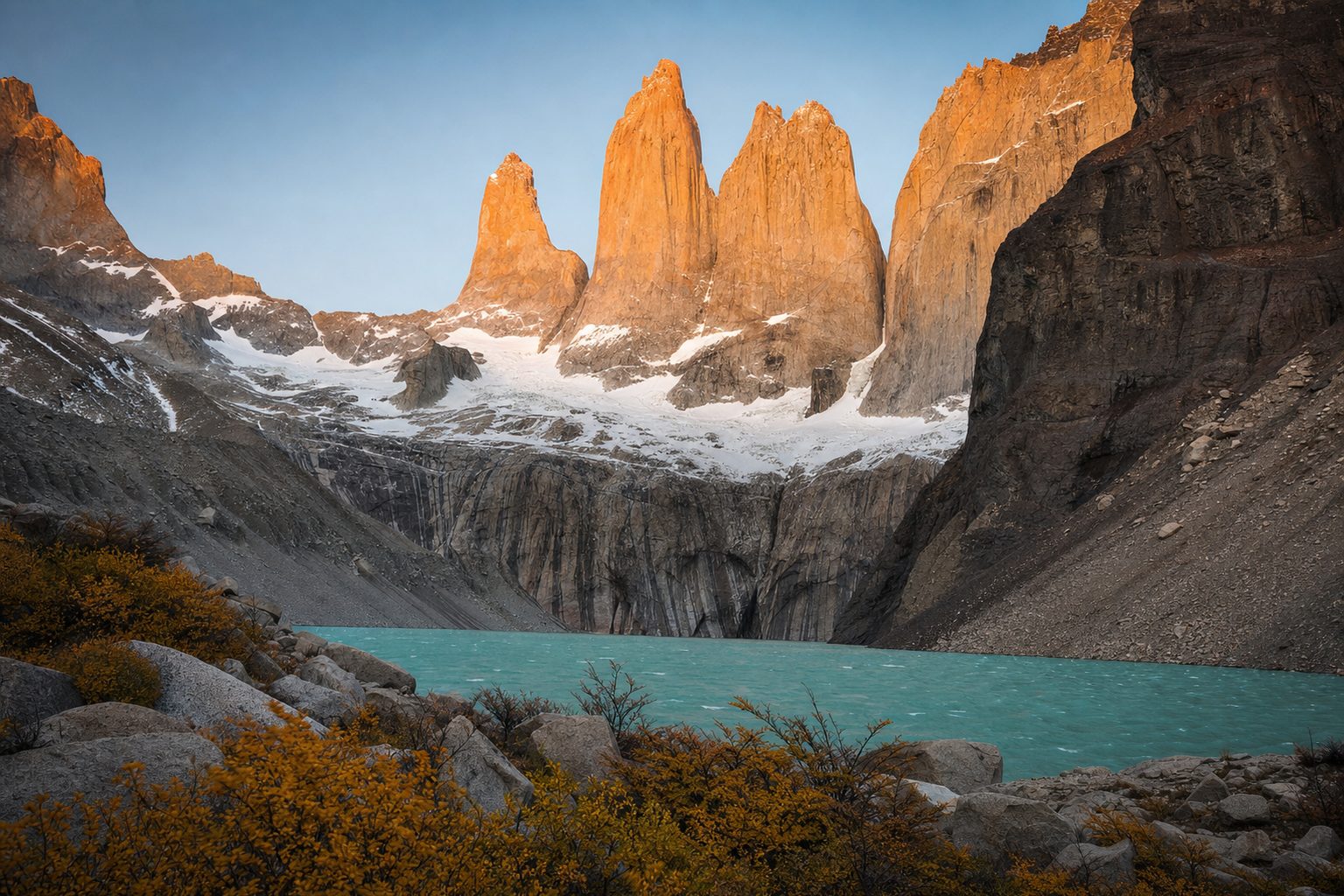
If the far south appeals, it pairs naturally with time either side of the voyage in Patagonia — our guide to Torres del Paine covers the classic add-on across the Chilean border from the Ushuaia gateway. And if it is the polar world itself that draws you, the Arctic offers the counterpart season each northern summer: see our guides to Longyearbyen and Svalbard and to the calving ice of Ilulissat Icefjord for the other end of the planet.
Sources & further reading
- 1. IAATO (International Association of Antarctica Tour Operators) — FAQ: Can large cruise ships travel to Antarctica? Vessel categories, the 500-passenger cruise-only rule, gateway ports and permits
- 2. Antarctic Treaty Consultative Meeting — General Guidelines for Visitors to the Antarctic (official poster, hosted by IAATO): the 100-passenger limit, one ship per site, guide ratios, wildlife distances and biosecurity
- 3. IAATO information paper to ATCM XXVIII (IP 90): Category 1 and Category 2 expedition-ship definitions and site-specific passenger caps
- 4. Secretariat of the Antarctic Treaty — Tourism and non-governmental activities: how Antarctic tourism is regulated, visitor numbers and the October–April season
- 5. Antarctica Tourism Guide — Antarctica weather by month: temperatures, daylight, sea ice, wildlife and the Drake Passage through the cruise season
- 6. Cruise Critic — The best time to cruise to Antarctica: month-by-month conditions and pricing
- 7. AFAR — Best Antarctica cruises: ship sizes, fly-cruise options and sample fares