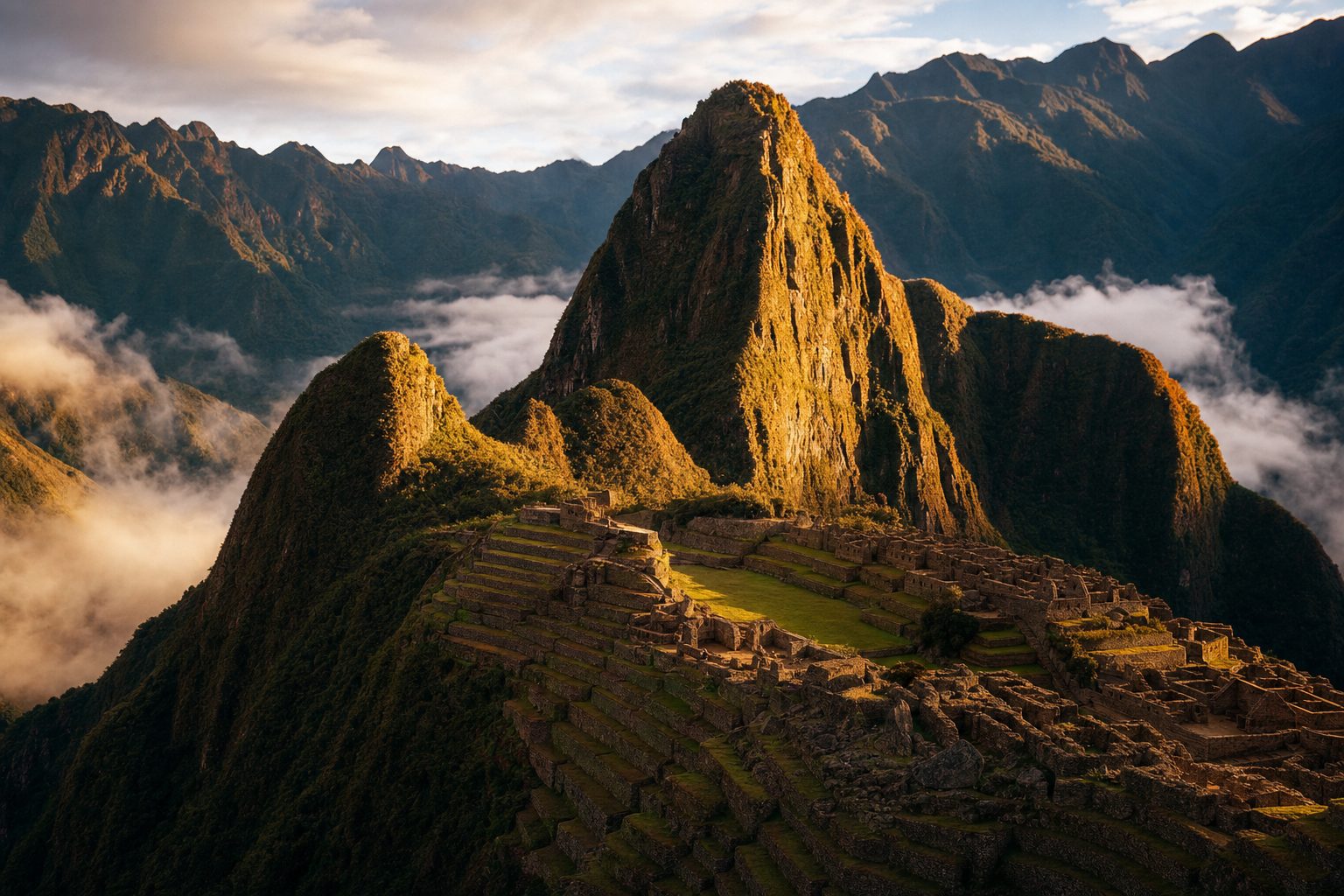
Machu Picchu is not a landmark to leave until the loose end of a Cusco itinerary. The image that arrives in a reel—the stone city spread below a ridge—sits behind a ticket system that asks visitors to make several decisions before they are anywhere near the gate. Pick the wrong circuit and the familiar panorama may not be part of the route. Pick the right circuit but the wrong hour, and the train, bus queue and entrance tolerance start to matter as much as the view.
The first task is therefore not to plan every photograph or every meal: it is to secure a date, a timed ticket and a circuit that fit the day’s transport. As checked in August 2026, the system is structured around named, date-bound tickets and one-way visits. Treat the ticket as the fixed point, then arrange the journey through Machu Picchu Pueblo (Aguas Calientes), the gate approach and any mountain route around it. Prices, capacity and access conditions can change, so confirm the live terms through the Machu Picchu ticket guidance before paying.
Start with the ticket, not the train
Tickets are sold through the Ministry of Culture’s tuboleto.cultura.pe portal; the booking is tied to a date, time slot and the passport name used to make it. That sequence matters. A rail departure can be changed into a different plan more easily than a site ticket that is non-refundable and matched against identification. Enter the passport details with care, keep the same passport for the visit and avoid treating a held basket as a completed booking. A reservation is held for only three hours before an unpaid booking is released, according to the 2026 booking guidance, so payment is part of the booking task rather than something to postpone.
As checked in August 2026, standard foreign-adult admission is approximately US$57 and a child ticket for ages 3–17 approximately US$32; foreign-adult prices rose by S/.11 from 1 May 2026. [4]
The useful planning order is simple: decide the day you can reach the citadel, select the route that serves the reason for going, then put transport around that fixed entry. Do not buy a general ‘Machu Picchu’ ticket on the assumption that the site works as a single open circuit. The system separates the experience into routes, and there is no useful advantage in being early at Aguas Calientes if the booked route does not contain the part of the llaqta you came to see. Keep the confirmation accessible in addition to the passport; both belong in the practical plan, not in luggage left at accommodation.
Choose the circuit that contains your priority
The most important distinction is visual as well as logistical. Circuit 2, Machupicchu Clásico, includes the classic postcard photo platform. Circuit 1, Panorámico, is built around upper-terrace views. Circuit 3, Machupicchu Realeza, takes in the lower town and does not include the classic panorama; it is also the circuit associated with the Huayna Picchu and Huchuy Picchu add-on routes. Those are different visits, not interchangeable labels. Start with a sentence about what matters most—classic view, upper terraces, lower town or a mountain add-on—and choose from there.
Since June 2024, visits have been organised into three circuits—1 Panorámico, 2 Machupicchu Clásico and 3 Machupicchu Realeza—bundling ten routes, with some guidance counting high-season variants separately. Each ticket permits one circuit in one timed window; visitors cannot switch circuits at the gate and routes operate as one-way flows. [3]
That is why a downloaded aerial image should not decide the booking by itself. A Circuit 3 mountain plan and a Circuit 2 postcard plan make different promises. If a particular photograph matters, use the circuit description to test whether it is genuinely included before buying. If the aim is to walk a route rather than repeat a view, accept that the one-way design will shape what comes next. Build only one citadel route into the day; the rules do not support exiting and returning to correct a choice made in haste.
Think of the llaqta as a set of managed, one-way routes: the circuit printed on the ticket determines the experience, rather than serving as a suggestion after arrival.
— Paraphrased from HowtoPeru’s Machu Picchu circuit and entry-rules guide
Make the timed window the centre of the day
A capacity number is not a reason to arrive casually. The regular daily cap is 4,500 visitors, with a higher 5,600 cap on designated high-season dates. The current August 2026 period sits inside the 19 June–2 November high-season window, when the higher cap applies. More permitted visitors does not make entry flexible; it makes the printed time, the gate approach and the buffer before them more important. Use the ticket time as the day’s anchor and work backwards through the bus or walking approach, then through the train arrival.
As checked in August 2026, designated high-season dates carry a 5,600-visitor cap rather than the regular 4,500. The 19 June–2 November 2026 high-season period includes August. [2]
Timed entry begins hourly from 06:00, with the last slot around 14:00–15:00 depending on season. Late arrival tolerance is 45 minutes in peak season and 30 minutes otherwise; after that the ticket is void. [6]
That tolerance is a contingency, not a target. The standard circuits allow about four hours inside and there is no re-entry after exit. An early ticket can make the uphill logistics less compressed, but it should still be paired with transport that can reach Aguas Calientes comfortably before the gate process. A later ticket can be sensible when it gives a realistic rail connection, but only if it leaves enough margin for the final climb or bus. Do not turn the published tolerance into an itinerary with no spare time.
Plan Aguas Calientes as a transport step, not a shortcut
Machu Picchu Pueblo, widely known as Aguas Calientes, is the practical gateway. PeruRail and Inca Rail run from Cusco’s Poroy station or Ollantaytambo to the town; from there, visitors take the shuttle bus or walk roughly 1.5–2 hours uphill to the gate. On busy mornings, the bus queue can run 30–45 minutes. That makes the approach a timed component of the ticket plan rather than a last-minute choice. Select the bus when it protects the entry window; select the walk only when the uphill time is genuinely available.
For visitors already travelling through the Sacred Valley, the gateway decision is a useful reason to connect the citadel with a wider route rather than treat it as a detached day trip. The Sacred Valley trails beyond Machu Picchu offer the quieter counterpoint: arrange the timed citadel visit first, then give the surrounding walking days their own space. The same principle applies to a mixed Peru itinerary. A train seat, a bus queue and a gate tolerance are not minor details when the ticket cannot be recovered after a missed window.
Use the in-person option as a fallback, not a plan
When online inventory has gone, there is a controlled in-person route rather than an invitation to arrive without a plan. At the Ministry of Culture Cultural Centre in Machu Picchu Pueblo, up to 1,000 tickets are sold daily in person between 15:00 and 22:00 with identification. Since 7 May 2026, the last-minute window has applied to purchases up to three days ahead, replacing the older next-day-only arrangement. It is a fallback for flexibility, not a substitute for buying an important date in advance.
Up to 1,000 tickets are available daily in person at the MINCUL Cultural Centre in Machu Picchu Pueblo from 15:00 to 22:00, with ID required. [1]
A visitor using that fallback should be willing to accept what is available: date, time and circuit are all part of the result. It does not guarantee the preferred photograph route, a mountain add-on or a particular morning. If the trip has only one viable day at the citadel, the safer decision remains an online ticket bought before the transport and accommodation become non-refundable. If there is flexibility, the in-person centre can be an option worth understanding rather than a rumour to chase.
Treat mountain add-ons and site rules as separate commitments
Huayna Picchu, Huchuy Picchu and Machu Picchu Mountain are not casual extensions to bolt on at the gate. Huayna Picchu has roughly 350–400 places a day in two morning shifts and sells out first; Machu Picchu Mountain has only a few hundred places in two slots. The Inca Trail is a separate permit, and from 2026 its permit no longer automatically includes citadel entry, so a circuit ticket must be bought separately. A mountain or trail day therefore begins with the combined permissions, not with the assumption that a standard site ticket can be upgraded later.
On the ground, the same restraint keeps the visit usable. Passport names are checked against tickets at the gate, and wristbands control access to restricted trails. Casual visitors may not use tripods or drones; professional photography requires advance authorisation, and single-use plastics are banned. Pack for the route you actually booked, carry the correct passport and leave equipment that does not belong inside. These are not decorative conditions: they are part of a system designed to keep a timed, one-way visit moving.
- Buy the date- and passport-matched ticket before fixing the rail journey, then save the confirmation with the passport used to book.
- Choose Circuit 2 for the classic photo platform, Circuit 1 for upper-terrace views, or Circuit 3 for the lower town and relevant add-ons.
- Treat the printed entry time as fixed: plan the train, bus queue or uphill walk to arrive before the tolerance begins.
- Use the Aguas Calientes Cultural Centre only as a flexible fallback, accepting that the available date, time and circuit may differ from the ideal.
- Buy mountain or Inca Trail permissions as distinct commitments and follow the on-site rules for identity, equipment and plastics.
Getting into Machu Picchu is an exercise in matching one deliberate choice to the next: the ticket to the circuit, the circuit to the view, the time window to the journey, and the approach to the gate. Once those pieces are fixed, there is room to make the wider Peru trip slower and more spacious, away from the citadel’s strict timetable. Continue with Beyond Machu Picchu: Walking the Quiet Trails of the Sacred Valley for the surrounding trails, or compare another tightly managed Andean visit in our Galápagos planning guide.
Sources & further reading
- 1. PeruRail — Machu Picchu Tickets and 2026 Availability
- 2. The Cusco — Machu Picchu 2026 Capacity and Entry Windows
- 3. HowtoPeru — Machu Picchu Circuits, Entry Windows and Rules
- 4. Machu Picchu World — 2026 Circuit and Ticket Guide
- 5. MachuPicchu.org — 2026 Visitation Rules
- 6. Kichwa Peru — Machu Picchu Visitor Guide 2026
- 7. Tierras Vivas — Machu Picchu Restrictions and Inca Trail Changes
- 8. SETOURS — Machu Picchu New Rules