Antelope Canyon is not a stop to leave open until the day before. It is Navajo land near Page, Arizona, and every visit turns on a small set of decisions made in advance: which canyon suits the group, whether a photographed light beam is worth the peak-time premium, how much climbing is realistic, and what happens if weather closes the route. The familiar walls of wind-polished sandstone are the reward, but the useful plan begins with accepting the limits around them.
The first decision is not Upper versus Lower. It is whether a guided, timed group visit fits the itinerary at all. There is no self-guided entry to Antelope Canyon. Once that is clear, the three main choices become legible: Upper for the classic vertical beams and a largely level canyon floor; Lower for narrower passages and ladders at a lower standard-tour price; or Canyon X for a separate, moderate guided walk east of Page. Book the experience rather than the name, then leave room for a weather change.
Start with the non-negotiable: a Navajo guide
Antelope Canyon lies within Lake Powell Navajo Tribal Park, on land belonging to the LeChee Chapter of the Navajo Nation. It is a place with cultural as well as photographic significance, not an unregulated landscape. The practical consequence is simple: choose an operator listed or recognised by Navajo Nation Parks, reserve a timed place, and follow that operator’s check-in instructions. Do not arrive expecting to walk in independently, even if the forecast is clear and the road looks quiet.
As checked in August 2026, Navajo Nation Parks says every Lake Powell–Antelope Canyon location is accessible only on a guided tour and that tour guides are mandatory. Its published entry fee is $15 per person, per location, per day, with the guided tour charged separately. [2]
That $15 is often presented as a Navajo permit or park charge inside a tour checkout, but it is not displayed identically by every operator. Read the final price line by line: a tour may bundle it, add it after the headline fare, or show a different permit amount in older terms. Treat a National Park pass as irrelevant here; this is a Navajo Tribal Park. The point is not to find a loophole, but to make sure the price quoted actually includes the access required for that particular canyon.
Most tours leave from Page or from the Highway 98 park approach, rather than from inside the canyon. Visit Arizona advises arriving at least 15 minutes before the arranged time. Build in more if the group needs fuel, a car seat or a last toilet stop: some canyon sites have no facilities, and a late arrival can mean losing a departure rather than joining it halfway through. Page is the sensible base, with canyon tours, Horseshoe Bend and Lake Powell all drawing on the same limited day.
Access is organised around guided entry: arrange a listed tour operator first, then approach Antelope Canyon as a Navajo Tribal Park rather than a walk-in trailhead.
— Paraphrased from Navajo Nation Parks: Antelope Canyon tour operators
Choose Upper, Lower or Canyon X by the experience, not the label
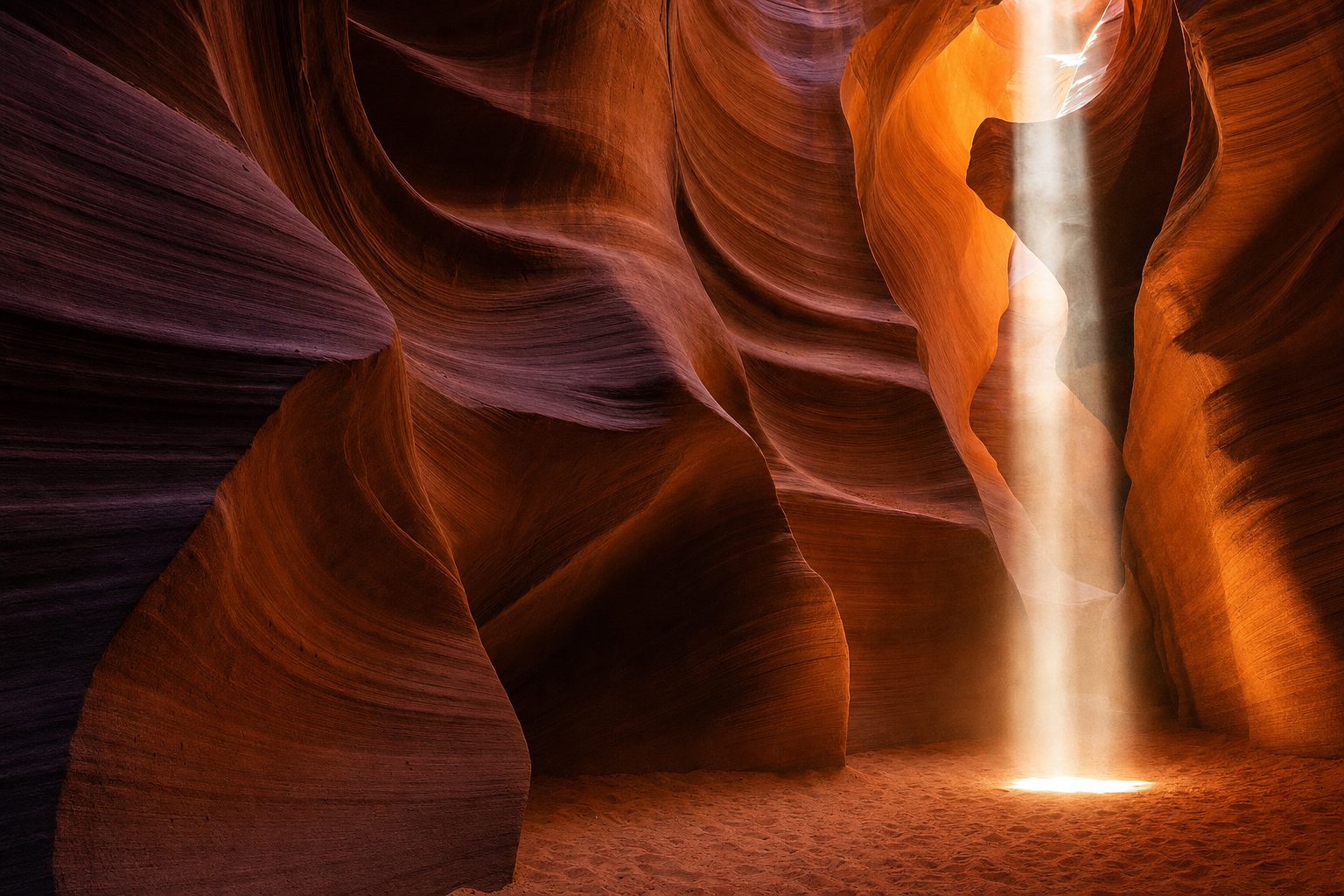
Choose Upper Antelope Canyon if the shaft-of-light image is the central ambition, or if the group needs the most straightforward canyon interior. Upper is the familiar narrow corridor where direct overhead sun can form the defined vertical beams. Navajo Tours describes much of its interior as ground level, and its standard package includes a 4×4 transfer and a guide. That does not make it step-free: the current route requires a descent of 150 stairs back to the vehicles and is not wheelchair accessible. Visitors with limited mobility should ask the chosen operator about the exact route rather than relying on an old impression that Upper is simply flat.
Choose Lower Antelope Canyon if you prefer a more physical route and care more about sculpted, glowing walls than a defined overhead beam. Its longer, tighter passageways use staircases and ladders, so good grip and a calm response to enclosed spaces matter more than photographic gear. It is commonly treated as moderate rather than easy. The reward is a different rhythm of colour and curves; the trade-off is that it is a poor choice for anyone who cannot comfortably manage uneven steps or carry a child through a narrow passage.
Choose Antelope Canyon X when the idea of a separate guided slot-canyon walk is more appealing than the classic Upper beam pursuit. Taadidiin Tours places Canyon X 12 miles east of Page on Highway 98 and describes its hiking tour as a 1.5-hour general walking experience through two slots. It can be a useful alternative when Upper or Lower timing does not work, but do not book it on the assumption that it is guaranteed empty or that it replicates Upper’s light beams. It is its own product, with a moderate route, its own permit and a strict no-bag hiking-tour rule.
- Book Upper for the strongest chance of the classic beam composition, accepting peak-time demand and a pricier time slot.
- Book Lower for a shorter, less costly standard visit if ladders, narrow passages and stairs are comfortable for everyone in the party.
- Book Canyon X for a distinct guided slot-canyon walk east of Page, not as a promise of solitude or a substitute for Upper’s beam window.
- If mobility, young children or claustrophobia are concerns, send the operator the specific question before paying rather than relying on generic descriptions.
As checked in August 2026, Navajo Tours lists its standard Upper tour at $85 plus a $15 Navajo permit ($100 before processing fee and tax); the 11:40 departure is $105 plus the $15 permit ($120 before processing fee and tax). The listed outing is 90 minutes round trip, with 60 minutes at the canyon site. [6]
These examples show why a simple Upper-versus-Lower price comparison can mislead. The bright middle-of-the-day slot is priced differently because it is in demand, while an early or late Upper departure may be a better choice for visitors who want tonal colour, shadow and a calmer schedule. No operator can promise a beam: the sun needs to be high and the sky conditions need to cooperate. Choose the premium time only when the possibility is genuinely worth shaping the day around.
Book the beam window without treating it as a guarantee
For Upper Antelope, work from two timeframes. The broad high-demand visiting season runs roughly March to October; the strongest, most reliable-looking beams are a summer and early-autumn proposition, with Navajo Tours identifying May to September as the peak beam period. The useful daily target is about 11:00 to 13:30, when the sun is high enough to reach into the slot. Late March to early October is a reasonable planning window for a first look at availability, but it should not be sold to yourself as a beam guarantee.
The defining error is to book any midday tour and expect the social-media image. Light is seasonal, brief and affected by cloud; a guide may position the group where conditions allow, but cannot manufacture the sun. June through August gives the strongest odds and the deepest crowd pressure. In March, April, September and October, the canyon can still be beautiful, but book for warm reflected colour and form rather than one precise shaft. Winter brings softer light, cooler weather and a better chance of a quieter departure.
For a peak-season Friday, Saturday or school-holiday visit, start looking as soon as the Page stay is fixed. Visit Arizona notes that tours can sell out weeks ahead, and Navajo Tours says demand means future slots are released only one to two months ahead. That means a booking timeline has two parts: create a short list several months out, then return promptly when the operator releases the relevant date. If the 11:00–13:30 slot is gone, decide whether a different Upper time still serves the trip before automatically shifting to Lower.
Compare current prices with the permit and restrictions visible
As checked in August 2026, Ken’s Tours lists a standard Lower guided walk from $80.50 for 50–60 minutes. That makes Lower the more economical first choice in this published comparison, while demanding more from knees, balance and confidence on stairs. The headline still needs checking at checkout: terms, taxes, booking charges and permit treatment can change. Do not use an old blog’s $60–85 estimate as a decision rule when the live operator page is available.
As checked in August 2026, Ken’s Tours lists its Lower Antelope Canyon standard guided walk from $80.50 per person for 50–60 minutes. Its published alternatives are longer or bundled products, so compare the standard walk rather than assuming every Lower ticket has the same price or duration. [7]
Canyon X needs the same care. Its current standard hike is not automatically a $105–160 experience: Taadidiin Tours lists the adult hike at $47 plus a $15 hiking permit, while its three-hour photography tour is $142 plus that permit. A private guided option is listed at $150 per person with a five-person minimum. Those published options explain why a broad online price range is not enough—select the level of access and equipment policy you want, then inspect the exact booking screen before committing.
As checked in August 2026, Taadidiin Tours lists its 1.5-hour Antelope Canyon X hiking tour at $47 for adults, plus a $15 hiking permit for visitors aged eight and over; its 3-hour photography tour is listed at $142 plus the permit. [8]
The sensible budget is therefore a range, not a single figure: add the tour, the specified Navajo or hiking permit, processing and taxes where shown, then transport and a meal in Page. A cheap-looking price that excludes the compulsory access charge is not cheaper. Conversely, paying extra for the 11:40 Upper slot only makes sense if the beam window is the purpose. The same discipline helps when folding Antelope Canyon into a broader national-parks road trip: fixed tours should lead the timetable, not be squeezed into it.
Bring less, move carefully and take monsoon closures seriously
The standard sightseeing tour is not a photography expedition. Tripods, monopods and selfie sticks are prohibited on Navajo Tours’ sightseeing visit, while its current policy requires bags to be transparent and viewable to staff. At Lower, Ken’s Tours publishes an even stricter practical list: bags, backpacks, fanny packs, hydration packs, sticks, canes, selfie sticks, recording eyewear and GoPros are not permitted. Canyon X’s hiking tour says no bags of any size. Restrictions vary by operator and can change, so the booking confirmation—not a packing list copied from another canyon—is the final instruction.
Pack a handheld camera or phone only if permitted, one water bottle, medication, sun protection for the exposed transfer and closed-toe shoes with grip. Leave a large camera bag in the car rather than arguing at check-in. Do not bring a tripod hoping a guide will make an exception. The narrowest passages need clear movement, and the tour is a shared visit rather than a private photo session. Keep walls untouched, stay on the directed route and give the guide room to manage the group.
Flash-flood reality is the final non-negotiable. June to September is Arizona’s monsoon period and heavy rain or snow can close Antelope Canyon. The immediate Page forecast is not enough: Visit Arizona warns that rain in the upstream watershed can send runoff into a slot canyon even when the local sky is blue. A cancellation is a safety decision, not an inconvenience to negotiate. Buy flexible accommodation where possible, avoid placing an inflexible flight or long drive immediately afterwards, and keep a second Page-area activity available.
A considered Antelope Canyon visit is therefore precise rather than rushed: reserve an authorised guide, choose the canyon that matches the group, pay for the beam time only when it matters, and accept a weather closure without trying to outsmart it. With that mindset, Page becomes a stronger base for the wider desert landscape. Continue with the adventure travel planning guide when deciding which other big landscapes deserve the same amount of time and preparation.
Sources & further reading
- 1. Navajo Nation Parks: Lake Powell Navajo Tribal Park
- 2. Navajo Nation Parks: Antelope Canyon tour operators
- 3. Visit Arizona: A guide to visiting Antelope Canyon the right way
- 4. Visit Arizona: A photographer's guide to Arizona slot canyons
- 5. Antelope Canyon Navajo Tours: Canyon information
- 6. Antelope Canyon Navajo Tours: Tour packages
- 7. Ken's Tours: Lower Antelope Canyon tours
- 8. Taadidiin Tours: Antelope Canyon X hiking tour