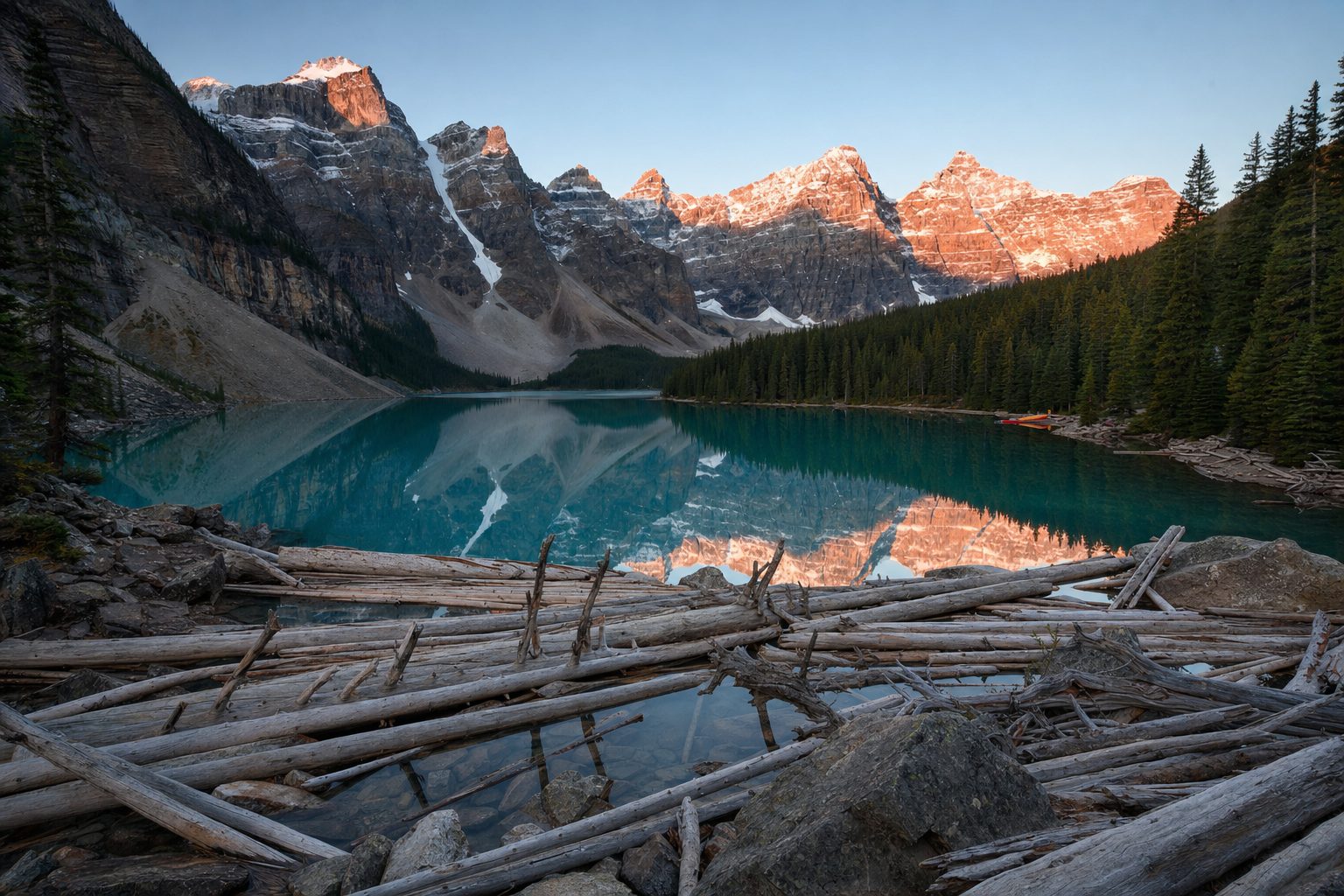
Banff National Park rewards planning more than spontaneity. Canada's oldest national park, established in 1885, draws millions of visitors each summer into a compact stretch of the Rockies where two lakes, Louise and Moraine, sit close enough together to visit in a single day but far enough from the town of Banff that getting there has become a logistics exercise in its own right. The decisions that matter are not really about which trail to walk; they are about how you plan to reach the lakes at all, when you go, how you pay for entry and parking, and how you behave once wildlife or water is involved.
As checked in July 2026, the rules governing Moraine Lake Road, the Parks Canada shuttle system, and what you can put on the water have all changed meaningfully in the last two years. This guide sets out those specifics using Parks Canada's own current guidance, so a first-time visitor can build an itinerary around what is actually possible this season rather than what an older blog post describes.
Entry fees, passes, and the 2026 free-entry window
Every vehicle entering Banff National Park needs a park pass, sold by the day or the year. As checked in July 2026, Parks Canada's official fee schedule lists daily admission at CAD 12.25 for an adult, CAD 10.75 for a senior, free for youth, and CAD 24.50 for a family or group of up to seven people arriving in one vehicle. An annual Discovery Pass, which covers entry to more than 80 Parks Canada sites across the country, costs CAD 83.50 for an adult and CAD 167.50 for a family or group, a better value for anyone spending more than about a week across multiple parks in a year.
For 2026, the federal government's Canada Strong Pass adds a temporary layer on top of the usual fee structure. As checked in July 2026, Parks Canada's Banff overview page confirms free admission and a 25 percent discount on camping and other overnight stays with Parks Canada from 19 June to 7 September 2026. The waiver covers park entry only; parking remains a separate cost, and privately operated attractions inside the park boundary, such as the hot springs, are not included. Visitors travelling in this window should still expect the same shuttle reservations, vehicle restrictions, and parking fees described below, since none of those are waived by the pass.
As checked in July 2026, the Canada Strong Pass gives free admission to Banff National Park from June 19 to September 7, 2026, plus 25 percent off Parks Canada camping and overnight stays, with no citizenship or geographic restriction, per Parks Canada. [1]
Lake Louise vs. the town of Banff: choosing a base
Most first-time visitors base themselves in the town of Banff, a genuine mountain town with the widest range of hotels, restaurants, and the year-round Roam Transit network, roughly an hour's drive from Lake Louise. Basing in Lake Louise village instead cuts that commute and puts you closer to the shuttle departure points for both Lake Louise and Moraine Lake, at the cost of a much smaller selection of accommodation and services, most of it clustered around a single hotel and a handful of hostels and lodges. Canmore, just outside the park's eastern boundary, is a third option with generally lower prices and its own Roam connection into Banff, useful if hotel rates in the townsite spike in peak season.
The practical trade-off is time versus convenience: a Banff base means a longer day trip to the lakes but more evening options, while a Lake Louise base shortens the lake-day logistics but limits where you eat and sleep. Either way, a car is not required to reach Lake Louise, since Roam Transit's Route 8X runs between the two.
Moraine Lake: shuttle-only access and how the booking window works
This is the detail that catches the most visitors off guard: Moraine Lake Road has been closed to personal vehicles year-round since 2023, and that policy continues in 2026, with no exception for accessibility permits. The only ways in are a Parks Canada shuttle, a licensed commercial operator, a Roam Transit Reservable Super Pass connecting through the Lake Connector shuttle, or arriving on foot or by bicycle, which Parks Canada notes requires full self-sufficiency since there is no cell service, running water, or lighting at the lake itself, only pit toilets.
As checked in July 2026, Moraine Lake Road is closed to all personal vehicles year-round, and access is limited to Parks Canada shuttles, licensed commercial operators, and registered Moraine Lake Lodge guests, per Parks Canada's official shuttle and access page. [3]
Booking follows a two-stage release. As checked in July 2026, Parks Canada's shuttle reservation page states that roughly 40 percent of seats for the 2026 season opened for advance booking on 15 April at 8am MDT, with the remaining 60 percent released on a rolling basis at 8am MDT exactly two days before each departure. Reservations come in one-hour arrival windows, cost a non-refundable CAD 3.50 online (CAD 5.50 by phone) per booking regardless of party size, and allow up to ten seats per reservation. Parking at the Lake Louise Park and Ride is free for reservation holders; showing up without a booking on a Roam bus, Parks Canada shuttle, or commercial tour makes finding a parking space at the lakeshore itself unlikely.
The Lake Connector and Alpine Start: linking Louise and Moraine
Once you are at the Lake Louise Lakeshore, the Lake Connector shuttle handles the final leg to Moraine Lake. As checked in July 2026, Parks Canada describes it as a first-come, first-served service running every 30 minutes between 7am and 6pm from 1 June to 12 October 2026, requiring a boarding pass issued at check-in rather than a separate timed booking, so it functions as a shared link between the two lakes on one visit rather than a second reservation to make.
For visitors chasing a sunrise reflection shot rather than midday crowds, the Alpine Start shuttle departs the Lake Louise Lakeshore parking lot at 4am and 5am daily through the same season, returning via the Lake Connector. Unlike the free Park and Ride, parking here is paid and not included in the shuttle ticket, and the service currently has no accessible vehicle option. Roam Transit's Reservable Super Pass offers an alternative route to the same outcome, bundling a reserved Route 8X ride from Banff with Lake Connector access and unlimited local Roam travel for the day.
- Book a Parks Canada shuttle seat or Roam Reservable Super Pass before you travel; walk-up parking at Lake Louise Lakeshore is not a reliable backup plan.
- If the advance window is sold out, try again at 8am MDT exactly two days before your date, when the rolling 60 percent release happens.
- Choose the Alpine Start (4am or 5am) only if you are prepared for paid parking and no accessible-vehicle service.
- Carry a printed or downloaded boarding pass and photo ID; check-in happens at the Lake Louise Park and Ride kiosk, not at the lake.
- Treat Moraine Lake itself as backcountry: no cell signal, no running water, and pit toilets only, so bring water, food, and layers.
What you can and can't do on the water
Banff's lakes are now divided into water-activity zones, introduced after whirling disease, a parasitic infection harmful to trout, was confirmed in Lake Louise. As checked in July 2026, Parks Canada's official water activities page places Moraine Lake and Bow Lake in a Water Preservation Zone, where paddling, large inflatables, and motorized boating are all prohibited; swimming, snorkelling, and fishing without waders remain allowed. The one exception at Moraine Lake is the lodge's own rental canoe fleet, which never leaves the lake and so falls outside the personal-watercraft ban. Lake Louise itself sits in a more permissive Water Recreation Zone, where personal canoes, kayaks, and paddleboards are still allowed provided the gear is clean, drained, and dried, and certified under a self-certification permit.
As checked in July 2026, Parks Canada classifies Moraine Lake and Bow Lake as Water Preservation Zones where personal paddling, large inflatables, and motorized boating are prohibited, with an exception only for the on-site Moraine Lake Lodge rental canoe fleet. [4]
Parks Canada frames the new zoning system around a simple standard for anyone bringing watercraft or fishing gear into the park: equipment must be cleaned of mud, sand, and plant or animal material, drained completely, dried for at least 48 hours if last used within Alberta, British Columbia, the Northwest Territories, or Yukon, and certified through a self-certification permit or an official inspection before it touches the water.
— Paraphrased from Parks Canada's official Banff water activities guidance
The Icefields Parkway: what a day on Highway 93 actually involves
North of Lake Louise, the Icefields Parkway (Highway 93) runs 232 kilometres to the town of Jasper, and Parks Canada's own routing notes describe it as one of the world's most spectacular drives, threading past Bow Lake, Peyto Lake, the Columbia Icefield, and the Athabasca Glacier along the way. As checked in July 2026, Parks Canada's Icefields Parkway travel page is explicit that the road has no year-round cell coverage, limited services running roughly from early May to mid-October, and only one summer-only gas station along the entire stretch, at Saskatchewan River Crossing; a park pass is required to drive it. A single day is enough to see the highlights without stopping overnight, but Parks Canada recommends downloading trip resources and checking 511 Alberta for road conditions before setting out, since weather can shift by the hour even in summer.
As checked in July 2026, the Icefields Parkway (Highway 93) runs 232 km between Lake Louise and Jasper with no year-round cell coverage, one seasonal gas station at Saskatchewan River Crossing, and services generally available only from early May to mid-October, per Parks Canada. [6]
Travellers weighing a longer Rockies loop sometimes pair the Icefields Parkway with a wider North American road trip through Yellowstone and Grand Teton, since both routes share the same logic of managing wildlife, weather, and long distances between services.
Wildlife safety and everyday park etiquette
Banff sits inside grizzly bear, black bear, wolf, and elk range, and Parks Canada treats close encounters as a park-wide risk rather than a backcountry-only concern. As checked in July 2026, the agency's wildlife guidance advises carrying bear spray year-round, travelling in groups, making noise on trails, and keeping dogs leashed at all times, noting that wildlife may appear anywhere in the park, including inside the townsites. Feeding, enticing, or disturbing any wildlife is illegal and can carry fines of up to CAD 25,000. Bear and cougar sightings should be reported to Banff Dispatch.
Getting around without relying on a rental car
Inside the town of Banff, Roam Transit runs year-round local routes to stops including Sulphur Mountain, the Banff Springs area, and Lake Minnewanka, at CAD 2 for a single adult fare or CAD 5 for a day pass, with children riding free. As checked in July 2026, Roam's official fares page lists the reservable Route 8X to Lake Louise at CAD 12.50 one-way for an adult and CAD 6.25 for a senior or youth, making a car-free day trip from Banff to Lake Louise, and onward to Moraine Lake via the Lake Connector, a realistic option for visitors who would rather not drive and park at the lakeshore themselves.
None of this removes the need to plan the Moraine Lake leg separately, since Route 8X terminates at the Lake Louise Lakeshore and does not itself continue up Moraine Lake Road. Anyone building a broader look at how other mountain and coastal destinations handle similar visitor pressure might compare notes with the Pacific Coast Highway guide, which covers a different but related set of seasonal-access and parking trade-offs.
Banff's rules will likely keep evolving as visitor numbers climb and the park manages both crowding and ecological pressure on its lakes; the shuttle system, the water zoning, and even the free-entry window are all recent enough that they are worth re-checking against Parks Canada's official pages close to your travel dates rather than assuming this year mirrors last year. For a broader sense of how a Rockies trip fits into a longer North American itinerary, the adventure travel bucket list is a reasonable next stop.
Sources & further reading
- 1. Parks Canada: Banff National Park (overview, Canada Strong Pass)
- 2. Parks Canada: Banff National Park Fees
- 3. Parks Canada: Getting to Lake Louise and Moraine Lake (shuttles)
- 4. Parks Canada: Water Activities, Banff National Park
- 5. Parks Canada: Wildlife and You, Banff National Park
- 6. Parks Canada: Travelling the Icefields Parkway
- 7. Roam Transit: Fares
- 8. Roam Transit: Lake Louise - Banff Express Route 8X