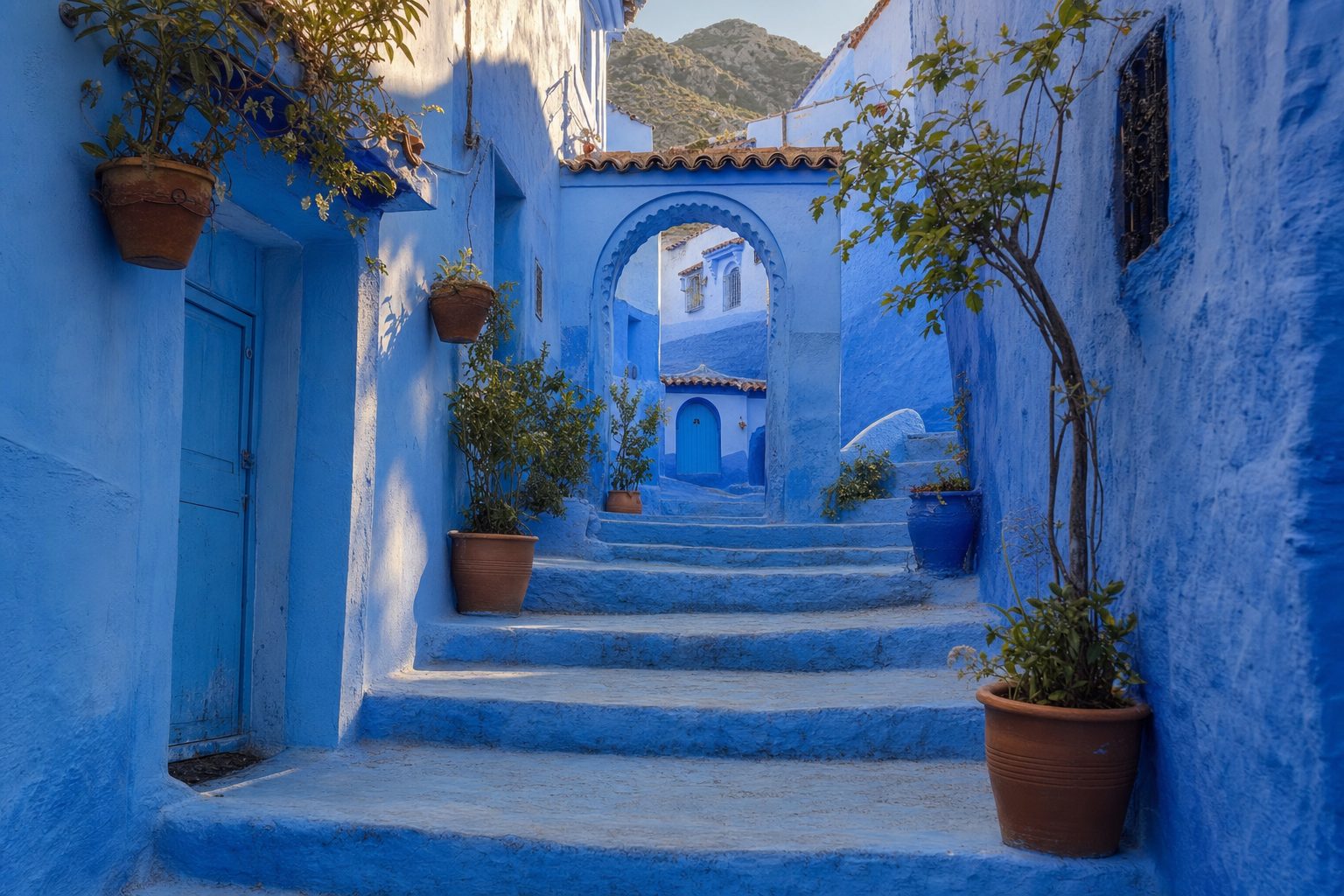
The clip arrives the same way every time: a narrow lane washed in powdery indigo, steps painted the colour of deep water, and a caption along the lines of “a whole town painted blue — no one agrees why”. Both halves of that caption are true. Chefchaouen, a small town of blue-rinsed houses folded into Morocco's Rif mountains, really is painted blue more or less throughout its medina, and there really is no settled account of why. What the clip never shows is the practical shape of the visit: a mountain town with no airport and no railway, four to four and a half hours by road from Fes, that rewards an unhurried overnight far more than the rushed day trip most first-timers attempt.
The decisions, then, are straightforward to name if not always to make. Which gateway city you approach from — Fes, Tangier or Tetouan — and whether you go by coach or shared taxi. Whether you stay the night, which the bus timetable strongly argues for. And when you walk the alleys, because the blue town of the photographs exists mainly between seven and nine in the morning, before the day-trip coaches arrive. If Chefchaouen is part of a longer northern loop, it pairs naturally with Fes and the Atlas mountains to the south.
A whole town painted blue, and no agreed reason why
Chefchaouen predates its colour by centuries. The town began as a fortress in the western Rif, built to resist Portuguese incursions along the northern coast, and grew into a walled medina of Andalusi character as refugees from Iberia settled it. The kasbah at its centre is the original citadel, a rammed-earth enclosure that now holds a museum and a quiet garden courtyard.
Chefchaouen was founded in 1471 by Ali ibn Rashid al-Alami as a small fortress against Portuguese invasions of northern Morocco; that fortress survives as the kasbah, and the town sits at roughly 600 metres in the western Rif mountains. [1]
The blue is another matter. One tradition ties it to the town's Jewish community — refugees from Spain after 1492, reinforced by families fleeing Europe in the 1930s — for whom blue carries sacred significance, the colour of the heavens woven into prayer shawls. Another holds that the wash keeps mosquitoes away, supposedly by mimicking moving water. A third says it simply keeps houses cooler under a Rif summer sun. And some residents offer a more commercial account: that the town leaned into the blue in living memory, around the 1970s, because it drew visitors. None of these has been conclusively proven, and the honest position is that the colour probably owes something to several of them, layered over a century of repainting. What is certain is that the tradition is now actively maintained — walls, stairs and doorways are refreshed each spring, which is why some lanes glow a deeper indigo than others.
The town's heritage runs deeper than paint. Chefchaouen's food culture — goat's cheese, olives, mountain herbs, the slow shared meal — earned it a formal role in one of UNESCO's better-known cultural listings, a fact that surprises visitors who arrive expecting only a photogenic backdrop.
Chefchaouen was chosen as the UNESCO emblematic community of the Mediterranean diet for Morocco, representing the country in the inscription alongside communities in Spain, Italy, Greece, Cyprus, Croatia and Portugal. [6]
Getting there: no airport, no train, one mountain road
Every visitor arrives by road. The railway network does not reach into the Rif, and the nearest airports — Tangier and Fes — are each a healthy drive away. From Fes, the run is about 200 kilometres and takes four to four and a half hours by coach, depending on mountain traffic. From Tangier it is closer to 115 kilometres and two and a half to three hours, through genuinely scenic Rif foothills. CTM, Morocco's national coach company, is the dependable operator on both routes, and its timetables and tickets are published at ctm.ma.
As checked in August 2026, CTM runs Fes–Chefchaouen coaches in about 4 to 4.5 hours for roughly 110–140 MAD, with departures around 8:00, 11:00, 12:45 and 16:15; times shift seasonally, so confirm at ctm.ma before travelling. [2]
The Fes CTM station sits in the Ville Nouvelle, not the medina — allow half an hour by petit taxi from Fes el-Bali. The 11:00 departure is the one most travellers want, arriving mid-afternoon with daylight left to settle in; it is also the first to sell out in summer and at weekends. From Tangier, direct CTM services run around midday and mid-afternoon for roughly 50–65 MAD as checked in August 2026, leaving from the city-centre station rather than the Tangier Med ferry port. The cheaper, more local alternative from the north is the grand taxi: a shared Mercedes or people-carrier from Tangier to Tetouan (about 45 minutes), then a second from Tetouan's main taxi stand over the N2 mountain road to Chefchaouen (about an hour, 30–40 MAD a seat). Taxis leave when six seats fill; pay for empty seats if you want to leave immediately.
Arrival has one final quirk. Buses and taxis set down at the gare routière at the bottom of the hill, about 1.5 kilometres — and almost entirely uphill — from Bab El Ain, the main gate into the blue streets. With luggage, that is a sweaty 20 to 25 minutes; a blue petit taxi from outside the station costs a modest 10–20 MAD and takes five.
Day trip or overnight: the timetable decides
A day trip from Fes is technically possible and rarely satisfying. Take the earliest bus and you arrive around noon; the afternoon return means three to four hours in the medina, most of them the busiest of the day, before a late-evening arrival back in Fes. The arithmetic from Tangier is kinder, but the conclusion is the same: Chefchaouen is a town whose best hours are dawn and dusk, and a day-tripper is present for neither.
Stay one night — ideally two — and the town changes character. By early evening the coaches have gone, the light drops low across the valley, and Plaza Uta el-Hammam fills with residents rather than tour groups. The following morning you have the alleys to yourself until nine. Guesthouses inside the medina are plentiful and modest in price; if you arrive by car, guarded parking near the bus station runs 20–30 MAD a night as checked in August 2026.
Inside the medina: the square, the kasbah and the spring
The medina is compact — twenty minutes corner to corner — and orientation is simple: walk downhill and you will eventually reach Plaza Uta el-Hammam, the market square at the heart of the old town. The square is ringed by cafés, the Great Mosque with its unusual octagonal minaret, and the kasbah, whose rammed-earth towers and garden courtyard are worth the 60 MAD museum entry as checked in August 2026, less for the ethnographic collection than for the tower-top view over the rooftops. The square was probably laid out in the sixteenth century by a son of the town's founder, and it remains what it has always been: the place where Chefchaouen conducts its public life, best watched from a café table between six and eight in the evening as the kasbah walls light up.
Ten minutes' walk east, just outside the old walls, the Ras el-Ma spring pours off the mountain at the medina's edge. This was the town's original water source, now channelled through a small stone structure beside an old mill, and it is where local life is most visible — laundry done in the run-off channels, children in the shallows, fresh orange juice sold for 10–15 MAD at the café beside the stream. Most visitors never walk that far, which is precisely the argument for doing so.
The whole city seems bathed in azure, its blue-rinsed houses lending the walk an air of unreality, while the kasbah's gardens offer a haven of freshness at its centre.
— Paraphrased from the Moroccan National Tourist Office's Chefchaouen listing
The Spanish Mosque and the photography question
The classic panorama — the whole blue town cupped in its valley — belongs to the Spanish Mosque, a disused 1920s mosque on a hill east of the medina. The walk up from Plaza Uta el-Hammam is about a kilometre and 30 minutes, uphill through olive groves past Ras el-Ma, and the path itself is half the pleasure. Sunset is the famous hour and also the crowded one: arrive 30 minutes early to claim a spot on the wall, or go at sunrise and have the view nearly to yourself.
Within the lanes, timing matters more than location. Between seven and nine in the morning the alleys are empty and the light is soft; by ten, the most photographed lanes — Callejon El Asri above the square is the busiest — are a queue. Streets such as Rue Bin Souk and Calle Hassan I carry the same saturated blue staircases with a fraction of the foot traffic. Two points of etiquette are non-negotiable. Ask before photographing residents — this is a conservative mountain town, not a set — and treat the prettiest doorsteps with care: several are styled with flowerpots and painted stairs by the households that own them, and a small tip is expected if you pose there. Blue-painted cobbles often signal a private courtyard; pass through if the path clearly continues, but do not linger in doorways.
- Book buses at ctm.ma a day or more ahead; the 11:00 from Fes and weekend departures sell out first.
- Carry small cash: petit taxis (10–20 MAD), kasbah entry (60 MAD), juice at Ras el-Ma and doorstep tips are all coins-and-notes affairs.
- Walk the alleys at 7–9am for empty lanes and soft light; save the Spanish Mosque for sunrise or arrive 30 minutes before sunset.
- Pack a layer even in summer — at 600 metres the evenings run noticeably cooler than the coast or Marrakech.
- Ask before photographing people, and expect to tip for posed shots on styled doorsteps.
Beyond the blue: Talassemtane and the Akchour valley
The strongest case for a second night lies outside the paint. Chefchaouen sits on the edge of Talassemtane National Park, a serious stretch of Rif high country whose cedar and fir forests hold hiking that most visitors never touch. The park's best-known excursion is the Akchour valley, about 30 kilometres from town: an hour's drive by grand taxi, then a two-to-three-hour round-trip walk up a river gorge to waterfalls, natural swimming pools and the rock arch known as God's Bridge. It is a full day, and in summer the pools justify it.
Talassemtane National Park, established in October 2004, covers 589.5 square kilometres of the Rif and was created to conserve Morocco's last threatened fir forests — the only Spanish firs native to the country grow in its core zone. [7]
Chefchaouen rewards the traveller who resists the checklist. Come by the mid-morning bus, stay the night, walk early, climb to the Spanish Mosque once, and leave a half-day for the mountains — that is the whole method. If the blue town is your first taste of Morocco's medinas, the labyrinths of Marrakech await in the south with an entirely different temperament; and if it is monuments you are collecting, the pyramids of Giza make a logical next chapter in North Africa. Neither, though, will hand you a whole town in a single colour — still quietly arguing about how it got that way.
Sources & further reading
- 1. Wikipedia — Chefchaouen
- 2. Explora Morocco — How to Get to Chefchaouen
- 3. Morocco For You — Chefchaouen Travel Guide
- 4. Moroccan National Tourist Office — Chefchaouen
- 5. CTM — Official Coach Operator, Timetables and Booking
- 6. Mediterranean Diet UNESCO — Chefchaouen, Morocco
- 7. Wikipedia — Talassemtane National Park