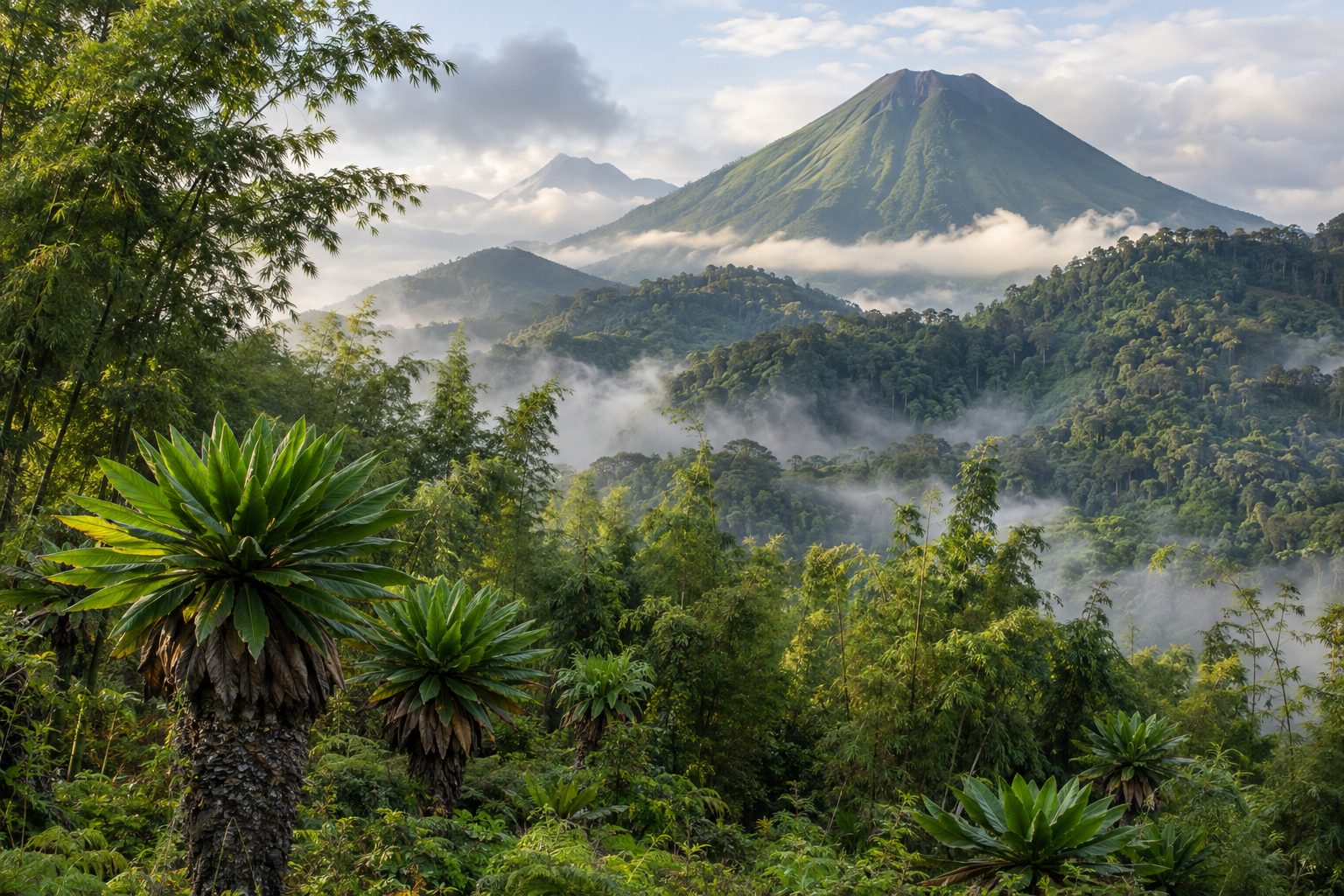
No zoo on Earth has a mountain gorilla. Every gorilla behind glass, anywhere in the world, is a lowland gorilla; the mountain subspecies has never survived in captivity, and the only way any human being will ever see one is to walk up a volcano and find it at home. That home is startlingly small: the Virunga Massif, a chain of volcanoes shared by Rwanda, Uganda and the Democratic Republic of the Congo, plus Uganda's Bwindi Impenetrable Forest. Rwanda's share is Volcanoes National Park, a crescent of bamboo and rainforest above the town of Musanze, and it has become the most polished — and most expensive — place on the planet to make that walk.
The decisions a first-time trekker faces are few but consequential. Whether the permit — USD 1,500 for most international visitors, among the highest wildlife fees anywhere — is worth it against Uganda's cheaper alternative. When to book, and for which season. And what the day itself actually demands of you, because this is a genuine trek at altitude, governed by rules written for the gorillas' benefit rather than yours. This guide takes those decisions in order, with prices as checked in October 2026.
Why seeing them wild is the only option
The wild-only status of the mountain gorilla is not a marketing line; it is the species' defining fact. In the 1960s and 1970s there were repeated attempts to start a captive population, and many adults were killed in the course of capturing infants — none of which survived. Whether the cause was diet, stress or disease has never been settled. The attempts stopped, and the conservation effort turned instead to protecting the animals where they live, with tourism as its funding engine.
According to the International Gorilla Conservation Programme, no mountain gorillas are known to exist in any captive facility anywhere in the world — every gorilla in a zoo is a lowland gorilla — and only eight visitors per day may visit each wild gorilla group. [1]
That strategy has produced one of conservation's rare good-news stories. From a low point of roughly 250 animals in the 1980s, the population has climbed steadily, and the recovery crossed a symbolic threshold in the last decade: more than 1,000 mountain gorillas now live in the wild, split between the Virunga volcanoes and Bwindi. The trekking fee you will wince at is a large part of why that line went up rather than down.
Mountain gorillas were downlisted from Critically Endangered to Endangered in 2018, after the wild population crossed 1,000 for the first time since systematic monitoring began; the most recent census-based estimate puts the global figure at about 1,063 animals. [2]
Permits: what USD 1,500 buys and how to book
Gorilla permits in Rwanda are issued by the Rwanda Development Board (RDB), and the headline price has held at USD 1,500 per person for international visitors. Citizens of Rwanda and other East African Community states pay USD 200 under promotional rates, and foreign residents of Rwanda and nationals of other African countries are quoted USD 500. The permit covers your ranger guides, park entry and the trek itself; it does not cover transport, porters or tips. Book directly through the RDB booking portal or through a licensed operator — and book early, because with daily numbers capped, peak-season dates sell out three to six months ahead.
As checked in October 2026, a Rwanda gorilla permit costs USD 1,500 for visitors from outside Africa and USD 200 for East African citizens, with a reported 30 percent low-season discount — about USD 1,050 — available from November to May for travellers who also book two nights in Akagera or Nyungwe national parks. [3]
Two cautions on the fine print. The low-season promotion is widely reported but conditional — it is tied to visiting Rwanda's other parks, and RDB notes that promotional rates do not apply in certain peak windows — so confirm the current terms on the official portal before you budget around USD 1,050. And supply is genuinely finite: around a dozen habituated families receive visitors, eight permits per family per day, which puts the daily ceiling at roughly 96 to 112 permits for the whole country, depending on how many groups are open to tourism in a given season. There is no walk-up surplus to count on.
Booking itself is straightforward but unforgiving of improvisation. You will need passport details for every trekker at the time of purchase, the permit is issued for a named date and person, and the minimum age of 15 is checked against the document rather than taken on trust. If your dates are fixed — honeymoons, tight itineraries — secure the permit before you book flights or lodges, not after; the permit is the scarce item, and everything else in northern Rwanda can be arranged around it in a way that a sold-out trekking date cannot.
How trekking day actually works
Trekking day starts before dawn. Most visitors sleep in Musanze or the village of Kinigi, because everyone with a permit must report to the park headquarters at Kinigi by 7:00 in the morning — comfortably done from a local lodge, brutal as a same-morning drive from Kigali, which takes around two to three hours depending on traffic and stops. At headquarters there is coffee, a briefing and the allocation: rangers assign each party of up to eight to a specific gorilla family, weighing fitness and preference, since some families graze low bamboo an hour's walk away and others sit high on the saddles between volcanoes.
From the briefing you drive to your family's trailhead, then walk. Trackers have been with each group since first light, so the rangers are navigating to a known position rather than searching blind; even so, the trek can run from thirty minutes to four hours or more, through stinging nettles, mud and steep volcanic soil at altitudes above 2,500 metres. When you reach the gorillas, packs and poles are left with the porters, and the clock starts: one hour, no extensions. It is the strangest, fastest hour in travel — a silverback feeding an arm's length beyond the regulation distance, juveniles rolling through the undergrowth — and then the rangers call time and you walk back down.
On fitness: rangers do a good job of matching groups to treks, and the allocation system means a reasonably mobile sixty-something and a trail runner can both have the right day — say so at the briefing if you want a shorter walk. But there is no version of this that is not a hike at altitude. The park floor starts higher than most European ski resorts, the paths are informal and often hacked open by the lead ranger, and rain can arrive in any month. Treat it as a half-day mountain walk with an extraordinary intermission, not a game drive.
The rules that protect the gorillas
Every rule on trekking day exists because mountain gorillas share our susceptibility to disease — a cold that inconveniences you can kill an animal with no acquired immunity to human pathogens. The rules are enforced by rangers without much appetite for negotiation, and they are worth knowing before you book rather than discovering at the briefing.
The Rwanda Development Board's tracking rules cap visits at eight visitors per group for a maximum of one hour, set the minimum age at 15, and require visitors to keep a distance of seven metres from the gorillas at all times. [5]
- Keep seven metres back — if a curious juvenile approaches you, back away slowly rather than holding your ground.
- No flash photography; check your camera settings before the hour starts, not during it.
- Turn away and cover your mouth to cough or sneeze, and speak in low voices near the group.
- Do not trek if you are ill — declare a cold or flu at the briefing; permits can sometimes be rescheduled, and concealing symptoms endangers the animals.
- Wear long trousers, long sleeves and garden-style gloves: the approach runs through stinging nettles, and gaiters or tucked socks keep ants out.
Twelve fully habituated gorilla families live in Volcanoes National Park, with others habituated solely for research; eight tracking permits are issued per troop per day, visits are limited to a strict hour, and a tenth of permit revenue is channelled to surrounding communities for schools, health centres and roads.
— Paraphrased from the official Visit Rwanda gorilla tracking guidance
Rwanda or Uganda: the cost question
The comparison every first-timer runs is with Uganda, where the Uganda Wildlife Authority's published tariff prices a gorilla permit at USD 800 for foreign non-residents — roughly half Rwanda's rate — with low-season reductions reported in some months. The honest answer is that both deliver the same hour with the same subspecies, and the difference is logistics and margin. Rwanda's park is around two to three hours by good road from Kigali's international airport, so a trek fits inside a weekend; Bwindi sits a long overland day from Entebbe for most itineraries, or requires a regional flight. Rwanda tends to suit shorter, higher-budget trips; Uganda rewards travellers with more days than dollars. Trekkers on a wider East African circuit often pair either park with the savanna spectacle of the Masai Mara across the border in Kenya — the plains and the volcanoes make a complementary pair rather than a choice.
When to go and where to stay
Trekking runs year-round, and the gorillas do not migrate; what changes is the mud. The long dry season from June to September and the short one from December to February offer the most forgiving trails and the clearest views of the volcano summits, and they are also when permits sell out furthest ahead. The rainy months are not a mistake so much as a trade: lower lodge rates, the reported permit discount, greener forest, heavier going underfoot. At this altitude it can rain in any month, so waterproofs are not seasonal equipment.
Base yourself in Musanze, the regional hub with the widest range of guesthouses, or closer to the park gate around Kinigi, where lodges range from mid-range farm stays to some of the most expensive safari properties in Africa. The practical test is simple: anywhere that puts you at Kinigi headquarters by 7:00 without a pre-dawn alarm is close enough. Most travellers arrive via Kigali, which is worth a day in its own right — the genocide memorial and the city's café culture reframe everything else you will see in Rwanda — before the drive north into the volcanoes.
What the fee actually funds
USD 1,500 stings less once you trace where it goes. Permit revenue pays for the daily tracker teams and ranger patrols that protect each family, veterinary care for the gorillas, and anti-poaching work across the park — and an official tenth of it is channelled directly into surrounding communities, building schools, health centres and roads, alongside a compensation fund for farmers whose crops gorillas raid. That community share is the quiet mechanism behind the population graph: villages that once set snares now staff the trailheads, carry the daypacks and run the lodges. The high price is not incidental to the conservation model; it is the model — few visitors, paying a lot, for an animal that exists nowhere else.
The one-hour rule is the best summary of the whole experience: scarcity, enforced, is exactly what makes it worth having. If deliberately rationed wildlife encounters are becoming your kind of travel, the same logic governs the ranger-led dragon walks in Komodo National Park in Indonesia — another place where the only way to see the animal is on its own ground, under rules written in its favour.
Sources & further reading
- 1. International Gorilla Conservation Programme — Mountain gorilla FAQs
- 2. Bwindi National Park — Gorilla species and subspecies guide
- 3. Volcanoes Park Rwanda — 2026 Rwanda gorilla permits
- 4. Duma Explorer — Rwanda gorilla trekking permits, costs and booking guide
- 5. Rwanda Development Board — Mountain gorilla tracking (official booking portal)
- 6. Visit Rwanda — Gorilla tracking (official)
- 7. Volcanoes National Park guide — Gorilla trekking
- 8. Uganda Wildlife Authority — Conservation tariff July 2024–June 2026 (official)