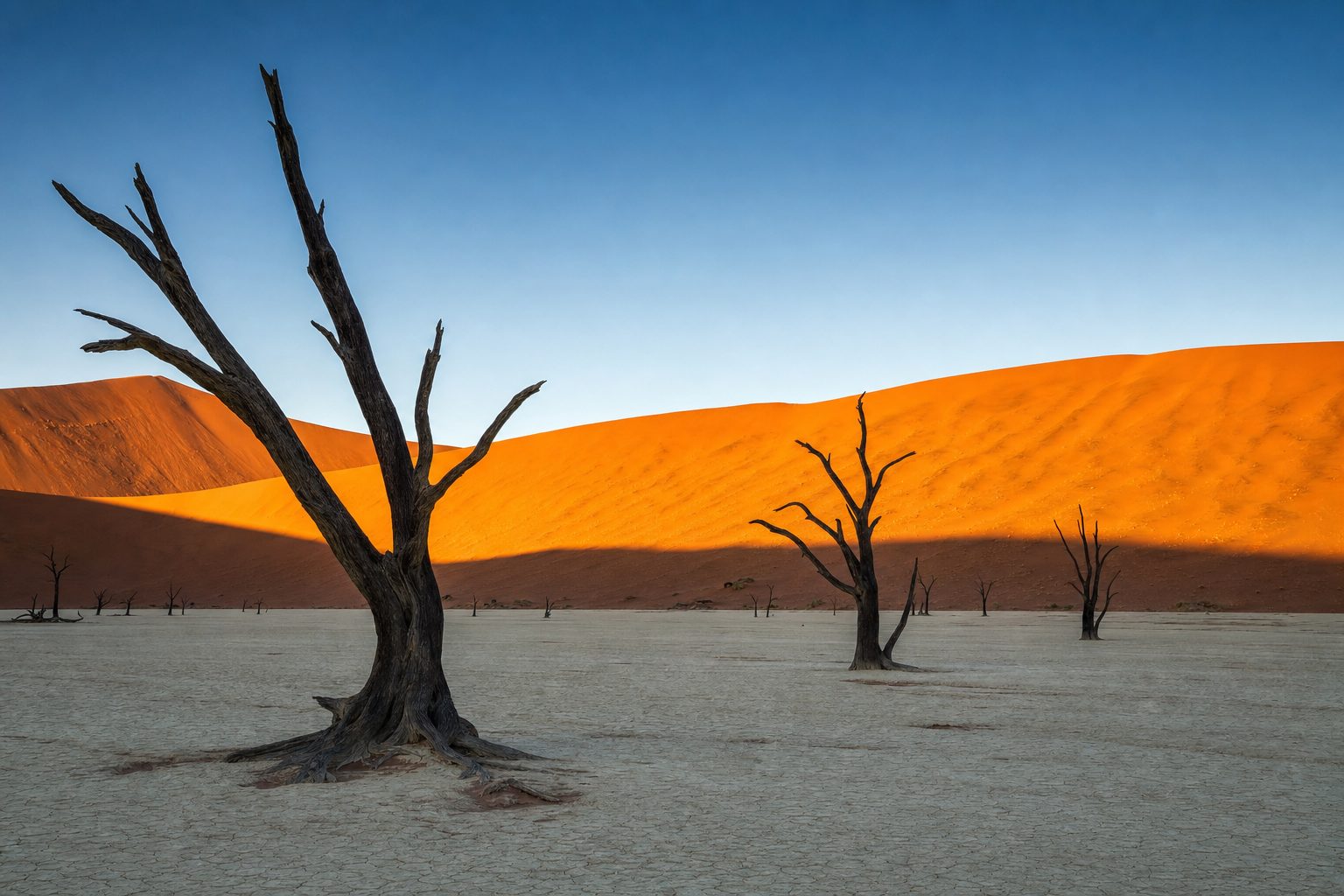
A first visit to Sossusvlei is not really a question of how many dunes to see. It is a question of whether you can reach the one you choose while the light is still low. The headline image—orange sand, a white pan and black camel-thorn silhouettes—depends on a narrow morning interval, and access to that interval is shaped by where you sleep the night before. A room or campsite inside the Sesriem boundary is not simply a nicer address: it can be the difference between being at Deadvlei for sunrise and beginning the 60-kilometre drive when sunrise has already started.
The other decisions are practical rather than romantic. Choose winter or shoulder season according to heat tolerance, decide whether your rental and confidence suit deep sand, and avoid trying to climb Dune 45, visit Deadvlei and detour to every vlei in one morning. This guide sets out a measured way to make those calls, with a fee check for 2026 and a clear plan for the hour that matters.
The hour that changes the visit
Sesriem works with two barriers, not one. The outer gate is the public park entrance for visitors sleeping outside the boundary. It opens with the sun—roughly 6.00 to 6.45am by season—and closes around 6pm. Beyond it, the inner gate controls the road towards the dune field. Guests at Sesriem Camp or Sossus Dune Lodge can use this inner access about an hour earlier in the morning and about an hour later in the evening. Exact times move with sunrise and sunset, so read the posted timetable the afternoon before rather than treating an online schedule as a promise.
As checked in August 2026, Sesriem’s outer gate opens at sunrise (about 6.00–6.45am seasonally) and closes at sunset, while the inner gate for Sesriem Camp and Sossus Dune Lodge guests opens about one hour earlier and closes about one hour later. [1]
That head start is the core booking decision. From the gate area, the drive through the dune corridor takes close to an hour before the final sand section and walk to Deadvlei. A visitor released through the outer gate at sunrise cannot reasonably expect to stand in the pan at the first light of the day; an inside-park guest can set out in darkness and arrive as the surrounding dune faces begin to catch sun. For photographers, for anyone who wants a quieter pan, or for a short one-night stop, paying for inside access is often more valuable than adding a longer list of stops.
It is also worth separating access from a guarantee of solitude. Dune 45 is the customary sunrise climb, so it gathers people quickly; Deadvlei spreads visitors out but is not empty once the first public vehicles arrive. The useful objective is not to reproduce an empty social-media frame. It is to reach one place before the heat and hard overhead light make the desert less comfortable and less legible. If staying outside, be ready at the outer gate before opening, drive directly to the chosen sight and accept that sunrise itself will be viewed from the road or later in the dunes.
Choose your season, then your light
April to September is the most forgiving broad window for a first trip. Viatu describes daytime winter temperatures around 20–25°C, cloudless skies and low-angle light that gives the sand its deepest orange. The trade-off is cold at dawn: June and July can be near 6°C or lower at night, so a fleece or insulated layer belongs in the vehicle even if the day will feel warm. These months are also a popular period for inside-park beds, so the choice of season and the choice of accommodation need to happen together.
October and November keep much of the strong light but turn the temperature problem up quickly. In summer, December to March, daytime heat can exceed 36°C and the surface of the sand becomes far hotter than the air. A dramatic green flush after rain is possible, but it is not a reason to schedule a demanding dune climb at midday. The sensible summer adjustment is an even earlier start, a deliberately shorter walk and a firm retreat before the day becomes punishing. Carry more water than seems necessary, plus food, sun protection and closed shoes that will cope with hot sand.
The Namib Sand Sea is a coastal desert where extensive dune fields are influenced by fog, and its dunes, pans and ephemeral rivers are kept in motion by wholly natural processes.
— Paraphrased from the UNESCO World Heritage listing for the Namib Sand Sea
The light has a logic of its own. Early sun makes a sharp division between lit and shaded slopes; by late morning that sculptural contrast weakens. The advice to arrive early is therefore about comfort and shape, not merely avoiding queues. Plan to be on Deadvlei or at the top of Dune 45 before 9am, then move on before the middle of the day. Leave sunset for a nearer option such as Elim Dune only if your gate and return time make it realistic. Visitors sleeping outside must allow enough time to clear the outer gate before it closes.
Drive the dune road with the right vehicle
A conventional two-wheel-drive car can reach the 2x4 parking area on the sealed route through the park, which is enough for Dune 45 and for a shuttle-based visit to Deadvlei. The complication is the last five kilometres towards Sossusvlei and the Deadvlei access point: this is deep, soft sand, reserved for proper 4x4 vehicles. Do not turn a self-drive itinerary into a recovery exercise by taking a standard rental along it. Park at the 2x4 lot and use the authorised shuttle if your vehicle is 2WD or if the driver is not comfortable on sand.
The final five kilometres from the 2x4 parking area are deep, soft sand. Viatu advises 4x4 drivers to lower tyre pressures to about 1.4–1.6 bar, reinflate before returning to tar, and use the shuttle from the 2x4 lot if travelling in 2WD or without deep-sand confidence. [3]
Tyre pressure is not a decorative detail. Lowering it within the rental company’s guidance increases the tyre footprint and reduces the chance of digging in; returning to sealed road with tyres still soft risks both damage and poor handling. Before departing Windhoek or the previous stop, make sure the vehicle really has a gauge and compressor and that the driver knows how to use them. A 4x4 badge alone is not a skill course. Drivers unsure of line choice, momentum and recovery should take the shuttle and keep the day calm.
Make a realistic plan for Deadvlei and Dune 45
Dune 45 and Deadvlei ask for different kinds of effort. Dune 45 sits beside the main road and is the straightforward choice for a compact sunrise climb. It is not a technical hike, but loose sand makes the ridge slower than it looks; allow roughly an hour for the ascent, descent and a pause. Deadvlei is the more complex stop because it involves the final deep-sand section or shuttle and then a walk over sand to the clay pan. Its reward is the particular meeting of pale ground, ancient dead trees and a high orange dune wall, not a checklist box.
Trying to force both into the same first-light slot weakens both. The practical choice is Dune 45 first if you want an active, accessible sunrise and need to stay close to the road; choose Deadvlei first if the pan is the non-negotiable image and you have early access or a carefully planned shuttle. Big Daddy is a separate, more strenuous commitment. Add it only when the morning is cool enough, water is plentiful and the group actually wants a long climb—not because it is famous. On a first visit, two sites at most is an achievement, not a compromise.
- Choose Deadvlei first when the pan is the priority; leave Dune 45 for another morning or for a later, gate-safe visit.
- Choose Dune 45 first for the simplest dawn climb from the main road, then use the cooler early hours for a second, shorter stop.
- Keep water, a hat, sun protection, closed shoes and a warm layer in the car; desert temperatures can change sharply between dawn and late morning.
- Treat Big Daddy as the day’s principal activity, not an extra squeezed in after Deadvlei.
- Stay on marked routes, do not climb or touch the dead trees, and leave the pan as you found it.
Work out fees and accommodation before you arrive
Park fees changed on 1 April 2026, so old blog posts are especially unreliable here. As checked in August 2026, the published 2026 guidance used for this article reports a single premium-park daily rate for Namib-Naukluft: N$280 for an international adult, N$180 for a SADC adult and N$60 for a Namibian adult, with N$60 for a vehicle of up to ten seats. The prior entrance and conservation charges were combined, payment is made at the gate and the pass is described as valid for 24 hours from entry. Confirm the amount and payment method at the gate or with Namibia Wildlife Resorts before travel, because fee schedules can change and older pages still show lower figures.
As checked in August 2026, the published premium-park schedule for Namib-Naukluft lists N$280 per international adult, N$180 per SADC adult, N$60 per Namibian adult and N$60 per vehicle up to ten seats; the single daily rate is paid at the gate and valid for 24 hours from entry. [1]
The larger accommodation calculation is whether early access justifies the extra expense. Sesriem Camp and Sossus Dune Lodge are the named options linked to the inner-gate advantage in the current guidance. Their availability is limited during the April-to-September sweet spot, and rates can be seasonal, so check the Namibia Wildlife Resorts rate pages and booking channels directly rather than building a plan on a stale aggregator price. An outside-the-gate lodge gives wider choice and can work very well for Dune 45 after opening; it simply does not buy the pre-sunrise drive to Deadvlei.
For a short self-drive circuit, think about the visit as a precision stop rather than an all-day attraction. An afternoon arrival can be used to check gate hours, confirm permit arrangements, fill water bottles, inspect tyres and decide the one essential morning objective. It also leaves time for Sesriem Canyon or a low-stakes nearby viewpoint, instead of expecting the next dawn to carry every sight. That discipline is useful elsewhere in Southern Africa, whether the planning challenge is a long road in the Cape and Garden Route or strict timing inside another desert landscape.
Protect the place and use the afternoon well
Sossusvlei sits within a much larger desert system, not a purpose-built photography set. UNESCO lists the Namib Sand Sea as a World Heritage property of 3,077,700 hectares, wholly within Namib-Naukluft Park, and describes it as the only coastal desert with extensive fog-influenced dune fields. That context explains why small choices matter: tyre tracks, litter and shortcuts do not disappear from a hyper-arid landscape on the next rainfall. Keep vehicles where they are permitted, walk established approaches, and give the trees and pan the same distance you would give wildlife.
UNESCO lists the Namib Sand Sea at 3,077,700 hectares within Namib-Naukluft Park and calls it the world’s only coastal desert that includes extensive dune fields influenced by fog. [5]
A good final measure of the visit is not whether every dune fitted into the itinerary, but whether the group left with enough water, energy and daylight to drive safely. After the early window, rest, eat and use the heat for a slower drive or a canyon visit. The dramatic images will still be there; the advantage comes from accepting that the dune sea works on its own timetable. Travellers continuing with another arid-region itinerary can carry the same principle into Wadi Rum’s desert guide: make the access rules and daylight plan first, then let the landscape set the pace.