The clip that brings most people here lasts about eight seconds: a swimmer lying in calm green water, chin on a rock, while the Zambezi pours over a cliff a metre from their face. What it does not show is the calendar. Devil's Pool is swimmable for roughly five months a year, when the river drops far enough to expose the basalt lip of Victoria Falls and leave this one natural basin on the Zambian side quiet enough to enter. For the rest of the year it is simply part of the falls.
That window is the first decision, and it dictates the rest: whether to build a Zambia trip around a booking or accept the falls at full power without a swim; which of the five daily sittings to choose; which visa to hold if you also want to cross to Zimbabwe; and how to think about a swim that is, by design, at the edge of a 100-metre drop. This guide takes those questions in order.
What Devil's Pool is, and why it only exists in the dry months
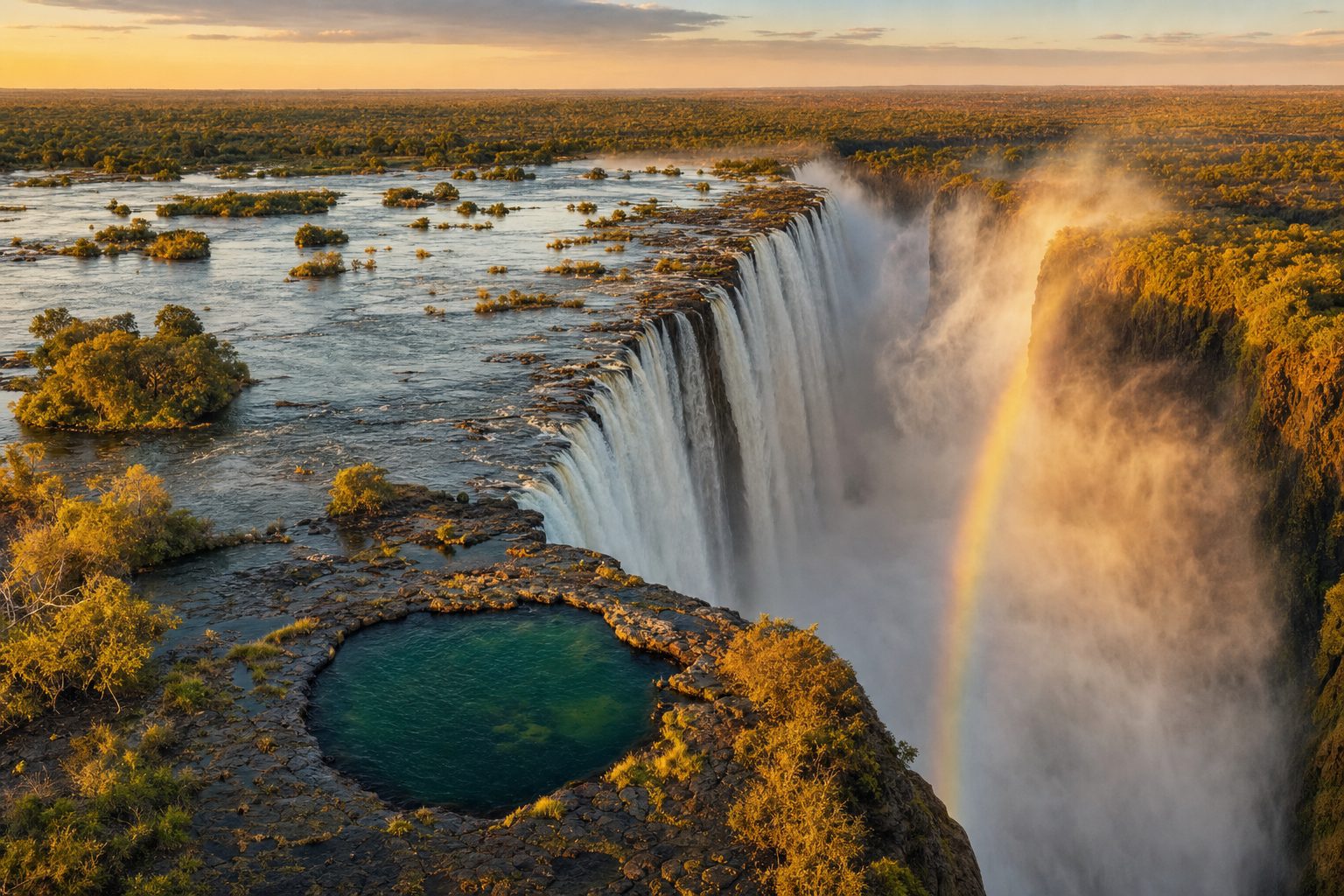
Victoria Falls, or Mosi-oa-Tunya, the Smoke that Thunders, is where the Zambezi drops off a basalt plateau into a chasm on the Zambia-Zimbabwe border. UNESCO, which inscribed the falls in 1989, calls them the largest curtain of falling water in the world: about 1,708 metres wide, 108 metres at the deepest point and, in flood, up to 500 million litres a minute. Livingstone Island sits on that edge, roughly mid-river, and Devil's Pool is reached from it.
The pool itself is a bowl eroded into the rock right at the lip. A raised rim of basalt on its downstream side acts as a natural wall, so that when the river is low the water in the basin sits calm and shallow while the falls continue either side of it. When the river is high, that rim is underwater and the pool is indistinguishable from the torrent. That is why the operator, Livingstone Island, quotes a swimming season of around mid-August to late December and stresses that the dates depend entirely on river levels. In a dry year the window can stretch into January; in a wet one it can close early.
UNESCO's listing records Mosi-oa-Tunya / Victoria Falls as 1,708 metres wide with a deepest point of 108 metres, and notes that up to 500 million litres of water a minute descend in peak flow. The site was inscribed in 1989 under natural criteria (vii) and (viii). [4]
The Zambezi River Authority's flow readings show the swing clearly: in May and June the river commonly runs at more than 2,500 cubic metres a second; by early September it is down to a few hundred. As checked in September 2026, the authority's Victoria Falls station recorded 438 cubic metres a second on 7 September and falling, and the pool had already reopened. The operator's rates page carries a live status line for the island, Devil's Pool and its higher-water alternative, Angel's Pool.
Timing the season: five months, not twelve
Think of the year in three parts. From roughly mid-August to late December the river is low enough for Devil's Pool; this is when the reels are shot. From January to about March the river rises with the rains, Devil's Pool closes and the tour switches to Angel's Pool, a second basin set back from the lip that stays calm for longer. From the end of March to mid-June the island is usually closed entirely because boats cannot land safely. Livingstone Island's terms confirm the pattern: the island closes through May unless levels are unusual, and swimming can be stopped without notice whenever guides judge the water unsafe.
Within the window there are trade-offs. Late August and September give a fuller curtain and cool mornings, but the pool is at its edge of viability and a slow-clearing river can delay the opening. October and November are hot, often above 35 degrees by midday, but the water is at its most predictable and the exposed shelf lets the island run its walking approach as well as boats. December brings the first storms, and heavy weather can cancel a sitting. If the swim is the point, September to November is the safest bet; book two to four weeks ahead because each sitting is capped.
Livingstone Island states that Devil's Pool is open from around mid-August to late December depending on river levels, that swimming is permitted only when deemed safe by the guides, and that the minimum age for swimming is 12. [2]
How access works: guided boat tours only
There is no walk-up. Livingstone Island lies inside Mosi-oa-Tunya National Park on the Zambian bank, and access is through a single concession run by Green Safaris under the Livingstone Island name, with the Tongabezi lodge group as its long-standing partner. Every visit starts and ends at the Livingstone Island Launch Site, about 1.3 kilometres from the Royal Livingstone Hotel's main entrance, where guests are briefed and issued safety equipment before a short jet-boat ride through the channels above the falls. The operator is blunt that reaching the island with an unofficial guide or alone is illegal and dangerous.
Five boat sittings run each day, each built around a meal. The three morning Breezer trips leave at 07:30, 09:00 and 10:30 with a light breakfast; Lunch departs at 12:30 and High Tea at 15:30. Each includes the guided island walk, the swim if conditions allow, and a meal in a tented dining area seating around fourteen. The swim is done in small batches so a guide can position each person. As checked in September 2026 the operator quotes the Breezer at US$149 in green season and US$159 in peak, Lunch at US$199 and US$209, and High Tea at US$189 and US$199, park fees included; rates move with government levies, so confirm at booking.
Livingstone Island's published 2026 rates list the Breezer boat tour at US$149 (green season) and US$159 (peak), Lunch at US$199 and US$209, and High Tea at US$189 and US$199, all including a guided island visit, seasonal swimming if conditions permit, a meal and park fees. Children may visit from age 8 but may swim only from 12, and pay full adult rates. [1]
From around mid-September to December a second option opens: a walking safari across the exposed lip of the falls to the island, for a maximum of six people, at US$100 as checked in September 2026. It is an hour and three-quarters on wet basalt with the drop a few metres away, excludes the separate National Heritage Conservation Commission fee paid at the falls gate, and suits people who want the geology more than the meal. A return shuttle from lodges within six kilometres of the falls costs US$30 a person, two-person minimum.
As for which sitting, the Breezers are the value choice and, for photographers, arguably the best, with soft light and the sun behind you. Lunch costs roughly US$50 more for a cooked meal and hard midday light. High Tea is the sitting most likely to give a rainbow in the spray as the sun drops. None guarantees a swim; that call belongs to the guides, and the price is the same whether you get in or not.
Safety: what the rock lip does and does not do
The pool is safe in the sense that a natural barrier of rock stands between the calm water and the drop, and that the concession claims a 100 per cent safety record for its guided swims. It is not safe in the sense of a swimming pool. The approach involves wading and a short swim across a moving channel, the rock is slippery, and the current at the lip is real enough that guides place each swimmer and hold them where necessary. Livingstone Island reserves the right to refuse weak swimmers, and the minimum age of 12 exists because a child must be able to follow instructions in moving water.
The UK Foreign, Commonwealth and Development Office puts it plainly: adventure activities around Victoria Falls carry risks, there have been serious accidents and deaths, and medical care in Zambia varies greatly. For Devil's Pool the rules are simple. Do exactly what the guide says, including where to put each hand. Do not swim after drinking. And do not try to reach the lip from the Zambian viewpoints on your own, however inviting the exposed rock looks in November.
The UK FCDO's Zambia advice states that adventure sports, including in the Victoria Falls area, carry risks, that there have been serious accidents and deaths, and that the quality of medical care varies greatly; it advises following safety instructions closely and holding insurance that covers treatment and repatriation. [8]
Visas, park fees and getting to Livingstone
Most visitors fly into Harry Mwanga Nkumbula International Airport at Livingstone, from Lusaka or via Johannesburg, or cross the bridge from Zimbabwe. As checked in September 2026, Zambia's Department of Immigration lists a single-entry visa at US$50 for nationalities that need one, after a fee revision in January 2026; many nationalities, including British passport holders, are visa-exempt for tourism and need only a passport with six months' validity and blank pages. If you want both sides of the falls, the KAZA UNIVISA is the better instrument: US$50, up to 30 days, unlimited crossings between Zambia and Zimbabwe, and day trips into Botswana via Kazungula. It is issued on arrival at Livingstone and Lusaka airports and at the Victoria Falls and Kazungula borders, or online in advance for those Zambian entry points.
The Zambia Department of Immigration states that the KAZA UNIVISA costs US$50, allows multiple visits to Zambia and Zimbabwe over a validity of up to 30 days, covers day trips to Botswana through Kazungula, and is available at Kenneth Kaunda and Harry Mwanga Nkumbula international airports and the Victoria Falls and Kazungula borders on the Zambian side. [5]
Livingstone Island's boat tours include the Mosi-oa-Tunya National Park fee, so the swim carries no gate charge. The falls viewpoints on the Zambian side are a separate ticket sold by the National Heritage Conservation Commission at the park entrance; as checked in September 2026 the international adult rate had risen to about US$30 from the start of the year. Kwacha are useful for taxis, but the island, the gate and most lodges take US dollars and cards.
- Passport valid at least six months with blank pages, plus visa-exempt status, a US$50 single-entry visa or the US$50 KAZA UNIVISA if you will cross to Zimbabwe.
- A confirmed Livingstone Island booking for a specific sitting, with a spare day in reserve for weather or river-level cancellations.
- Travel insurance that explicitly covers adventure activities and medical evacuation from Zambia.
- Swimwear worn under clothes, flat grippy shoes or hired water shoes (US$2 at the launch site), a hat, sunscreen and a dry bag.
- US dollars in cash for the falls entrance fee, shuttle and tips, plus some kwacha for taxis.
Where to stay and how to build the days around it
Livingstone town, about ten kilometres from the falls, has the widest range of beds and taxis to the launch site in fifteen minutes. The lodges along the Zambezi upstream, including Tongabezi, are quieter but pick-ups are earlier. The Royal Livingstone and Avani properties inside the park are the only places within walking distance of the launch site; you pay for that.
Two full days covers the island, the Zambian viewpoints and a sunset cruise or a morning tracking white rhino on foot in the park. A third day allows the Zimbabwean side, where the viewpoints face the main curtain and the KAZA UNIVISA saves a second visa fee. Livingstone also pairs naturally with a safari, as a bookend to a first East African safari or a run through Namibia to the Sossusvlei dunes.
The falls are the largest curtain of falling water on Earth, formed where the Zambezi has cut through layered basalt to carve eight successive gorges, and their spray, mist and rainbows are part of the reason the site was recognised for its beauty as well as its geology.
— Paraphrased from the UNESCO World Heritage listing for Mosi-oa-Tunya / Victoria Falls
Whether Devil's Pool is worth building a trip around
It is a short experience, perhaps twenty minutes in the water inside a three-hour outing, and it is not cheap. What justifies the cost is not adrenaline, which is modest once you are seated behind the rim, but position: nowhere else can you sit inside a waterfall of this size and look down its face. The scarcity is real, which is why a January or June visitor should plan for the falls at full power instead. Seen from the Zimbabwean rainforest in April, with spray rising higher than the cliffs, Victoria Falls is arguably a greater spectacle; it simply is not a swimming one.
For the traveller who gets the timing right, the advice is unglamorous: book the sitting early, choose the Breezer or High Tea for the light, carry the KAZA UNIVISA if Zimbabwe is on the itinerary, and treat every instruction from the guides as non-negotiable. Then give the rest of the trip room: southern Africa's other set pieces, from the Cape and the Garden Route to the beaches of Zanzibar, are a single flight from here.
Sources & further reading
- 1. Livingstone Island (Green Safaris) — Rates & Essential Information
- 2. Livingstone Island — Experiences: Devil's Pool and island tours
- 3. Livingstone Island — Plan Your Visit (launch site, safety briefing, shuttle)
- 4. UNESCO World Heritage Centre — Mosi-oa-Tunya / Victoria Falls
- 5. Zambia Department of Immigration — KAZA UNIVISA
- 6. Zambia Department of Immigration — Visa and permit fees
- 7. Zambezi River Authority — River flows at Victoria Falls
- 8. UK FCDO — Zambia travel advice: safety and security