Komodo National Park is the only place on Earth where you can watch a wild Komodo dragon amble across a beach, and that single fact has shaped everything about how the park now runs. The dragons live on a scatter of volcanic islands between Sumbawa and Flores in eastern Indonesia, every visit arrives by boat from the harbour town of Labuan Bajo, and every walk in dragon habitat happens behind a ranger. None of that is new. What is new in 2026 is a hard daily limit on how many people may enter the park at all, and it changes the first decision you make: not which boat to book, but which date you can get.
This guide works through the choices in order. How dragon encounters are actually organised on Komodo and Rinca islands; what the entry fee covers and how the new 1,000-a-day cap and booking system work; whether Padar's famous three-bay viewpoint and the pink beaches are worth building the day around (they are); day trip versus liveaboard from Labuan Bajo; when to go; and the rules that keep both visitors and dragons out of trouble.
How seeing the dragons actually works
The park protects the world's only wild population of Komodo dragons across 29 islands — Komodo, Rinca and Padar plus 26 smaller ones — together with a large protected marine area. Wild dragons are reliably seen in exactly two places: the ranger stations at Loh Liang on Komodo island and Loh Buaya on Rinca. At both, you walk marked trails in a small group with a park ranger carrying a forked stick; the escort is mandatory on every dragon trail, with no exceptions, and independent hiking in dragon habitat is not allowed.
Komodo National Park was declared a national park in March 1980 and extended to 219,322 hectares in 1984; its three major volcanic islands — Komodo, Rinca and Padar — shelter a dragon population of around 5,700 animals, found nowhere else in the world. [1]
A standard trek lasts one to two hours. Rinca's smaller landmass carries a denser concentration of dragons for its size, so sighting odds there are often slightly better; Komodo island offers the longer trails and the classic savannah scenery. Padar, despite being the park's most photographed island, no longer holds dragons in meaningful numbers — you climb it for the view, not the wildlife. Mornings are the best time on any trail, when the animals are most active before the heat sets in.
The volcanic islands of the park are home to a population of giant lizards that exist nowhere else in the world, living in a rugged landscape of dry savannah and green thornbush set against white beaches and blue water over coral.
— Paraphrased from the UNESCO World Heritage listing for Komodo National Park
Fees, the new daily cap and how to book
As checked in October 2026, international visitors pay IDR 250,000 (roughly USD 15) per person for each day spent inside the park boundary, a flat rate set under Government Regulation PP 36/2024 and in force since late October 2024. Indonesian citizens pay IDR 50,000 on weekdays and IDR 75,000 on Sundays and public holidays. The single daily ticket now folds in what used to be separate activity charges: the Padar viewpoint climb, snorkelling at Pink Beach and the ranger-escorted walk are all covered by the day's entry. Scuba diving adds IDR 25,000 per diver per diving day, and boats pay their own vessel-entry charge, which a chartered operator normally handles and itemises on the invoice. Full tables are published by operators such as Komodo Luxury and Neptune Liveaboards.
Under Government Regulation 36/2024, foreign visitors pay IDR 250,000 per person per day inside Komodo National Park, the same on weekdays and holidays, with a further IDR 25,000 per diver per diving day — so a foreign diver's park line comes to IDR 275,000, about USD 15.50, per day. [5]
Because the fee is charged per day inside the park, the arithmetic matters most for liveaboards: a snorkeller on a five-day route inside the boundary pays IDR 1,250,000 in park fees alone, while a one-day speedboat trip pays a single IDR 250,000. You may also see operators quoting consolidated route prices of around IDR 650,000 for a Komodo-and-Padar day, which bundle per-group ranger fees, harbour charges and other levies on top of the base ticket. The components are legitimate, but ask for the breakdown in writing so you can see what is park tariff and what is service.
The biggest change for 2026, though, is not the price but the visitor ceiling. After a trial and simulation phase, a hard cap of 1,000 visitors per day across the park became fully operational in April 2026, applying equally to liveaboard guests, speedboat day trippers and snorkelling excursions — everyone draws from the same daily allocation. Every visitor must be registered in advance through SiOra, the park's online reservation system, with full name, nationality and passport number; the name must match the passport exactly. Tickets are issued for a printed date, do not carry over and are non-refundable. There are no walk-in tickets.
Komodo's daily cap of 1,000 visitors became fully operational in April 2026 after a three-month trial, with the quota divided into three visiting sessions of roughly 300 to 330 people; before the cap, peak days had exceeded 1,700 visitors. [6]
Treat the fine print as moving: the ministry has described the cap as adaptive, and in September 2026 the park authority announced the daily quota for September to December 2026 would be topped up by at least 500 places a day in stages. The practical rules, as checked in October 2026, are simple enough — registration closes at the latest the day before arrival, quota is only confirmed at registration, and no operator can promise availability. For July and August, trade reporting has operators advising clients to secure dates up to six months ahead. Confirm the current quota and session rules with your operator or the park office in Labuan Bajo when you book.
Padar's viewpoint and the pink beaches
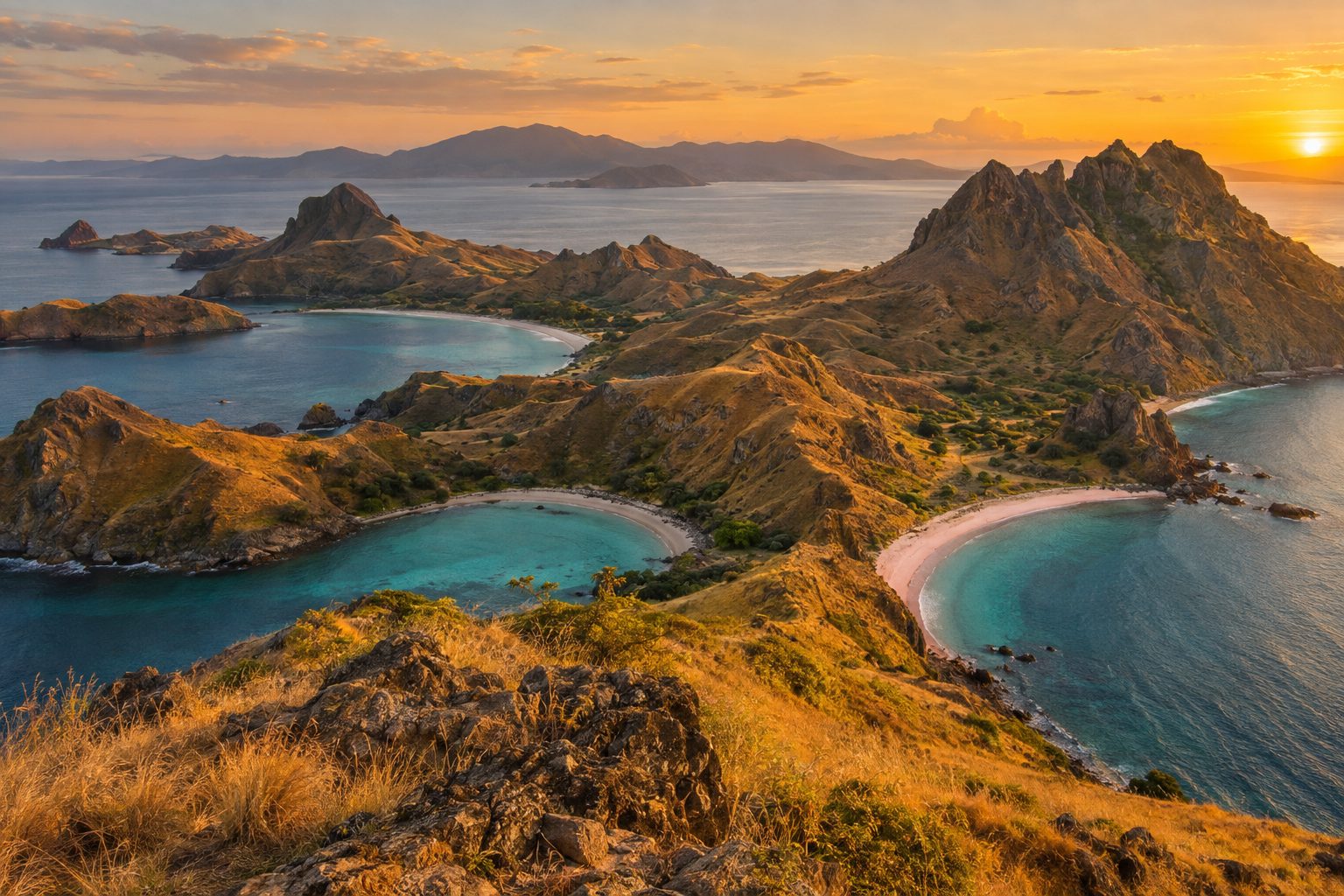
Padar is the postcard: a ridgeline climb to a saddle overlooking three curved bays, each with differently coloured sand. The trail gains the viewpoint on roughly 800 steps from the jetty — built stairs lower down, rough rock near the top — and the climb is steep, exposed and entirely without shade. Carry at least a litre of water per person; there are no shops or water sources on the island. Sunrise is the time to do it, for soft light, cooler air and the thinnest crowds, which is one of the strongest arguments for sleeping on a boat rather than in town.
Padar's viewpoint trail climbs roughly 800 steps from the jetty; most visitors take 30 to 45 minutes up at a relaxed pace, fit hikers around 20, and the island — about 30 km from Labuan Bajo — is reachable only by boat. [4]
The pink beaches are the park's other signature. Pink Beach off Komodo island and the southern bay of Padar both get their blush from fragments of red organ-pipe coral crushed into the white sand, and both double as easy snorkelling stops with healthy shallow reef. Note that south Padar has operated on timed visiting sessions since early 2026 — another reason the morning slots are worth securing early.
Day trip or liveaboard from Labuan Bajo
Everything starts in Labuan Bajo, on the western tip of Flores. Komodo Airport (LBJ) has frequent daily connections from Bali (about 1.5 hours) and direct flights from Jakarta (2.5 to 3 hours) and Surabaya, plus a growing handful of international links. Fly in the evening before your boat leaves: delays on the Bali run are common, and a boat already at sea cannot be caught. Many travellers stage the trip through Bali anyway — if you are building a longer Indonesian route, our guide to Bali beyond the beaches pairs naturally with a Flores leg.
From town you have two honest options. A speedboat day trip — typically Padar at mid-morning, Pink Beach, a ranger walk at Loh Liang or Loh Buaya, and a snorkel stop such as Taka Makassar — costs one day of park fees and suits travellers short on time, at the price of doing the Padar climb in full heat and sharing each stop with every other day boat. A liveaboard of at least three days and two nights, whether a budget shared phinisi or a private charter, gets you to Padar at dawn, adds the further-flung dive and snorkel sites, and spreads the park's daily sessions across quieter corners. Remember that every person aboard needs a registered park slot for every day inside the boundary.
When to go
The dry season from April to October is the reliable window: calmer seas, dependable boat schedules and the best trekking underfoot. July and August are the driest months and the peak of dragon activity, but also the busiest for the quota and the windiest for open-water crossings, so those dates need the longest lead time. April to June is the sweet spot for many — the hills still green from the rains, seas settling, and permit pressure lower — while September to November trades golden-brown scenery for quieter trails and excellent underwater visibility. The December-to-March monsoon brings rougher crossings and afternoon storms; the park stays open, prices drop, and manta sightings are often at their best, but boat plans need slack built in. Seasonal detail is covered well in AirAsia's Labuan Bajo guide.
Diving and snorkelling in the park
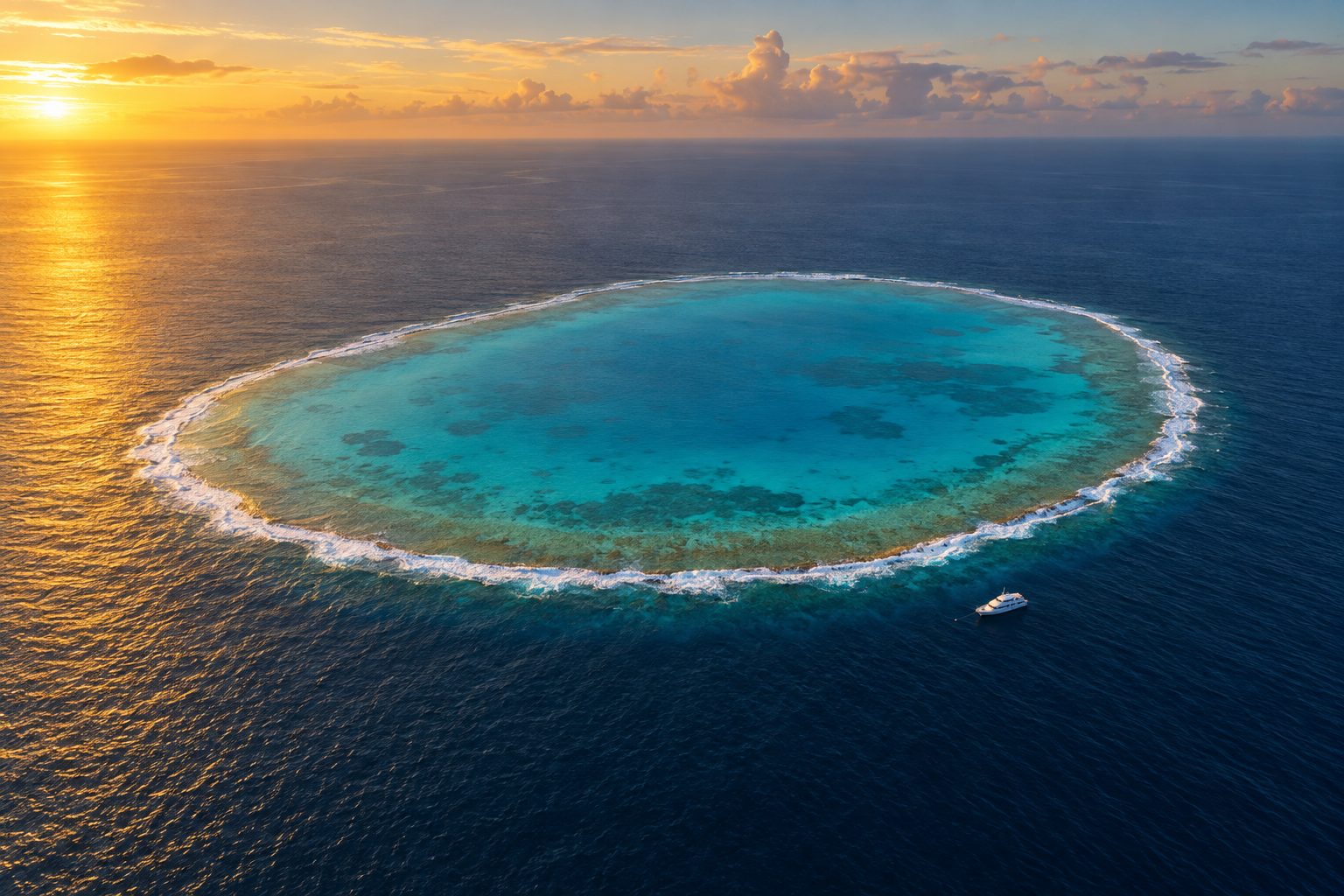
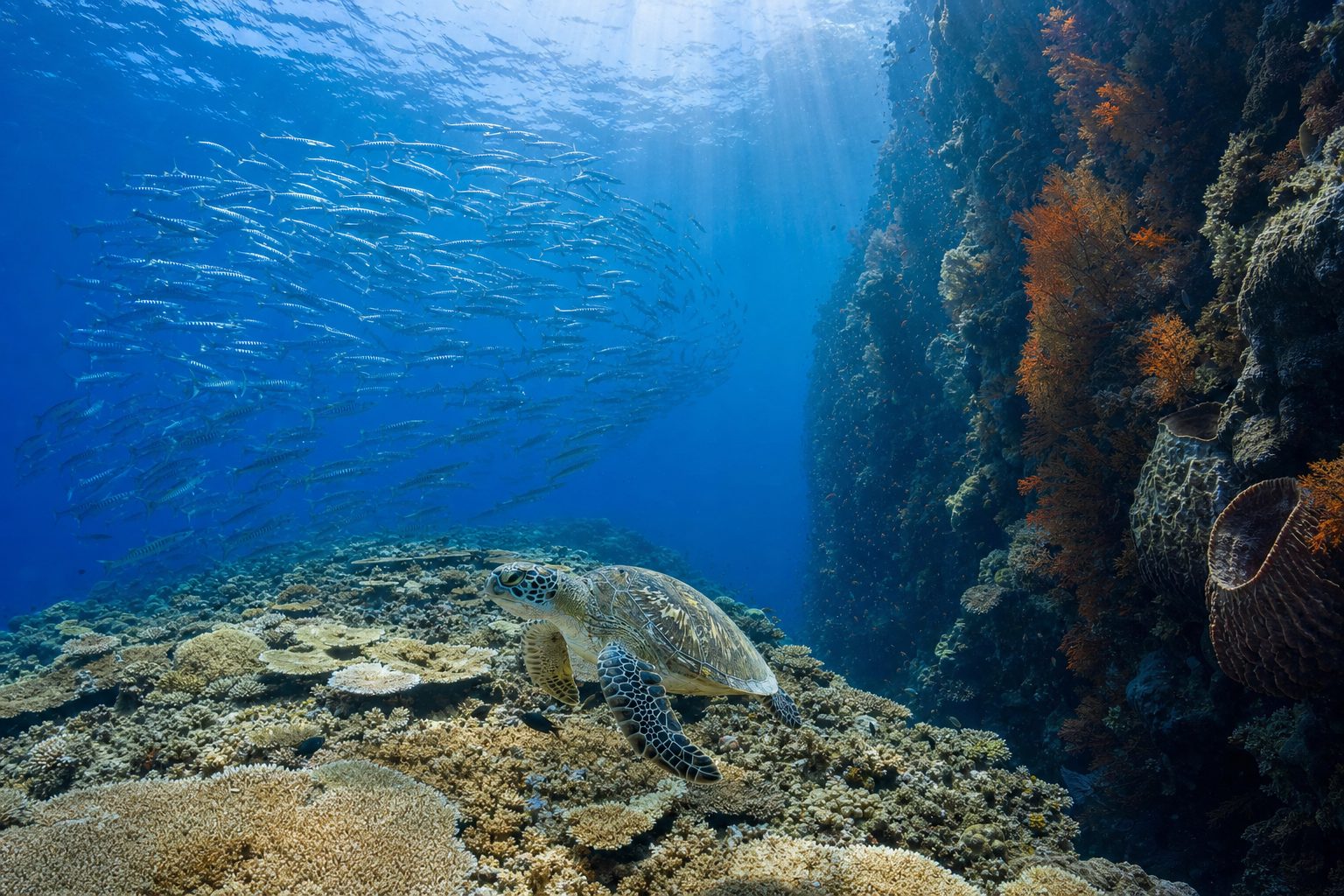
Komodo sits in the heart of the Coral Triangle, and the same currents that make its channels tricky for boats feed some of the richest reef in Indonesia — walls, coral gardens and manta cleaning stations, with Manta Point delivering encounters year-round. This is drift-diving country: currents can be very strong, several sites are unsuitable for beginners, and you should be frank with the dive master about your experience. Snorkellers are far from short-changed, with Pink Beach and the Taka Makassar sandbar covered by the standard entry ticket. Divers who find Komodo addictive tend to graduate to Indonesia's remoter east — see our guide to Raja Ampat, where the park fee system works quite differently.
Rules, safety and visiting responsibly
Komodo dragons are dangerous wild predators, not photo props. They ambush rather than chase, they are faster than they look, and the park's safety rules exist because the animals will test lapses. The ranger system works — incidents are rare — but it only works if you treat the escort as a hard rule rather than a formality. The park's conservation logic, laid out in the UNESCO listing, is the reason the cap exists at all: the quota is a conservation measure first and a crowd-control measure second.
- Never walk alone anywhere in dragon habitat — stay with your ranger, keep to the marked trail and do not lag behind the group.
- Keep a respectful distance from any dragon and follow the ranger's positioning instructions for photographs.
- Book your dated park slot through SiOra or a licensed operator before paying for flights; bring your passport, as details are checked against the registration.
- Carry water, sun protection and proper shoes for Padar — the climb is shadeless, and flip-flops cope badly with the loose upper section.
- Leave the drone at home unless you have paid the official permit of IDR 2,000,000 per unit per day.
Pack out everything you bring ashore, skip single-use plastics on the boat, and choose operators who brief properly on reef etiquette — no touching, no standing on coral, no chasing mantas. The cap means every visitor slot is scarcer than it used to be; the least you can do with yours is leave no trace of it.
Komodo rewards the planner. Fix the date through the quota system, build the boat around a dawn Padar climb and a morning dragon walk, and give the crossing seasons the respect they demand, and you will meet the only wild dragons on Earth on something like their own terms. If protected marine parks with strict visitor systems are becoming your kind of trip, the reef-first logistics of Tubbataha in the Philippines and Sipadan's daily permit system in Malaysian Borneo make natural next studies.
Sources & further reading
- 1. UNESCO World Heritage Centre — Komodo National Park
- 2. Komodo Luxury — Komodo National Park: fees, rules, zoning and how visits work (2026)
- 3. Komodo Luxury — Komodo National Park entrance fees 2026/2027
- 4. Komodo Luxury — Complete guide to visiting Padar Island
- 5. Neptune Liveaboards — Komodo and Raja Ampat park fees 2026
- 6. Travel And Tour World — Komodo's 1,000-visitor daily cap in 2026
- 7. TouristsInsider — Komodo National Park: the complete travel guide (2026)
- 8. AirAsia — Best time to visit Labuan Bajo