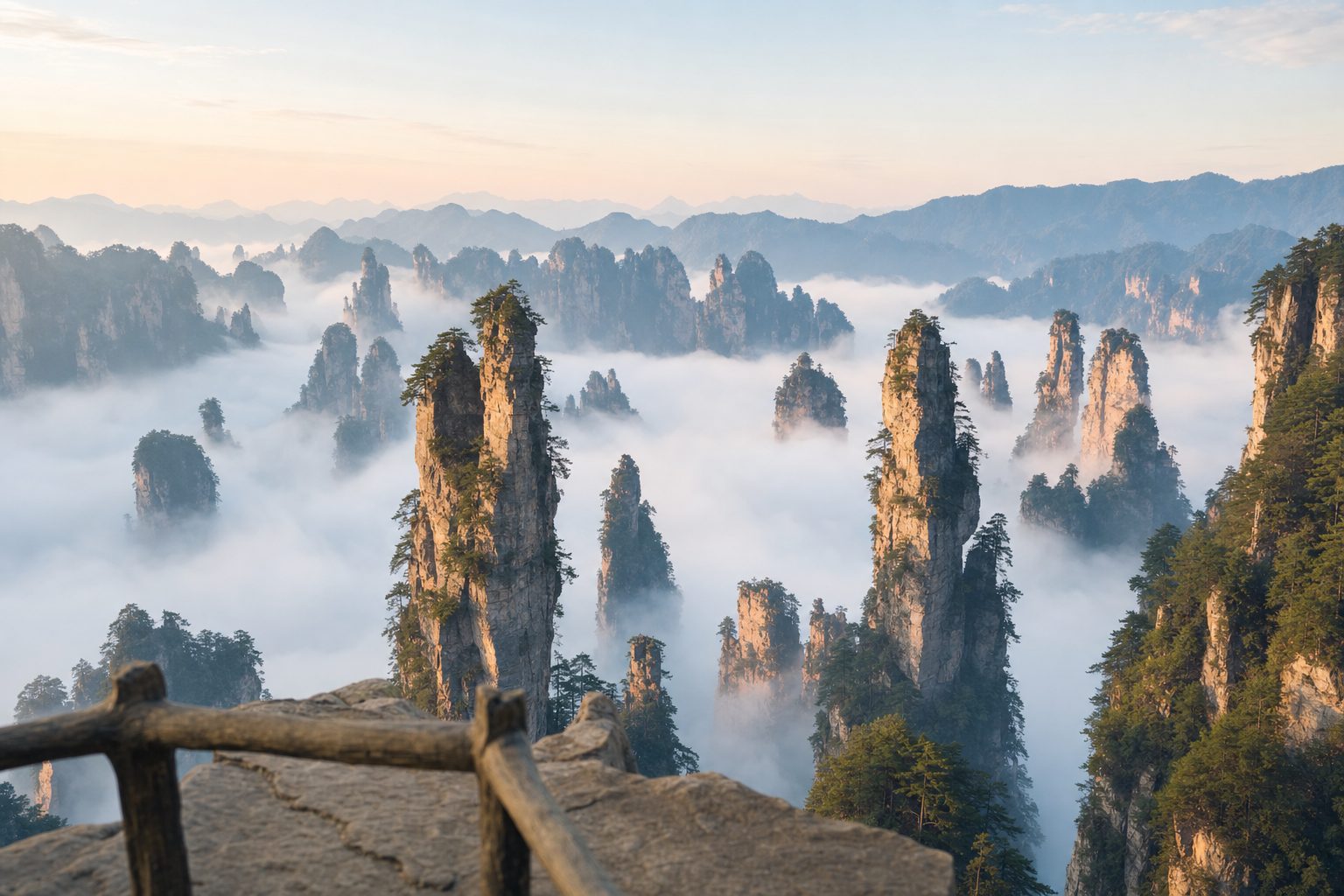
The image that brings most people to Zhangjiajie is a single frame: quartz-sandstone pillars rising out of a white sea of morning mist, their bases hidden so completely that they appear to hang in the air. The frame is real, and it belongs to a specific viewpoint at Yuanjiajie in Zhangjiajie National Forest Park, the core of the Wulingyuan Scenic Area in north-western Hunan. Being there at the right hour, on the right kind of morning, is the whole art of a visit.
Everything else is a matter of choices: whether to buy the park ticket with or without the shuttle buses, whether to pay for the Bailong Elevator or walk the stairs it replaces, whether Tianmen Mountain, a different mountain with a different ticket on the other side of the city, deserves one of your days, and when to travel so that the mist is scenic rather than a wall of fog. This guide is organised around those decisions rather than a fixed itinerary.
What Zhangjiajie actually is, and what it is not
The names overlap in a way that trips up first-time visitors. Wulingyuan Scenic and Historic Interest Area is the UNESCO World Heritage property, a landscape of more than 26,000 hectares dominated by over 3,000 narrow sandstone pillars and peaks, many of them more than 200 metres high. Zhangjiajie National Forest Park, established in 1982 as China's first national forest park, is the southern core of that property; Tianzi Mountain, Yangjiajie and Suoxiyu are the other zones, and a single ticket covers all of them. The UNESCO listing is a better introduction to the geology than anything printed at the gates.
UNESCO describes Wulingyuan as stretching over more than 26,000 hectares of Hunan Province, dominated by more than 3,000 narrow sandstone pillars and peaks, many over 200 metres high, with some 40 caves and two large natural stone bridges, one of which rises 357 metres above the valley floor. [1]
Two famous attractions are not in the park at all. Tianmen Mountain rises directly above Zhangjiajie city, roughly 45 minutes south of the park gates, with its own ticket, cableway and glass skywalks; the Grand Canyon Glass Bridge is another separate scenic area, about 30 kilometres from the city. Neither is included in any park ticket. Decide early which of the three you are visiting, and in what order.
When to go: mist you can see through, and mornings that belong to you
The floating-mountain effect depends on a thin layer of valley mist under clear sky, and the two windows that produce it most reliably are spring and autumn. Visitor guides consistently point to April and May, and again September through November, as the best months: mild temperatures, more clear mornings, and crowds that are moderate rather than overwhelming. Summer is hot, stormy and crowded, with fog that can close in for days; winter is quiet, occasionally snowy and cold on the summits. Two national holidays should be ruled out entirely: Labour Day, 1 to 5 May, and Golden Week, 1 to 7 October, when daily entry quotas fill days ahead and lift queues stretch past ninety minutes.
The hour matters as much as the month. Tour groups arrive in force between about 8:30 and 11:00; a viewpoint at 7:45 is a quiet platform, the same viewpoint at 9:30 a shoulder-to-shoulder crowd. Gates open at 7:30, and a 6:00 alarm in Wulingyuan town puts you at the top before anyone else. After 15:30 the platforms are calm again, and the low autumn light is often better than at midday.
Tickets: what the ¥236 buys, and what it does not
As checked in September 2026, the park sells two adult gate tickets under its 2026 policy: a joint ticket at ¥236 that includes admission and the environmental shuttle buses inside the park, and an entry-only ticket at ¥165 with buses paid separately. Both are valid for four consecutive days from first entry, cover Yuanjiajie, Tianzi Mountain, Yangjiajie, Huangshizhai, Golden Whip Stream and Ten-Mile Gallery, and allow re-entry through any of the five gates. Children under 14 and seniors 65 and over enter free; 14 to 17s, 60 to 64s and full-time students pay half. The shuttles are the only way to move between zones, so for almost everyone the joint ticket is the sensible purchase. Verify current figures through the official Wulingyuan channels before you travel; the structure has changed more than once in recent years.
Under the 2026 ticket policy, the adult joint ticket (admission plus in-park environmental shuttle buses) costs ¥236 and the entry-only ticket ¥165, both valid for four consecutive days from first entry; all five ticket gates operate 7:30 to 17:00 and entry uses real-name booking, timed slots, face recognition and the original passport used to book. [4]
Ticketing is real-name and tied to your passport. Since summer 2025 the park has required advance reservation with a timed entry slot, checked at the gate against your original passport by scanner and face recognition. The official sales channel is a WeChat mini-programme; gate ticket offices and international platforms also sell tickets. Foreigners pay the same rate as everyone else.
None of the vertical transport is included. The four paid lifts are the Bailong Elevator (¥65 one way), the Tianzi Mountain cableway (¥72), the Yangjiajie cableway (¥76) and the Huangshizhai cableway (¥65), plus a ¥38 sightseeing train along Ten-Mile Gallery. Each direction is a separate ticket, though a four-ride combo (¥238) and an unlimited four-day lift pass (¥298) exist. A typical two-day visit adds roughly ¥200 per person in lift fares to the gate price.
The Bailong Elevator and the choice of how to go up
The Bailong Elevator is the piece of infrastructure that makes the Yuanjiajie viewpoints accessible to people who would never climb to them. Three glass-fronted double-deck cars run up the face of a quartzite cliff, and Guinness World Records certifies it as the world's tallest outdoor elevator at 326 metres. The ride lasts under two minutes and deposits you on the Yuanjiajie plateau near the pillar renamed Avatar Hallelujah Mountain in 2010, after the film's success. It is also the most congested point in the park: on weekends and holidays the queue can reach ninety minutes, worst between 9:30 and noon.
Guinness World Records lists the glass-sided Bailong ("Hundred Dragons") Elevator in Zhangjiajie National Forest Park as the world's tallest outdoor elevator at 326 metres (1,070 feet), a record dated May 2002; the three double-deck cars carry 46 people per trip and make the ascent in about 1 minute 58 seconds. [3]
There are alternatives. From the Golden Whip Stream valley, a stone stairway climbs the same height in two to three hours. Entering through the North Gate, the shuttle buses alone reach Tianzi Mountain, Yangjiajie and Yuanjiajie without any lift fare. A common pattern is to ride the elevator up early and descend by the Tianzi Mountain cableway in the late afternoon. The lifts pause in high wind and thunderstorms, so keep a walking option in reserve.
Where to spend your days inside the park
The four-day ticket is a hint: the park rewards being split rather than rushed. Yuanjiajie is the reason most people come, with the Avatar Hallelujah Mountain platform, the natural arch called the First Bridge Under Heaven and a cliff-edge path with the densest pillar views. Tianzi Mountain, to the north, offers broader panoramas and the best late-afternoon light. Yangjiajie, in the west, is the least visited zone, with its own cableway. Huangshizhai, above the South Gate, is a plateau loop, and Golden Whip Stream is a flat, shaded valley walk of about seven kilometres beneath the pillars, popular with families and with the macaques that patrol it.
An efficient two-day plan begins at the East Gate with the elevator and Yuanjiajie, continues by shuttle to Tianzi Mountain for the afternoon and descends by cableway; day two enters at the South Gate for Huangshizhai and Golden Whip Stream, and a third day belongs to Yangjiajie. Shuttle announcements are in Chinese only; photograph the route map at your first stop.
- Carry the exact passport you booked with; it is scanned at the gate and again on re-entry, and tickets cannot be transferred.
- Pack layers and a rain shell. Summits are markedly colder than the town, and showers arrive fast in spring and summer.
- Download an offline map and a translation app; roaming data can be patchy, and if the re-entry QR code fails on a foreign SIM the ticket office can help.
- Keep food sealed along Golden Whip Stream; the macaques are habituated and persistent, and feeding them is prohibited.
- Stay on paved paths and behind railings. Some viewpoints are unfenced cliff edges, and the stone is slick in mist.
Tianmen Mountain and the Glass Bridge: separate mountains, separate tickets
Tianmen Mountain is the second Zhangjiajie, and confusing it with the forest park is the most common planning error. Its cableway, a little over seven kilometres long, leaves from a station in the city centre and takes about half an hour to reach the summit. As checked in September 2026, the standard adult ticket was ¥285, bundling park entry with the cableway and the escalators; it is sold as a Route A, B or C that fixes your direction of travel, and the glass skywalks on the summit cliffs require ¥5 shoe covers. The 99-bend Tongtian Avenue, the 999 steps through the Tianmen Cave arch and the Coiling Dragon Cliff skywalk are all here, not in the national forest park. A visit takes most of a day.
The Zhangjiajie Grand Canyon Glass Bridge, a 430-metre span roughly 300 metres above the canyon floor, is a third separate site with mandatory online reservation and a daily visitor cap. As checked in September 2026, the minimum ticket including the bridge walk was ¥178; the ¥60 canyon-only ticket does not include it, and slots sell out days ahead in peak season. With four days, two in the park plus one each for Tianmen and the bridge is a reasonable shape; with fewer, the forest park should win. For another Chinese landmark that now runs on passport-linked tickets, see our Mutianyu Great Wall guide.
Getting there and where to base yourself
Zhangjiajie Hehua International Airport is about five kilometres from the city centre and 35 kilometres from the park, with daily flights from Beijing, Shanghai and Xi'an and limited international routes to Seoul, Busan and Singapore. A taxi to the park's East Gate takes about 45 minutes. By rail, the fastest way in is the high-speed line from Changsha, the provincial capital, to Zhangjiajie West station: roughly two to three hours on the quickest trains, with dozens of departures a day and second-class fares from around ¥166. From the station, a public bus (¥13, 45 to 60 minutes) or a ride-hailing car (around ¥40 to ¥60) reaches Wulingyuan.
Wulingyuan Scenic and Historic Interest Area was inscribed on the UNESCO World Heritage List in 1992; the IUCN World Heritage Outlook rates its conservation outlook as 'good with some concerns' in its latest assessment cycle. [2]
The base decision is simple. Zhangjiajie city has the airport, the rail stations and Tianmen Mountain; Wulingyuan town, about 45 minutes away, sits at the park's East Gate with hotels a few minutes' walk from the turnstiles. Sleep in Wulingyuan for park days, and in the city only for Tianmen. Set up Alipay or WeChat Pay with a foreign card before you leave home. If you have taken the train to a mountain in Japan, the Chinese system will feel familiar, only with passport checks at every station.
How to behave on the plateau
The management authority monitors visitor numbers, air and water quality and noise across the property, and the rules that follow are straightforward. Stay on marked paths; the drops are unmarked in places. Do not fly drones without a permit, which for most visitors means not at all. Take litter out with you; the cliff paths have no bins. Speak quietly at the viewpoints, and give way on the stone stairs to porters carrying supplies up on their shoulders, which is still how many plateau restaurants are provisioned.
UNESCO's statement of significance describes Wulingyuan as a landscape of more than three thousand narrow sandstone pillars and peaks, many over two hundred metres high, with ravines, gorges, streams, pools, waterfalls, some forty caves and two large natural bridges lying between them, and notes that the site shelters endangered species including the dhole, the Asiatic black bear and the Chinese water deer.
— Paraphrased from the UNESCO World Heritage Centre listing for Wulingyuan Scenic and Historic Interest Area
Weather is the one variable you cannot book. Check the forecast, aim for the day or two after a cold front has cleared the humidity, and shift a day if you can when solid rain is forecast; fog does not soften the view, it removes it. The four-day ticket is, in the end, a hedge against exactly this. The temple ridges of Angkor could not be more different in character, but the same lessons about sunrise, quotas and early alarms apply; for more places where the first hour of the day is the whole point, see our adventure travel bucket list.
Sources & further reading
- 1. UNESCO World Heritage Centre — Wulingyuan Scenic and Historic Interest Area
- 2. IUCN World Heritage Outlook — Wulingyuan (inscribed 1992)
- 3. Guinness World Records — Tallest outdoor elevator (Bailong Elevator)
- 4. Zhangjiajie National Forest Park 2026 ticket policy and opening hours (Halal China Trips, from Zhangjiajie Tourism Net)
- 5. Zhangjiajie cost guide 2026 — park, lifts, Tianmen Mountain, Grand Canyon and transport
- 6. China Survival Kit — Zhangjiajie Avatar Mountains visitor guide (2026)
- 7. TravelChinaGuide — Changsha to Zhangjiajie by high-speed train
- 8. TravelChinaGuide — Zhangjiajie Hehua International Airport