There is no hotel at Tubbataha, no dive shop, no jetty and no day boat. The two atolls and outlying reef of Tubbataha Reefs Natural Park sit in the open Sulu Sea roughly 150 kilometres south-east of Puerto Princesa, and the only way to dive them is to board a liveaboard in that Palawan port, cross overnight for ten hours or more and live aboard for a week. The park is open for about three months a year, mid-March to mid-June, when the sea between the monsoons is calm enough for the crossing; for the other nine it is left to its rangers and its sharks.
That combination, liveaboard-only access and one of the shortest dive seasons anywhere, shapes every decision a first-time visitor makes: which boat and how far ahead to book it, which weeks to aim for, what the park charges and what the operator adds, and whether your certification is adequate for drift dives on walls that drop past 100 metres.
What Tubbataha is, and why it is protected the way it is
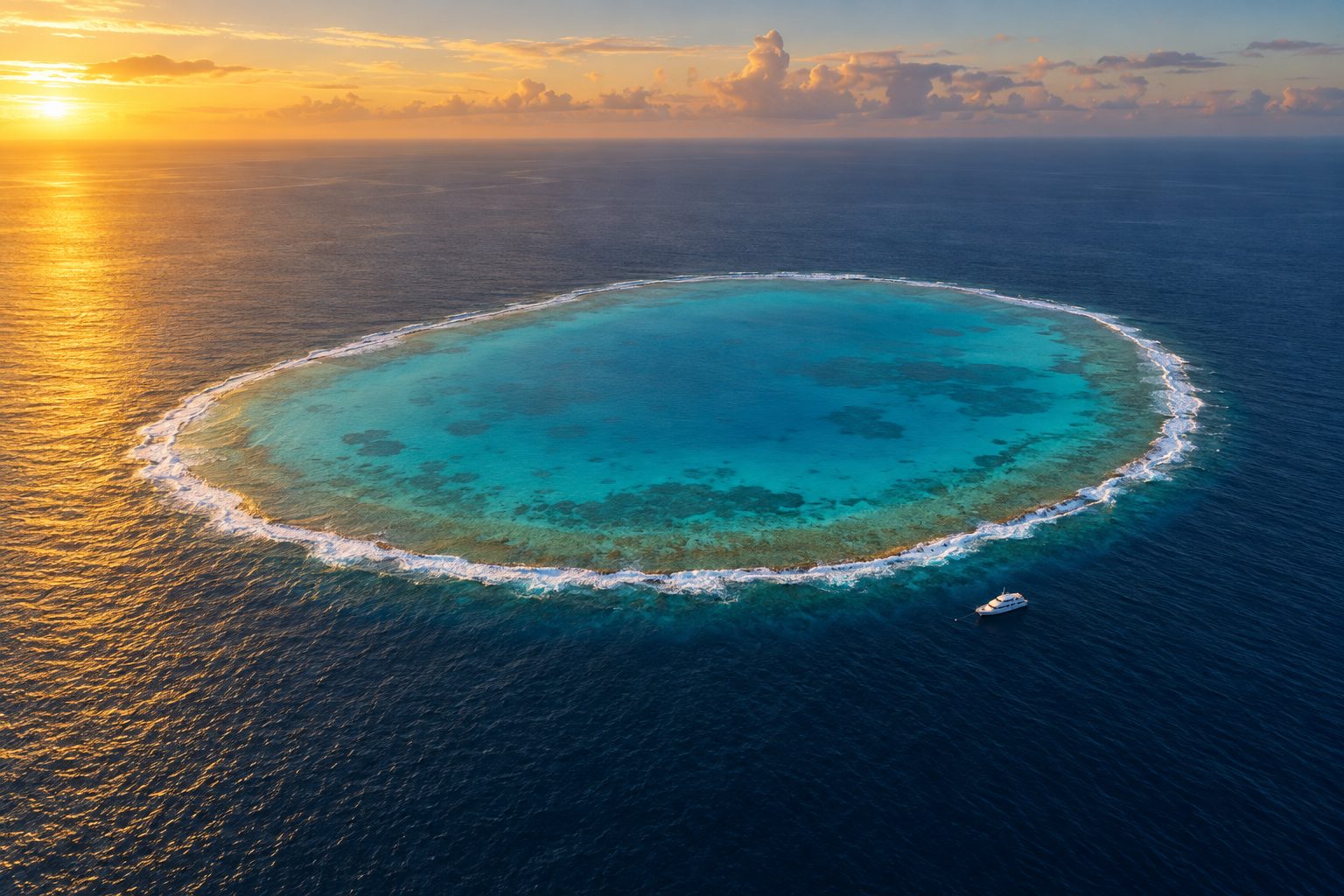
Tubbataha is two coral atolls, North and South, separated by a deep channel a few nautical miles wide, plus Jessie Beazley Reef, a smaller reef to the north-west. Each atoll is a ring of reef around a shallow lagoon, with sand islets used by nesting seabirds and turtles; outside the ring the wall falls almost vertically into water averaging 750 metres deep. The Tubbataha Management Office describes the park as 97,030 hectares, the largest marine protected area in the Philippines and a strict no-take zone at the core of the Coral Triangle.
The protection is recent and hard-won. Remoteness kept fishing boats away until the 1970s; by the 1980s motorised boats had brought dynamite and cyanide fishing, and divers who saw the damage lobbied for a national park, declared in 1988. UNESCO inscribed Tubbataha in 1993, and the Tubbataha Reefs Natural Park Act of 2009 gave the site its own law, management board and a trust fund financed largely by visitor fees. It has since been named a Ramsar wetland, an ASEAN Heritage Park and, by the International Maritime Organization, a Particularly Sensitive Sea Area.
UNESCO's listing describes Tubbataha Reefs Natural Park as 96,828 hectares comprising the North Atoll, South Atoll and Jessie Beazley Reef, inscribed under natural criteria (vii), (ix) and (x), with more than 360 coral species, almost 700 fish species, 11 species of shark, perpendicular walls more than 100 metres deep and the highest known population densities of white-tip reef sharks in the world. [4]
Authorised entry into the park is a privilege rather than a right; the whole of Tubbataha Reefs Natural Park is a no-take zone in which the only permitted activities are tourism under the management plan, research authorised by the management board, and the board's own park management work.
— Paraphrased from the Tubbataha Protected Area Management Board's Park Rules 01-08 (2009)
The season: three months, and why it cannot be longer
The Sulu Sea takes the north-east monsoon from roughly November to March and the south-west monsoon from July to October. Between them lies a window of settled weather, and that window is the season: liveaboards begin crossing in mid-March and the last boats leave in mid-June, with the exact dates set each year by the management office. Outside it the crossing is considered unsafe and the park is effectively closed to tourism.
The months are not equal. March trips can still meet transitional weather and lumpy crossings. April and early May are generally the most settled weeks, with flat seas, visibility that operators quote at 30 to 45 metres and the best odds of schooling hammerheads and manta rays. By June the first signs of the south-west monsoon can return. Water temperature sits between 27 and 30 degrees Celsius throughout, so a 3 mm suit is enough for most divers.
Choosing and booking a liveaboard
Choosing the boat is the trip. The management office does not run trips itself; it accredits commercial vessels holding a Permit to Operate, and its tourism page lists the accredited liveaboards. As checked in September 2026 it ran to around a dozen boats, among them the two Philippine Aggressor vessels, Philippine Siren, Atlantis Azores, Seadoors, Infiniti, Resolute, Narayana and the eight-guest M/Y Gypsy. Check that any vessel you are quoted appears on that list before paying a deposit.
The standard itinerary is six nights out of Puerto Princesa: board in the early afternoon, sail in the evening, wake at the reef, dive for four full days, sail back on the fifth evening and disembark the next morning. Some boats run seven nights, and a few offer longer transition trips via the Visayas. Expect three to four dives a day and 15 to 20 sites over the week, all of them drift dives with the tender following the group.
Prices vary more with the boat than with the diving. As checked in September 2026, six-night packages ranged from around PHP 95,000 on the simplest boats to PHP 270,000 and more on the largest, roughly US$1,600 to US$4,500 per person. Packages normally include cabin, meals, tanks, weights and guiding; nitrox, equipment hire, alcohol and tips are usually extra. Most boats ask a 30 to 50 per cent deposit with the balance due two to three months before sailing.
The Tubbataha Management Office's 2024 Annual Report records 217 dive trips by 16 boats carrying 3,686 tourists in the 2024 season, and 162 ranger patrols against a required minimum of 120. Its surveys found the density of the endangered Napoleon wrasse had risen 88 per cent since 2017, to 12.95 individuals per hectare. [6]
Permits, fees and what your operator handles
Two permits are needed for every trip and you will hold neither yourself. The vessel needs a Vessel Entry Permit, and every person on board a Visitor Entry Permit, issued by the Tubbataha Protected Area Management Board through the management office once the conservation fee has been paid. Visitor permits are tied to an accredited vessel, so there is no way to apply as an individual: your operator collects passport and certification details a month or so before departure and submits the application and fee on your behalf. Before sailing the management office gives a mandatory briefing to all guests and the Coast Guard inspects the vessel.
The official fee is lower than most operators quote. As checked in September 2026, the management office's permits and fees page lists a conservation fee of PHP 5,000 per visitor, about US$90 at 2026 exchange rates, plus PHP 500 per working divemaster and a vessel entry fee of PHP 5,500 to PHP 11,000 depending on tonnage. What operators call the marine park and port fee is typically US$120 to US$150 per diver, payable in cash on board, because it bundles the vessel permit and port charges with the conservation fee; some boats fold it into the package instead. Ask which, in writing, before comparing quotes.
The Tubbataha Management Office fee schedule sets the Visitor Entry conservation fee at PHP 5,000 per person and PHP 500 per divemaster, with vessel entry fees of PHP 5,500 for boats of 100 gross tons and below, PHP 8,250 for 101 to 200 gross tons and PHP 11,000 above that. Fees are paid in Philippine currency before a permit is issued, minors aged 12 and below are exempt, and drones need a separate permit. [1]
The fees fund the park: under the 2009 Act they go into a trust fund that pays for the ranger station, patrol boats and monitoring. Two other paper matters are worth handling early: a drone permit must be applied for through the management office, with operators advising between two weeks' and two months' notice, and single-use plastics including water bottles and straws have been banned in the park since 2019.
Certification, currents and how the diving works
The park rules do not set a certification level for visitors, but the operators do. Most accredited boats require Advanced Open Water or equivalent and around 50 logged dives, for physical reasons: every dive is a drift in open-ocean current, the walls go well past 40 metres, and the nearest recompression chamber is in Puerto Princesa, ten to twelve hours away. Some boats accept Open Water divers with 25 or more logged dives but may keep them off strong-current sites such as Black Rock and Shark Airport. If you are between the two, do a Deep or Drift speciality before the trip, and bring dive insurance that covers hyperbaric treatment and evacuation.
The daily rhythm is set by light and current: a briefing before six, a first dive at first light when the sharks are most active, a second in mid-morning, a third in the early afternoon and, on most boats, an optional dusk or night dive. Divers enter from the tenders in small guided groups; independent diving is not permitted.
The conduct rules are those of any no-take park, written into the 2009 rules and repeated at the briefing: nothing is touched, chased, fed or collected, dead coral and shells included; buoyancy is checked over sand; boats use the park's mooring buoys and never anchor. Rangers can board and inspect any vessel at any time, and divemasters are banned from carrying cameras so that they watch their guests rather than their viewfinders.
The dives: North Atoll, South Atoll and Jessie Beazley
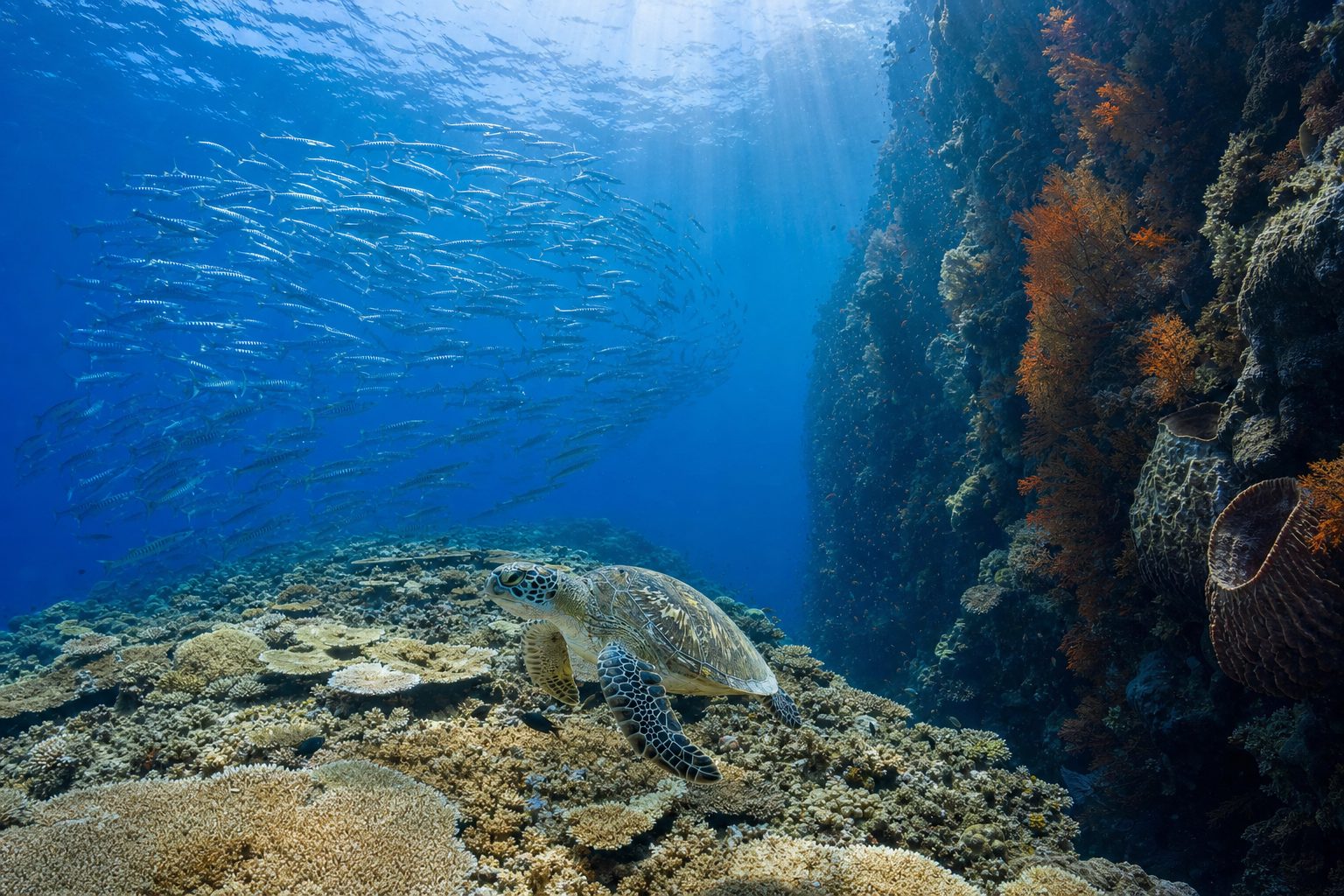
Tubbataha's reputation rests on reliability. White-tip reef sharks rest on the sand of almost every site, grey reef sharks patrol the drop-offs and green and hawksbill turtles are on most dives; what varies week to week is the pelagic cast above them. On the North Atoll, Shark Airport is named for the white-tips lined up on its sandy runway at 22 to 28 metres, Washing Machine is a dusk dive in current on the east face, and Amos Rock and Malayan Wreck give long walls with schools of trevally and barracuda. The ranger station stands on a sandbar here, and some boats arrange a short visit if the rangers' schedule allows.
The South Atoll holds the sites divers talk about afterwards. Delsan Wreck, on the south-east corner, is where the current concentrates jacks, barracuda and grey reef sharks, and where whale sharks and hammerheads are most often reported; Black Rock is a strong-current pelagic dive with dogtooth tuna and, in April and May, the occasional reef manta. Jessie Beazley Reef, two hours' steaming north, is usually dived last: dense hard coral from seven metres down, Napoleon wrasse and unpredictable current.
PhilippineDives.com's Tubbataha dive guide lists more than 30 named sites across the three reefs, with liveaboards typically visiting 15 to 20 over a six-night expedition of three to four dives a day; it records 10 to 15 white-tip reef sharks routinely resting at 22 to 28 metres at Shark Airport, and states that most operators require Advanced Open Water certification and about 50 logged dives. [8]
Getting to Puerto Princesa, and the crossing
Puerto Princesa International Airport (PPS) has frequent flights from Manila, about 90 minutes, and from Cebu, and is a short taxi ride from the pier. Every operator asks guests to arrive the day before embarkation, because a delayed flight can mean a missed briefing and a boat that sails without you; disembarkation is typically between 09:00 and 10:00 on the final morning, and a same-day flight leaves little margin if the return crossing is slow.
The crossing is the part nobody enjoys. Boats leave the Baywalk pier in the early evening and steam through the night, arriving at dawn; ten hours is a fair average, twelve to sixteen on slower vessels or into a headwind. In settled April weather it can be almost flat; in March or June a metre or two of swell is normal. Take the seasickness medication before departure and choose a lower, central cabin if you can; the return journey doubles as your no-fly interval.
- Book a six- or seven-night departure between mid-March and mid-June, ideally in April or early May, six to twelve months ahead.
- Confirm the vessel appears on the Tubbataha Management Office's accredited liveaboard list and ask exactly what its park and port fee covers.
- Hold Advanced Open Water or equivalent with around 50 logged dives, and carry dive insurance covering hyperbaric treatment and evacuation.
- Budget the PHP 5,000 conservation fee, or the operator's US$120 to US$150 all-in park and port fee, plus nitrox and tips on top of the package.
- Arrive in Puerto Princesa the day before embarkation and fly out no earlier than the day after disembarkation.
Tubbataha is the reef the rest of the Philippines is measured against, but it is a week booked a year ahead, and it pairs well with something gentler on either side. The limestone lagoons of El Nido, a few hours north of Puerto Princesa, make an easy decompression. For rationed, big-animal wall diving without a liveaboard, Malaysian Borneo's Sipadan issues its daily permits through the resorts on Mabul; for a longer season on the other side of the Coral Triangle, Raja Ampat runs liveaboards and resorts from October to April. None is quite as absolute as Tubbataha, where the rangers count every boat, the season closes on the sea's terms and the sharks at Shark Airport have no reason to move.
Sources & further reading
- 1. Tubbataha Management Office — Permits and Fees (official conservation and vessel fee schedule)
- 2. Tubbataha Management Office — About Tubbataha (official park profile and designations)
- 3. Tubbataha Management Office — Law Enforcement (official: marine park rangers and ranger station)
- 4. UNESCO World Heritage Centre — Tubbataha Reefs Natural Park (listing 653)
- 5. Tubbataha Protected Area Management Board — TRNP Park Rules 01-08 (2009), Supreme Court E-Library
- 6. Tubbataha Management Office — 2024 Annual Report (official; visitor, patrol and monitoring figures)
- 7. Liveaboard.com — Best time to dive Tubbataha (season calendar and booking lead times)
- 8. PhilippineDives.com — Tubbataha dive guide (dive sites, certification norms, package prices)