The clip that sends most people to Mutianyu is the way down: a rider in a helmet leaning into the bends of a metal chute that drops 1,680 metres from the wall to the valley floor, the Great Wall of China receding overhead. The toboggan is real, it is as good as it looks, and it is the least complicated part of the day. What the reels never explain is the paperwork that stands between you and the ride — a real-name ticketing system that sells entry against your passport number, checks the original document at the gate, and limits every passport to one ticket per day.
Mutianyu rewards a little planning more than almost any major sight in Beijing. The decisions stack up quickly: when to book and under which name, whether to ride the enclosed cable car or the open chairlift — two systems run by different companies, from different gates, to different towers — how far along the restored wall to walk, and whether to time your descent for the toboggan before the afternoon queue forms. This guide takes those choices in the order the day imposes them, with prices and hours as checked in August 2026.
How passport ticketing actually works
Mutianyu no longer sells entry at a window; ticket counters closed at the end of 2021 and admission is online only, under China's real-name reservation rules. When you book, you enter each visitor's name, identity-document number and a contact number, and foreign visitors use their passports. The name must match the passport exactly — same spelling, same order, no dropped middle names — because the ticket is tied to the document, and the document is what gets you in. The scenic area's official reservation centre and its visitor notice set out the rules in English.
Under Mutianyu's real-name system each ID card, foreigner's permanent residence card or passport is limited to one ticket per day; ticket holders enter by presenting the original document used for booking, with no ticket exchange required, and the reservation window opens 15 days ahead. [2]
The closest thing to an official booking channel in English is the Throughout the Great Wall WeChat service account (ID: changchengnw), whose mini program sells Mutianyu tickets at face value, supports foreign passports and switches into English — but it requires WeChat Pay or Alipay. If you are booking from abroad without a Chinese payment method, a reputable reseller is a legitimate alternative: they enter the same passport details into the same system on your behalf, charge a service margin, and take international cards. Either way, arrive with the passport you booked under; a ticket registered to someone else's document cannot be used.
One quirk matters at the entrance. Visitors with cable car reservations enter through the North Ticket Gate, while chairlift and toboggan ticket holders use the Slide Ticket Gate. If your party splits between the two ascents, agree a meeting tower before you separate — mobile signal on the wall is workable but the gates are several minutes apart.
Hours in 2026, and the August night openings
Mutianyu runs on a two-season calendar, and in 2026 the peak season is generous. The gates open at 7:30 every day of the week, which is the single most useful fact in this guide: the first cable car rises with the gate, and the hour before the tour buses arrive around 10:00 is the quietest the wall gets.
In peak season 2026 (16 March to 15 November) Mutianyu opens 7:30–18:00 on weekdays with ticket sales ending at 17:00, and 7:30–18:30 at weekends; opening hours are extended to 7:30–21:00 from 13 to 31 August 2026. [1]
The August extension is a night tour rather than full evening access: after dark, only the stretch between towers 10 and 15 stays open, lit for the occasion, and the programme is weather-dependent — the scenic area cancelled the 25 August 2026 session outright over safety concerns after bad weather. Treat a night slot as a bonus rather than a plan, and check the official site's notices on the day you intend to go.
What it costs: entry, two lifts and the slide
As checked in August 2026, adult entry is CNY 45, with children between 1.2 and 1.4 metres at CNY 25 and smaller children free. The enclosed cable car to Tower 14 costs CNY 100 one-way or CNY 140 return; the open chairlift to Tower 6 is priced the same, and a chairlift-up, toboggan-down combination is CNY 140. The toboggan alone — descent only, from Tower 6 to the base — is CNY 100. The internal shuttle between the entrance complex and the foot of the wall, a distance of about three kilometres, runs CNY 15–20 depending on how you buy it, and is worth taking in both directions to save your legs for the stairs. A typical independent visit with entry, shuttle and a return lift comes to roughly CNY 185 per adult; prices are set by the operators, so confirm current fares when you book.
The detail that catches people out is that the two ascents are separate businesses. The cable car to Tower 14 and the chairlift-and-toboggan operation at Tower 6 are run by different companies, and their tickets are not interchangeable: a cable car return will not put you on the toboggan, and a chairlift ticket will not board the gondola. The classic circuit — up one system, down the other — therefore needs two one-way tickets bought as separate products, which every booking channel supports if you select them deliberately.
The classic route: Tower 14 west to the summit, back east to Tower 6
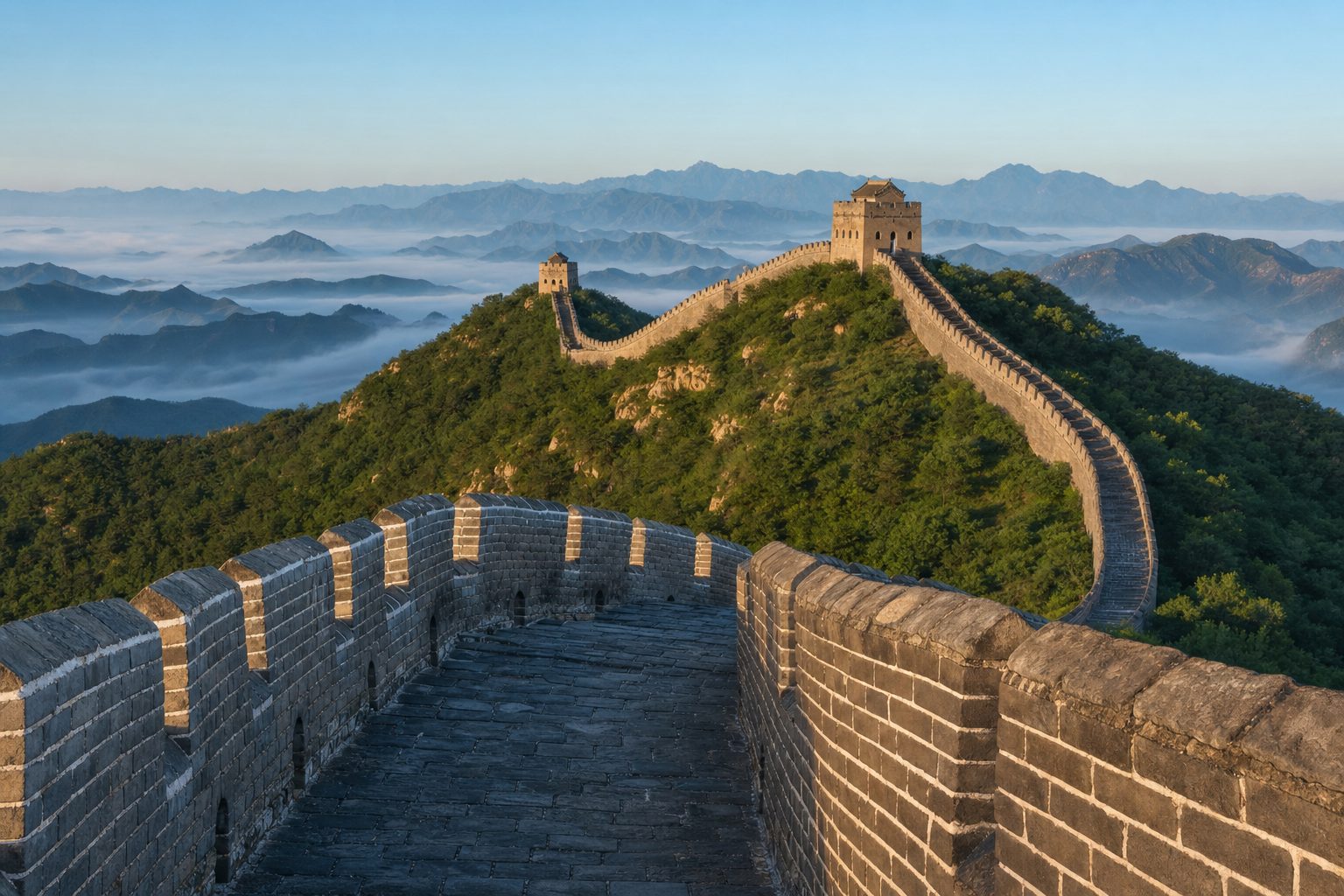
The restored, open section of Mutianyu runs between towers 1 and 20 — about 2.25 kilometres of walkable wall threading a forested ridgeline in Huairou District, with watchtowers every couple of hundred metres. Restoration here is complete rather than cosmetic: the walkway is sound underfoot, the parapets intact, and the forest pressing in on both sides is what gives Mutianyu its green, enclosed character. Do not mistake restored for easy. The wall follows the ridge honestly, which means long staircases, some of them steep enough to demand hands, and a route that rises and falls the whole way.
- Take the shuttle from the entrance complex to the foot of the wall, then the cable car up to Tower 14.
- Walk west along the rising wall to Tower 20, the high point of the open section, for the summit views.
- Retrace to Tower 14 and continue east on the long descent toward Tower 6 — the most staircase-heavy stretch.
- At Tower 6, hand in your toboggan ticket and ride the chute down to the base.
- Catch the shuttle back to the entrance complex for the bus or your driver.
End to end, that circuit covers roughly four to five kilometres of walking with the towers and stair sections included, and most people take three hours over it at an unhurried pace. If your knees prefer a gentler day, invert the plan: chairlift to Tower 6, walk as far west as enthusiasm carries you, return and toboggan down — the wall between towers 6 and 14 has the best photographic angles around towers 8 to 10 in any case.
The toboggan: timing the queue, riding the chute
The toboggan descends from Watchtower 6 to the base on a 1,680-metre metal track, takes roughly five minutes, exceeds 30 km/h on the straights, and closes in rain or snow — after rain, drying the track can add a 30–60 minute wait. [5]
Riders sit singly on a wheeled cart with a hand-lever brake — push forward to go, pull back to slow — and children under ten ride with an adult. The chute is descent-only, and speed is largely yours to choose, within the patience of whoever is behind you; wall staff posted along the track wave the enthusiastic down to sensible speeds on the tighter bends. The queue is the real variable. It is longest after about 13:00, when the tour-bus cohort converges on Tower 6 for the same descent, and shortest before noon or after 15:30. If the ride is the point of your visit, build your walking route to arrive at Tower 6 by late morning.
Mutianyu or Badaling
The comparison every first-time visitor makes has a fairly settled answer. Badaling is the historic showpiece — first section opened to tourism, served by a 19-minute high-speed train from Beijing North — and it absorbs the bulk of domestic group tourism, with weekend and holiday crowds routinely described as shoulder-to-shoulder. Mutianyu draws a fraction of the traffic, restores more atmosphere per visitor, and adds the toboggan. The trade-off is transport: Mutianyu has no railway, so you are committing to a road journey of around ninety minutes each way.
Badaling lies 70 kilometres from Beijing in Yanqing District and Mutianyu 73 kilometres away in Huairou District; the direct tourist bus from Dongzhimen to Mutianyu takes 90 minutes and costs CNY 40 single or CNY 80 return. [7]
Because Badaling's fame attracts such heavy visitor numbers, the quieter walkways and scenery at Mutianyu simply make for a better experience of the wall itself, and it is the section to recommend to most foreign travellers.
— Paraphrased from China Travel's Badaling–Mutianyu comparison
If you have queued for sunrise at Angkor Wat, the calculus will feel familiar: the most famous gate is rarely the best one. Choose Badaling only if the train matters more than the crowds; Mutianyu asks for a road journey each way, and repays it with room to walk.
Getting there, and when to go
The direct tourist bus from Dongzhimen (subway lines 2 and 13, Exit C) is the simplest public option, with morning departures at 6:30, 8:00 and 10:00 and timed returns into the evening. The cheaper DIY route runs the 916 express bus from Dongzhimen Outer Bus Station to Huairou for CNY 12, then a local H23/H24 minibus (CNY 10) or negotiated taxi (CNY 30–50) to the scenic area — about two and a half hours door to door. Group tours run CNY 350–500 per person with hotel pickup and a guide; a private car and driver for two to four people costs CNY 800–1,500 for the day, and a DiDi ride-hail can manage the round trip for CNY 800–1,200 if you arrange the return, since hailing a car from Mutianyu itself can be slow.
Seasonally, Mutianyu is at its photogenic best in the shoulder months — fresh green and blossom in late April and May, red and gold leaf through late October into early November — while high summer brings haze, heat and the biggest domestic crowds, softened in 2026 by those extended August evenings. Winter strips the forest and occasionally dusts the wall with snow, but shortens hours and closes the toboggan in bad weather. Whenever you come, the formula holds: book against your passport early, go up one lift and down the other, and be walking the parapet before the buses arrive.
Mutianyu slots naturally into a wider East Asian itinerary built around timed tickets and early starts. If this kind of reservation discipline is shaping your trip, our guides to climbing Mount Fuji under its gate-and-quota system and the Taj Mahal's timed-entry mornings apply the same playbook: know the booking window, carry the right document, and let everyone else sleep in.
Sources & further reading
- 1. Mutianyu Great Wall scenic area — official site (2026 opening hours and notices)
- 2. Mutianyu Great Wall — official Notice to Visitors (real-name ticketing and entry rules)
- 3. Mutianyu Great Wall — official reservation centre (ticket booking)
- 4. Great Wall Guide — How to book Great Wall tickets online 2026
- 5. Beijing Tourism — Mutianyu Great Wall guide: tickets, cable car and tips 2026
- 6. China Transit Guide — Mutianyu Great Wall (lift operators and practical access)
- 7. China Travel — Badaling vs Mutianyu comparison
- 8. Go China Compass — Mutianyu vs Badaling: which one to choose