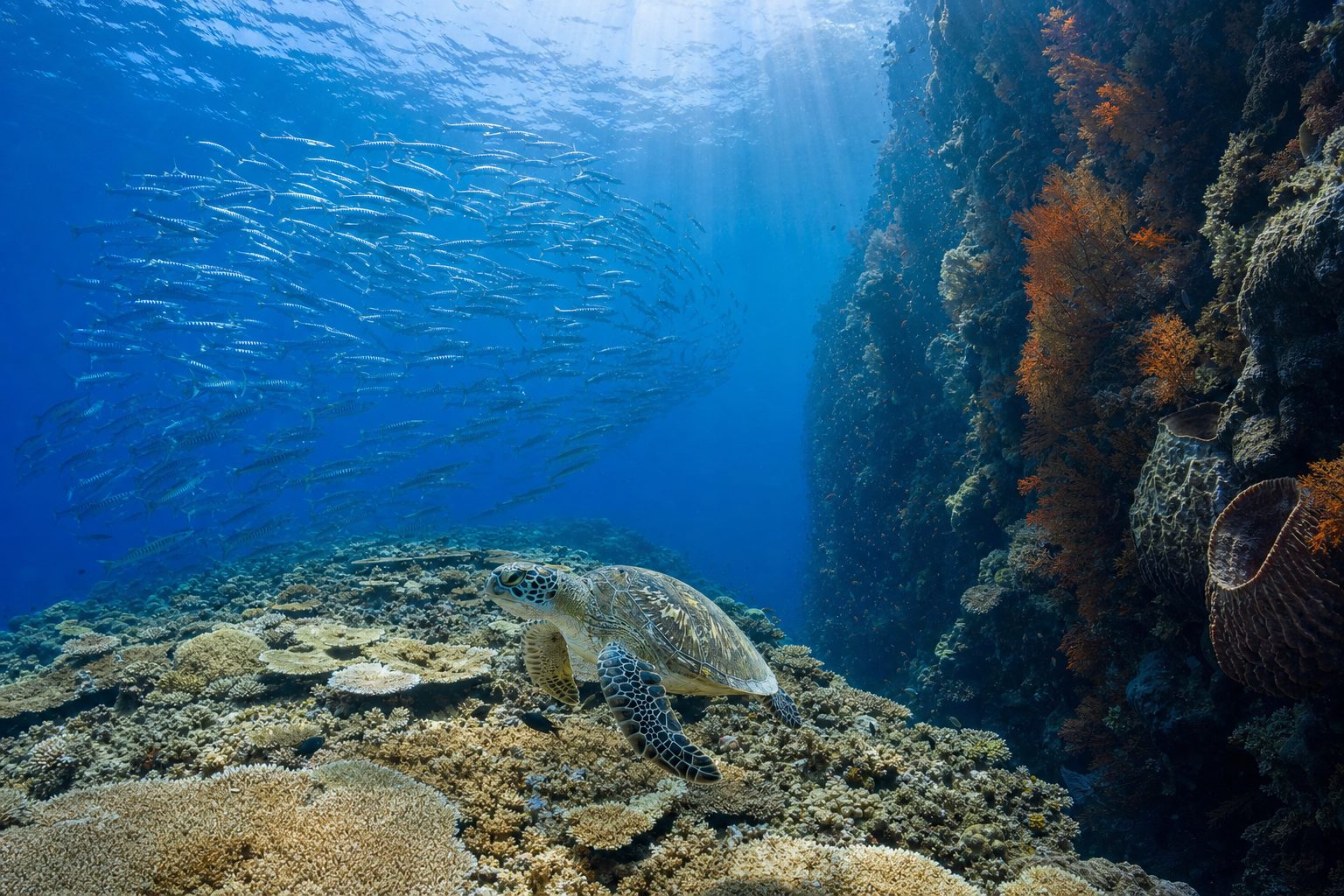
Nobody sleeps on Sipadan any more. Its resorts were dismantled at the end of 2004, and the only way onto Malaysia's one true oceanic island is a dated, named permit issued by Sabah Parks, capped at roughly 252 people a day and sold not to divers but to the licensed operators who house them on neighbouring Mabul and Kapalai. The wall those permits unlock drops 600 metres within a few fin-kicks of the jetty, and the chevron barracuda schooling over Barracuda Point have kept the island on every list of the world's great dives for forty years.
So the planning problem is not whether Sipadan is worth it. It is how to be sure your name is on a permit list on a day you are actually there, which resort to book for that to happen, what it costs on top of the package, whether your certification qualifies, and which months to avoid.
What Sipadan is, and why access is rationed
Sipadan sits in the Celebes Sea off the south-east coast of Sabah, in Malaysian Borneo, close to the sea borders with Indonesia and the Philippines. Unlike the low sand cays around it, it is a cap of living coral on an extinct volcanic cone rising 600 metres from the seabed, and that is the whole point: pelagic fish, reef sharks and turtles gather where open ocean meets a vertical reef, and here that happens metres from the shore.
Protection has come in layers: bird sanctuary in 1933, turtle egg reserve in 1964, protected area in 1997, and in 2004, after studies on reef damage, an order for the island's resorts to relocate to Mabul and Kapalai. Sabah Parks now manages Sipadan Island Park, 16,860 hectares of land and reef policed by its own dive marshals.
The Sabah Ministry of Tourism, Culture and Environment records that Sipadan was declared a bird sanctuary in 1933, that resorts were relocated off the island in 2004 to conserve the reefs, that 13.5 hectares of land were gazetted in 2009 and a further 6,846.5 hectares of surrounding coral reef in July 2015, giving Sipadan Island Park a total of 16,860 hectares under the Sabah Parks Enactment 1984. [5]
Sipadan is Malaysia's only oceanic island, living coral on a volcanic cone rising 600 metres from the Celebes Sea floor, at the centre of one of the richest marine habitats in the world, with more than 400 fish species recorded; since 2004 no accommodation has been permitted on the island.
— Paraphrased from the Sabah Parks Sipadan Island Park page
How the permit system actually works
You cannot buy a Sipadan permit. Sabah Parks sells them only to the operators on its register, 42 companies as listed in September 2026, and each receives a fixed daily allocation to share among its own guests. The large Mabul and Kapalai resorts hold around 12 permits a day; smaller resorts, the Semporna dive shops and the liveaboard Celebes Explorer hold smaller blocks. Your odds depend entirely on where you stay and how that operator shares its quota, which is why the choice of resort matters more here than almost anywhere else.
Under the rules on the Sabah Parks Diving at Sipadan page, operators reserve dates up to six months ahead, pay a 50 per cent deposit, settle in full two weeks before the dive date and submit one list of named divers per date; permits are issued solely at the park's discretion. They are date-specific and non-transferable. As the Sabah Tourism Board puts it, each diver gets a one-day visit, and the quota of 252 is shared between divers and snorkellers, so places for divers on any morning are fewer than the headline figure suggests.
The Sabah Tourism Board's Sipadan page, reviewed in May 2025, states that a permit is required to dive Sipadan, that the daily quota is limited to 252 permits, that each diver is allowed a one-day visit with a maximum of two dives, that divers must hold at least an Advanced Open Water certification, that permits can only be obtained through licensed tour operators registered with Sabah Parks, and that the island no longer hosts any accommodation. [4]
The practical consequence is the three-night rule. Operators will not put you on the Sipadan boat on your arrival day, because they want to see you dive first, or on your departure day, because of the no-fly interval, so a guaranteed day needs at least three nights. Borneo Divers Mabul Resort, for example, guarantees one Sipadan day for stays of four days and three nights, with extra days subject to availability. Get the guarantee in writing before paying a deposit, and check whether children under 12 are excluded, as they are at some resorts.
What it costs on top of your package
The Sabah Parks charges are government fees and are almost never included in the headline package price. As checked in September 2026, the park's own page lists a scuba diving fee of RM350 per person for international visitors (RM250 for Malaysians) and a conservation fee of RM100 (RM50 for Malaysians), a combined RM450 per foreign diver for each Sipadan day, or roughly 90 euros at 2026 exchange rates. Snorkellers pay the conservation fee only. Resorts collect the fees on Sabah Parks' behalf; Seaventures, for one, shows the RM450 as a separate line on its price list.
The Sabah Parks Sipadan Island Park page lists its updated fees as a conservation fee of RM100 per person for international visitors and RM50 for Malaysians, and a scuba diving fee of RM350 per person for international visitors and RM250 for Malaysians. [1]
Two smaller charges catch people out: since 1 January 2026 the Semporna jetty has levied a departure fee of RM10 for non-Malaysian adults, payable in cash, and non-Malaysians pay a tourism tax of RM10 per room per night. Package prices vary widely: Seaventures' four-day, three-night package with one Sipadan day was listed from RM4,719.60 per person in September 2026, full board with transfers, before permit fees; budget resorts on Mabul and Semporna dive shops cost far less but hold smaller allocations.
Certification, dive limits and conduct on the island
Sabah Parks requires an Advanced Open Water certificate or equivalent to dive Sipadan, a rule introduced in October 2022 because of the depth and current on the wall sites. Open Water divers can still dive Mabul and Kapalai, and most resorts will run the Advanced course there in your first two days; no training dives are allowed on Sipadan itself. Bring your certification card and passport, or photographs of both, for the rangers' sign-in at the jetty.
Since October 2022 a permit has allowed two dives at Sipadan per day, each capped at one hour and 40 metres, with one dive at Barracuda Point per diver per day; the third dive of a normal day happens at Mabul or Kapalai on the way home. Several operators report that Sabah Parks restored a third Sipadan dive from May 2026, but the Sabah Tourism Board page still says two, so plan on two and confirm with your resort. There is no night diving.
Amazing Borneo's guide to the current Sabah Parks rules states that around 250 permits are issued per day through a rotation system, that each permit allows a one-day visit with a maximum of two dives, that divers must hold Advanced Open Water certification, that each dive may not exceed one hour or 40 metres, that Barracuda Point is limited to one dive per diver per day, and that Sipadan is closed to all diving from 1 to 30 November each year. [7]
Conduct rules are the usual marine park set, enforced by Sabah Parks' dive marshals: no touching or standing on coral, no taking anything from the reef, and no fishing gear on boats. Turtle Cavern, whose entrance opens about 22 metres down the Drop-Off wall, may only be entered with a local divemaster.
The dives: Barracuda Point, the Drop-Off and the turtles
Sabah Parks lists twelve dive sites around the island, and a permit day usually takes in two. Barracuda Point, on the north coast, is the one everyone wants. Divers roll in onto the top of the wall at about ten metres and drift with the current to where the wall flattens into a sloping plateau; that is where the chevron and blacktail barracuda gather, sometimes in a column that closes around you like weather, while grey reef sharks, dogtooth tuna, bumphead parrotfish and Napoleon wrasse work the same current. Heed the park's own warning not to follow the fish too far north or too deep, where the current can strengthen abruptly and pull downwards.
The Drop-Off begins where the jetty ends. In the Sabah Parks description, a nine-metre walk down the beach leads to a 600-metre abyss, and the wall is hung with fans, sponges and black coral and patrolled by jacks, grey reef and whitetip sharks; its shallow reef top gives a long, rich safety stop. Turtle Patch in the south-east and Mid Reef on the east wall are where green and hawksbill turtles rest on sandy terraces, habituated enough that the Sabah Tourism Board says twenty turtles on a dive is not unusual; South Point and Staghorn Crest are the pelagic gambles, with occasional hammerheads.
A typical day, taking Scuba Junkie's published schedule as representative, leaves Mabul at about 06:15, registers with the rangers before 07:00, dives at 07:15 and 09:30, lunches on the island and leaves around 12:30 for a third dive at Mabul or Kapalai, ahead of the day-trip boats from Semporna.
When to go, and the November closure
Sipadan is closed to all divers every November, from the 1st to the 30th, an annual conservation closure that leaves the reef undisturbed for a month; Mabul, Kapalai and the wider Tun Sakaran Marine Park stay open, so a November trip still dives, just not here. The Sabah Tourism Board page still describes the closure as December, a hangover from the original 2020 announcement; every operator checked in September 2026 works to November, so confirm the month with your resort.
The best conditions run from April to October, with the calmest seas and clearest water broadly from April to June and again in September, which are also the quieter months for permits. July and August bring the holiday rush and livelier seas; the north-east monsoon months from December to March generally bring more rain and lower visibility, though the fish do not leave and permits are far easier to come by. Currents can be strong in any month.
Getting there: Tawau, Semporna and the boat
The gateway is Tawau Airport (TWU) on Sabah's east coast, with daily flights from Kuala Lumpur, a little under three hours, and from Kota Kinabalu. From the airport it is about 90 minutes by road to the fishing town of Semporna, then 30 to 45 minutes by speedboat to Mabul or Kapalai. Resorts run scheduled transfers timed to the main flights, with boats typically leaving Semporna around 10:00 and 12:30 and none after dark, so a late-afternoon arrival usually means a night in Semporna. The overnight bus from Kota Kinabalu takes about ten hours, but its road climbs to roughly 1,500 metres and should not be taken within 18 hours of your last dive.
Mabul, about half an hour by boat from Sipadan, has the widest choice of bases, from the long-established Borneo Divers and Sipadan-Mabul resorts to Scuba Junkie's beach resort and local homestays, with celebrated macro diving on its own reefs. Kapalai is a single resort on stilts over a sandbar; Seaventures is a converted oil rig off Mabul; Semporna town is the budget option, an hour's boat ride away. Check any company against the Sabah Parks register of Sipadan operators before paying.
- Confirm you hold Advanced Open Water, or schedule the course on Mabul for days one and two of your stay.
- Book at least three nights, ideally four or five, with an operator that guarantees a Sipadan day in writing.
- Budget RM450 per Sipadan day in Sabah Parks fees, plus the RM10 Semporna jetty fee and RM10 per room per night tourism tax.
- Carry your certification card and passport, or photos of both, for registration with the rangers at the Sipadan jetty.
- Avoid November entirely if Sipadan is the goal; the island is closed for reef recovery.
The irony of Sipadan is that most of your diving will not be on Sipadan. With one or two permit days in a five-night stay, the rest is spent on the muck and reef sites of Mabul and Kapalai, extraordinary in a different register: flamboyant cuttlefish, frogfish and pygmy seahorses on the shelf where the resorts stand. Divers who want more big-animal wall time will find the same Coral Triangle geography, without the daily quota, in Raja Ampat, and ocean-facing drop-offs and reef sharks in Palau. Closer to home, the seasonal liveaboards of Thailand's Similan Islands and the island-hopping reefs of El Nido round out a Southeast Asian dive circuit. None of them asks you to plan half a year ahead for a single morning; Sipadan does, and the barracuda at the top of the wall are the reason people keep doing it.
Sources & further reading
- 1. Sabah Parks — Sipadan Island Park (official park page: fees, geography, history)
- 2. Sabah Parks — Sipadan Island Park: activities and facilities (official dive-site descriptions)
- 3. Sabah Parks — Diving at Sipadan Island (official booking procedure and registered operators)
- 4. Sabah Tourism Board — Sipadan Island, Semporna (state tourism board)
- 5. Sabah Ministry of Tourism, Culture and Environment (KePKAS) — Sipadan gazetted for marine preservation
- 6. XTVT (Malaysian tour operator) — How to get a Sipadan dive permit in 2026: fees, quota and rules
- 7. Amazing Borneo Tours (Sabah operator) — Latest guide to Sipadan diving rules
- 8. The Scuba News — Sipadan 2025: new diving permit rules and resorts with direct access (editorial)