Bhutan is not a country to price by the airfare alone. For most visitors, the fixed Sustainable Development Fee is USD 100 for every night in the kingdom, before a hotel, driver, guide or monument ticket has entered the calculation. That is the number that turns a striking Tiger’s Nest reel into a real decision: how many nights make sense, whether Paro should be the first base, and how much structure to arrange before the flight is booked.
The useful way to plan is to separate the country-wide rules from the hike. Sort the visa and nightly levy first; choose an arrival window that gives the flight and hotel inventory some slack; then give Paro enough time to acclimatise and walk to Taktsang without treating a sacred monastery as a quick viewpoint. This guide uses the current official visitor guidance, with all fees and access arrangements checked in August 2026 and worth reconfirming before payment.
Start with the nightly fee, not the headline itinerary
The Sustainable Development Fee, usually shortened to SDF, is a government levy rather than an accommodation rate. It is charged by night, so a four-night itinerary means four SDF nights even if a late-arriving flight leaves little usable time on the first day. For most US-dollar-paying visitors, the arithmetic begins at USD 100 per adult per night. It is paid as part of the visa process, not handed over at a hotel. Keep it separate in the budget from rooms, food, transport, guides and paid monuments; a tour price can bundle these items, but bundling does not make the levy disappear.
As checked in August 2026, the effective Sustainable Development Fee is USD 100 per adult per night for US-dollar-paying tourists, a 50% reduction from the USD 200 rate. Bhutan Travel says that incentive remains effective through 31 August 2027, after which it may be reviewed or discontinued. [1]
Family and regional rates matter because they change the shape of a mixed-age or India-based trip. Bhutan Travel lists USD 50 per night for children aged six to under 12 from countries other than India, while children under six are exempt. For Indian nationals presenting a valid Indian passport or voter ID, the listed rate is Nu. 1,200 or the equivalent in Indian rupees per person per night; children aged six to under 12 pay Nu./INR 600 and under-sixes are exempt. These are nationality- and age-specific rules, not informal discounts, so use the official portal rather than a currency-converted package quote.
There are narrow exceptions, notably a 24-hour border-town arrangement, but they are not a route to Paro or Tiger’s Nest. Treat that as a separate land-border visit rather than a saving to build a mountain itinerary around. The practical rule is simpler: decide the number of Bhutan nights before choosing hotels, and reserve enough of the budget for the SDF at the outset. If an itinerary seems improbably inexpensive, ask whether it states the levy, guide, transport and monument entries separately.
Get the visa approved before you book a non-refundable flight
For most nationalities, Bhutan requires a visa approved before travel. The official portal allows a traveller to apply online, while a certified tour operator or hotel can submit an application on the traveller’s behalf. The application asks for a passport copy, recent photo, dates and payment details; Bhutan Travel says a correctly entered application can take up to five working days to process. That is a reason to leave a buffer, not a promise that a last-minute air fare can be used safely.
As checked in August 2026, Bhutan Travel lists a non-refundable, one-off USD 40 visa processing fee for visa applicants. Most visitors need their visa approved in advance; Bangladesh and Maldives nationals may also apply on arrival, while Indian nationals use an entry-permit process. [3]
Do not reduce this to ‘visa on arrival’ in general advice. Bhutan Travel’s FAQ distinguishes the usual pre-approval requirement from the Bangladesh, Maldives and Indian processes, and even for the latter it recommends arranging the document beforehand because queues at the entry point can be long. A visa is not a casual border purchase for the typical international visitor. Check passport validity, spelling and travel dates before submission, and do not assume an operator’s itinerary hold equals an issued visa.
A guide is part of the access plan, not merely an optional narrator. Bhutan Travel states that a guide is required to enter monuments and dzongs, and that all treks must be undertaken with an accredited tour operator or guide. That makes the Tiger’s Nest day a guided monument visit even if the rest of a Paro stay is deliberately unhurried. Use a Department of Tourism-certified guide or an operator that names the guide and explains what is included: transport from Paro, the monument ticket, the guide’s time and any horse arrangement.
Plan around Paro, the single international airport
Bhutan has one international airport, in Paro. Flights operated by Drukair and Bhutan Airlines connect it with regional gateways including Bangkok, Delhi, Kolkata, Bagdogra, Bodhgaya, Dhaka, Kathmandu, Guwahati and Singapore. This makes routing less flexible than it looks on a world map: an international connection, a weather-sensitive mountain arrival and the first hotel all need to work as one chain. Neither carrier’s timetable should be treated as permanent; Bhutan Airlines explicitly says schedules can change and should be checked against its live information.
As checked in August 2026, Bhutan Travel says the country has one international airport, located in Paro, and identifies Drukair and Bhutan Airlines as the airlines operating international arrivals and departures. [3]
Build the first Paro night as a recovery night, especially after a long connection. The airport is close enough to the valley’s hotels that there is no need to force a major sight that afternoon, and the pause helps with the altitude before the Taktsang climb. A late incoming flight should move the hike later, not compress it into the following morning. For the same reason, leave the final night in Paro or keep an itinerary flexible enough to absorb a changed flight, rather than relying on a tight same-day international connection.
If the trip continues to Thimphu or Punakha, make the guide and vehicle plan explicit rather than assuming a rental-car solution. The official FAQ says self-drive rental is not available and says a guide is required for guests driving their own cars into Bhutan. Paro is therefore a useful place to settle transport and guide details while the setting is simple. The broad travel logic will feel familiar to readers of this Sri Lanka coastal loop, but Bhutan’s entry and guide rules make advance sequencing even more important.
Give Tiger’s Nest a full, paced day
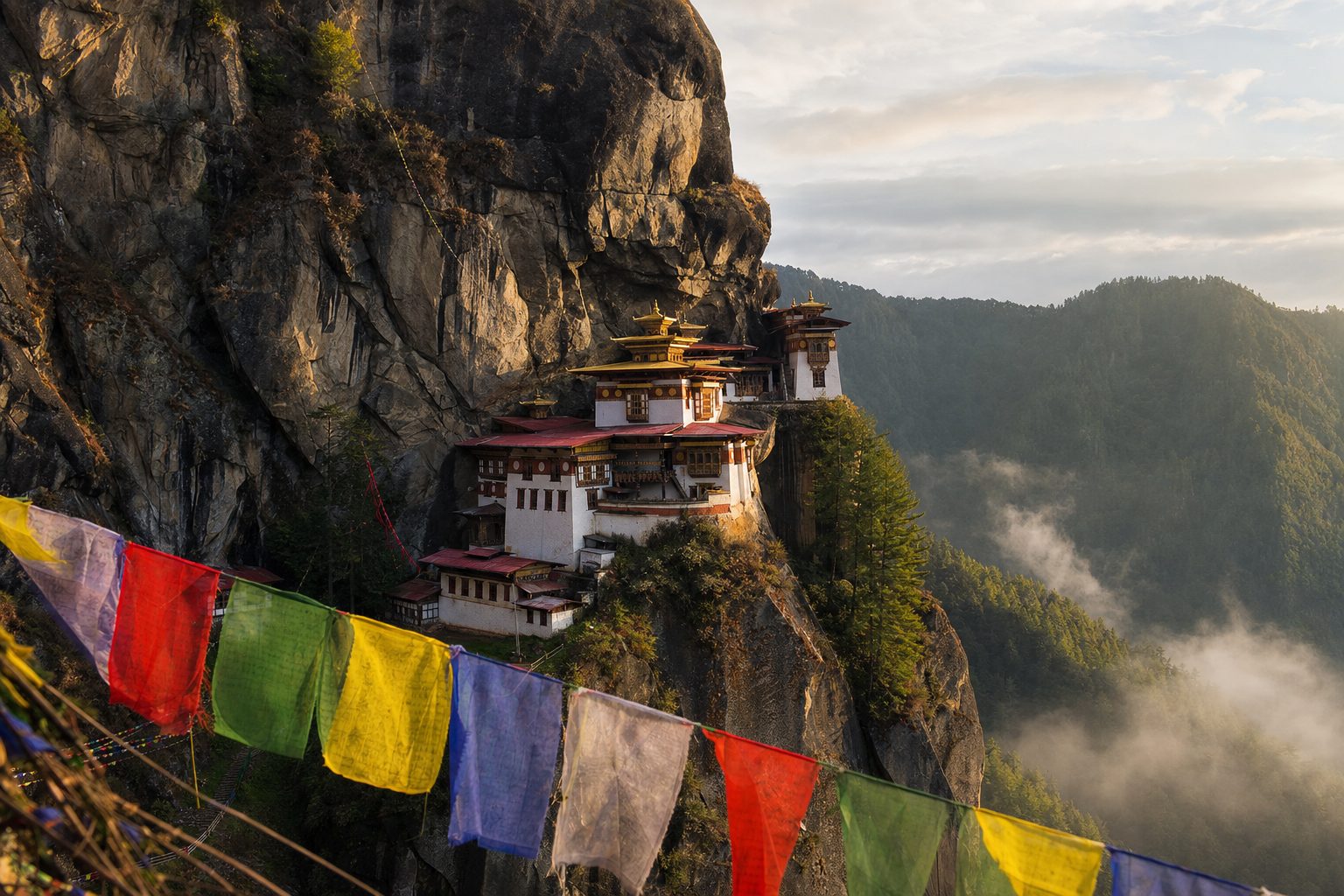
Paro Taktsang, commonly called Tiger’s Nest, is a monastery visit reached by a sustained mountain walk, not an attraction beside a car park. Bhutan Travel describes a steady two-hour climb from the Paro side to roughly 10,000 feet, with ponies available only to around the halfway point for younger guests. Allowing for a measured ascent, breaks, the final stone steps, the monastery visit and descent, block five to seven hours door to door rather than trying to fit it before an afternoon transfer. Start after at least one night in Paro if your schedule allows.
The route has a clear decision point: whether to use the halfway cafeteria as a genuine rest rather than a deadline. The climb rises through forest before the better-known view across the valley and then drops towards a bridge and waterfall before the final ascent. A horse or mule can reduce the first uphill section for some travellers but does not remove the steep walking or the final stairs, and horse arrangements need advance coordination. Wear grippy walking shoes for the trail, carry water and add layers; take time for short breaks before breathing becomes ragged.
- Leave Paro with an early, unhurried start and tell the guide whether the group expects a steady walk, a horse to the midpoint, or frequent stops.
- Carry water, sun protection, a light insulating layer and footwear with grip; the trail and temple entry have different footwear rules.
- Keep passport/permit and ticket arrangements with the guide, and confirm whether the monument entry is included in the quoted trip price.
- Use the cafeteria and viewpoints as pacing points, not proof that the rest of the route will be easy.
- Keep the following morning free if possible, so weather, fatigue or a religious closure does not distort the entire itinerary.
Know what happens at the monastery gate
The walk and the monastery are separate permissions. The hiking trail can be started earlier, but the monastery normally opens at 8am and has a midday break; current operator guidance lists 8am–5pm with closure from 1pm–2pm. An entry ticket is required for the monastery itself, and its current cost and any Bhutanese-calendar restricted days should be confirmed with the guide immediately before the hike. Do not rely on an old blog’s fee: monument charges and access hours have changed over time, and a package may include a ticket without making that obvious.
As checked in August 2026, current Tiger’s Nest operator guidance lists a typical 4–5-hour round trip on the trail, monastery hours of 8am–5pm with a 1pm–2pm break, and an admission process at the monastery. It also notes dates on the Bhutanese lunar calendar when only Bhutanese visitors may enter; confirm the day’s access with your guide. [5]
The important etiquette is practical. Before entering the monastery rooms, visitors must deposit bags, phones and cameras, and photography is prohibited inside. Shoes and headwear come off for the internal temples; shoulders and knees should be covered, and the atmosphere is quiet rather than performative. Plan the bag around that rule: put water, layers and any valuable electronics somewhere easy to hand over, but do not expect to take them inside for a last interior photograph. Exterior views are the place for cameras.
Tiger’s Nest should be approached as a holy place reached on foot: take the time the climb requires, leave recording devices outside the temple rooms and follow the guide’s lead on dress, footwear and silence.
— Paraphrased from Bhutan Travel and Druk Asia’s Taktsang visitor guidance
The most respectful strategy is also the least stressful one. Aim for an early trail start, not a sprint to the gate; accept a pause if clouds, fatigue or the noon break intervene; and do not interpret a no-camera rule as a minor inconvenience. The reward is not an interior content shoot but the sequence of forest, cliff, waterfall and monastery, with enough time left to walk down safely. Travellers who enjoy a regulated mountain objective can compare the preparation mindset in this Mount Fuji climbing guide, where early rules and a conservative pace matter just as much as the final view.
Choose autumn for festivals and clarity, then book early
Autumn runs from September to November in Bhutan’s visitor guidance, more specifically from late September or early October to late November after the rainy season. The official description is bright, sunny days, some early high-altitude snow and a season of feasts and festivals. For a Tiger’s Nest-led first trip, that usually means clearer walking conditions and a strong chance of pleasant valley weather, balanced by more demand for limited flights and good Paro accommodation. Festival dates follow the lunar calendar, so check the official calendar for the year rather than importing last year’s dates.
Book the flight, a Paro base and the guide as one package of commitments as soon as dates are settled, especially if a major festival is the point of the trip. The objective is not to chase the fullest itinerary, but to protect the two fixed elements: an approved visa and enough time for Tiger’s Nest. Spring can be equally appealing for clear skies and blossom, while summer brings monsoon effects and winter brings colder high ground. The best choice is the one that leaves at least a spare night, rather than the one with the most named valleys.
Bhutan makes more sense when its constraints shape the trip from the beginning: the USD 100 nightly SDF, a visa resolved before travel, Paro’s finite flight options, a certified guide and one steady day for Taktsang. Build around those commitments, check official pages again before paying, and let the rest of the itinerary remain deliberately light. For a wider comparison of journeys where preparation earns a better outdoor day, continue with our adventure travel bucket list.
Sources & further reading
- 1. Bhutan Travel — Sustainable Development Fee announcement
- 2. Bhutan Travel — visa application guidance
- 3. Bhutan Travel — visitor FAQs
- 4. Bhutan Travel — Tiger’s Nest family guide
- 5. Druk Asia — Tiger’s Nest monastery access guide
- 6. Bhutan Travel — Bhutan’s festivals
- 7. Drukair — official airline information
- 8. Bhutan Airlines — official flight schedule