Seoul has a palace rule that sounds like a marketing stunt and is in fact long-standing policy: dress the part and the gate is free. Anyone wearing hanbok, the traditional Korean dress, walks into Gyeongbokgung without a ticket, foreign visitors included, and on an October afternoon the courtyards fill with rented silk in every colour as a result. It also points to the real shape of a good trip here. The city's historic core rewards people who know the rules — which day each palace closes, when a residential lane stops welcoming tourists, which week the maples turn — and quietly penalises those who do not.
This guide is built around those decisions: how to sequence the five Joseon-era palaces, how to visit Bukchon's hanok lanes without becoming the problem the neighbourhood is legislating against, whether to chase the autumn colour in the city or on the granite peaks of Bukhansan, and where to base yourself. Fees, hours and forecasts are as checked in October 2026; each is linked to the official source so you can confirm before you go.
Why Seoul in autumn
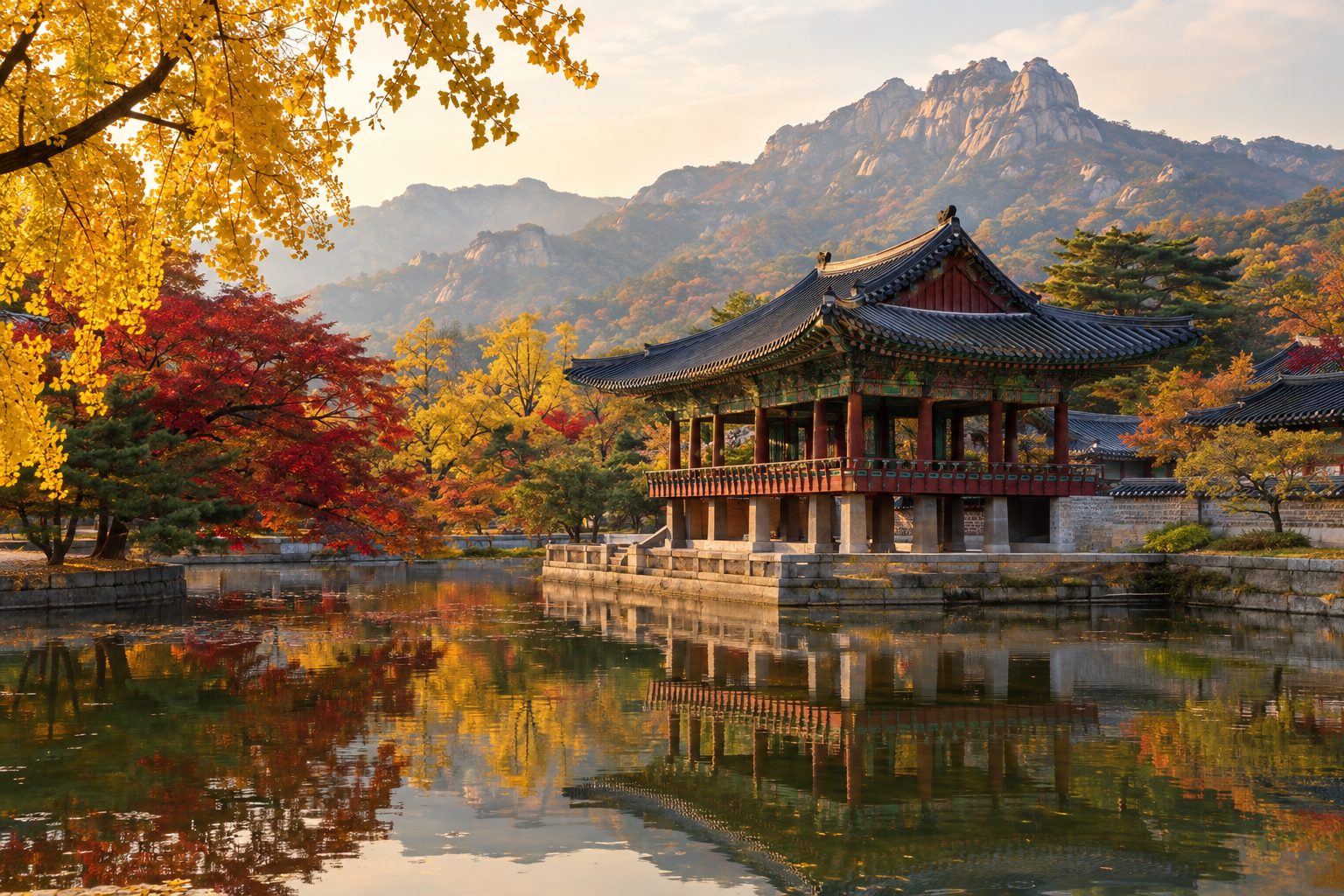
Seoul's seasons are emphatic. Summers are hot, humid and rain-heavy; winters are dry and genuinely cold; spring brings the cherry blossom crowds. Autumn is the sweet spot for a first visit: clear skies, cool mornings and, from mid-October into November, a wave of colour that runs through the palace gardens, the riverside parks and the national park on the city's northern edge. The palaces, designed around their wooded hills and ponds, look their most deliberate when the ginkgoes turn gold.
The trade-off is crowds: foliage weekends are busy, hanbok shops run at capacity and old-centre hotels price accordingly. Go early, use weekdays for the headline sights, and keep weekends for markets and neighbourhoods.
The palace strategy: Gyeongbokgung first, then choose your second
Gyeongbokgung, the main royal palace of the Joseon dynasty, is the one to see if you see only one. Its axis runs from Gwanghwamun Gate through a sequence of courtyards to the throne hall of Geunjeongjeon, with the mountain Bugaksan rising directly behind, and the lotus pond around Gyeonghoeru Pavilion is the scene on most of the postcards. Tickets are sold in the forecourt, take cards and need no advance booking.
As checked in October 2026, Gyeongbokgung's official adult admission (ages 19–64) is 3,000 won, with entry free for children six and under and visitors aged 65 and over; the palace is closed on Tuesdays and, in September and October, opens 09:00–18:00 with final admission at 17:00, shortening to 09:00–17:00 from November. [2]
The hanbok rule is where the reel angle comes from, and it holds up: the palace waives admission for anyone wearing hanbok, whether owned or rented, regardless of nationality. Rental shops cluster around Gyeongbokgung Station and the streets west of the palace, and a basic rental for a few hours runs to roughly 15,000–20,000 won, so the free ticket alone does not pay for the outfit. The point is the experience. One caution from the gate: very short or heavily modernised "fusion" costumes have occasionally been questioned, so ask the shop whether an outfit qualifies before you pay. Admission is also free for everyone on the last Wednesday of each month, Korea's Culture Day, which makes that date predictably crowded.
Time your arrival for the guard ceremony. At 10:00 and 14:00, in front of Gwanghwamun, gatekeepers in Joseon-era uniform hand over the watch to drums and a traditional military band, according to the Korea Heritage Service Foundation's programme. It is free, lasts about twenty minutes and does not run on Tuesdays. The ceremony can be cancelled in heavy rain or extreme heat, so treat it as a bonus rather than the fixed point of the day.
For a second palace, the choice is between scale and atmosphere. Changdeokgung, a fifteen-minute walk east and listed by UNESCO, is the more intimate and, for many visitors, the more beautiful, because its buildings follow the contours of the hill rather than a straight axis. Its rear garden, Huwon, often called the Secret Garden, can be seen only on a timed, capped guided tour at an extra charge, and English sessions sell out in foliage season, so book through the palace's reservation service as soon as your dates are fixed. Deoksugung, near City Hall, is the easy evening option, and Jongmyo Shrine, the austere royal ancestral shrine, is the one for travellers who want quiet. An integrated palace ticket covering all five sites is sold at the gates; published prices have differed between sources this year, so check the current rate on the official palace site before deciding whether it beats paying as you go.
Bukchon, respectfully: the red zone and its hours
Between Gyeongbokgung and Changdeokgung, on the slopes behind Jeongdok Library, lies Bukchon, the largest surviving cluster of hanok, the tiled-roof wooden houses of the Joseon gentry. It is beautiful and photogenic, which is precisely its problem: it is also a residential neighbourhood where people live, sleep and raise children, and for years the lanes absorbed tour groups from early morning until well after dark. The district's answer has been to designate a special management area with fixed hours for tourists.
Seoul Metropolitan Government restricts tourist visits to the Bukchon red zone, about 34,000 square metres around Bukchon-ro 11-gil, from 17:00 to 10:00 the following day; after a guidance period, a fine of 100,000 won has applied since 1 March 2025. [4]
In practice, the window is 10:00 to 17:00, and taking photos, filming, lingering and wandering for sightseeing all count as tourism outside it. Residents, shop customers and guests staying in the zone are exempt, as is anyone simply passing through. The rest of Bukchon has no curfew, though the same courtesy applies everywhere. The official Visit Seoul guidance asks for what it calls silent tourism, and the rules are simple enough to follow without thinking about them.
- Keep voices low and skip loudspeakers, microphones and group chatter in the lanes; the official guidance caps groups at ten.
- Never open, lean on or step through a private gate, and do not photograph or film house interiors, even when a door stands open.
- Visit the red zone on a weekday between 10:00 and noon, before the afternoon groups arrive, and leave well before 17:00.
- Take your litter with you; there are few public bins in the residential lanes.
Pair Bukchon with the gentler streets around it rather than treating it as the main event. Pair it with Samcheong-dong's cafés along the palace's eastern wall, or Ikseon-dong, a short walk south-east, is a compact maze of converted hanok restaurants that welcomes evening visitors, which Bukchon's core no longer does.
Timing the foliage: city palaces or Bukhansan
Korea's autumn colour moves south and downhill, starting on the high peaks of the north-east in early October and reaching the lowland cities and the south coast by November. That gives you two distinct targets from Seoul. The first is the city itself: palace gardens, the ginkgo-lined avenues and the big parks, where colour peaks later and lasts into early November. The second is Bukhansan National Park, whose granite ridges loom over the northern districts and are reachable by subway and bus, where the season starts earlier and the colour is wilder.
The Korea Tourism Organization's 2026 forecast, credited to Weatheri, puts first foliage at Seoraksan on 3 October (peak 25 October) and at Bukhansan on 23 October, with Bukhansan's peak forecast for 4 November; in Seoul it names Gyeongbokgung, Seoul Forest, Olympic Park and N Seoul Tower as foliage spots, and notes that actual dates depend on the weather. [6]
Inside the city, the maples and ginkgoes in the palaces are typically at their best from late October into early November. The Korea National Arboretum's own phenology forecast, reported by Asia Economy this week, expects the Seoul metropolitan area to peak in late October, with maples around 29 October and ginkgoes around 31 October. So the practical answer is this: a trip in the last week of October or the first days of November catches both the city peak and Bukhansan in full colour. Arrive in mid-October and the palaces will still be mostly green, but a day trip east to Seoraksan will be at its best.
Peak autumn colour is expected across the country from mid-October through early November, but the forecast dates are guidance only and can shift with the weather.
— Paraphrased from the Korea Tourism Organization's 2026 Fall Foliage Forecast (VisitKorea)
Treat Bukhansan as a proper hike rather than a stroll. The popular routes to the summit area at Baegundae climb steeply over bare granite with fixed cables on the upper sections, autumn weekends bring heavy foot traffic on the main trails, and daylight is short by November. Start early on a weekday, carry water and layers, and turn back in good time.
Eating: Gwangjang Market and beyond
Gwangjang Market, east of Jongno, is the city's best-known food introduction and one of its oldest markets. The draw is the covered food alley at its centre, where vendors sit behind counters of bindaetteok, the mung bean pancakes fried in a puddle of oil, alongside gimbap rolls, knife-cut noodles and raw beef yukhoe. Order at a stall, sit on the bench in front of it, and pay that vendor; prices are posted and the menus increasingly carry English and pictures.
As listed by Visit Seoul in October 2026, the market's shops open 09:00–18:00 and close on Sundays, while the food alley runs 09:00–23:00 year-round. Individual stalls keep their own hours and some close early on quiet days, so if a particular vendor is the reason you are going, go at lunchtime or early evening rather than late. Beyond Gwangjang, the city's eating is best done by neighbourhood: Tongin Market, west of Gyeongbokgung, for a coin-lunchbox lunch picked stall by stall; the barbecue streets of Jongno and Euljiro for an evening of grilled pork and soju; and the cafés of Seongsu for the long weekend brunch.
Getting around, and where to stay
Seoul's subway is clean, frequent and comprehensively signed in English, and it reaches almost everything in this guide. Buy a rechargeable transport card on arrival and tap it on every subway gate and bus reader, including when you get off the bus, which is what earns you the free transfers. The Airport Railroad from Incheon brings you into Seoul Station, and the same card works on it.
VisitKorea lists a standard Tmoney card at 3,000–5,000 won from convenience stores including GS25, CU and 7-Eleven and from subway information centres; it is reloaded at station machines and works on subways, buses and taxis nationwide, with transfer discounts between bus and subway. [8]
Seoul's own unlimited-travel scheme is in transition this autumn: the city has been moving its Climate Card towards a new pass for residents, and its tourist short-term options have been changing. Unless you will ride the subway many times a day, a pay-as-you-go T-money card is the simplest choice; if an unlimited pass appeals, check the current terms on the Seoul Metropolitan Government's Climate Card page before buying.
On where to sleep, three bases suit three kinds of trip. Jongno, the historic centre, puts Gyeongbokgung, Changdeokgung, Bukchon, Insadong, Ikseon-dong and Gwangjang within a walk or two subway stops, and its hanok guesthouses let you stay inside the old city, which also exempts you from Bukchon's curfew if you sleep in the red zone itself. Myeongdong, just south, is the convenient generalist: airport buses, department stores, street food and fast links to everywhere, at the cost of crowds and character. Seongsu, east across the river bend, is the choice for repeat visitors and design-minded travellers, a former factory district of warehouse cafés and concept stores close to Seoul Forest, one of the city's better foliage parks, but a longer ride to the palaces. For a first autumn trip, Jongno is the strongest case.
A three-day shape for an autumn visit
Day one is the Joseon core: Gyeongbokgung at opening, in hanbok if you want the free entry and the photographs, staying for the 10:00 ceremony at Gwanghwamun, then the National Folk Museum and lunch at Tongin Market. Walk through Samcheong-dong to Bukchon in the early afternoon, comfortably inside the 10:00–17:00 window, and end with dinner in Ikseon-dong. Day two goes north, to Bukhansan for a morning hike if the colour has arrived, or to Changdeokgung and a pre-booked Secret Garden tour if it has not, with Gwangjang's food alley in the evening. Day three is for the modern city: Seoul Forest and Seongsu in the morning, then the cable car or a walk up to N Seoul Tower for the view across the city at dusk, the river and the mountains turning dark together.
Keep the sequence flexible around the Monday and Tuesday palace closures and the foliage itself, which may arrive a few days either side of the forecast; rain days suit the free national museums and the covered markets.
Seoul also pairs naturally with Japan, a short flight or ferry away, and the two make an instructive contrast in how East Asian capitals look after their royal and religious heritage. If you are extending the trip, our guide to Kyoto's temples and food culture applies the same early-start logic to another autumn-colour city, and the thatched farmhouses of Shirakawa-go raise the same questions about visiting a living village with care.
Sources & further reading
- 1. Seoul Tourism Guide — Gyeongbokgung Palace: tickets, hanbok entry, hours and seasons (checked September 2026)
- 2. Gyeongbokgung Palace (official) — Hours & Admissions
- 3. Korea Heritage Service Foundation — Royal Palace Guard Changing Ceremony programme
- 4. Seoul Metropolitan Government — Notice on restrictions for tourist visits to the Bukchon Special Management Area
- 5. Visit Seoul (official tourism site) — Bukchon Hanok Village
- 6. VisitKorea (Korea Tourism Organization) — 2026 Fall Foliage Forecast
- 7. Visit Seoul (official tourism site) — Gwangjang Market
- 8. VisitKorea (Korea Tourism Organization) — Transportation Cards