Jaipur arrives with a story attached. In 1876 the Prince of Wales toured India, and Maharaja Sawai Ram Singh II had the whole city painted pink as a gesture of hospitality; the walled city has stayed pink ever since and the nickname has outlived the visit by a century and a half. The trip itself turns on plainer questions: which of the dozen forts, palaces and observatories deserve a ticket, how the state's combined ticket works after the January 2026 fee revision, when the heat makes the whole exercise miserable, and how Jaipur fits into a Delhi and Agra loop.
This guide takes those decisions in order, written for a first visit of two to three days, and it errs on the side of the official record where the internet offers three different prices for the same gate.
What the pink actually is, and where you will see it
The old city that Jai Singh II founded in 1727 was laid out on a grid drawn from the Prastara plan of the Vastu Shastra, with nine gates, broad straight streets meeting at right angles and long rows of uniform bazaar frontages. UNESCO inscribed the walled city in 2019 under criteria (ii), (iv) and (vi), and notes that its architectural controls run through the Jaipur heritage management framework, including the 1970 building byelaws and a 2009 amendment to the Municipalities Act.
The colour is the part of that framework a visitor notices. Rajasthan Tourism dates the repainting to the 1876 royal tour and attributes it to Maharaja Ram Singh, pink being read as a colour of hospitality. Municipal heritage rules have kept the facades to the same terracotta shade, so what reads as a romantic accident is a maintained planning decision. The effect is strongest along Johari Bazaar and Tripolia Bazaar, where whole blocks share one tone and one cornice line; walk them in the first hour of the day, before the shutters go up.
Jaipur was founded in 1727 by Sawai Jai Singh II and planned by his architect Vidyadhar on a grid-iron model drawn from the Prastara plan of the Vastu Shastra; UNESCO records that most of the city's public and royal infrastructure was completed in four years, 1727 to 1731. [1]
Choosing between the big three: Amber, Hawa Mahal, Jantar Mantar
Amber Fort (also written Amer) sits 11 kilometres north of the walled city in a fold of the Aravalli hills, below Jaigarh Fort. It is the sight most people would keep if forced to choose. The state's official booking portal lists the fort as open from 8.00 am to 9.00 pm, closed on Dhulandi (the day after Holi), with a separate night ticket for the evening hours; arriving at opening means having the Sheesh Mahal's mirrored ceiling largely to yourself rather than shuffling through with coach groups from about 9.30. Allow two to three hours, then walk down the paved path past Maota Lake; it takes about fifteen minutes and gives the classic view of the ramparts in the water.
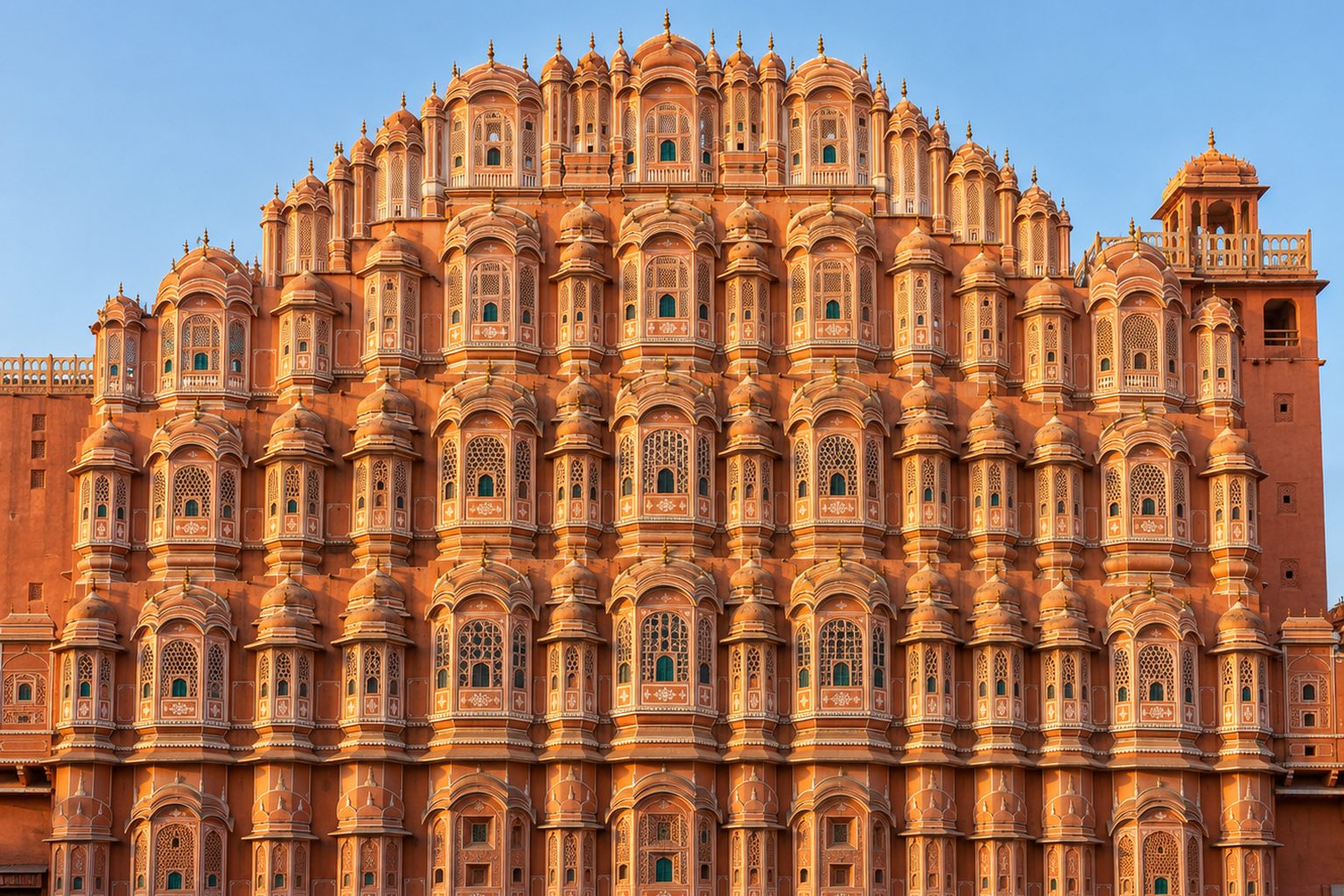
Hawa Mahal is the building on the carousel, and the decision here is whether to go inside at all. The Ministry of Tourism describes it as an extension of the royal women's quarters built in 1799 by Maharaja Sawai Pratap Singh, its screen designed by Lal Chand Ustad so the women could watch processions and the bargaining in Johari Bazaar unseen. The facade is popularly counted at 953 jharokha windows. The important practical point is that there is no front door; the entrance is round the back, off Tripolia Bazaar, and the upper floors are reached by ramps rather than stairs. The interior is modest, so if time is short, see the facade from a rooftop café opposite at sunrise and spend the saved hour at Jantar Mantar.
Jantar Mantar is the site first-time visitors most often skip and most often regret skipping: an open-air observatory completed in 1734 by the same Jai Singh II, and was inscribed by UNESCO in 2010 as the most significant and best preserved of India's historic observatories. The state tourism department lists nineteen masonry instruments over roughly 18,700 square metres, with the Vrihat Samrat Yantra, the world's largest stone sundial, at the centre. The instruments only make sense with explanation, so hire a licensed guide or take the audio tour here; without one it is a sculpture park. Hours are 9.00 am to 7.00 pm with last tickets at 6.30 pm, and the shadows that make the sundials legible are sharpest in the middle of the day.
The Vrihat Samrat Yantra at Jantar Mantar is 27 metres long, is described by Rajasthan Tourism as the tallest sundial in the world, and calculates local time to an accuracy of about two seconds; the observatory was completed in 1734 and holds nineteen instruments. [4]
The composite ticket and what the 2026 fee revision changed
Rajasthan's Department of Archaeology and Museums sells a composite ticket that covers Amber Fort, Hawa Mahal, Jantar Mantar, Nahargarh Fort, Albert Hall Museum and several smaller state sites, valid over two consecutive days. For three or more of those it is cheaper than paying at each gate. It does not cover City Palace, run by the royal family's trust with its own, dearer tickets, nor Jaigarh Fort above Amber.
As checked in September 2026, the prices need a caveat. From 1 January 2026 the state roughly doubled entry fees at its monuments, the first revision since 2015: Amber Fort rose to ₹200 for Indian visitors and ₹1,000 for foreign visitors, while Hawa Mahal, Jantar Mantar, Nahargarh and Albert Hall each moved to ₹100 and ₹600. The department's own booking pages, however, still carried the older schedule when we checked, listing the Jaipur composite ticket at ₹400 for Indians and ₹1,000 for foreigners, with student rates of ₹100 and ₹500, and Amber's single ticket at ₹100 and ₹500. Post-revision reports put the new composite at ₹550 and ₹1,700. Treat every figure here as a planning range and confirm the live price at the OBMS booking portal or the Jaleb Chowk counter at Amber before you pay.
Rajasthan's revised monument entry fees took effect on 1 January 2026, the first major revision since 2015: Amber Fort rose from ₹100 to ₹200 for Indian visitors and to ₹1,000 for foreign visitors, while Hawa Mahal, Jantar Mantar, Nahargarh Fort and Albert Hall Museum moved to ₹100 (Indian) and ₹600 (foreign). [7]
From the official schedule: children under seven enter free, and the state monuments open without charge on 30 March, 18 April, 18 May and 27 September. Free days are also the busiest, which is the trade-off.
The elephant question at Amber
Tourists have for decades ridden painted elephants up the ramp to the Suraj Pol, and the image still appears in a great deal of marketing. Our recommendation is not to ride. Animal Welfare Board of India investigations, summarised by Humane World for Animals, found that most of the roughly 100 elephants working the fort had wounds or scars, were chained when not working and showed stereotypic swaying, and a magistrate's court at Amer ordered a police investigation into cruelty complaints. Litigation over the rides continues in the Rajasthan High Court.
The alternatives are better anyway. The walk up from the car park takes ten to fifteen minutes on a gentle paved slope, and shared jeeps run from the base for a small fixed fare if the heat argues against walking. The elephant ride ends at the same gate.
City Palace, Nahargarh, Jal Mahal and the rest
Beyond the three headline sites, the choices become more personal. City Palace, at the centre of the grid, is still the residence of the former royal family and charges separately; its courtyards, the Peacock Gate and the silver urns of the Diwan-i-Khas justify a couple of hours on a third day. Albert Hall Museum, at the southern edge of the old city, is on the composite ticket and is a good hot-afternoon option.
Nahargarh Fort, on the ridge directly above the walled city, is the sunset choice. It is on the composite ticket, about twenty minutes by car from Amber, and the view back over the pink grid explains the city plan better than any map. Jal Mahal, the palace standing in Man Sagar Lake on the Amber road, is not open to the public; you view it from the lakeside promenade, and there is no ticket to buy. Patrika Gate, near the airport, is a modern, heavily painted gateway that photographs well at first light.
- Day one, early: Amber Fort at opening, walk down past Maota Lake, stop at the Jal Mahal lakefront on the way back into town.
- Day one, afternoon: Albert Hall Museum in the heat of the day, then Nahargarh Fort for sunset on the same composite ticket.
- Day two, dawn: Hawa Mahal facade from a rooftop café opposite, then the bazaars before the shutters open.
- Day two, midday: Jantar Mantar with a guide while the sundial shadows are sharp; City Palace next door if you have the appetite and the budget.
- Third day, if you have it: Jaigarh Fort above Amber, then the Sanganer or Bagru block-printing workshops.
When to go, and what the heat really means
The comfortable window is October to March, and the official climate record explains why. The India Meteorological Department's normals for Jaipur put January's average maximum at 22.5°C with nights around 8°C, and December and February are only a few degrees warmer. From March the maximum climbs fast, reaching 31.5°C in March, 37.2°C in April and 40.5°C in May, with heatwave days running well above that. Forts and observatories are open-air and unshaded; from mid-April to late June the sensible pattern is one site at dawn and nothing else until evening.
The monsoon normally arrives around 25 June and withdraws around 15 September, bringing about 88 per cent of the year's rain in roughly twelve weeks. The rain comes in bursts rather than as a grey season, the hills turn green and the crowds thin, but humidity is high. October is the pivot: maximums fall from about 35°C to 32°C across the month, and the winter season begins with the Diwali period, when hotel prices spike.
India Meteorological Department normals for Jaipur give a mean maximum of 40.5°C in May, the hottest month, against 22.5°C in January, the coldest; the monsoon normally sets in on 25 June and withdraws around 15 September, delivering about 88 per cent of annual rainfall. [8]
The walled city of Jaipur was conceived as a new trading capital on the plains, a deliberate departure from the hill-fort cities of the region, with a grid of broad streets, uniform bazaar facades and quarters assigned to specific crafts and communities, and its living craft traditions still underpin the conservation of the city today.
— Paraphrased from the UNESCO World Heritage listing for Jaipur City, Rajasthan
Getting there and fitting Jaipur into the Golden Triangle
Jaipur is one corner of the Golden Triangle with Delhi and Agra, roughly 240 to 280 kilometres from each, and most first-time itineraries approach it as the third stop after the Taj Mahal at Agra. By road, Agra to Jaipur takes five to six hours with a stop at Fatehpur Sikri or the Chand Baori stepwell; Delhi to Jaipur is around five hours. The fastest daytime trains from New Delhi take about four and a half hours. Jaipur's airport at Sanganer has domestic connections to most large Indian cities.
Within the city, app-based taxis and auto-rickshaws are cheap; agree the auto fare before you sit down and expect ₹300 to ₹400 for the run to Amber. A car with driver for a day is the easiest way to string Amber, Jaigarh, Nahargarh and Jal Mahal together on the same northern road. Inside the walled city, walk: Hawa Mahal, City Palace and Jantar Mantar are a few hundred metres apart, and the bazaars are the point.
Etiquette, money and small realities
Jaipur is a working city, not an open-air museum, and the walled city's residents live above the shopfronts you are photographing; ask before pointing a camera at people. Bargaining is expected for textiles and block prints, not at ticket counters, and monument guides should carry a government licence badge. The gem trade is famous and so are its scams: do not buy stones on the promise of reselling them at home. Cards work at hotels and larger shops, but carry small notes for autos, chai and temple offerings, and do not drink the tap water. A plate of pyaaz kachori from a Johari Bazaar counter costs less than the gap between the Indian and foreign tickets, and is a better use of an afternoon than a fourth fort.
If Jaipur is your first taste of Rajasthan, it works as a hinge. The obvious next move is west to Jodhpur, Udaipur and the desert towards Jaisalmer, covered in our Rajasthan road trip guide. Travellers heading east can pair Agra and Jaipur with a slower week on the coast in our Sri Lanka coastal loop, or continue into the Himalaya with the monastery trail to Bhutan's Tiger's Nest. Whichever way you go, you now know why the city is that colour.
Sources & further reading
- 1. UNESCO World Heritage Centre — Jaipur City, Rajasthan (1605)
- 2. UNESCO World Heritage Centre — The Jantar Mantar, Jaipur (1338)
- 3. Rajasthan Tourism (Government of Rajasthan) — Jaipur
- 4. Rajasthan Tourism (Government of Rajasthan) — Jantar Mantar
- 5. Incredible India (Ministry of Tourism) — Hawa Mahal
- 6. OBMS Rajasthan Tourism — Amber Fort official booking page (timings, tickets, closures)
- 7. Pink City Post — Jaipur heritage-site entry fees revised from 1 January 2026
- 8. India Meteorological Department — Climate of Jaipur (PDF)