Most people arrive at Teotihuacan with one question: can you still climb the Pyramid of the Sun? The short answer is no — and the longer answer, which involves a partially reopened Pyramid of the Moon and rules that have shifted several times in recent years, is worth understanding before you set expectations for the day. What has not changed is the essential bargain. Roughly 40 kilometres northeast of Mexico City sits one of the largest cities of the ancient Americas, reachable by a cheap public coach in little more than an hour, for an entry fee of a few hundred pesos.
A good Teotihuacan day trip turns on four decisions: whether to buy the simple INAH ticket at the gate or overpay a reseller; what you expect to climb once inside; whether to travel by public bus, organised tour or hired driver; and how early you are willing to start. This guide works through each in turn, with the current climbing position as it stood in October 2026.
Tickets, hours and what the fee covers
Ticketing is the easy part. The site is run by Mexico's National Institute of Anthropology and History (INAH), and there is one ticket, sold at booths at the gates from opening time and on INAH's own online shop at ventadeboletosenlinea.inah.gob.mx. There is no timed entry, tickets do not sell out, and walk-up admission is normal — so the US$29 'skip-the-line' entry tickets sold on booking platforms buy the same admission at more than double the gate price, for a queue that rarely exists.
Under the INAH tariff that took effect on 1 January 2026, non-resident foreign visitors pay MX$210 and Mexican nationals and foreign residents pay MX$105; children under 13, students and teachers with credentials, visitors with disabilities and INAPAM cardholders enter free, and Sundays are free for nationals and residents. [5]
The archaeological zone opens 8:00 to 17:00 every day of the year, holidays included, and the 2026 admission fees are confirmed at MX$210 for foreign visitors and MX$105 for Mexican nationals. [3]
Last access is at 16:30, though the on-site museums keep slightly shorter hours, roughly 9:00 to 16:30. The ticket covers the whole archaeological zone and both museums — the Museo de Sitio Manuel Gamio near the Pyramid of the Sun, with its scale model of the city, and the mural museum — so keep it with you, as staff check it again at the museums and other gates. As checked in October 2026, the only extras are parking (around MX$45 for a car) and permits for professional camera kit; verify current fees on the INAH shop before you travel. Carry some cash in small notes, although the gate booths also take cards.
What you can and cannot climb right now
This is the part of the trip where guidebooks age fastest, so treat any climbing as a bonus rather than the point of the day. The Pyramid of the Sun has been closed to climbing since 2020. The suspension began as a pandemic measure, became a conservation one, and INAH's spring 2026 bulletin reconfirmed that ascent is not permitted, with no reopening date published. Barriers and security staff enforce the rule, and one British guide notes that attempting the stairs can draw a fine of up to 20,000 pesos.
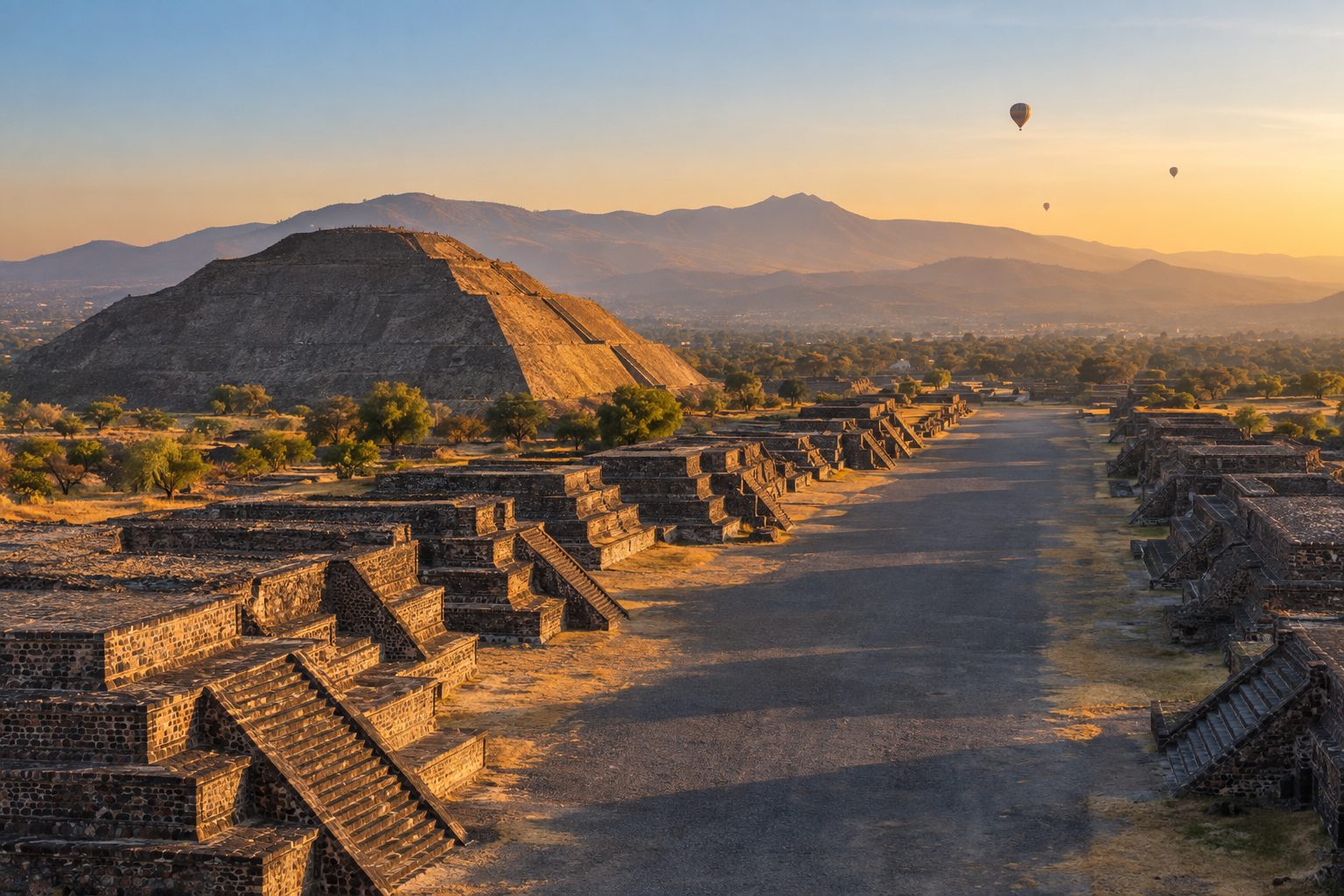
The Pyramid of the Moon is the partial exception. INAH reopened its lower platform — the first section, about 47 steps up five broad bodies — in May 2025, and after a brief suspension it was reported open again in late April 2026, per Visit Mexico City Guide. Other current guides, including Mexico City Trip, describe all three major pyramids as roped off. The honest position: the lower platform has reopened at times through 2025–26, access is suspended whenever conservation or security requires it, and the only answer that counts is the one posted at the ticket booth on the morning you visit. Even the lower platform repays the climb — it looks straight down the Avenue of the Dead with the Pyramid of the Sun rising to the left, the view on most postcards.
Climbing the Pyramid of the Sun has been prohibited since 2020 and INAH's 2026 bulletin keeps the summit closed; the Pyramid of the Moon reopened on 19 May 2025 only as far as the first platform at the foot of the upper stairway, and visitors are advised to confirm access at the gate on the day. [4]
The Temple of Quetzalcoatl — the Feathered Serpent Pyramid, inside the sunken plaza of the Ciudadela — is viewed from the adjacent platform and at ground level, where its carved serpent heads are close enough to study without climbing anything. The smaller stepped platforms lining the Avenue of the Dead remain open to walk up, and they are enough to lift you above the crowds for photographs. Drones are banned throughout the site. If it helps to frame the restrictions: the same tension between access and conservation has reshaped visits to Machu Picchu, where timed circuits now ration the citadel. Rules that feel restrictive are what keep 2,000-year-old staircases standing.
Walking the Avenue of the Dead, gate to gate
Teotihuacan is a walking site — vehicles stay outside — and the geography is simple: one straight ceremonial axis, the Avenue of the Dead, with the Ciudadela near its southern end, the Pyramid of the Sun partway up its eastern side and the Plaza of the Moon closing the northern end. The public gates, numbered Puerta 1 to 5, sit around the perimeter. Gate 1, beside the Ciudadela, is the natural starting point: begin there, see the Temple of Quetzalcoatl first, then walk the roughly two kilometres north along the avenue, taking the Pyramid of the Sun in the middle of the route and finishing at the Plaza of the Moon and the Quetzalpapálotl palace complex beside it.
Buses from Mexico City drop passengers at Gate 1 or Gate 2 (ask for 'las pirámides' so you are not set down in the town of San Juan Teotihuacán, three kilometres short). Walking the highlights end to end takes two to three hours at an unhurried pace; add the museums and the outlying mural compounds and five to six hours disappear easily. Plan the exit before you need it: return coaches pick up outside the gates on the main road, and queues build near closing.
UNESCO's listing records the Pyramid of the Sun at 225 by 222 metres at the base and 75 metres high, within a city that covered 36 square kilometres at its peak and held at least 25,000 inhabitants between the 1st and 7th centuries AD. [2]
The World Heritage listing describes Teotihuacan as a unique artistic achievement whose monuments — the Pyramids of the Sun and the Moon and the Temple of Quetzalcoatl along the Avenue of the Dead — were laid out on cosmic symbolism, and whose cultural influence reached across central Mexico and as far as Guatemala; the Aztec name means 'the place where the gods were created'.
— Paraphrased from the UNESCO World Heritage listing for the Pre-Hispanic City of Teotihuacan
The Ciudadela, the murals and the museums
With the summits off limits, the ground-level city is the compensation, and it is substantial. The Ciudadela is a vast sunken plaza that held the city's political and religious centre; the carved façade of the Feathered Serpent Pyramid at its heart is the finest sculpture on the site, and early or late light brings out the detail that midday sun flattens. At the northern end, the Palace of Quetzalpapálotl keeps a painted patio with carved pillars, and the apartment compounds of Tepantitla and Tetitla, east and west of the core, preserve murals — including the famous paradise scenes — that most coach tours skip entirely.
Give the Museo de Sitio Manuel Gamio half an hour: its scale model of the whole 36-square-kilometre city makes sense of how little of Teotihuacan the ceremonial centre actually represents — about a tenth, on UNESCO's figures. Both museums are included in the entry ticket, which is worth remembering when a reseller offers to 'add' them.
Getting there: bus, tour or driver
The public coach is the default for independent travellers, and Mexico City's official visitor page calls it the most affordable way out. Take Metro Line 5 to Autobuses del Norte, walk into the Terminal Central del Norte and head for Gate 8 at the northern end, where the Autobuses Teotihuacán counter is signed 'Pirámides'. Coaches leave every 15–20 minutes from around 6:00, cost roughly MX$52–60 each way in cash, and take between an hour and an hour and 40 minutes depending on traffic. The whole independent day — metro, coach both ways, entry — comes to about MX$330 before food. Return buses run from outside the gates until around 18:00.
Organised day trips remove the terminal logistics and add a guide: as checked in October 2026, half-day tours from Mexico City run about 450–700 MXN per person including entry, and full-day versions pairing the pyramids with the Basílica de Guadalupe and lunch run 700–900 MXN, per Mexico City Trip's comparison. Early-access tours that enter ahead of the coach crowds cost more (around US$68 on the big platforms) and are the one premium worth weighing. The third option is door to door: Uber or DiDi runs about 300–450 MXN one way from the centre — set the pin to 'Zona Arqueológica de Teotihuacan, Gate 1' — while a negotiated driver for the day, or a hotel-arranged car, runs roughly 700–1,200 MXN. Phone signal is patchy at the gates, so walk towards the Gate 1 parking area to summon the return ride.
Beating the crowds, the sun and the altitude
Timing decides what kind of day you have. Be at the gate for the 8:00 opening: the first two hours bring cool air, long light down the avenue and near-empty plazas. Coach groups own the middle of the day — the city government's own page warns the site is busiest from midday to 16:00 — and Tuesday to Thursday run consistently quieter than weekends. Avoid Sundays if you can, when free entry for nationals and residents roughly doubles the crowd, and give the spring equinox around 21 March a wide berth unless you want to share the avenue with thousands of white-clad energy seekers.
The physical conditions deserve respect. The valley floor sits at about 2,300 metres, so flights of ancient stairs leave lowland lungs short; pace yourself, especially on day one of a trip. There is almost no shade anywhere in the archaeological zone, and by late morning the high-altitude sun is fierce — the official advice amounts to hat, sunscreen, water and comfortable shoes, and it is all genuinely necessary. In the May–October rainy season, afternoon storms are one more argument for the early start; November to April brings the clearest skies.
- Arrive for the 8:00 opening, on a Tuesday, Wednesday or Thursday if you can choose.
- Carry at least 1.5 litres of water per person, a hat and sunscreen — shade is almost nonexistent.
- Bring pesos in small notes for the bus, the ticket booth and the inevitable vendors.
- Wear proper walking shoes for uneven stone, and pace the stairs at 2,300 metres.
- Check the climbing notice at the ticket booth before planning your route around the Pyramid of the Moon.
The balloon option — and how to visit well
The one view of Teotihuacan no rule can close is from above. Sunrise hot-air balloon flights over the pyramids have become the signature add-on: operators collect passengers from Mexico City in the small hours or meet them near the launch fields beside the site, fly at first light, and have you at the gate for opening time afterwards. Packages with transport from the city list from around US$162. Flights are genuinely weather-dependent — expect cancellation or rescheduling if the wind is wrong — so book with an established operator, read recent reviews, and do not schedule a balloon for your last morning in Mexico.
On the ground, visiting well is mostly a matter of taking the conservation rules at face value: stay off anything roped, keep to the marked routes, leave the drone at home and buy nothing claimed to be an original artefact. The barriers are not there to spite visitors; they exist because a city that has stood for two millennia receives millions of footsteps a year, and the stairways were never built for them.
If Teotihuacan starts an appetite for the great ruined cities, the comparison trips are natural ones. Our guide to Luxor covers the other hemisphere's monumental avenue of temples and tombs, and Petra pairs the same early-start, beat-the-sun logic with a canyon entrance that no photograph prepares you for. Closer in spirit, the timed circuits of Machu Picchu show where managed access at the world's most-visited ruins is heading — Teotihuacan, for now, remains the rare wonder you can still decide to visit tomorrow morning.
Sources & further reading
- 1. Mexico City Government (cdmx.gob.mx) — Teotihuacán venue page: buses from Autobuses del Norte, crowd times and what to bring
- 2. UNESCO World Heritage Centre — Pre-Hispanic City of Teotihuacan: Outstanding Universal Value, monuments and protection
- 3. VisitarTeotihuacan.com — practical information: daily opening hours, 2026 admission fees, exemptions and parking
- 4. Visit Mexico City Guide — Teotihuacán 2026: hours, prices and what you can climb (INAH bulletins on the Sun and Moon pyramids)
- 5. Visit Mexico City Guide — Teotihuacán tickets: the 2026 INAH tariff, official sellers and free-entry categories
- 6. Mexico City Trip — Can you climb the Teotihuacan pyramids? Current restrictions and what you can still see
- 7. Mexico City Trip — How to get to Teotihuacan from Mexico City: bus, rideshare and tour options compared
- 8. Departly — Teotihuacan day trip guide: climbing status, altitude and timing