The Alhambra is the most visited monument in Spain, and the way it is visited has changed. Tickets are named, timed and non-transferable; they go on sale a maximum of three months ahead; and in summer the best dates disappear within minutes of the window opening. The palace-city on Sabika hill above Granada is much harder to enjoy on impulse than it was. Turning up in July hoping for a ticket at the gate is, as one Granada guide puts it, a lottery.
So the decisions come early. Which ticket suits you? What Nasrid Palaces time slot should you fight for when sales open? Day or night? How do you get up the hill, and what if the tickets are gone? This guide answers each from the Patronato de la Alhambra y Generalife's own visitor pages.
What you are actually buying a ticket to
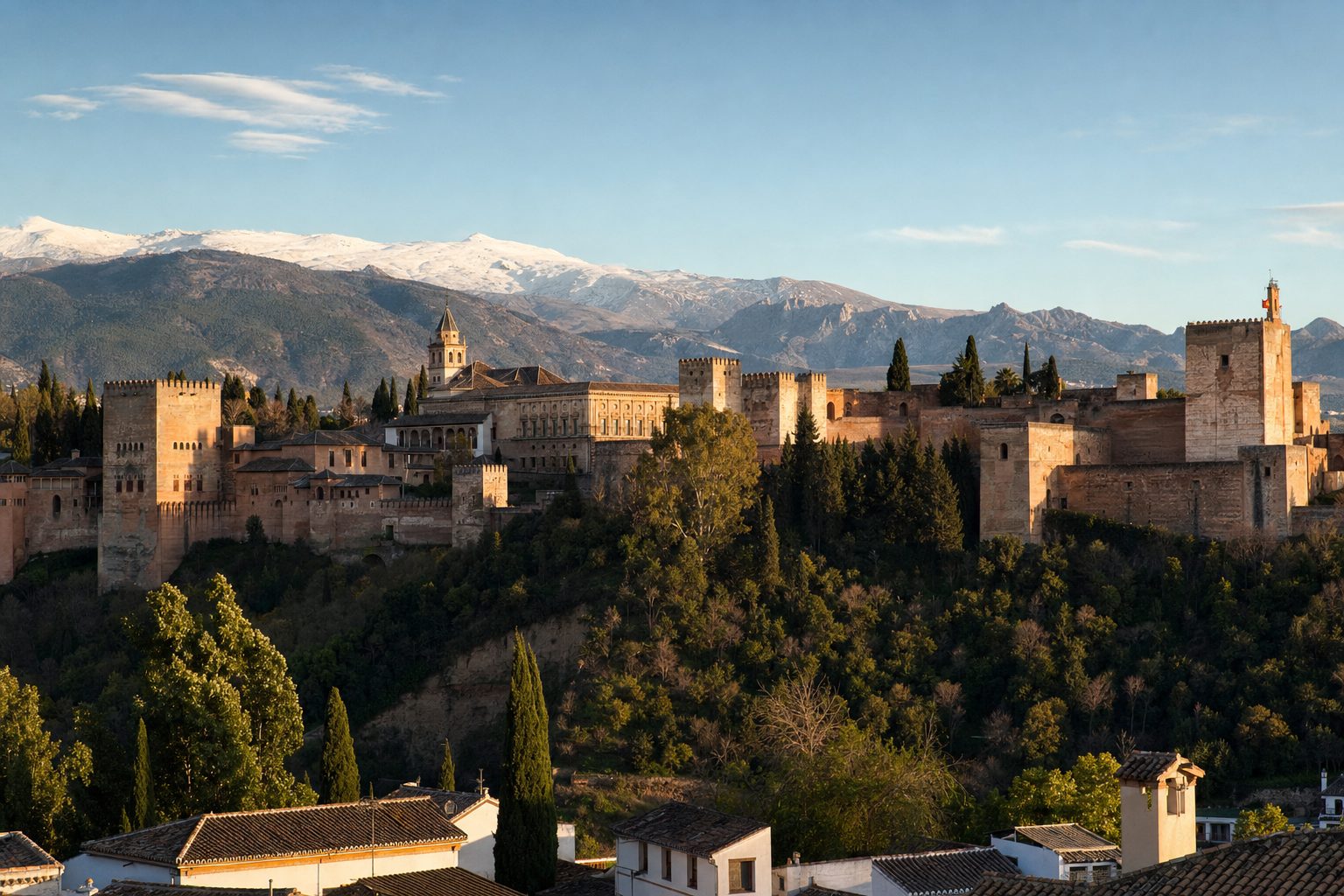
The Alhambra is a walled hilltop city built mostly by the Nasrid emirs who ruled Granada in the thirteenth and fourteenth centuries, the last Islamic dynasty in Iberia. The general visit divides it into four spaces you may each enter once: the Alcazaba, the fortress at the western tip; the Nasrid Palaces, the courtyards, pools and stucco-lined halls around the Court of the Myrtles and the Court of the Lions; the Partal, the garden terraces below them; and the Generalife, the emirs' country estate on the next slope east. The Palace of Charles V, the Alhambra Museum inside it and the Bath of the Mosque are free to enter without a ticket.
Since 1984 the Alhambra and Generalife have been a UNESCO World Heritage property, extended in 1994 to take in the Albaicín, the old Moorish quarter on the facing hill across the Darro. The pairing matters: the best view of the Alhambra is from the Albaicín, and the Patronato manages smaller Andalusi monuments there that can be bundled into your ticket.
The Alhambra is the only preserved palatine city of the Islamic period, the Generalife one of the few medieval areas of agricultural productivity still in use, and the Albayzín the best-preserved illustration of a Hispano-Muslim city in southern Spain; together they form a single urban system integrating architecture and landscape on two hills separated by the river Darro.
— Paraphrased from the UNESCO World Heritage listing for the Alhambra, Generalife and Albayzín, Granada
Which ticket to choose
As checked in September 2026, every price on the Patronato's list includes a 1.27 euro web fee on top of the base price set by the regional government. The ticket almost everyone should buy is the General Day Tour at 22.27 euros, covering the Alcazaba, the Nasrid Palaces, the Partal and the Generalife, with the palaces on a fixed half-hour entry time. The Gardens Day Tour at 12.73 euros covers everything except the Nasrid Palaces. Two night tickets exist: the Nasrid Palaces at night for 12.73 euros and the Generalife gardens at night for 8.48 euros, each covering only that space. An Alhambra Experiences ticket at 22.27 euros splits the visit across two days, palaces by night and the rest by day.
The Dobla de Oro General at 30.48 euros adds the Andalusi monuments in the lower town: the Bañuelo baths on Carrera del Darro, the Casa Horno de Oro, the Palacio de Dar al-Horra in the upper Albaicín and the Corral del Carbón near the cathedral. A night version at 23.06 euros pairs them with the illuminated Nasrid Palaces. Bought separately those monuments cost 8.48 euros, so the saving is small; the value is that they run on a different timetable and fill a morning or afternoon around your palace slot. Check the official hours and prices page before booking, because the list is revised each year.
As listed by the Patronato de la Alhambra y Generalife in September 2026, the General Day Tour costs 22.27 euros, the Gardens Day Tour 12.73 euros, the night visits 12.73 euros (Nasrid Palaces) and 8.48 euros (Gardens), and the Dobla de Oro 30.48 euros by day or 23.06 euros at night. The complex closes only on 25 December and 1 January. [1]
Discounts apply to EU citizens over 65, Youth Card holders and people with a disability of 33 per cent or more, with paperwork shown on the day. Children under 12 are free but need their own named ticket booked in the same order. There is no free day of the week, whatever older blogs claim, only occasional free days around International Monuments Day in April and a date in November.
When tickets go on sale, and why timing is everything
The official sales channel is tickets.alhambra-patronato.es, in English and taking international cards; it is the only place that sells at face value, and agencies and resale platforms add commission to the same ticket. Tickets are released a maximum of three months, or 90 days, before the visit date. For Holy Week, the May bank holidays, July and August and Christmas, Granada's own guides advise being online the moment your date opens, because those days can sell out within minutes. Sixty to ninety days out you can usually still choose your slot; inside a month only awkward times remain; inside a week, in season, you are waiting for cancellations that rarely appear.
Explore Granada's booking walkthrough, published in May 2026, states that the Alhambra receives around 2.7 million visitors a year as Spain's most visited monument, that online sales close at 23:59 the night before the visit, that the booking window opens up to three months ahead, and that in summer dates are gone within minutes of the window opening. [5]
Two rules from the Patronato's conditions shape the rest. Advance sales online, by phone and at ATMs close at 23:59 on the day before the visit; the only same-day channel is the ticket office in the access pavilion, subject to whatever is left. And each person, card and month is limited to ten tickets. Purchases are final: no date or time changes and no cancellations unless the fault is the Patronato's. Tickets carry the visitor's name, and staff may ask for a passport or identity card alongside the ticket at any point, so the name must match exactly.
The Nasrid Palaces slot: the one time you cannot miss
Everything in the complex can be entered whenever you like within opening hours, except the Nasrid Palaces. Capacity there is fixed at 300 people every half hour, so your ticket prints a specific entry time, and the Patronato is blunt: if you are not at the palace entrance at that time, you lose the right to visit them, with no refund. The rest of the ticket remains valid, but you will have crossed Europe to see the Court of the Lions and be standing outside it.
The Patronato's FAQ states that the Nasrid Palaces admit 300 people every half hour at the time printed on the ticket, that visitors not at the entrance at that time will not be allowed in, that tickets are personal and must be shown with an identity document, that the date and time cannot be changed once purchased, and that the general visit takes around three hours. [2]
The practical trap is distance. The access pavilion, where most people arrive, sits at the eastern end of the complex beside the Generalife; the Nasrid Palaces are a 15 to 20 minute walk west. Aim to be inside the complex at least 45 minutes before your palace time. If your slot is the last of the day, see the Generalife and Alcazaba first, which takes at least half an hour, and go to the palaces last; with an 08:30 entry, go straight to the palaces through the quiet grounds and enjoy the gardens afterwards. Mid-morning slots between 10:00 and noon sell out weeks ahead; the first and last slots are easier to get and noticeably emptier.
Inside, the rules are strict: no touching plasterwork, tiles, columns or floors, no food or drink, no smoking anywhere including outdoors, and bags larger than 40 by 40 centimetres go in the free lockers at the access pavilion or the Puerta del Vino. Allow around three hours; you can leave and re-enter the complex to eat, but each of the four spaces admits you only once.
Opening hours, seasons and the night visit
As checked in September 2026, the complex opens daily from 08:30, closing at 20:00 from 1 April to 14 October and at 18:00 from 15 October to 31 March, with the ticket office open from 08:00. Night visits to the Nasrid Palaces run Tuesday to Saturday from 22:00 to 23:30 in summer and Friday and Saturday from 20:00 to 21:30 in winter; the Generalife opens at night only in the shoulder periods, April to May and September to mid-November.
Which season suits you depends on tolerance for heat and crowds. Winter mornings are cold and clear with snow on the Sierra Nevada, the palaces are quiet and tickets are far easier to get from December to February. High summer brings afternoons well into the thirties on a hill with limited shade, which is why early slots are so contested and why the illuminated night visit is such a good alternative: the Nasrid Palaces only, but with a fraction of the numbers and the courtyards lit from within.
Under the Patronato's published 2026 timetable, the day visit runs 08:30 to 20:00 from 1 April to 14 October and 08:30 to 18:00 from 15 October to 31 March; the Nasrid Palaces night visit runs Tuesday to Saturday 22:00 to 23:30 in summer and Friday and Saturday 20:00 to 21:30 in winter; the Generalife night gardens open from 1 April to 31 May and from 1 September to 14 November. [3]
Getting up the hill from the centre
The Alhambra is roughly 800 metres from the centre on a slope of between 6 and 23 per cent, and private cars cannot reach it from the city side. The red C30 microbus runs from Plaza Isabel la Católica up through the Realejo to the Alhambra ticket office, calling at the Puerta de la Justicia and the Palace of Charles V on the way down; the C32 links the Alhambra with the Albaicín via Plaza Nueva. Buses are small and fill quickly in the morning. A single ticket was 1.60 euros as checked in September 2026, bought on board. Since late April 2026 both lines have been diverted around roadworks in Calle Santiago, so check the city mobility centre's line page for current stops.
Walking takes 20 to 30 minutes. From Plaza Nueva, the Cuesta de Gomérez climbs to the Puerta de las Granadas, the sixteenth-century gate built for Charles V, then through wooded avenues to the Puerta de la Justicia, the great Nasrid gate; the access pavilion is ten minutes further on. The alternative is the Cuesta del Rey Chico, better known as the Cuesta de los Chinos, which climbs about 860 metres from the Paseo de los Tristes in the ravine between the Alhambra's walls and the Generalife, and is the nicer way down afterwards. Drivers from outside Granada follow signs from the A-395 ring road to the car parks near the pavilion. Route notes are on this Granada visitor site.
- Book the General Day Tour on the official site the morning your date opens, three months ahead, choosing the palace slot first.
- Be inside the complex at least 45 minutes before your Nasrid Palaces time, with passports for every named ticket holder.
- Take the C30 microbus up from Plaza Isabel la Católica and walk down the Cuesta de los Chinos afterwards.
- If daytime tickets are gone, look for a night palace ticket or a Gardens ticket rather than paying a reseller's mark-up.
If the tickets are gone
Sold-out dates leave a few honest options. The night palace ticket often stays available after daytime allocations are gone; the Gardens ticket gets you everything but the palace interiors; and licensed agencies hold their own allocations for guided visits, at roughly 45 to 80 euros per person including entry and a two to three hour guide. The ticket office in the access pavilion may release a small same-day allocation never sold online; in low season, queueing from before 08:00 sometimes works, and in high season it almost never does. Avoid unofficial sites reselling the 22.27 euro ticket at a multiple of the price; buy only from the Patronato or a licensed guide.
Plan for two nights in Granada at minimum, which lets you place a day visit and a night visit on different days and wander the Albaicín. Granada pairs naturally with the rest of Andalusia and with Morocco across the strait, where the Andalusi architectural language of the Nasrid Palaces continues in the medinas of Chefchaouen and Marrakech. If your route runs west, the hilltop palaces of Sintra make an interesting counterpoint and our guide to Lisbon and the Algarve covers the onward Iberian leg. Whichever way you go, the Alhambra rewards the one thing modern travel discourages: deciding, three months early, exactly where you will be at half past eight on a given morning.
Sources & further reading
- 1. Patronato de la Alhambra y Generalife — Opening hours and prices (official)
- 2. Patronato de la Alhambra y Generalife — Frequently asked questions (official)
- 3. Patronato de la Alhambra y Generalife — Types of visit (official)
- 4. Patronato de la Alhambra y Generalife — Organise your visit (official)
- 5. Explore Granada — Buy Alhambra tickets online 2026: booking walkthrough (editorial)
- 6. ExploraSpain — Alhambra: how to visit it well, prices, tickets and traps (editorial)
- 7. UNESCO World Heritage Centre — Alhambra, Generalife and Albayzín, Granada
- 8. Movilidad Granada (city mobility centre) — Line C30 Alhambra–Centro