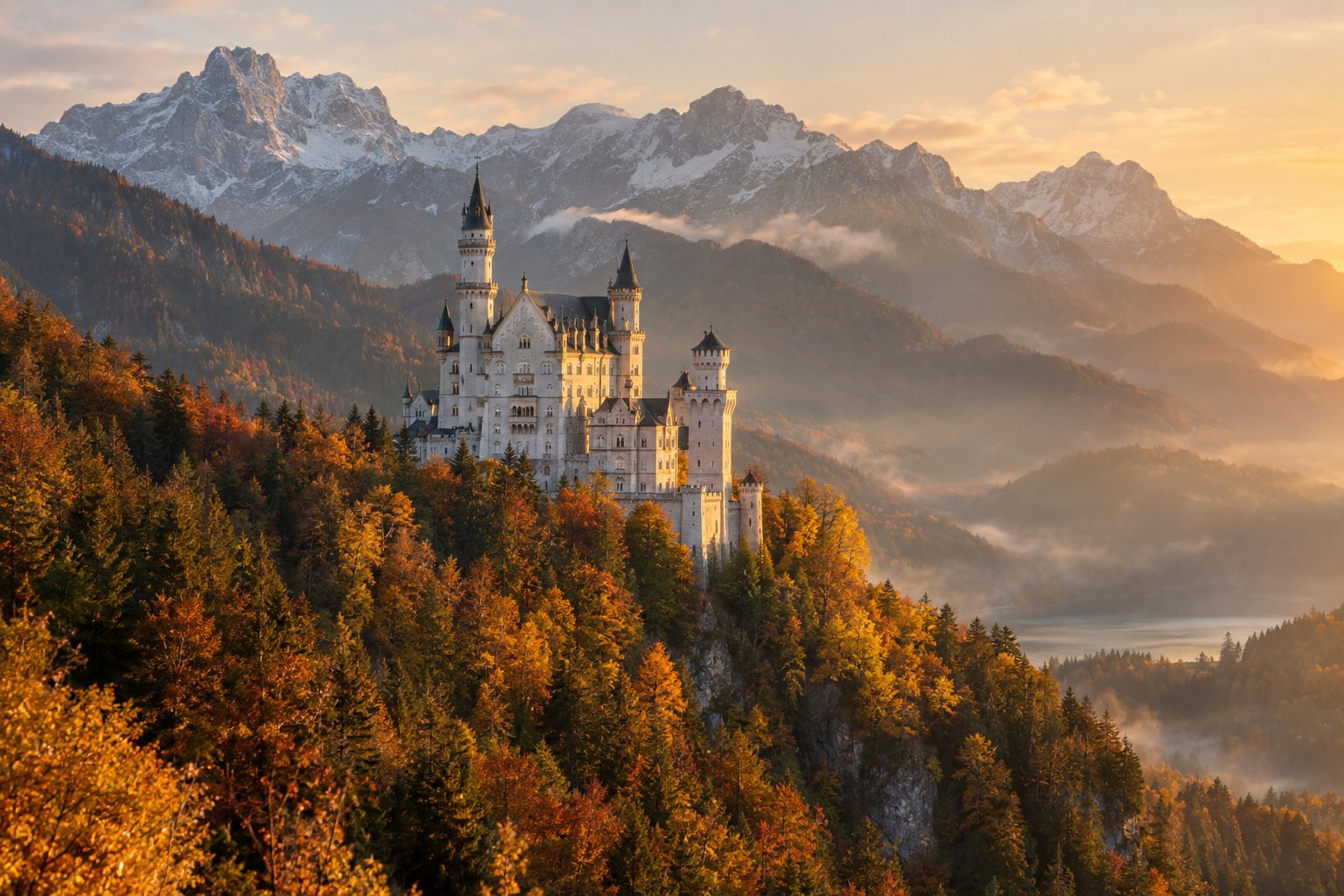
Neuschwanstein is the castle people know before they arrive: white limestone towers on a wooded spur above the village of Hohenschwangau, the Bavarian Alps behind, the Pöllat gorge below. King Ludwig II laid its foundation stone in 1869, spent by the usual count only about 172 days inside it, and died in June 1886 with the building still a construction site. Seven weeks later it opened to the public. In July 2025 it also became a World Heritage Site, one of four palaces the king built to escape a kingship he had largely lost.
The fame is the thing to plan around. Some 1.4 million people a year pass through rooms designed for one inhabitant, so the interior is seen only on a timed guided tour of about 30 minutes, tickets sell out, and a late arrival is turned away. The decisions that matter are how and when to book, how to reach a village with no railway station, how to make the steep final climb, where the photograph is taken, and which weeks are kindest.
What Neuschwanstein is, and why it was never finished
Ludwig II came to the throne in 1864 aged 18. Two years later Bavaria lost a war alongside Austria against Prussia and was forced into an alliance that stripped the king of command of his own army; from 1866, as the Palace Administration puts it, he was no longer a sovereign ruler. His answer was to build a kingdom of his own in stone: a New Hohenschwangau Castle on the ridge above his childhood summer home, inspired by the Wartburg and by Wagner, with theatre painter Christian Jank sketching the silhouettes before the architects drew plans.
The building history explains the shape you see. The foundation stone was laid on 5 September 1869, the main palace was topped out in January 1880, and the interior, including a Throne Hall on a steel frame and a Singers' Hall modelled on the Wartburg's, was essentially complete by mid-1884, when the king moved in. A planned Moorish hall was never built; a knights' bath was never started and its footprint is now the visitor staircase. Ludwig was declared insane and deposed in 1886 and died in Lake Starnberg on 13 June that year; the castle took the name Neuschwanstein only afterwards. The World Heritage inscription is a serial one shared with Linderhof, the King's House on the Schachen and Herrenchiemsee.
The Bavarian Palace Administration states that Neuschwanstein opened to the public seven weeks after Ludwig II's death in 1886 and now receives about 1.4 million visitors a year, around 6,000 a day in summer, in rooms intended for a single inhabitant; the crowds, alpine climate and light put considerable stress on the furniture and textiles. [8]
The four palaces were built under Ludwig II between 1868 and 1886 as personal retreats and imaginative escapes, drawing on Wartburg Castle, Versailles, German fairy tales and Wagner's operas; conceived as total works of art, they were private residences, opened to the public shortly after the king's death and now preserved as museums.
— Paraphrased from the UNESCO World Heritage listing for the Palaces of King Ludwig II of Bavaria
Tickets: what they cost and how to book
Every ticket is for a guided tour at a fixed time on a fixed date, capped at 35 people. The two legitimate points of sale are the official online shop, run on behalf of the Palace Administration, and the Ticket Center on Alpseestraße in Hohenschwangau, which sells whatever remains for the same day only. There is no telephone reservation, no waiting list and no exchange once paid. Third-party sites resell the same slots at a mark-up.
As checked in September 2026, the Bavarian Palace Administration's 2026 admission charges for Neuschwanstein are 21 euros for adults and 20 euros reduced, with under-18s free but still requiring a ticket; the online shop adds a 2.50 euro fee per ticket, including free ones, and box-office tickets at the Ticket Center in Hohenschwangau are sold only for the current day, first come, first served. [1]
The reduced price applies to over-65s, students, hotel guest card or KönigsCard holders and disabled visitors, with identification; the Ticket Center's price page lists the same categories and the separate prices for privately owned Hohenschwangau Castle, which the Bavarian palace passes do not cover. Pass holders still need a timed Neuschwanstein ticket, booked online for the 2.50 euro fee alone.
Book as soon as your date is fixed. Summer weekends sell out weeks ahead; if your date shows nothing, try an adjacent day or a German-language tour, which covers the same rooms. Failing that, a limited batch of same-day tickets goes on sale at the Ticket Center from 8 am and in high season is gone by late morning; the Palace Administration's own advice is to queue from 8 or earlier and to accept that on a sold-out day the castle cannot be visited. Tours run in German and English, with audio-guide versions in other languages on designated slots.
Timed entry and the rules inside
The official opening page is blunt: tours start punctually and late arrivals can no longer take part. Your ticket carries a tour number, which appears on a monitor beside the courtyard turnstiles when your group is called; you pass through, meet the guide inside and follow a fixed route through the royal apartments and the two great halls in about half an hour.
Neuschwanstein's official opening hours are 9 am to 6 pm from 28 March to 15 October and 10 am to 4 pm from 16 October to 27 March, daily except 1 January and 24, 25 and 31 December; the castle can be visited only on a guided tour of about 30 minutes, tours start punctually, late arrival ends participation, and rucksacks, prams and child carriers may not be taken inside. [2]
Two rules catch people out. Photography and filming inside, even for private use, are not permitted; the exterior is free to photograph. And there is no left-luggage facility, so day packs, prams and child carriers must be left in your car or coach, which for rail travellers means carrying only a small bag up the hill. Animals are not admitted and drones may not fly from the estate. Children under 14 must be accompanied by an adult, and every child needs a free ticket added at the moment of booking.
Getting there from Munich
Hohenschwangau has no station. The standard route is a regional train from Munich Hauptbahnhof to Füssen, about two hours, then RVA bus 73 or 78 from Füssen station to the stop named Hohenschwangau Neuschwanstein Castles, roughly ten minutes. As checked in September 2026 the operator lists a single fare of 3 euros and an adult day ticket of 8.90 euros, free with a Füssen guest card or KönigsCard. Check the last bus back before you climb.
For a day trip, the Bayern-Ticket, Deutsche Bahn's regional day ticket, is usually cheapest: as checked in September 2026 it cost 34 euros for one person and 44 euros for two in second class, covering regional trains and almost all buses in Bavaria, the castle buses included. The catch is the weekday start time of 9 am, which puts you in Hohenschwangau around noon at the earliest; at weekends it is valid from midnight. For an early weekday slot, buy a point-to-point ticket, or stay overnight in Füssen.
Drivers leave the A7 at its end near Füssen and follow the B17 to Schwangau. All four car parks are in the village, at 12 euros for up to six hours; the road up to the castle is closed to private cars, so the last stretch is on foot, by bus or by horse.
The climb, the shuttle and the carriage
The Palace Administration's access page gives the walk as about 1.5 kilometres and 30 to 40 minutes from the Ticket Center on a steep tarmac road through the woods: not difficult for anyone used to hills, but relentless, and slower in summer heat or with small children.
The shuttle bus leaves from beside car park P4, below Hohenschwangau Castle, and climbs to the Jugend viewpoint next to Marienbrücke, above the castle. From there it is about 500 metres and 10 to 15 minutes downhill to the entrance, on a path of 12 to 19 per cent gradient not recommended for anyone unsteady on their feet. Buses run on demand roughly every 20 minutes, in summer from 8 am with a last descent at 6.45 pm and in winter from 9 am with a last descent at 5 pm; they stop in snow or ice. Tickets are bought on board.
The horse-drawn carriages start outside Hotel Müller on Alpseestraße and take about 20 minutes to a turning area below the castle, leaving a final 450 metres and 10 to 15 minutes uphill. They run all year on demand, roughly every half hour, with no reservation; you pay the driver. Bus and carriage are run by independent companies, so check the Ticket Center's pages for current fares. A folding wheelchair fits in a carriage, but there is no ramp and the tour involves stairs; contact the castle administration in advance if step-free access matters.
Marienbrücke and the photograph
The view everyone has seen is from Marienbrücke, an iron footbridge slung high across the Pöllat gorge, with the castle filling the frame and the lakes beyond. Ludwig's father Maximilian II had a wooden bridge built here in the 1840s for his mountain-walking queen, Marie; the iron replacement of 1866 carries her name, and Ludwig used it to watch his building rise.
The Ticket Center Hohenschwangau states that the shuttle bus to the Jugend viewpoint and Marienbrücke costs 3.50 euros uphill or 5 euros return, runs on demand without a timetable and only when there is no snow or ice; in winter the bridge itself is closed temporarily when icy, with daily status posted on the Ticket Center's homepage, and castle tours continue regardless. [5]
The bridge is free and needs no ticket, it is narrow and busy in the middle of the day, and the light is best early or late. Winter closures for ice typically come between November and March. Do not climb the railings or step onto the fenced slope beyond the bridge. A wider, less crowded angle is the Tegelberg cable car station to the east.
When to go, and what else is in the valley
Late September and October are the sweet spot: the beech on the slopes turns gold, coach traffic thins, the walk up is cool and the castle keeps its long hours until 15 October. From 16 October the day shortens to 10 am to 4 pm; in exchange, mid-week tickets are easy to find and snow on the towers is possible from November. July and August bring the largest crowds, the earliest sell-outs and the hottest climb. Spring, from the return to summer hours on 28 March, is quiet but the bridge may still be closed after a cold spell.
Give the valley more than the gap before your tour. Hohenschwangau Castle, the ochre-yellow house on the lower hill, is where Ludwig grew up among wall paintings of the swan-knight legend that shaped everything he later built; its guided tour is a gentler 15 to 20 minute walk from the Ticket Center. The Museum of the Bavarian Kings on the lakeshore needs no timed slot, and the Alpsee, a cold green lake ringed by forest, has a level two-hour path around it. Füssen, ten minutes away by bus, has a painted old town and is a far better place to eat than the village car park.
- Book a timed tour in the official online shop as soon as your date is fixed: 21 euros per adult plus a 2.50 euro fee, and a free ticket, also with the fee, for every child.
- Be in Hohenschwangau 1.5 to 2 hours before your slot; on a weekday Bayern-Ticket that means a tour no earlier than early afternoon.
- Walk up if you have the legs, or take the shuttle to Marienbrücke for the view first; carriages leave from Hotel Müller.
- Carry only a small bag: rucksacks, prams and child carriers cannot enter the castle and there is no storage at the top.
- Check the Ticket Center's daily notice for Marienbrücke and shuttle status in winter or after a cold snap.
Respect for the place is mostly arithmetic. Six thousand people a day pass through rooms intended for one, so keep to the roped route, touch nothing, and stay on the roads and marked paths outside. The Palace Administration is honest that the castle's fabric is under strain from its own popularity; the least a visitor can do is not add to it.
Neuschwanstein rewards a considered day rather than a snatched one, and the mountains around it deserve the rest of your week. To the east, Hallstatt presents the same problem of a small place with a famous view and the same solutions of early hours and an overnight stay. Across the Swiss border, the waterfall valley of Lauterbrunnen is a good foil: no ticket, no tour, just the walk. And if the romantic-palace impulse itself draws you, Portugal's Pena Palace at Sintra was rising on its own hilltop in the decades Ludwig was sketching his.
Sources & further reading
- 1. Bavarian Palace Administration — Neuschwanstein Castle: Admission charges 2026 (official prices, online fee, box-office rules)
- 2. Bavarian Palace Administration — Neuschwanstein Castle: Opening hours and guided tours (official hours, closures, timed-entry rules)
- 3. Bavarian Palace Administration — Neuschwanstein Castle: How to get there (official walk, carriage and shuttle-bus guidance)
- 4. Ticket Center Hohenschwangau — Visitor FAQ (official: tour capacity, same-day sales, shuttle and carriage frequency, parking fees)
- 5. Ticket Center Hohenschwangau — Marienbrücke (Mary's Bridge): history, shuttle fares and winter closures
- 6. UNESCO World Heritage Centre — The Palaces of King Ludwig II of Bavaria: Neuschwanstein, Linderhof, Schachen and Herrenchiemsee (listing 1726)
- 7. German Federal Foreign Office / UNESCO — Inscription of the castles of King Ludwig II of Bavaria, 12 July 2025
- 8. Bavarian Palace Administration — Neuschwanstein: the palace today (official visitor numbers and conservation pressures)