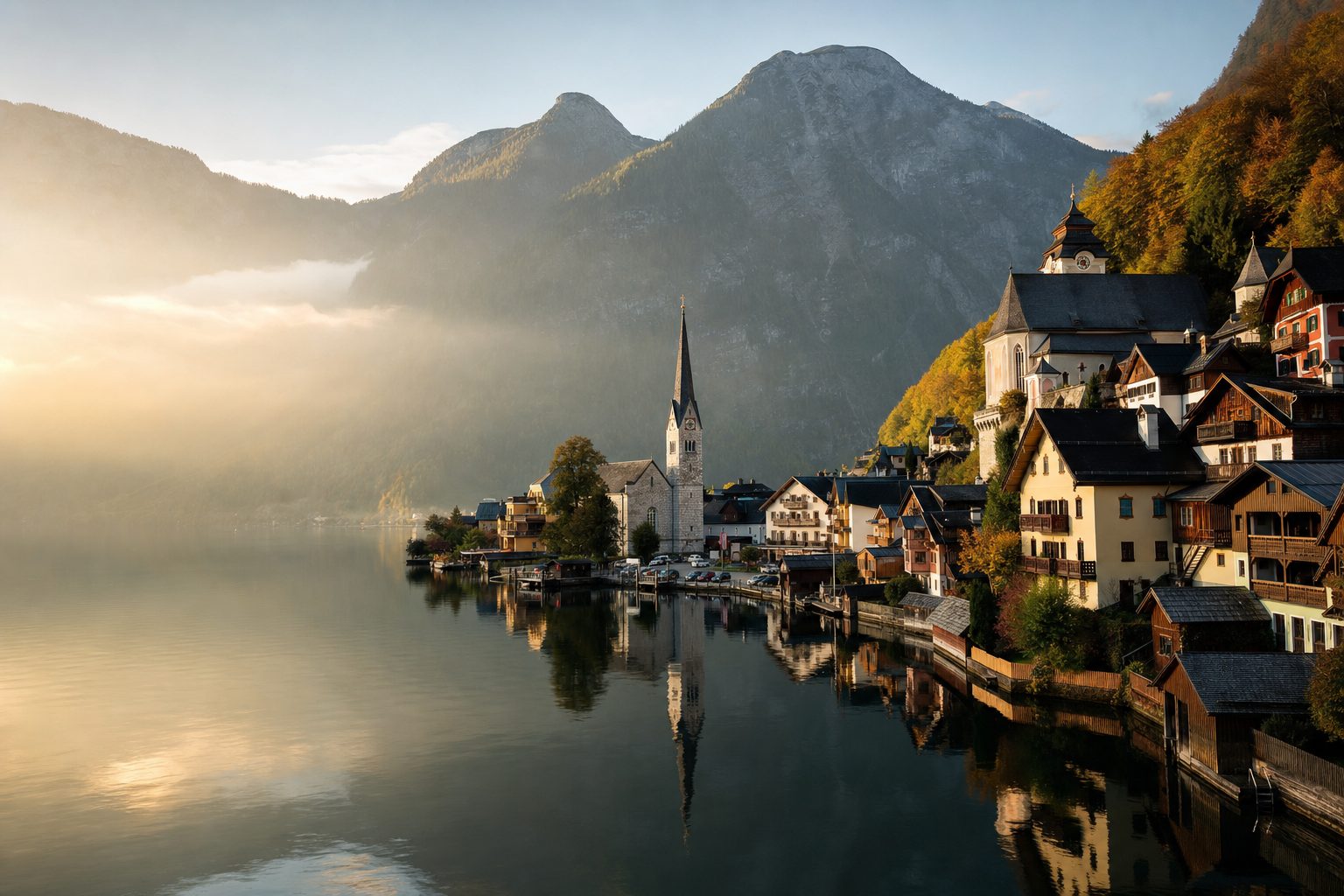
Hallstatt’s setting is unusually easy to recognise: steep wooded slopes fall into a narrow lake, a church spire punctuates the shore, and timbered houses sit between water and mountain. The late-2026 version of the familiar view comes with two decisions. First, decide whether the reopened salt mine is the centre of the visit or simply a reason to spend a few hours above the village. Then choose whether to arrive before the day-trippers or stay after they have gone. Those choices matter more here than a longer list of sights.
This is a village of about 780 permanent residents that receives more than one million visitors a year; summer peak days can bring more than 10,000 people. Hallstatt is not a place to “beat” by rushing through it. The more useful aim is to give the narrow streets, lake path and high valley different parts of the day, while accepting that the most photographed hour is usually the least rewarding. As checked on 17 August 2026, reopening dates, ticket prices and transport arrangements remain time-sensitive, so confirm the live details with Salzwelten Hallstatt before travelling.
Choose the quiet hours before choosing the date
For a summer day trip, the most effective crowd strategy is simple but demanding: be on the lakeside before 09:00 or make the principal walk after 17:00. Coaches begin to change the village’s rhythm from roughly 09:30, and the waterfront path is commonly congested by 10:30; the hardest period is late morning through afternoon. This is not a call to race around at dawn. It is a reason to use the first hour for the lake edge, the cemetery and the lanes around the centre, when those spaces can still feel like parts of a lived-in settlement rather than a queue between viewpoints.
Hallstatt has around 780 permanent residents yet receives more than one million visitors a year, with more than 10,000 visitors a day reported in July and August. The village centre has no through-traffic for ordinary visitors. [5]
If dates are flexible, May, early June and October generally offer a calmer balance of open services, lake weather and room to walk. July and August can still work, particularly with an overnight, but should be treated as a morning-and-evening destination rather than an all-day promenade. Avoid using 15 August as a test of the village’s normal character: Austria’s Assumption Day holiday is among the busiest dates. In late September and October, the shorter daylight is the trade-off, yet the chance to look across the lake without a coach line in the foreground is often worth it.
The most considerate Hallstatt visit uses the village in its quieter margins: arrive ahead of the main coach wave or remain after it, rather than trying to force a leisurely experience into the central midday surge.
— Paraphrased from Salzburg Trip’s Hallstatt crowd-timing guide
Plan around the salt mine reopening, not an assumed opening
Salzwelten Hallstatt, its funicular and the Skywalk remain closed for renovation until 28 August 2026. The announced reopening is Saturday 29 August at 09:00, so visitors in the final days of August should not build an itinerary around facilities that are still inaccessible. For anyone who has saved the familiar elevated Hallstatt reel, this is the important late-summer dividing line: before it, the high valley is a closure problem; from reopening, it becomes a timed-ticket and queue-management decision. Check the official opening-hours and prices page again close to the date.
Salzwelten Hallstatt, the funicular and Skywalk are closed for renovation until 28 August 2026 and are scheduled to reopen on Saturday 29 August 2026 at 09:00. From 29 August to 24 October, the mine’s last tour starts at 16:30 and the funicular runs 09:00–18:00; from 25 October to 6 January 2027, those closing points move to 15:00 and 16:30 respectively. [2]
After reopening, the main combined ticket is €49 for an adult and €23 for a child aged 4–15, including the funicular. Hikers can enter the mine without the funicular for €33, while a funicular-only return is €29 for adults and €14 for children; those return tickets are bookable from 1 September 2026. The €80 adult season pass makes sense only for a genuinely repeat local or extended regional stay, not as a hopeful way to avoid one busy day. Children under four are not admitted to the mine, so a family should decide this before reaching the upper station.
The mine is a better middle-of-the-day commitment than the village’s main lakefront. Allow enough margin for the funicular, the tour and the return, and do not take the published final tour time as a reason to arrive at the last possible minute. Visitors need sturdy footwear and warm clothing; audio guides are available in 15 languages. The practical choice is whether the mine’s history is worth a substantial part of the day. If it is, place it between an early lake walk and a late village dinner. If not, avoid paying for an ascent solely to reproduce a view.
Use the Altaussee shuttle only before the reopening
There is a short transitional option while Hallstatt’s own mine is shut. Until 31 August 2026, the official daily service leaves Hallstatt Lahn bus terminal at 13:30 for Salzwelten Altaussee, returning after the guided mine tour. The €44 adult and €24 child fare includes the return journey and mine admission. It is an intelligent substitute for visitors already committed to Hallstatt in the closure window, but not an interchangeable Hallstatt experience: it gives access to a different mine and uses most of an afternoon that could otherwise be spent in the village after the coaches leave.
Treat the shuttle as a fixed commitment. It departs at 13:30, reaches Altaussee for the guided tour, and returns to Hallstatt at about 17:00. That timing can work neatly for an early Hallstatt arrival followed by the mine substitute, but only if luggage, parking and the return journey are already settled. It is not a useful late-morning rescue plan. From 29 August, Hallstatt’s own reopening generally makes the diversion unnecessary; on 29–31 August, compare the live booking availability and choose the mine that actually supports the rest of the day.
Arrive without adding to the road pressure
Driving calls for restraint. The centre is not a route through the village, and attempting to treat it as one makes a fragile traffic situation worse. For most visitors, P1 Park-and-Ride at Lahn is the practical option: it is about 1.2 km from the village, with a €2.50 shuttle. P2 at Lahn leaves an 800-metre walk but commonly fills by 08:00 in peak season. If the plan requires P2, arrive early enough to make that realistic; if it does not, go directly to P1 rather than circling in hope of a closer space.
That last kilometre should shape accommodation too. An overnight in Hallstatt or nearby allows a lake walk before breakfast and a return after the buses have gone, without a second parking decision. A day trip can work, but it needs a firm arrival or departure edge. Train travellers may find the broader guide to travelling around Europe useful for joining scenic rail legs to local transfers; drivers planning a larger Alpine route should also borrow the reservation-first mindset of our Dolomites hiking guide. Hallstatt rewards that preparation more than an improvised detour.
Understand what the new coach controls can and cannot solve
Austria’s tighter 2026 tourism measures are intended to reduce the unmanaged coach surges that have overwhelmed small high-profile destinations. In Hallstatt, the reported changes include strict coach time slots, numerical limits, advance registration for larger groups and higher coach entry or parking fees at peak hours. They should improve the conditions around arrivals, but travellers should not interpret them as a promise of an empty village. A cap on buses does not remove cars, independent visitors or the appeal of a clear summer morning.
The 2026 Hallstatt controls reported for larger coach groups include timed arrival slots, numerical caps, mandatory advance registration and higher peak-hour coach parking or entry fees. Exact limits and start details should be checked locally because the published report gives no figures. [6]
The respectful response is to travel as though those limits did not create extra space for another unplanned group. Keep pathways clear, step away from doorways for photographs, and do not make the cemetery, churchyard or residents’ thresholds an extension of a viewing platform. Choose one or two viewpoints rather than attempting every social-media angle. Hallstatt’s scale is the reason it is memorable, but it is also the reason a small number of inconsiderate decisions are conspicuous. A 90-minute visit at a thoughtful time can be better than four congested hours.
- In July and August, arrange to be on the lake path before 09:00 or after 17:00; avoid treating late morning as the main sightseeing window.
- For visits from 29 August 2026, verify Salzwelten’s reopening status, ticket availability and the seasonal last-tour time before travelling.
- Use P1 Park-and-Ride if driving, or arrive very early for P2; do not enter the restricted village centre looking for a shortcut.
- Take sturdy shoes and a warm layer for the salt mine, and do not plan a mine visit for children under four.
- Keep the churchyard, lanes and private doorways clear, and let the new coach controls reduce pressure rather than become a reason to add to it.
Treat the Skywalk as a view, not the whole visit
Once the funicular has reopened, the Skywalk is the natural add-on for anyone already going to the high valley. The 12-metre walkway projects above the village and lake; access is free once up the funicular. Below Rudolfsturm, the Welterbeblick deck provides another angle without pretending that every visitor needs to stay long. Use both with patience, take the photograph efficiently, and make space for people who may have waited behind. The better reason to ascend is the shift in scale: Hallstatt becomes a narrow inhabited shore rather than a thumbnail.
The Hallstatt Skywalk is a 12-metre viewing walkway above the village. It is free to access after the funicular ascent, and the Welterbeblick viewing deck sits below Rudolfsturm. [3]
For a first visit, an overnight makes the elements cohere: lake path in the early light, mine or Skywalk while the village is crowded, then a quieter evening by the water. For a day trip, choose either the mine-and-Skywalk combination or a village-led visit, rather than forcing both into a narrow schedule. If Hallstatt is one stop in a Central European route, our Lake Bled guide offers a useful next comparison: another iconic lake setting where early and late hours, rather than a frantic checklist, determine how the destination feels.
Sources & further reading
- 1. Salzwelten Hallstatt: reopening notice and Altaussee shuttle
- 2. Salzwelten Hallstatt: prices and opening hours
- 3. Dachstein Salzkammergut: Hallstatt Salt Mine and Skywalk
- 4. Salzburg Trip: Hallstatt crowd timing guide
- 5. Travel Tip Now: Hallstatt travel guide 2026
- 6. The Traveler: Austria’s 2026 tourism controls
- 7. Salzburg.info: Hallstatt Saltmines visitor information
- 8. Im Salzkammergut: Altaussee shuttle during Hallstatt renovation