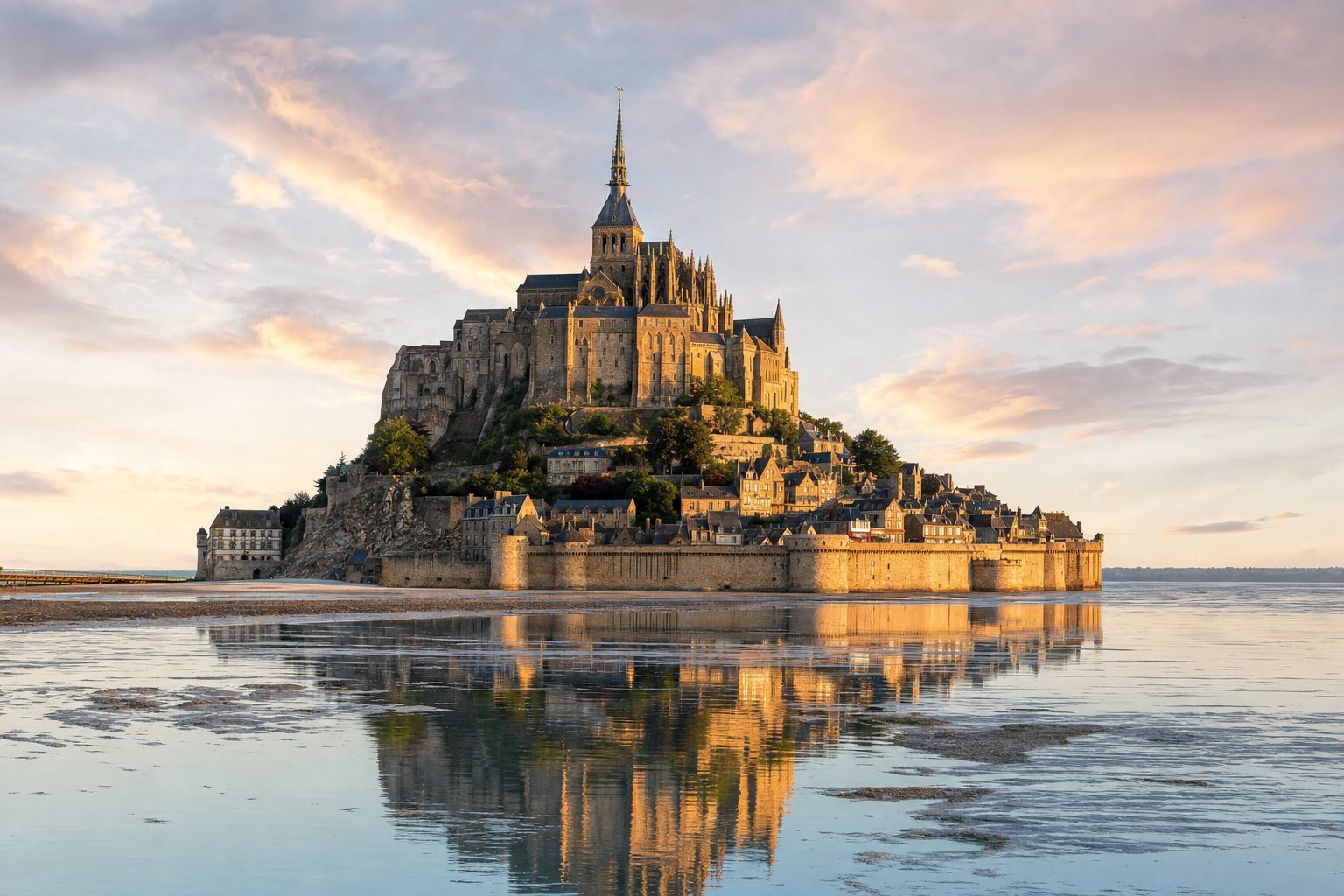
Mont Saint-Michel photographs as a single dramatic silhouette, but visiting it well means making several separate decisions before you arrive: where to park, whether the abbey ticket is worth timing around opening hours, and whether to plan the trip around a big tide or avoid one. Since 2014 there has been no way to drive onto the rock at all, so the first decision is really about the mainland side of the bay, not the Mont itself. A causeway that once let cars park on the sand beside the walls was replaced by a footbridge on piers, built specifically to stop vehicles reaching the base of the ramparts and to let the sea flow freely around the Mont again, as it once did before a 19th-century dam and road caused the bay to silt up.
That single change reshaped almost everything about a visit: parking, walking distance, shuttle timing and even how the tides look from the ramparts. This guide works through the decisions in the order a first-time visitor actually faces them, from reaching the village to deciding whether the abbey ticket and a big-tide date are worth building the trip around. As checked in August 2026, fees, hours and shuttle details can shift with the season, so confirm specifics at the official abbey site and the Normandy Tourism board before finalising dates.
Decide how to cross from the car park, because you cannot drive to the Mont
Every visitor now parks on the mainland and finishes the journey on foot, by bicycle or aboard a free shuttle bus. The paid car parks sit roughly 2.5 kilometres from the rock, a deliberate distance built into the 2014 redevelopment that moved vehicles off the strand entirely and restored a clear view of the bay on the approach. From the car parks, a free shuttle line called Le Passeur runs pedestrians to the Mont, and walkers and cyclists can also use the footbridge directly, which is open around the clock all year except under an exceptional prefectural order.
As checked in August 2026, light-vehicle parking areas are located 2.5 km from Mont Saint-Michel, the 2.2 km pedestrian footbridge is open to walkers and cyclists year-round, and the free shuttle service, Le Passeur, carries pedestrians between the car parks and the Mont, according to the site's official access page; parking itself is paid, with rates varying by season and length of stay. Budget more time for this stretch than the map distance suggests. Walking from the car parks to the abbey entrance typically takes 45 minutes to an hour depending on visitor numbers, and that is before you factor in the climb through the village itself once you reach the base of the ramparts. Cyclists are asked to dismount on the footbridge when pedestrian traffic is heavy and may only use the western side, so a bike does not guarantee a faster crossing on a busy afternoon; it mainly saves the wait for a shuttle.
Separate the free village from the paid abbey before you budget the day
One of the more useful things to understand before arriving is that most of what makes Mont Saint-Michel visually striking, the fortified village, the Grande Rue, the ramparts walk and the sweeping bay views, costs nothing and has no opening hours. The abbey at the summit is the only part of the site that requires a paid ticket and operates on a timed schedule, so a visitor who only wants to walk the ramparts and photograph the bay can do that at 6am or 11pm without booking anything.
As checked in August 2026, the village of Mont Saint-Michel, including the Grande Rue and ramparts, is freely accessible year-round without a reservation, ticket, or time restriction, according to the official abbey site; only the abbey at the summit requires a paid entry ticket. That distinction changes how you should plan arrival time. If the abbey is the priority, build the day around its published hours and the last-entry cutoff. If it is not, the free portion of the site rewards an early or late visit regardless of ticket logistics, since the crowds thin out well before the abbey even opens and again after most tour groups have left in the late afternoon.
Book the abbey around its 2026 hours, fees and free-entry rules
Abbey admission runs on a seasonal fee structure and a seasonal clock, both of which the official site updates each year. Getting the timing wrong mainly costs you time in a queue rather than money, since same-day tickets are generally available, but arriving close to the last-entry cutoff risks a rushed visit through a site that includes a genuine climb.
As checked in August 2026, the individual abbey ticket costs €16 from 1 April to 30 September 2026 and €13 from 1 October 2026 to 31 March 2027; opening hours run 9:00 a.m. to 7:00 p.m. from 1 May to 31 August and 9:30 a.m. to 6:00 p.m. the rest of the year, with last entry one hour before closing; the abbey is closed on 1 January, 1 May and 25 December. [1]
Admission is also free for visitors under 18 travelling with family, and free for 18 to 25 year olds who are EU citizens or long-term French residents (not valid for groups); other free-entry categories include jobseekers with recent documentation and the first Sunday of January, February, March, November and December. The climb itself deserves honest expectations. The route to the abbey winds up roughly 350 steps through the village and ramparts, and the official guidance is blunt that the site is difficult for anyone with reduced mobility, strollers or certain health conditions, since there is no lift. Strollers must be folded before entering the monument, and walking from the car parks alone already takes the better part of an hour, so the abbey visit sits on top of a day that is physically active well before you reach the first staircase.
Choose your visiting window around the tides, not just the abbey clock
The Bay of Mont Saint-Michel has the largest tidal range in continental Europe, and that fact drives a second, independent scheduling decision on top of the abbey's opening hours. France rates every tide with a coefficient, and once that figure passes roughly 110, the incoming water can fully encircle the rock and turn it back into a true island for an hour or so, exactly as it was before the causeway existed.
As checked in August 2026, the Bay of Mont Saint-Michel has the highest tides in continental Europe, with a tidal range that can reach around 14 metres and a low tide that can retreat several kilometres from shore; when the tidal coefficient exceeds roughly 110, the rising sea can fully surround the Mont and cut off pedestrian access for a period of hours. [2]
As checked in August 2026, the highest tidal coefficient forecast for 2026 is 105, on 18 April, with other strong tide windows around the spring equinox on 20–21 March and around the autumn equinox on 12–14 September; the modern footbridge remains passable on piers even during the largest tides, though the low esplanade near the entrance can flood briefly, around an hour at the peak, on the strongest days. [2]
In practice, this means 2026's very highest coefficient falls short of the roughly 110 threshold where the Mont becomes a genuine island, so most visitors planning around the equinox windows will see a dramatic, fast-rising tide reach the base of the ramparts rather than a full encirclement. If watching the water close in matters to your trip, arrive at the ramparts, the western terrace or the footbridge about two hours before the predicted high tide, since the flood advances quickly once it starts. Tide tables and daily coefficients are published by the local tourist office and by Normandy's regional tourism board well in advance, so check the specific date against the current calendar rather than relying on a general rule of thumb.
The rising tide surges around the base of the rock quickly enough that the roar of the advancing water can be heard before it arrives, surrounding Mont Saint-Michel with the sea on the highest-coefficient days of the year.
— Paraphrased from Normandy Tourism's guidance on high tides at Mont Saint-Michel
Decide whether to walk the bay, and only with a licensed guide
The exposed sand at low tide looks walkable, and pilgrims did cross it on foot for centuries, but the bay is not a casual detour from the footbridge. Shifting quicksand, fast-moving river channels and a tide that can advance faster than a person can walk make unguided crossings genuinely dangerous, and French authorities treat this as a matter of licensing, not just advice.
As checked in August 2026, crossings of the Bay of Mont Saint-Michel are only permitted with a guide certified by the Manche prefecture, due to quicksand, shifting river channels and tides that can advance faster than walking pace; official guidance states visitors should never venture into the bay alone. [3]
Certified guides run everything from a short one to two-hour introduction to the quicksand near the Mont, to a full return crossing of roughly 13 to 15 kilometres from Bec d'Andaine or Vains-Saint-Léonard on the mainland, typically taking five to six hours. Départures are set by the tide rather than the clock, since the bay floor is only walkable in the hours around low water, and guides plan the route to stay clear of the main river channels well before the flood returns. Bookable outings run through the Mont Saint-Michel tourist office and independent certified guides listed on its site; going barefoot or in snug neoprene booties is standard practice, and ordinary shoes are not permitted on a guided crossing.
- Park on the mainland and take the free Le Passeur shuttle or walk the 2.2 km footbridge; no vehicle access to the Mont has existed since the 2014 causeway replacement.
- Visit the village, Grande Rue and ramparts for free at any hour; reserve the paid abbey ticket and its timed hours only if the summit visit matters to your plan.
- Check the current tidal coefficient before choosing a date if you want to see the bay dramatically fill or empty, and arrive at the ramparts roughly two hours before high tide.
- Book a Manche-certified guide for any walk onto the bay's sand; never attempt an unguided crossing because of quicksand and fast-moving tides.
- Arrive before 10am or after 5pm, especially in summer, when the village's cobbled streets are least crowded.
Time your arrival to avoid the midday crush
Mont Saint-Michel is described by Normandy's regional tourism board as the second most visited monument in France, and that popularity concentrates heavily around midday in summer, when tour buses converge with independent travellers on the same narrow Grande Rue. The practical fix is straightforward: shift your visit earlier or later rather than fighting the peak.
As checked in August 2026, Normandy Tourism advises that the medieval streets and site are generally quieter outside holiday periods, on weekdays, before 10am and after 5pm, particularly in summer, and around 8am the cobbled streets are still uncrowded; the board also recommends allowing at least half a day to see the village, ramparts and abbey together. An overnight stay in one of the village's hotels, or nearby on the mainland, is the most reliable way to see the Mont in the early morning or after dark, when the day-trip coaches have gone and the site's own evening events, including summer light displays, are worth planning around. If a day trip is the only option, arrive at opening time or plan the abbey visit for the final hour before closing when queues are shortest, accepting the trade-off of a more time-pressured visit inside.
Mont Saint-Michel rewards travellers who treat it as a set of separate logistical decisions rather than a single stop on a wider itinerary. If tidal islands and causeway access are part of what draws you here, the same reasoning about checking current tide and access rules before travelling applies to Venice's own relationship with the water, while travellers drawn to dramatic rock formations rising from a plain may want to compare notes with our Meteora guide, and those building a longer Western Europe itinerary can pair this stop with our Dubrovnik old town guide for another fortified, pedestrian-only historic core.
Sources & further reading
- 1. Abbaye du Mont-Saint-Michel — Practical Information
- 2. Normandy Tourism — The Mont-Saint-Michel (unmissable sites)
- 3. Établissement public du Mont Saint-Michel — Crossings of the Bay
- 4. Établissement public du Mont Saint-Michel — Getting to Mont Saint-Michel
- 5. Normandy Tourism — High Tides at the Mont-Saint-Michel (2026 calendar)
- 6. Office de Tourisme Mont Saint-Michel Normandie — Crossing of the Bay (guides)
- 7. Dezeen — Mont Saint-Michel Bridge by Dietmar Feichtinger Opens to Pedestrians