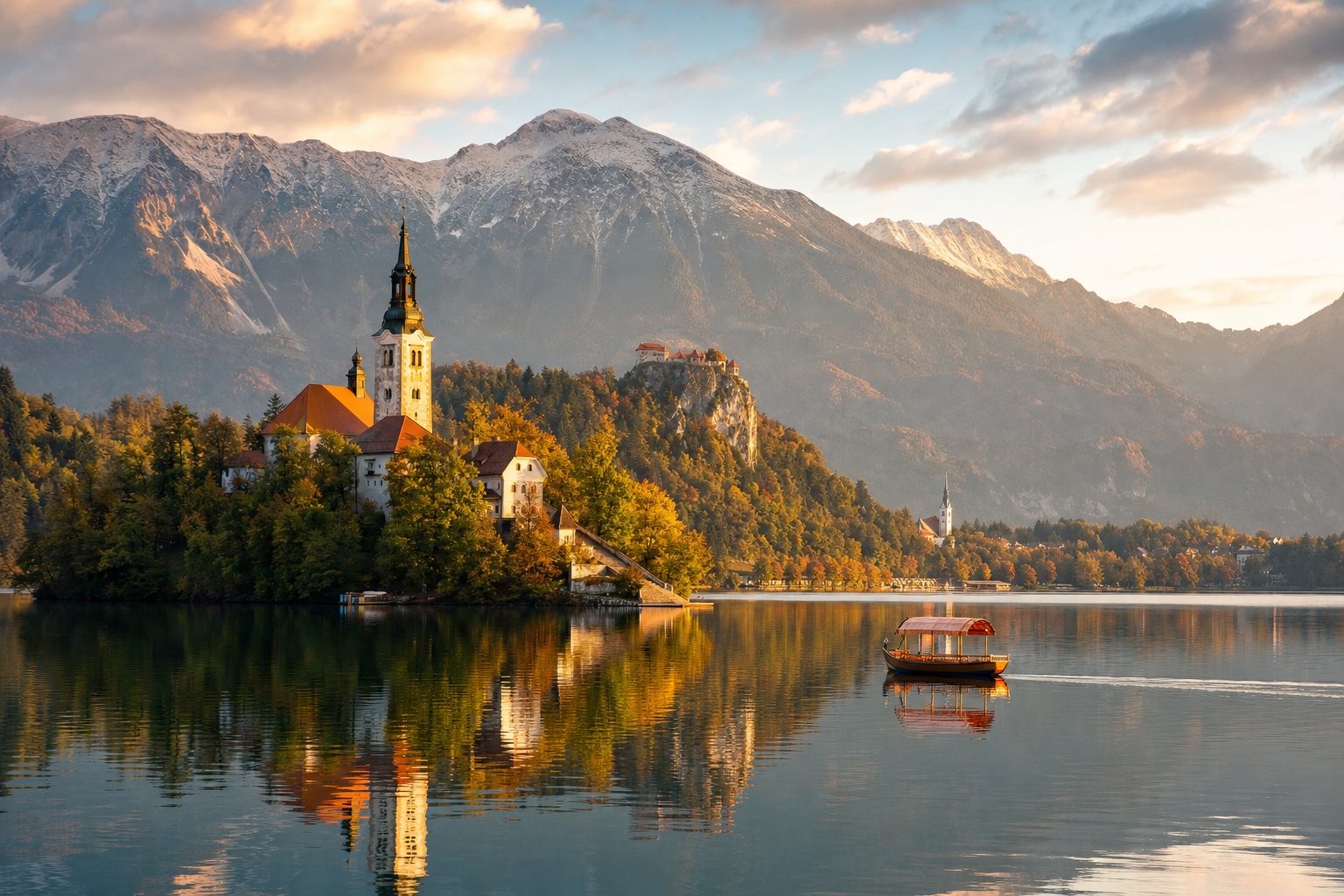
Lake Bled rewards a visitor who treats it as a timing problem rather than a checklist. The familiar image—a church on an island, a cliff-top castle and alpine slopes behind—can be seen in a long day from Ljubljana. Yet the choices that shape that day are practical: whether to take the traditional boat, when to reserve Vintgar Gorge, and whether the classic viewpoint is worth a steep walk before breakfast.
The most workable first visit gives the lake two different tempos. Use an early arrival for the shore and the island, then put a timed gorge slot or the castle in the middle of the day, when the open lake is busiest. An overnight stay makes the plan much easier, but a well-ordered day trip can still feel considered. This guide focuses on the decisions behind the postcard, including what each headline attraction costs and where the crowds have a real effect.
Arrive for the quiet edge of the lake
From Ljubljana, the direct Arriva bus is usually the simplest choice. As checked in August 2026, services run from Ljubljana bus station to Bled roughly every 30–60 minutes, take about 75–80 minutes and cost around €6 one way; the Bled stop is a short, flat walk from the lake. Timetables change seasonally, so use the current operator timetable rather than treating that frequency as a promise. For a summer day trip, select a departure that reaches Bled before the main late-morning wave, not merely the cheapest one.
The train is reasonable only when its connection suits the wider journey. Ljubljana–Lesce-Bled takes about 50 minutes, but Lesce-Bled station is 4 km from the lake, leaving a local-bus, taxi or cycle link to arrange. That extra leg commonly removes the train’s apparent advantage over the direct bus. Visitors continuing across the continent may find the broader guide to travelling around Europe useful for joining rail and local transport without turning Bled into a rushed stop.
As checked in August 2026, the direct Arriva bus from Ljubljana runs roughly every 30–60 minutes, costs about €6 one way and takes around 1 hour 15–25 minutes; the train to Lesce-Bled takes about 50 minutes but leaves a 4 km connection to the lake. [6]
Once in town, start with the lake rather than the castle queue. The official Bled visitor information describes a 6 km circuit that normally takes about an hour and a half, partly on asphalt and partly on sandy ground. It is a useful orientation walk, not a compulsory lap: take the quieter western shore when the light is good, note the pletna landing points, and leave enough margin to be back at a booked attraction. In July and August, a circuit begun early or after the day visitors leave is a better use of the path than a midday march.
The lake is best understood as one connected walk: a 6 km circuit whose changing surface and views make time, rather than speed, the important measure.
— Paraphrased from Bled official visitor site: Frequently Asked Questions
Decide what the pletna boat is worth to you
The pletna is not simply a scenic transfer. These flat-bottomed wooden boats are rowed standing up by pletnarji, and the operating tradition is associated with hereditary families dating to 1590. That history is the reason to choose one over a quicker-looking alternative, provided that a shared, weather-dependent crossing suits the day. Independent passengers normally board when a boat fills rather than against a rigid reservation timetable; bring patience as well as a view of the island.
As checked in August 2026, a standard pletna round trip costs €20 per adult, paid in cash directly to the pletnar. Allow roughly 15–20 minutes each way and about 40 minutes on Bled Island; the exact crossing varies by departure point. [2]
The fare is for the crossing, not a bundled monument ticket. On the island, visitors climb 99 steps to the Church of the Assumption. As checked in August 2026, adult church admission is €12; the tradition is to ring the wishing bell while there. This is a short visit by design. Treat the boatman’s agreed return time as fixed, skip a slow terrace lunch, and settle the church decision before climbing the steps. The island paths and the view back to the castle still give the crossing a purpose if you prefer not to pay for the interior.
For the calmest version, go early, carry €20 notes or smaller euros, and ask the pletnar when to be back at the landing. This is not the place to manufacture a private moment with a drone, a loud speaker or a prolonged photo set on the steps. Share the small landing space, keep the boat balanced while boarding, and accept that strong wind can interrupt services. The lake’s visual appeal remains even if the crossing does not run; a closed boat service is a reason to lengthen the shore walk, not to pressure the crew.
Book Vintgar Gorge before building the rest of the day
Vintgar Gorge is the part of a Bled visit least suited to spontaneity. It lies beyond the town and now works as a managed, one-way walk: the 1.6 km gorge section follows wooden bridges and paths above the Radovna, then a thematic return route completes the outing. The full experience can take around three hours, so it should displace another major attraction rather than be squeezed into a spare hour after lunch.
As checked in August 2026, Vintgar’s All-in-One Pass is €15 for adults, €5 for children up to 15 and €3 for dogs. Helmets are mandatory and provided, the gorge is one-way, and walking in the prohibited opposite direction can incur a €50 charge. [3]
Reserve the timed slot first. Tickets are sold online at tickets.vintgar.si, at the Vintgar LIP car-park hub and at Bled bus station—not at the gorge entrance. In July and August, allow around 48 hours’ lead time where possible, then verify the day’s opening window on the official site. The pass is designed around the access system: do not plan to drive to the entrance and improvise a ticket at the gate.
Wear shoes with grip, take water and regard the helmet as a safety measure rather than an inconvenience. The gorge’s boards can be wet and narrow, and the return is part of the route, not an optional reversal. If travelling with very young children, anyone uncomfortable with an extended one-way walk, or a dog that will find shuttle and foot traffic stressful, decide candidly whether Vintgar is the right outing. A lake day with the short Ojstrica climb is a better plan than a gorge visit undertaken under pressure.
Use Bled Castle as the late-day alternative
Bled Castle has the broadest lake view and works particularly well when a pletna or Vintgar booking has already fixed the morning. As checked in August 2026, it is open year-round; the stated April–October hours are 08.00–20.00. The climb from town is steep, so give the approach its own time rather than treating the terrace as a five-minute detour from the promenade. For a same-day visitor, late afternoon can be more useful than the middle of the day, when buses and group tours compete for the courts and viewpoints.
As checked in August 2026, Bled Castle admission is €19 for adults, €16 for seniors, €11.50 for students and €7 for children aged 6–14. The published April–October opening hours are 08.00–20.00. [5]
The admission covers more than the view, including the museum, chapel and printing works, so allow about 90 minutes if those elements matter. Otherwise, be precise about the purchase: €19 is an expensive viewpoint if you are only seeking a distant island photograph. The castle makes better sense for a traveller who wants historical context or who has deliberately saved the open water for another time. Its practical contrast with Venice’s managed visitor flow is worth considering in this Venice guide, especially when planning a route through several crowded European landmarks.
If the weather closes in, do not compensate by rushing between attractions. The lake circuit still offers changing angles of the island and castle, and the castle’s indoor rooms provide a defensible wet-weather substitution. Save Vintgar and Ojstrica for a dry, unhurried window; both are more enjoyable when surfaces are secure and the decision is not driven by a non-refundable-looking timetable.
Climb Ojstrica only with the right shoes and light
Ojstrica is the classic elevated composition: the island centred in the lake, Bled Castle to one side and mountains behind. It is not a paved viewing terrace. From the south side of Velika Zaka, the marked forest route takes about 20 minutes up to the 611-metre hill, and the official Bled guidance describes it as short but steep. Go in shoes with grip, avoid it when the ground is wet, and do not assume that a social-media image makes the final rocky ground suitable for sandals.
The decision is simple: climb early if the viewpoint is central to the trip, or skip it if your knees, footwear, weather or schedule make it marginal. The summit is small and its bench is not a stage. Let other walkers have a turn at the view, keep a distance from exposed edges and return before fading light reaches the forest. For travellers who want a more sustained alpine walking holiday rather than a short Bled ascent, the Dolomites hiking guide is a more appropriate next step.
- Book Vintgar first, then shape the Bled day around its timed entry and full one-way route.
- Arrive from Ljubljana early by direct bus if possible; use the train only when the Lesce-Bled connection fits the wider itinerary.
- Bring cash for the pletna and confirm the island return time before stepping ashore.
- Choose either Ojstrica at first light or Bled Castle late in the day instead of forcing both into the busiest hours.
- Leave the 6 km lake circuit flexible so it can absorb weather, a boat delay or an unhurried meal.
Choose an overnight when the lake itself is the point
A day trip is enough to understand Bled’s geometry, but an overnight lets the place become more than an arrival-and-departure photograph. It allows a pletna before the busiest boats, a Vintgar slot without sacrificing the lake, and a late return along the shore after the coaches have gone. It also gives weather a place in the plan: mountain showers, wind and low cloud should prompt a rearrangement, not a sense of failure.
The most useful first-time rule is to make one headline activity the anchor, then use the lake as the connecting space. A traditional boat, the gorge, the castle and the viewpoint each have a different rhythm; none improve when forced into the same crowded hour. If Bled becomes the opening stop in a longer route, use these Europe itineraries to build onward time in Ljubljana, the Julian Alps or northern Italy rather than treating Slovenia as a scenic interruption.
Sources & further reading
- 1. Tanya Guide: Pletna boat price in 2026
- 2. MachuPicchu.org: Lake Bled tours and walking routes 2026
- 3. Vintgar Gorge: official price list
- 4. E-Slovénie: Vintgar Gorge 2026 visitor guide
- 5. Adventure Factory: Bled Castle 2026 guide
- 6. Slovenia Spirit: Ljubljana to Lake Bled transport guide
- 7. Bled official visitor site: frequently asked questions
- 8. Bled official visitor site: Ojstrica