No road reaches Churchill. The town sits on the western shore of Hudson Bay, roughly 1,000 kilometres north of Winnipeg, and the nearest highway gives up at Gillam, some 300 kilometres to the south. Everything and everyone arrives by air, by rail or by sea, and that isolation is precisely why the place matters: each autumn one of the world's most watchable gatherings of polar bears assembles on the tundra at its doorstep, close enough that the town runs a dedicated bear patrol with its own phone line. Churchill calls itself the polar bear capital of the world, and for six weeks or so a year the title is hard to argue with.
Planning a trip here is a sequence of linked decisions rather than a shopping list. You need to understand when and why the bears gather, because the season is short and inflexible. You need to choose between a two-hour flight and a two-day train, because there is no third option. You need to decide between tundra vehicle day trips and a night or more out on the tundra itself. And you need to book all of it far earlier than feels natural for a town of around 900 people. This guide takes the decisions in that order.
Why hundreds of bears gather at Churchill
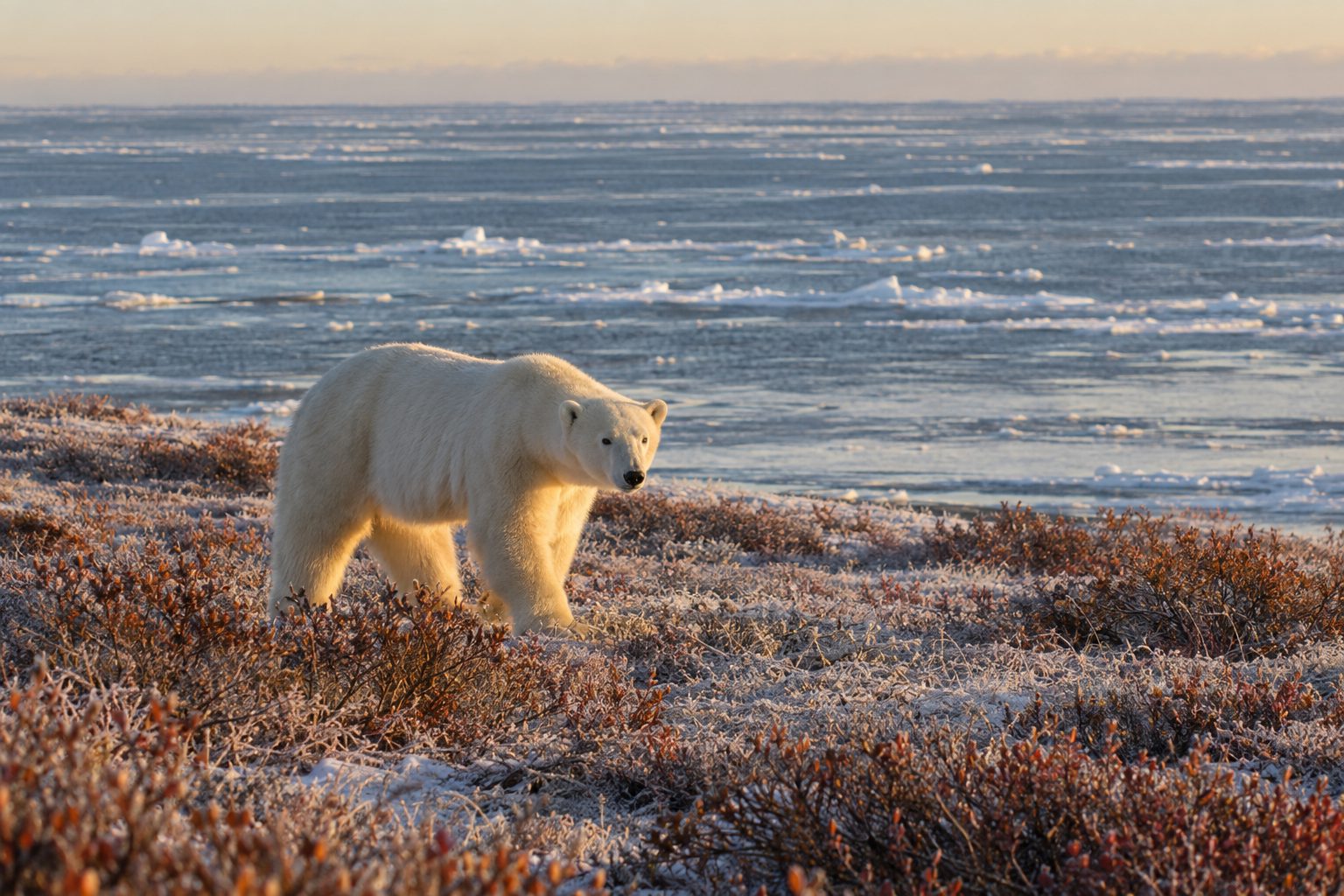
The western Hudson Bay polar bears are creatures of the sea ice: it is the platform from which they hunt seals, and it disappears entirely every summer. When the bay finishes melting in high summer the bears are forced ashore, where they eat very little and conserve energy in a state researchers call walking hibernation. Crucially for visitors, the ice re-forms first along the western coast near Cape Churchill, so as freeze-up approaches, bears from a huge sweep of coastline converge on the stretch of tundra east of town to wait for their hunting grounds to return.
The ice of Hudson Bay melts completely by the end of July or early August and does not refreeze until approximately early November, forcing the region's polar bears ashore for about three to four months, during which they live off fat reserves built up over the winter. [3]
That mechanism sets the viewing calendar. From mid-October to mid-November an average of around 600 bears roam the Hudson Bay coastline near Churchill, and this is when the tour industry runs at full tilt. Within the window there are nuances: early October brings fewer bears but snow-free tundra and thinner crowds; late October the biggest concentrations and sparring males; early November the best chance of mothers with cubs in golden light and fresh snow. By late November most bears are out on the frozen bay and the season is over. The Travel Manitoba polar bear pages are the best single overview of the season and its licensed operators.
From mid-October to mid-November, an average of about 600 polar bears roam the Hudson Bay shoreline near Churchill while waiting for the water to freeze, and Travel Manitoba advises planning and booking peak-season trips at least a year in advance. [1]
One caution from the scientists who live with this population: the Churchill Northern Studies Centre notes there is no guaranteed peak, because the congregation tracks ice formation rather than the calendar, and the window can run anywhere from early October to mid-December in a given year. Build your trip around the statistical heart of the season, then treat any specific week as a probability rather than a promise.
Getting there when the road stops 300 kilometres short
From Winnipeg you have exactly two choices. The quick one is the roughly two-hour flight, with Calm Air operating the main scheduled service, often via a brief stop in Thompson, and extra capacity added during bear season. As checked in October 2026, return fares typically run CAD 600 to 1,100, with late-October and early-November departures at the top of that range; checked baggage on these small aircraft is limited, with a standard 20-kilogram allowance and charges above it.
The slow one is one of North America's great remaining rail journeys. VIA Rail's Winnipeg–Churchill train — the historic Hudson Bay route — leaves twice a week and rolls north through boreal forest, across the Canadian Shield and finally onto treeless permafrost tundra, where frost-heaved track keeps speeds low and the ride gently rocking. Economy seats, curtained Sleeper Plus berths and a small number of private cabins are sold; as checked in October 2026, return fares span roughly CAD 340 to 1,200 by class, and a berth is worth it on a journey this long. Check current schedules and fares with VIA Rail directly, and note the service's history of weather and track delays: pad the itinerary.
VIA Rail's Winnipeg–Churchill train covers 1,694 kilometres with an average scheduled journey of 1 day, 20 hours and 55 minutes, and departs twice per week. [7]
Many travellers split the difference: train north for the slow transition from prairie to tundra, then fly back south in two hours. Whichever combination you choose, Winnipeg is the staging post, and most visitors sleep there the night before the northbound leg rather than gambling on a same-day connection.
Tundra Buggy day trips or a night on the tundra
Almost all vehicle-based viewing happens in the Churchill Wildlife Management Area east of town, where Manitoba regulates both the number of operators and the number of vehicles allowed on the trail network. The machines built for the job — Frontiers North's Tundra Buggies and Great White Bear Tours' Polar Rovers — ride on balloon tyres taller than a person, which spread the vehicle's weight so it can cross boggy tundra and rocky headlands without tearing up the permafrost. Inside are heated cabins for 20 to 40 passengers, big opening windows and an open rear observation deck; bears that have grown up around the vehicles often walk over to investigate, sometimes standing directly below the deck.
A standard day tour runs about eight hours door to door: an early pick-up in town, four to six hours out among the bears with lunch on board, and a return by late afternoon. On a good day in the heart of the season you might encounter 15 to 30 bears; on a slow one, five to ten. As checked in October 2026, the day trip itself is typically CAD 250 to 400 per person, though most seats are sold inside multi-night packages with hotels and transfers at roughly CAD 2,500 to 4,000.
The deeper option is to sleep out there. The Tundra Buggy Lodge is a train of linked buggy carriages parked in the management area for the season, hosting three-to-five-night programmes in which bears sometimes wander past at dawn, at roughly CAD 5,000 to 8,000 and up per person. Beyond the buggy network entirely, Churchill Wild runs walking-safari programmes from remote coastal ecolodges with licensed bear guards, at around CAD 8,000 to 15,000 for a week. The honest calculus: day trips deliver the classic experience at the lowest cost; the lodges buy you first light, last light and the tundra after the day vehicles have gone home.
Belugas, aurora and the other two seasons
Churchill is a three-season wildlife town, and the bears are only the loudest act. In summer — June to August — the Churchill River estuary fills with beluga whales, and operators run Zodiac, boat and kayak trips that put you among hundreds of the white whales at a time, with a side chance of spotting an early bear loafing along the coast. Days are long and comparatively mild, and the same trip pairs naturally with the town's Hudson Bay Company-era history and birdlife.
In late winter the sky takes over. Churchill sits directly beneath the auroral oval, and February and March bring the most reliable combination of long dark nights and clear skies, with temperatures from minus 20 to minus 40 Celsius as the entry fee. It is a different, cheaper, quieter trip than bear season — and if you are weighing subarctic aurora destinations against each other, our guide to Tromsø and northern Norway makes a useful comparison, trading Churchill's deep-freeze certainty for Gulf Stream mildness.
When to book and what to budget
Churchill's constraint is arithmetic: a six-week peak season, a town of under a thousand people, a capped number of tundra vehicles and limited hotel beds. Travel Manitoba's blunt advice is to book at least a year ahead for October and November, and the operator timelines agree — secure the buggy seats or lodge programme and accommodation nine to twelve months out, flights or train soon after, and treat anything under six months before peak season as a lottery. The return flight is worth fixing before the activities, since in peak weeks planes fill before hotels do.
On cost, as checked in October 2026, a realistic five-day bear-season trip — flights, accommodation, meals and one premium wildlife day — runs roughly CAD 6,000 to 12,000 per person travelling as a pair, with single supplements common. A summer beluga trip runs about CAD 4,500 to 8,000 and an aurora trip CAD 3,500 to 6,500 on the same basis. Detailed logistics, fare ranges and booking lead times are laid out well in Canada Spirit's Churchill logistics guide.
- Book in this order: tundra vehicle seats or lodge programme, Churchill accommodation, then the return flight or train — nine to twelve months ahead for bear season.
- Build one buffer day at each end of the trip; weather delays to flights and the train are routine, not exceptional.
- Dress for subzero windchill even in October: insulated boots, thermal layers, mitts, a toque and a proper parka — the open observation deck is far colder than the cabin.
- Pack to the 20-kilogram checked allowance of the small northern aircraft, and carry essential medications with you.
- Expect no mobile signal on the tundra and patchy coverage beyond the townsite; download everything you need before you fly.
Safety, the Polar Bear Alert line and viewing responsibly
Churchill is one of very few towns on Earth where a polar bear can plausibly be around the next corner, and it stays safe through a system rather than luck. Manitoba's Polar Bear Alert Program patrols the townsite through the season, hazing bears away from the community with noisemakers and, when needed, non-lethal rounds; if you hear cracker shells going off, a bear is being moved, and the correct response is to get somewhere safe and stay out of the officers' way. Visitors are asked to report every sighting immediately to the Polar Bear Alert line on 204-675-2327, to heed posted bear warnings, and never to walk beyond the settlement — or along the coastal rocks at its edges — without a guide, especially at night and in autumn.
Bears that refuse to stay out of Churchill are captured and placed in the Polar Bear Holding Facility, then either relocated by helicopter or released directly onto Hudson Bay once the ice has formed — a system designed to stop bears learning problem behaviour. [8]
The programme exists to protect people, polar bears and property alike in the Churchill area, and it depends on everyone — resident or visitor — reporting every bear sighting in or near town as soon as it happens.
— Paraphrased from Parks Canada's Polar Bear Alert Program guidance for Churchill
Out in the management area the rules are simpler because the vehicle does the work: stay inside except on the designated deck, never feed or bait a bear, keep noise down when animals are close, and follow the naturalist guide's instructions without negotiation. The operators' viewing protocols — no feeding, no crowding, no behaviour that stresses an animal — are what keep the bears calm around the buggies, and that calm is the entire product. Choose licensed operators, accept that sightings are earned rather than guaranteed, and remember that the fat reserves these animals are burning through have to last until freeze-up.
Churchill rewards travellers who respect its arithmetic: one short season, two ways in, a handful of regulated vehicles and a town that has learned to share its streets with the largest land carnivore on the planet. Book early, pad the schedule, and let the tundra set the pace. And if standing at the cold edges of the map watching wildlife on its own terms turns out to be your kind of travel, the expedition logistics of Antarctica make a natural next study.
Sources & further reading
- 1. Travel Manitoba — Polar bears in Churchill, Manitoba
- 2. Natural Habitat Adventures — Best time to visit Churchill for polar bears
- 3. Churchill Northern Studies Centre — Polar bears of the Churchill area
- 4. Canada Spirit — How to get to Churchill: VIA Rail, flights and costs (2026)
- 5. Paradise Aurora — Getting to Churchill, Manitoba
- 6. Canada Spirit — Churchill polar bear tundra buggy tours: complete guide
- 7. VIA Rail — Travel by train from Winnipeg to Churchill
- 8. Parks Canada — Polar Bear Alert Program, Churchill