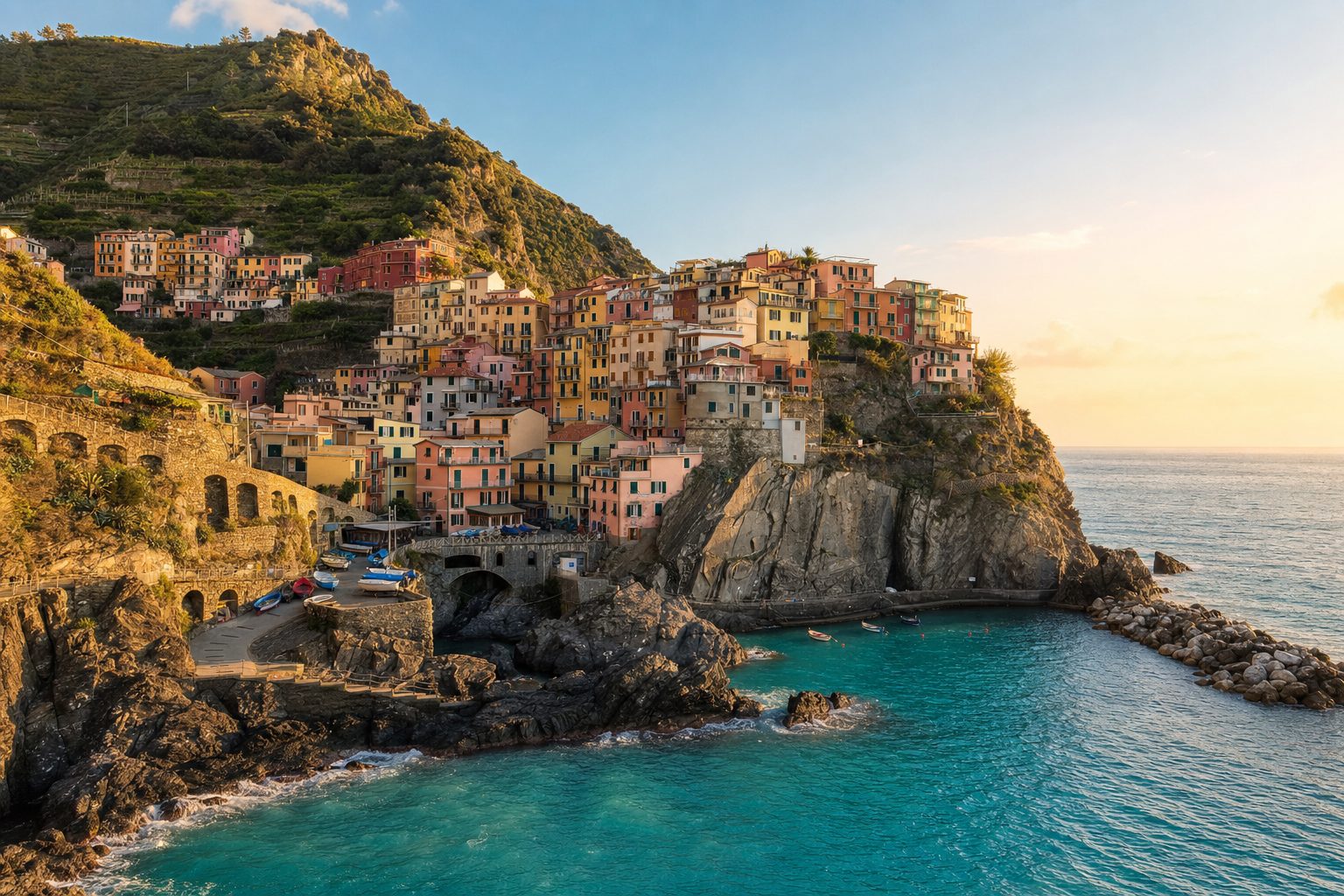
Cinque Terre is easy to reduce to one coastal reel: five painted villages, a rail line and paths stitched into steep ground. The useful first visit is less about trying to collect all five in a single sweep than about choosing what should connect them. The decisions are practical: arrive through the rail gateways rather than trying to make a car work; decide whether trains, paid trails or both justify a card; and treat the celebrated coastal walk as a managed system, not one uninterrupted promenade. The five villages are Monterosso al Mare, Vernazza, Corniglia, Manarola and Riomaggiore. Their sequence matters because it helps turn a map into a plan.
This guide addresses the version of Cinque Terre that appears just beyond the photograph: marked paths require appropriate shoes, the Via dell’Amore runs on timed, one-way entry, and a landslide closure breaks the old Manarola–Corniglia coastal link. As checked in August 2026, prices, access rules and trail status are changeable. Confirm the live Cinque Terre Card terms and Via dell’Amore visitor rules before travelling, especially if a particular hike is the reason for the trip.
See the five villages as a chain, not a checklist
Start by naming the five stops in order rather than following the day’s busiest platform: Monterosso al Mare, Vernazza, Corniglia, Manarola and Riomaggiore. A first-timer does not need to turn each station into an equal-length visit. The better approach is to use the line as a flexible connector, choose one or two villages for time on foot, and let the rest remain deliberate short stops or views from the train. That leaves room for a booked path or an unplanned meal without making every delay feel like a lost attraction.
That designation is a useful cue for pace. This is a cultural landscape of towns, terraces and coast, not a queue of interchangeable backdrops. Put the element that cannot be improvised first: perhaps a reserved Via dell’Amore time, perhaps a paid trail open in the desired direction. Then use the train to fit the villages around it. It is a calmer way to get beyond the reel’s compressed geography and it avoids treating a delayed train or a closed path as a reason to rush the whole day.
Read Cinque Terre with Portovenere and its islands as one exceptional Ligurian cultural landscape, where small towns and the shaped terrain are inseparable from the coast’s scenic value.
— Paraphrased from the UNESCO World Heritage listing for Portovenere, Cinque Terre, and the Islands
Choose a rail gateway, then a base that matches the trip
Cars are effectively useless for moving between the five villages. Make the arrival decision before booking accommodation: approach by train through La Spezia or Levanto, the two practical gateways, then continue by regional rail. That removes the false promise of driving village to village and keeps the trip aligned with the transport that actually links the places on the map. The relevant Treno Card covers regional trains from La Spezia through Cinque Terre to Levanto, so the gateway choice also feeds directly into the card calculation.
For a base, La Spezia or Levanto is the pragmatic choice when rail access, arrivals and departures are the priority. A base in one of the five villages makes more sense when the priority is to begin or end the day within the chain itself. Neither choice is inherently more authentic; the useful distinction is how much friction you want around luggage, check-in and a final train. Do not select a village on the assumption that a car will solve movement later. Plan each change of place around the railway instead.
Keep the first and last day lighter than the itinerary on paper suggests. A traveller arriving at La Spezia or Levanto can use the railway to get oriented without committing to a long walk straight after carrying bags. Conversely, someone sleeping in a village can make an early reserved path the centre of the day and leave the other stops to the train. Our guide to travelling around Europe is useful background for the same habit: make the principal rail link reliable first, then add the scenic component.
Choose the Trekking Card or Treno Card by the day you will actually have
The cards are not competing souvenirs; they answer different days. Choose the Cinque Terre Trekking Card when the day is centred on a paid Sentiero Azzurro section and local park access, with limited need for repeated rail hops. Choose the Cinque Terre Treno Card when the plan combines paid trail access with several regional trains. It includes unlimited second-class regional travel on the La Spezia–Cinque Terre–Levanto line as well as access to the paid paths, so it is the simpler option if a train will connect more than one village movement.
As checked in August 2026, a one-day adult Trekking Card is €10 on standard dates and €15 on peak dates; the one-day adult Treno Card is €22, €29.50 or €35 by season band. Both cover the paid coastal trails and include Via dell’Amore access, while the Treno Card also covers unlimited regional trains between La Spezia and Levanto. [1]
Work backwards from the committed element. If the plan is one paid hike and a slow village stay, buy the Trekking Card only if the day calls for it. If the plan is to step off trains repeatedly, link a path to a reserved walk, and return through either gateway, the Treno Card removes the need to keep making single-journey choices. The precise price band matters, so check the date rather than repeating a price from an old post. Cards are personal and non-transferable; carry identification with the card and keep the date visible.
There is also a seasonal reset. As checked in August 2026, the card guidance says the hiking trails other than Via dell’Amore are free from 2 November to 12 March. That can make the Trekking-versus-Treno decision less important in the off-season: judge the rail use on its own merits and confirm what is open. Do not convert that calendar into a promise that every path will be accessible; a free trail and an open trail are different questions.
Reserve the Via dell’Amore before building around it
The Via dell’Amore is the short, famous connection between Riomaggiore and Manarola, but it is not an open-ended stroll to fit in whenever a train arrives. It reopened in August 2024 after a 12-year closure and now operates as a timed visit. Build the day around the booked direction: enter at Riomaggiore and exit at Manarola. That can be the beginning of a northbound village sequence or a purposeful final walk after arriving by train at Riomaggiore; it should not be treated as a return route.
As checked in August 2026, individual visitors must reserve a specific 30-minute Via dell’Amore slot. Capacity is 200 people every 30 minutes, tourist access in the 29 March–24 October 2026 period runs from 09:00 to 21:00, and the route is one-way from Riomaggiore to Manarola. [2]
Book the date and slot online first, then decide which rail leg serves it. Access is included in the Cinque Terre Card rather than sold as a standalone entry, but the reservation is still mandatory to guarantee entry. If you already hold a card, the official FAQ describes the additional Via dell’Amore reservation process at National Park information points; do not assume a card without a slot will open the gate. The confirmation is nominative, so take the identity document that matches it.
Hike to the live rulebook, not the classic map
The familiar image of a continuous sea-level walk through all five villages is not the 2026 reality. The lower Manarola–Corniglia coastal route is closed after landslide damage. Use the train for that connection, or choose the higher inland route via Volastra if it suits the day and the current conditions. A route that joins two names on a vintage map is not a substitute for the live status at the trailhead. This is where allowing a train connection is not a compromise but sensible itinerary design.
The Manarola–Corniglia lower coastal trail remains closed, while the Monterosso–Vernazza section runs one-way from Monterosso to Vernazza between 09:00 and 14:00 on designated peak dates, including Easter, 1 May, 2 June and July–August weekends. [6]
The direction rule on the Monterosso–Vernazza section is exactly the sort of detail that can undo an otherwise careful day. If walking it on a designated date, begin from Monterosso in the 09:00–14:00 window; reverse-direction walkers must wait until afternoon bidirectional access resumes. Check the date-specific notice again before setting off, because managed access exists to deal with real crowd pressure and can change with conditions. Do not make a non-refundable onward booking depend on a trail direction you have not verified.
Footwear is not a style footnote. Flip-flops and smooth-soled shoes are banned on marked hiking trails, where rangers can check at trailheads and fines range from €50 to €2,500. The rule applies to the trails, not to walking within the villages, so there is no need to turn ordinary village time into a boot-only exercise. The sensible answer is simple: pack shoes with proper grip for any marked path, and keep lighter footwear for rail platforms, accommodation and village streets.
As checked in August 2026, the Cinque Terre trail footwear rule bans flip-flops and other flimsy or smooth-soled shoes on marked hiking trails; reported fines run from €50 to €2,500. The restriction does not apply inside the villages. [5]
- Arrive by train through La Spezia or Levanto, then use regional rail for movements among the five villages.
- Book the Via dell’Amore slot before choosing the surrounding trains; enter in Riomaggiore and continue from Manarola.
- Buy the Trekking Card for a trail-led day or the Treno Card when repeated regional trains are part of the plan.
- Use the train or the higher Volastra route for the closed Manarola–Corniglia lower coastal connection.
- Wear shoes with proper grip on marked trails and check any peak-date direction rule before leaving the station.
Use the calendar to protect both the walk and the stay
The best time is the one that matches the experience you want. Peak dates concentrate the rules most visibly: higher Trekking Card pricing, managed direction on the Monterosso–Vernazza path and greater reason to reserve a timed walk early. Travellers who want long visitor hours on the Via dell’Amore should note the 29 March–24 October 2026 period, but should also expect that the practical system is at its most structured then. Early planning is not overkill when a particular path or sequence matters.
Outside the main season, the card calendar changes and the pace can shift, but the core discipline remains: verify the live trail status, work from the train gateways, and treat the weather or a closure as a route decision rather than an obstacle to push through. Cinque Terre rewards an itinerary that leaves one village or one rail hop unassigned. For another Italian coast where access conditions shape the day as much as the view, continue with our La Pelosa planning guide; for a different kind of Italian trail decision, see the Dolomites hiking guide.
Sources & further reading
- 1. Cinque Terre Card — 2026 Card Prices and Coverage
- 2. Via dell’Amore — Official Method of Use
- 3. Via dell’Amore — Official Frequently Asked Questions
- 4. UNESCO World Heritage Centre — Portovenere, Cinque Terre, and the Islands
- 5. CNN Travel — Flip-flop Fines in Cinque Terre
- 6. World Wonders — Cinque Terre Travel Tips 2026