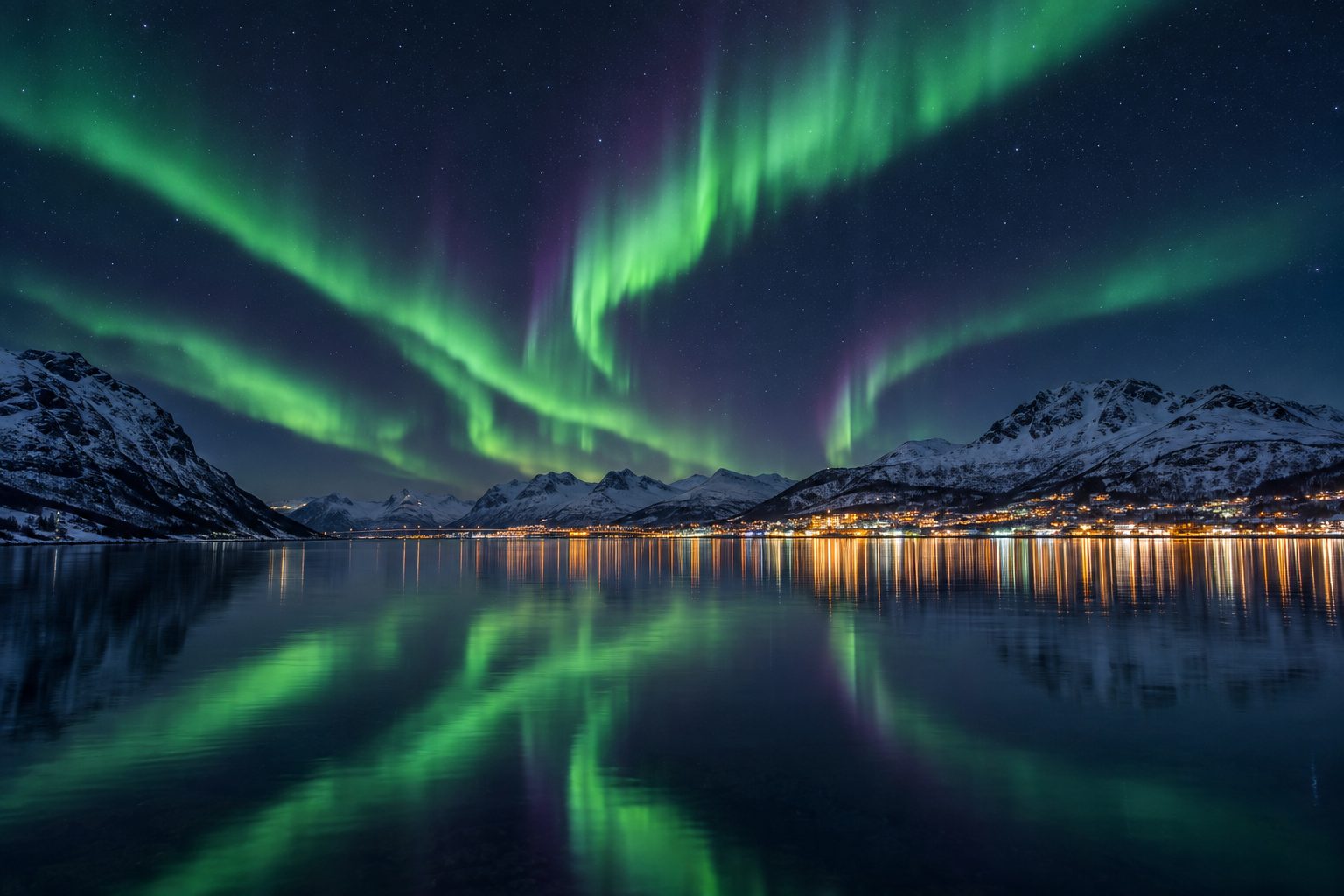
Tromsø sells one thing above all others between September and April: the chance to stand under the aurora. The city sits at almost 70 degrees north, on an island between fjords and mountains, directly beneath the ring of the auroral oval. That geography is why the northern lights are routine here rather than rare, and why a city of about 80,000 fills with visitors in the darkest months.
The decisions that determine whether you see anything are not the ones most people worry about. The Kp number matters less than the cloud forecast; the month matters less than the number of nights you stay; and the choice between the shoreline on your own and a guided chase is really about how far you will drive to find a hole in the weather. This guide works through those choices, then the daytime anchors, above all the Fjellheisen cable car, that shape a Tromsø trip when the sky is grey.
When the season runs and why Tromsø works
The aurora does not switch on in winter. It is present over the auroral zone around the clock, all year; what changes is whether the sky is dark enough to see it. The midnight sun rules out late May to late July, and the pale nights either side are nearly as bad. Darkness returns in the second half of August, and from then until early April any clear night can produce a display.
Visit Tromsø states that the northern lights may be visible in the Tromsø region from late August to early April, whenever the sky is dark and sufficiently clear; they can appear at any time during the night but are most often active between about 20:00 and 02:00, and most organised northern lights activities do not begin until early September. [1]
Two things follow. First, cold is not the requirement, darkness is. September and October are aurora months with autumn colour, temperatures often above freezing and enough daylight for a hike or fjord trip before dinner; Visit Tromsø calls autumn the milder way to hunt the lights. Second, by mid-April the sky no longer gets properly dark.
Between those ends sits the polar night, when the sun does not clear the horizon. It is not blackness; there are hours of blue twilight around midday. It is also when the city is busiest, most expensive and most unsettled in its weather.
According to the Norwegian Meteorological Institute's Yr service, the polar night in Tromsø begins on 27 November and the sun returns on 15 January, while the midnight sun lasts from 20 May to 22 July. [6]
Local science backs the tourist board. The Norwegian Centre for Space Weather at UiT The Arctic University of Norway, which runs the national aurora forecasts from Tromsø, publishes a statistic worth building a trip around: some aurora occurs above the city every other night on average. Whether you see it comes down to the weather.
The forecast that matters is the cloud forecast
Most first-time visitors arrive with an app showing a Kp figure and a red-to-green gauge. Kp is a global, three-hourly measure of geomagnetic disturbance from 0 to 9; a higher number means the oval has swollen south, so that Scotland or Germany might see something. Tromsø sits under the oval already: a Kp of 1 or 2 on a clear night is often enough for a visible arc, and a high Kp under thick cloud shows nothing.
The Norwegian Centre for Space Weather explains that the Kp index runs from 0 (quiet) to 9 (extreme), that the aurora forms at roughly 100 kilometres altitude, far above any cloud, and that cloud cover is therefore usually the main obstacle to seeing it; it also records that statistically some aurora occurs over Tromsø every other night, and that the sky does not need to be entirely cloudless for a display to show through. [5]
So read two forecasts in this order. First, the hourly cloud table on yr.no, which splits cover into low, middle and high cloud and is the tool the guides use. Second, the UiT space weather pages, with a nowcast and one- and four-hour forecasts of the oval, a Tromsø chart of the hours dark enough to see, and live all-sky cameras at Skibotn and Andøya showing what is actually overhead. NOAA's 30-minute OVATION forecast is a good third check.
One further variable: moonlight washes out faint aurora, and Visit Tromsø notes that around a full moon a somewhat stronger display is needed, though a moonlit landscape under a strong arc photographs well.
Watching on your own: the city's dark edges and a hire car
Tromsø is small and on a strong night the aurora shows from the harbour front and hotel windows. On an ordinary night the street lamps flatten the colour, and the official advice is to leave the lit centre for an open view of the northern sky. The Visit Tromsø FAQ names Prestvannet, the lake on the plateau above the city, as its example of a darker spot within walking distance; the shore at Telegrafbukta on the island's southern tip is another residents use. Both are twenty to thirty minutes on foot and free.
A hire car changes the arithmetic. It lets you follow the cloud forecast rather than hope: across the bridge to Kvaløya and its fjord shores, or along the E8 and inland towards the Lyngen and Skibotn valleys, where drier air often opens the sky when the coast is cloudy. The costs are real: dark, twisting roads in snow and ice, reindeer and elk on the carriageway, and a late return. Confidence on ice is not something a rental desk can supply.
Guided chases: what you are paying for
The Tromsø aurora chase is a minibus or coach that leaves around 18:00 to 19:00 and returns between midnight and 02:00, with a guide who has spent the afternoon reading the same forecasts. If the city is clear, the bus goes twenty minutes to a dark beach. If not, it goes as far as it must, sometimes hours inland to the dry valleys near the Finnish border, occasionally over it. You are not paying for the aurora, which nobody can promise; you are paying for the driving and the willingness to go a long way for a clear patch of sky.
Visit Tromsø separates two products. A hunt is built around finding the lights, by car, minibus or bus. An experience is built around an activity, such as an evening dog-sled run, a night in a lavvu or a fjord boat trip, with the aurora as a bonus. The hunt has the higher odds of a sighting; the experience has the better evening if the sky stays shut.
When comparing operators, the FAQ suggests checking group size, duration, transport, comfort and what is included: thermal suits, food, photographs, hotel pick-up and toilets. Small minibuses cost more but turn round faster when the cloud shifts; coaches are cheaper and often go to fixed camps with shelters and fires. Popular departures sell out in the winter peak; book before you arrive.
Fjellheisen and the daytime anchors
The view most people carry home is from the top of Fjellheisen, the cable car that rises from Tromsdalen on the mainland to the shoulder of Storsteinen. From the upper station the island city lies below, the Tromsø Bridge and the Arctic Cathedral in the foreground, the strait and the snow peaks of Kvaløya beyond. It is a day view and a night view: the lift runs until midnight, and on a clear evening it is the easiest place near the city to watch the aurora above the lights.
As checked in September 2026, the operator lists a return ticket at NOK 645 for adults, NOK 310 for children aged 3 to 15 and NOK 1,360 for a family of two adults and two children (one way NOK 415, 195 and 850), with the cable car running from 09:00 to 00:00 and departing every full and half hour; the upper station at Storsteinen is 421 metres above sea level, the cable is 752 metres long and the ride takes about four minutes. [3]
Two cautions. Fjellheisen closes in strong wind, sometimes for a whole day, so go the first time the forecast is calm rather than saving it for the last afternoon. And the site is mid-rebuild. The operator's information page describes a Fjellheisen 2.0 project with a temporary café at the top, the original outdoor viewing platform closed, no parking at the lower station and, until the works finish, no wheelchair or walker access; Visit Tromsø's listing puts that accessibility restriction at the end of 2027. Check the operator's status page if any of that affects you.
Getting there is simple. Bus 26 from the centre stops at Fjellheisen; the walk across the bridge past the Arctic Cathedral takes about 45 minutes; a taxi is roughly ten minutes and NOK 150 to 250. From 15 November the operator also runs an electric shuttle from the harbour.
Build your days around the weather. On clear days go up the mountain, drive out to Sommarøy or Ersfjord on Kvaløya, or join a whale-watching boat in November and December when herring draw orcas and humpbacks into the fjords. On wet days the Polar Museum, Polaria, the Arctic Cathedral and the wooden streets around Storgata fill an afternoon.
Where to base, and how many nights
Stay in the centre unless you have a car. Tours pick up at hotels along the harbour and Storgata, the airport is ten minutes away, and everything is within a fifteen-minute walk. With a car, a cabin on Kvaløya or in Tromsdalen gives dark sky from the door at the cost of driving in each evening.
Tromsø Airport at Langnes is on the island. Bus routes 40 and 42 connect it with the centre and Flybussen runs an express to the main hotels. As checked in September 2026, Svipper's adult single fare is NOK 50 within one zone from 1 February 2026 (NOK 30 off-peak on weekdays in Tromsø) and a 24-hour ticket NOK 140, bought in the Svipper app or at the stop. The Hurtigruten and Havila coastal ships call daily, which is how many visitors continue to Lofoten.
How long to stay is the most important number in the plan. Visit Tromsø's advice is blunt: the more nights, the greater the chance that aurora and weather line up. Two nights is a gamble that fails regularly; four is a sensible minimum for a trip whose purpose is the lights; a week lets you wait out a front. Accommodation and tours cost most from mid-December through February; late September to early November and March are cheaper and no worse for aurora.
What to wear, what to carry, how to behave
Tromsø is milder than its latitude suggests, thanks to the Gulf Stream; the tourist board calls the region mild northern lights country. Inland, where the chases go, it can be minus 20. The problem on an aurora night is stillness: you will stand for two hours on frozen ground. Wool base layers, an insulated mid-layer, a windproof shell, insulated boots a size up for thick socks, mittens over thin gloves and a hat over the ears are the minimum. Operators usually lend thermal suits; take them.
- A head torch with a red-light mode, so you can see your feet without wrecking your own or anyone else's night vision.
- A small tripod and a phone or camera set to manual: UiT suggests 10 to 30 seconds' exposure, the widest aperture and ISO 800 to 1,600 as a starting point.
- Spare batteries kept warm inside your jacket; cold halves their life.
- A hot drink in a flask and something to eat, because chases return late and nothing is open.
- Microspikes or grippers for icy pavements in the city from November onwards.
The other half of preparation is conduct. Aurora tourism has grown fast enough that the destination company publishes rules for it, aimed as much at self-drivers as at operators.
Visit Tromsø asks aurora visitors to use registered guide companies and follow their instructions, to wear reflective clothing on tour and stay off dark roads, to keep out of gardens and private land, to give way to local traffic and respect lorry drivers' rest areas, never to light fires beside roads or in lay-bys, and to take every scrap of litter home, down to cigarette ends and cups.
— Paraphrased from the Visit Tromsø northern lights tourism guidelines
Add the ordinary Arctic sense the guidelines assume: tell someone where you are going if you drive out alone, keep the fuel above half, carry a charged phone, and turn back if the road is worse than you are. The aurora will come again; the point is to be there, warm and patient, when it does.
Tromsø is also the hinge for a longer northern journey. South-west by coastal ship or a long day's drive lie the peaks and beaches of the Lofoten Islands, and closer still the fjords and sea cliffs of Senja, both under the same oval with far less light. For a different Arctic winter, our guide to Reykjavik and Iceland's Ring Road covers the other great aurora destination on the edge of Europe.
Sources & further reading
- 1. Visit Tromsø (official destination company) — When and where to see the northern lights: season, nightly timing, polar night, guided tours
- 2. Visit Tromsø — Look out for the northern lights: the auroral oval, cloud cover, moonlight and the 20:00–02:00 window
- 3. Fjellheisen (official operator) — cable car to Storsteinen: prices, opening hours, frequency, altitude, how to get there
- 4. Fjellheisen — Important info: Fjellheisen 2.0 construction, parking, viewing platform and accessibility during the works
- 5. Norwegian Centre for Space Weather (UiT The Arctic University of Norway) — Northern Lights / Aurora Borealis: Kp index, forecasts, all-sky cameras, viewing advice
- 6. Yr (Norwegian Meteorological Institute and NRK) — Polar nights and midnight sun: dates for Tromsø
- 7. Visit Tromsø — Northern lights tourism guidelines: safety and sustainability rules for aurora viewing and tours
- 8. Svipper (Troms county public transport) — Bus fares from 1 February 2026