The Instagram version of Silfra is a single frame: a snorkeller in a black drysuit floating over a blue chasm, a hand on each continent. The version you plan for is more practical. Silfra is a flooded fissure at the northern edge of Lake Þingvallavatn, inside Þingvellir National Park, filled with glacier-fed spring water that stays at 2–4°C in every month of the year. You cannot swim it alone, skip the drysuit, or simply turn up at the shore. The experience is a guided, timed 30 to 45 minutes in the water inside a two-and-a-half-hour tour.
That structure makes the decisions simple. You need to choose between meeting on site and a Reykjavík pickup, pick a season, confirm you qualify to snorkel at all (there are age, height, weight and health limits), and decide how much of the rest of Þingvellir and the Golden Circle to fit into the same day.
What Silfra actually is, and what the two-continents claim means
Þingvellir sits where the Mid-Atlantic Ridge comes ashore. The valley is a rift between the North American plate on the west and, on the east, the Hreppar microplate, a sliver of crust between the main North American and Eurasian plates. The national park explains that the zone between the two plate edges here is roughly five kilometres wide and contains around a hundred fissures; Silfra is one of them, not the whole boundary. Tour marketing compresses this into "snorkelling between North America and Europe", which is fair in the broad sense: you are inside the rift that separates the continents, not in a single crack with a continent on each wall.
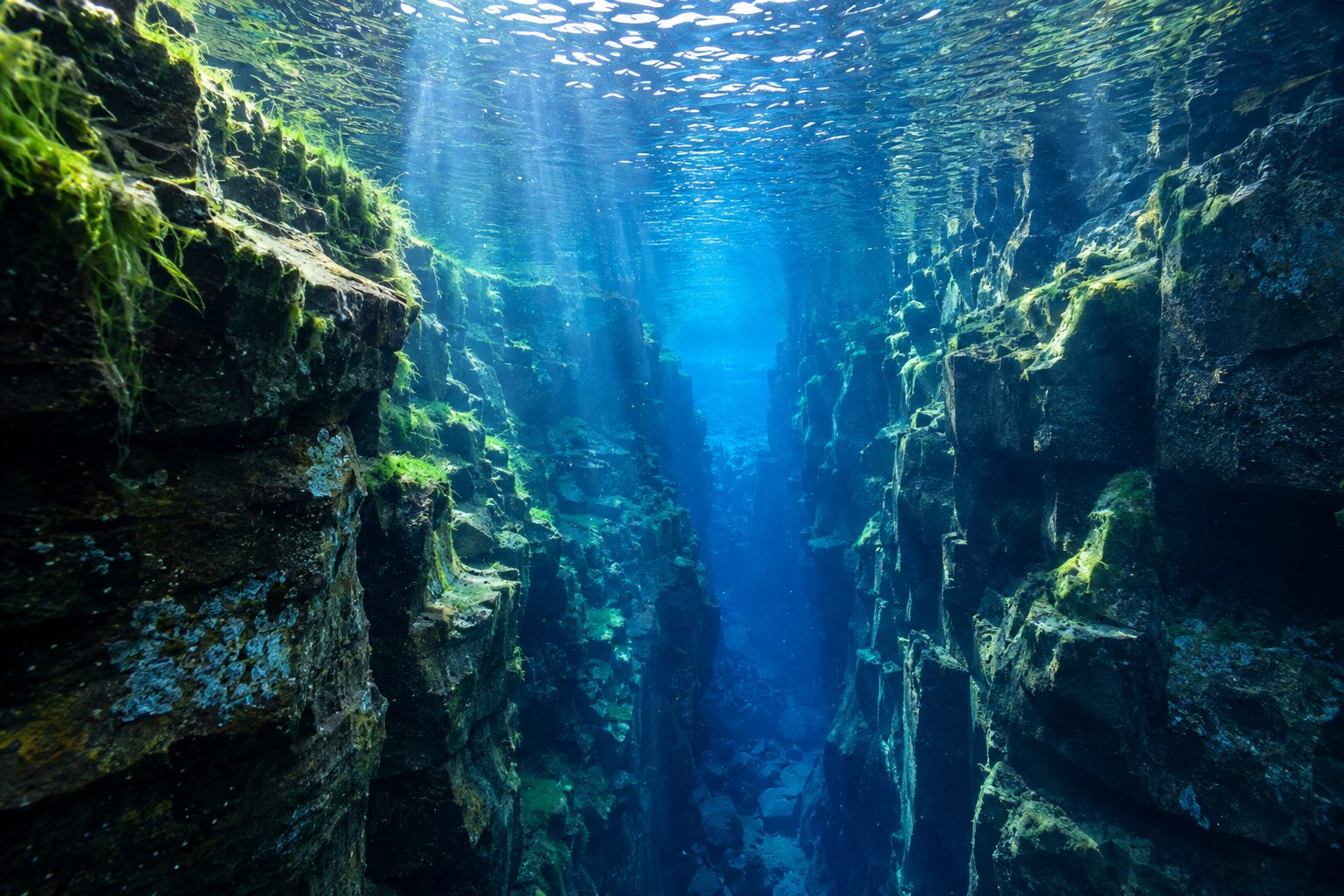
What Silfra does have is water of a clarity that is hard to picture until you are in it. Meltwater from the Langjökull ice cap, some fifty kilometres away, sinks into porous lava and travels underground for decades before emerging as a spring at the head of the fissure. The rock strips it of sediment, the constant flow means it never freezes, and the park puts prime visibility at about 100 metres. Silfra means silver.
Þingvellir National Park describes Silfra as one of roughly 100 fissures in a five-kilometre-wide rift zone between the North American plate edge and the Hreppar microplate. The fissure is up to 10 metres wide and reaches a depth of 60 metres, its water arrives from Langjökull after about 30 years of underground filtration, and prime visibility is approximately 100 metres. [1]
The date usually attached to Silfra, 1789, is also more complicated than the reels suggest. Earthquakes that year reshaped the rift and drowned the spring, but the park points out that a fissure ten metres wide would take well over a thousand years to open at a few millimetres a year, and written records describe fishing at Silfra before 1789. The honest version is that Silfra is ancient, was altered in 1789, and is still changing: DIVE.IS notes rockfalls after tremors altering its profile.
The route underwater and what the four sections look like
Everyone enters from a metal platform at the northern end and drifts south towards the lake through four named sections. The Big Crack is the narrow entrance beneath the platform, where the walls are closest. Silfra Hall opens out, with towering rock on both sides and sunlight cutting through the surface. Silfra Cathedral is the deepest part of the route, a chamber around 20 metres deep where the blue is most saturated. Silfra Lagoon is the shallow, wide finale, floored with pale sand and green algae, where you can see across roughly 100 metres of open water before climbing out.
The current does most of the work. Snorkellers float and steer; the drysuit is so buoyant that duck-diving is impractical. Divers are held to a maximum depth of 18 metres by park rules, with a typical dive around seven to twelve metres, and Silfra's caves and overhead passages, including a tunnel operators call "the toilet" for the strength of its current, are off limits to everyone.
Who can snorkel Silfra and who cannot
The park sets the framework and operators add their own thresholds, so read both. Þingvellir's regulations require that everyone in Silfra goes with a buddy, stays in open water, and wears full cold-water protection: suit, hood, gloves and neoprene boots or socks. Divers must hold an autonomous-diver certification such as Open Water plus either a drysuit specialty certificate or written proof of ten drysuit dives in the previous two years. Snorkellers need no certification at all, which is why the snorkel tour is the mainstream choice. The park is explicit that the activity is at the visitor's own risk.
Þingvellir National Park rules require divers to hold an autonomous-diver licence (for example Open Water) plus a dry-suit certificate or proof of 10 registered dry-suit dives in the last two years, prohibit diving deeper than 18 metres or entering caves and overhead environments, and require everyone to snorkel or dive with a buddy in water the park states is 2–4°C. [2]
The operator conditions are where most would-be snorkellers discover they are excluded. As checked in September 2026, DIVE.IS requires snorkel participants to be at least 12 years old in the year of the tour, between 150 cm and 200 cm tall and between 45 kg and 120 kg, able to swim and comfortable in water, not pregnant, and able to follow a briefing in English. Anyone aged 60 or over must have the medical form signed by a doctor, and under-18s need a guardian's consent; Arctic Adventures publishes near-identical thresholds. The limits follow the drysuit size range and are not negotiated at the meeting point, so check your own numbers against the operator's current page before you pay.
Two smaller rules catch people out: full-face snorkel masks cannot be used because they will not seal around the hood, and life jackets are not permitted; the drysuit is your buoyancy. If you wear glasses, bring contact lenses.
How much a Silfra snorkel costs and what the fee actually covers
There is no entrance fee to Þingvellir National Park and no gate, but there is a dedicated Silfra fee for anyone entering the water. As checked in September 2026, operators state that fee as 1,500 ISK per person, collected by the park and included in tour prices. On top of it, published from-prices for a standard guided snorkel meeting on site range from about 16,000 to 20,000 ISK per person with the major operators, rising to roughly 31,000 ISK when a Reykjavík pickup and return transfer are bundled in. Prices move each season, so treat these as a planning range and confirm on the booking page.
If you self-drive, budget for parking. Þingvellir charges a daily fee per vehicle, payable at machines in the P2 and P5 lots and at the Visitor Centre, or online through the park's CheckIt system. Cameras read number plates, so if you pay online make sure the plate matches the hire car. The fee covers all three paid lots for the day.
As of September 2026 the Þingvellir National Park parking fee is 1,000 ISK for a passenger car of up to five seats, 1,200 ISK for a six- to nine-seat vehicle and 400 ISK for a motorcycle, valid on the day of payment in car parks P1, P2 and P5. P5 (Valhöll) is the lot nearest Þingvellir Church and the Silfra fissure. [3]
Timing your visit: season, weather and light
Silfra runs every day of the year because the water never changes; what changes is everything above the surface. From June to August you get eighteen or more hours of daylight, the best light through the water, and the busiest platforms. Spring and autumn bring quieter slots but a real chance of cold rain and wind, and the 250-metre walk back from the exit in a wet drysuit is where you will feel it. Winter is a legitimate choice: the water is no colder, the fissure is uncrowded, and the lava fields are often under snow, but short daylight compresses the timetable and Route 36 can be icy.
Whatever the season, check two sites the night before: the Road Administration's live map at road.is for Route 36, and the Icelandic Met Office for wind and precipitation. Operators rarely cancel for weather, because the water is sheltered, but they will move start times, and you will be standing outside in the drysuit for a good half hour before you get in.
- Wear thermal base layers and warm socks; the operator provides the undersuit and drysuit, but what you wear underneath stays on. Avoid cotton.
- Bring a towel, a full change of clothes and a warm hat for afterwards. Changing facilities are basic and the wind at the car park is constant.
- Eat beforehand and skip alcohol the night before; cold-water immersion is tiring.
- Use a small action camera on a wrist strap or buy the operator's photo package; you will not have free hands.
- Arrive at the Silfra meeting point 15 minutes early with your signed medical statement and any doctor's letter; late arrivals forfeit the slot.
Getting there and combining Silfra with the rest of Þingvellir
Þingvellir is about 45 to 60 minutes north-east of Reykjavík on Route 36 and the natural first stop on a clockwise Golden Circle loop, with Geysir and Gullfoss an hour further on. There is no public transport into the park. Follow signs for P5, the lot for the church and the Silfra meeting area. If you are driving the Ring Road, Silfra slots neatly between arrival in the capital and the drive east along the south coast.
UNESCO lists Þingvellir National Park under cultural criteria (iii) and (vi) as the site of the Alþing, the open-air assembly of all Iceland established in 930 that met there until 1798. The inscribed property covers 9,270 hectares within the 24,000-hectare national park, about 49 km east of Reykjavík, and the valley floor has subsided by some 3–4 metres since the assembly was founded. [4]
The World Heritage listing, made in 2004, is a reminder that Þingvellir is not primarily a snorkelling venue. It was inscribed for the assembly ground where Iceland's laws were made for more than eight centuries, and the walk down Almannagjá gorge from Hakið to Lögberg, past Öxarárfoss and the drowned fissures of Peningagjá and Flosagjá, is why most visitors come. Allow ninety minutes for that circuit on top of the snorkel. Peningagjá, a few minutes' walk from P5, is also the best place to see the same clear rift water from above, for free, if someone in your group is not snorkelling.
Þingvellir is described as the place where the Alþing, an open-air assembly representing the whole of Iceland, was founded in 930 and met for over two weeks every year until 1798, set in a rift valley whose fissures and cliffs are visible evidence of the continents drifting apart.
— Paraphrased from the UNESCO World Heritage listing for Þingvellir National Park
Snorkel or dive, which operator, and how to behave in the rift
For most first-timers the snorkel is the right call, and not only because it needs no certification. The water is so clear that the drop into the Cathedral is fully visible from the surface. Diving adds the view up at the silver surface and longer in the Hall and Cathedral, but requires the drysuit qualification set out by the park, costs roughly double, and is capped at 18 metres. If you already dive in a drysuit, Silfra is a genuinely unusual dive; if you would be learning drysuit skills for the occasion, do that at home first.
Among snorkel tours the choice is mostly about group size. Standard tours run in groups of up to six per guide; small-group and private options cost several times more but let a family enter together at their own pace. Whatever you book, confirm the price includes the Silfra fee and all equipment, and check the cancellation terms: some operators charge in full for no-shows or for participants turned away on size or medical grounds.
Silfra is fragile in a way its scale hides. The green algae on the walls is slow-growing and breaks off at a touch, the layered lava is friable, and the water is a drinking-quality spring feeding Iceland's largest natural lake and its arctic char, which are themselves part of the World Heritage listing. Guides ask you to keep fins up and hands off the rock because a hundred pairs of feet a day would strip the fissure in a season. Keep to the marked path between P5 and the platform and take everything you bring back out.
If Silfra sends you looking for other places where the far north puts cold water and raw geology on display, look north and west. The Faroe Islands offer the same basalt as sea cliffs and sheer bird islands, and Ilulissat in Greenland shows what happens when the ice that feeds springs like Silfra reaches the sea directly. Our adventure travel bucket list puts Silfra alongside the trails and dives it is usually compared with. Book the snorkel first, though: it is a reliable, year-round hour in water you will not find anywhere else.
Sources & further reading
- 1. Thingvellir National Park — Silfra (nature and education)
- 2. Thingvellir National Park — Diving and snorkelling rules
- 3. Thingvellir National Park — Parking service and fees
- 4. UNESCO World Heritage Centre — Þingvellir National Park
- 5. DIVE.IS — Silfra dive site description
- 6. DIVE.IS — Silfra Snorkeling Day Tour (requirements, duration, price)
- 7. DIVE.IS FAQ — Silfra entrance fee and park parking
- 8. Guide to Iceland — Silfra travel guide