Skellig Michael rations itself. Fifteen licensed boats, twelve passengers each, one sailing per boat per day: 180 people, and no more, may set foot on this pyramid of Old Red Sandstone twelve kilometres off the Kerry coast. The landing season lasts barely five months, the Atlantic cancels sailings without notice, and the berths that do exist sell out weeks — sometimes months — ahead. If the island is on your list, the planning decisions start long before you reach the island itself.
Those decisions are fairly clean-cut: whether to book a landing tour or settle for a non-landing eco cruise; when in the season to travel; how to build enough slack into a Ring of Kerry itinerary to absorb a weather cancellation; and whether the 618 uneven, unrailed steps to the sixth-century monastery are within your party's ability. This guide works through each in turn.
Why landings are rationed
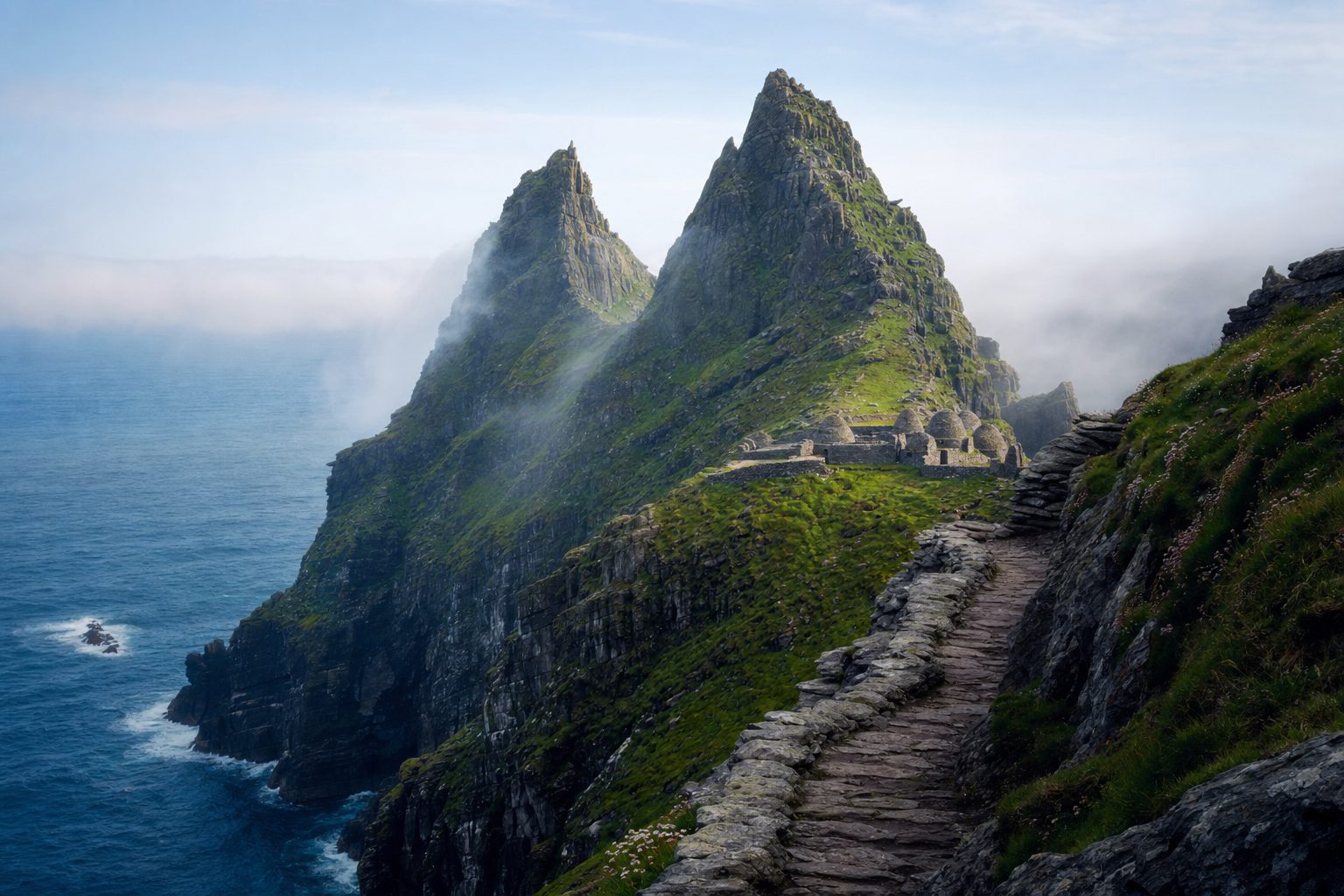
The reason for the quota is the site itself. Monks — tradition credits the community of St Fionán — established a monastery on the island's north-eastern summit around the sixth century and occupied it for roughly six hundred years, leaving drystone beehive cells, oratories and terraced enclosures that have survived on this exposed crag in a state few early Christian sites anywhere can match. UNESCO's listing describes it as illustrating the extremes of Christian monasticism as no other property can, and the Office of Public Works (OPW), which manages the island, has stationed guides there during visitor seasons since the late 1980s precisely to keep numbers and behaviour in check.
Sceilg Mhichíl was inscribed on the UNESCO World Heritage List in 1996, and an official guide service has operated on the island since 1987 to regulate visitor numbers and protect the monuments. [3]
Fifteen licensed boats, each carrying a maximum of twelve passengers and making one landing per day, are permitted during the season — a ceiling of 180 visitors on Skellig Michael per day. [5]
What the monks built is astonishing at close range. Six corbelled beehive cells and two boat-shaped oratories stand on a terrace roughly 180 metres above the sea, alongside a later medieval church, carved crosses and the garden plots the community cut into the rock to feed itself. A second, more precipitous hermitage clings to the South Peak, the island's higher summit — closed to general visitors, and a reminder that the routes you may use today are a small, managed fraction of the island. Conservation work has been continuous since the OPW's preservation programme began in 1978, which is another reason the daily cap holds firm even as demand keeps rising.
There is no way around the system. Admission to the island is free, but access is only possible with one of the permitted boat operators listed by the OPW; landing by private craft is discouraged, and outside the defined season visits are prohibited altogether. The 2015 appearance of the island as Luke Skywalker's refuge in Star Wars: The Force Awakens pushed demand well past supply, which is why the booking calendar, not the weather forecast, is usually the first constraint you will meet.
Landing tour or eco cruise
The headline choice is between landing and looking. A landing tour puts you ashore for around two and a half hours — enough time to climb to the monastery, hear the OPW guides, and get back to the pier. As checked in September 2026, landing tours cost roughly €125–145 per person plus booking fees, depending on the operator: Casey's charges €145, while the Celtic Victor out of the same marina lists €125 plus an €8.75 booking fee. Trips run once daily, usually departing Portmagee between 8am and midday, with the whole outing taking five to six hours.
Eco cruises — non-landing trips that circle Skellig Michael and Little Skellig — cost far less, typically €50–60 per person, take two and a half to three hours, and run a slightly longer season from late April into early October. You forfeit the steps and the monastery, but you gain the wildlife: Little Skellig holds one of the world's largest northern gannet colonies, a white-washed spectacle of tens of thousands of birds no landing passenger gets close to, and the boats linger beneath the cliffs of both islands. For travellers with children under the landing age limits, limited mobility, or a fixed schedule that cannot absorb a cancellation, the eco cruise is the honest choice rather than the consolation prize.
Timing adds a wildlife bonus either way. Atlantic puffins are on and around Skellig Michael from spring until they leave for the open ocean in early August, nesting in burrows beside the steps. Book May to July and you will likely share the climb with them; from mid-August the island belongs to the gulls again.
When to go and how booking actually works
As checked in September 2026, the 2026 landing season ran from 9 May to 30 September, dates the OPW sets each year and describes as subject to change — confirm the current season on the OPW's official announcements before you plan around it. Berths open for booking months ahead and the peak weeks of June and July go first. Book directly with a permitted operator — the OPW publishes the full list of fifteen — rather than through resellers, and read the cancellation terms: reputable operators refund in full when they cancel for sea conditions, but a reschedule is rarely possible on landing tours because every other sailing is already sold.
The OPW reopened Sceilg Mhichíl for the 2026 visitor season on Saturday 9 May 2026, with access dependent on favourable weather, sea and island conditions; at all other times the island is unmanned and visits are prohibited. [2]
Within the season, the choice of month is a trade-off between weather odds and wildlife. May and June bring the longest days, nesting puffins and, statistically, the best chance of calm crossings before Atlantic depressions pick up again in September; they are also the first dates to sell out. September sailings are easier to book but carry a higher cancellation risk, and the puffins will be long gone. Whichever month you choose, treat the boat ticket as the anchor of your Kerry plans and arrange accommodation around it, not the other way round — a landing slot is far harder to move than a hotel booking.
Getting to Portmagee and surviving the crossing
Landing boats leave from Portmagee marina, a fishing village on the Iveragh Peninsula reached via the Ring of Kerry and the Skellig Ring, on Ireland's Wild Atlantic Way — the same seaboard that carries the Cliffs of Moher further north in County Clare. Operators tell drivers to allow at least thirty minutes more than the satnav suggests: the final roads are narrow, slow and shared with coaches and campervans in summer. Kerry Airport, Killarney's rail connections and roughly a two-and-a-half-hour drive from Cork are the practical approaches for anyone slotting the island into a broader European itinerary.
The crossing itself takes about 45 minutes to an hour each way, and it is open Atlantic, not a harbour cruise. Even in fine weather the swell can be lively; operators advise anyone prone to motion sickness to take medication beforehand and avoid eating in the couple of hours before departure. Waterproof jacket and trousers earn their place in the bag even under a blue sky — the boats are small, and spray is part of the deal.
On the island: 618 steps and no shelter
From the landing pier, the route to the monastery climbs 618 hand-cut stone steps, ascending roughly 180 metres. There are no handrails. The steps are steep, uneven and slippery when wet, and the OPW warns of falling rocks and requires visitors to stay on the recognised pathways at all times. The OPW does not permit children under 12 on the island, and operators set their own stricter rules — Casey's, for one, only lands visitors aged over 14 and asks for excellent mobility, sure-footedness and a strong sense of balance. This is not a climb to attempt in sandals or smooth-soled shoes; treaded hiking shoes or trainers are the stated minimum.
Visiting the monastery involves climbing 618 steep, uneven steps rising over 180 metres; children under 12 are not permitted on the island, and the average visit lasts around two and a half hours. [1]
Once ashore, you are on your own resources. There are no shops, no food or drink for sale and no shelter from wind or rain, so carry a packed lunch and water — in reusable containers, as the OPW asks. What you do get is the OPW guide team, stationed at the monastery through the season, who brief visitors among the beehive cells and answer questions about the community that endured here. Budget your two and a half hours carefully: the climb takes a fit walker twenty to thirty minutes each way, and the guides' talk at the top is the part worth arriving early for.
- Grippy, closed footwear — hiking shoes or treaded trainers, never sandals or smooth soles
- Waterproof jacket and warm layers, even on sunny forecasts
- Packed lunch and drinking water in reusable containers — nothing is sold on the island
- Motion-sickness tablets taken before boarding if you are at all susceptible
- A phone or camera secured with a strap — retrieving dropped items on the steps is not an option
The island's monastic remains illustrate the extremes of early Christian monasticism as no other place can, preserved in an exceptional state because of the site's remoteness and difficulty of access.
— Paraphrased from the UNESCO World Heritage listing for Sceilg Mhichíl
Weather, cancellations and the backup plan
Assume a real chance your sailing will not run. The island is frequently inaccessible outside high summer, and even within the season the OPW makes access dependent on weather, sea and island conditions; in 2026 the reopening itself slipped past the planned 9 May date because of severe weather, as reported by The Irish Times. The rational response is buffer: give yourself two or three nights in the Portmagee area, book the earliest date in your window so a cancellation can roll into an eco cruise or a later attempt, and treat a completed landing as good fortune rather than an entitlement.
A cancelled sailing is not a wasted day on this coast. The Kerry Cliffs at Portmagee, the Skellig Experience centre on Valentia Island, and the beaches and viewpoints of the Skellig Ring fill an afternoon comfortably, and the drive around the Ring of Kerry is a trip in its own right. If the island refuses you entirely, the eco cruise still delivers the silhouette that drew you here — the same jagged profile that has stood in for the edge of the world on screen and, for six centuries of monks, very nearly was.
Skellig Michael rewards the traveller who plans like a sailor: early bookings, flexible days, respect for the forecast. If this kind of hard-won landing appeals, the same instincts serve on the world's other bucket-list adventures — and the rest of Ireland's Atlantic edge, from Kerry north to Clare, repays every extra day you give it.
Sources & further reading
- 1. Heritage Ireland (OPW) — Skellig Michael visitor information
- 2. Office of Public Works — Sceilg Mhichíl Visitor Season 2026 (gov.ie)
- 3. UNESCO World Heritage Centre — Sceilg Mhichíl listing
- 4. World Heritage Ireland — Sceilg Mhichíl (official Irish World Heritage site)
- 5. Casey's Skellig Michael Tours — landing tour and 2026 season
- 6. Casey's Skellig Michael Tours — safety briefing and OPW visitor guidelines
- 7. Skellig Boat Trips (Celtic Victor) — landing and eco trip prices
- 8. The Irish Times — photo essay: Skellig Michael reopens for summer visitors