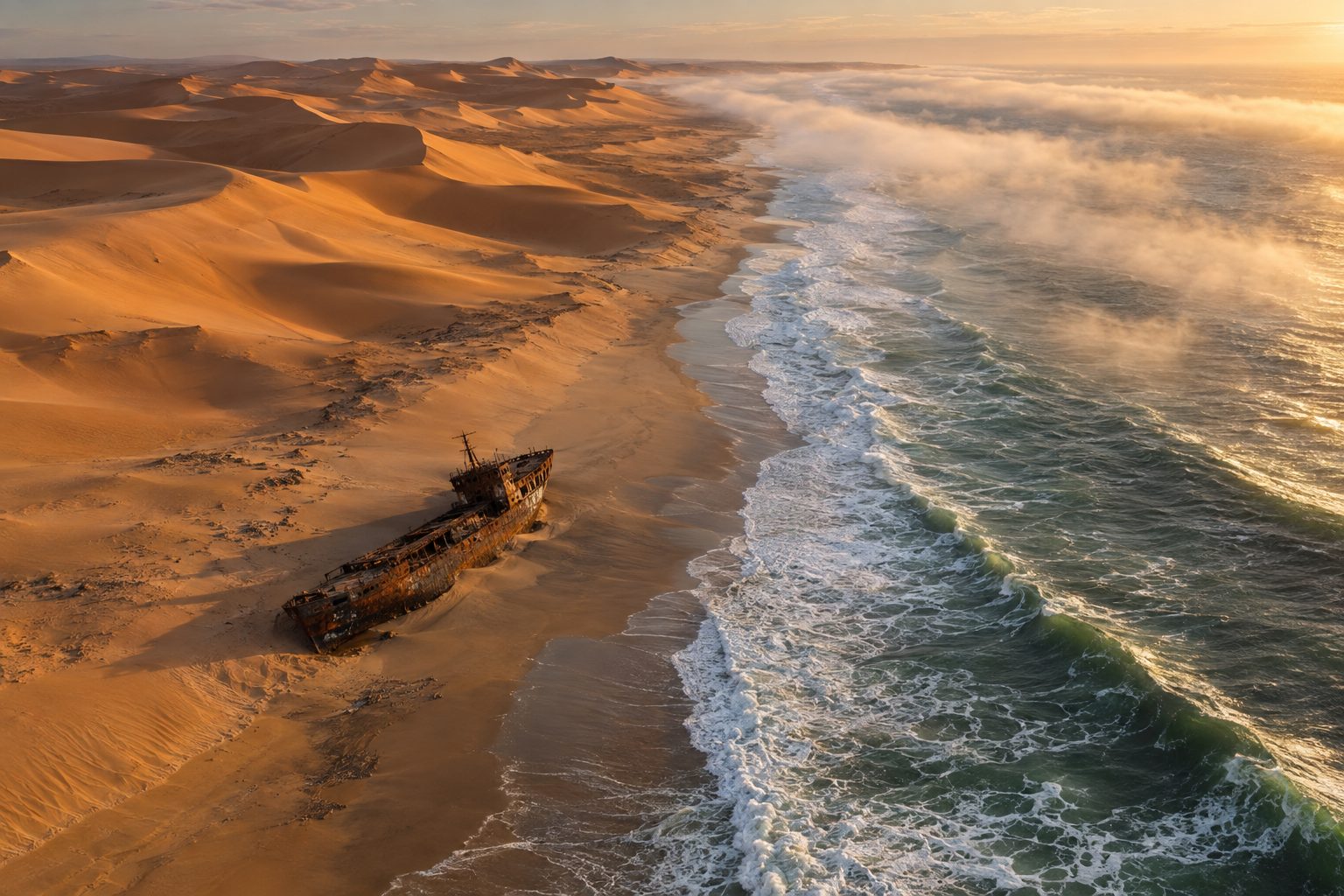
A cold current, a hot desert and 500 kilometres of surf between them produce fog, rust and bones: shipwrecks folded into dunes, hyena tracks along an empty tideline. What the images do not show is that the park protecting this shore is split in two, and the half most people picture is the half almost nobody is allowed to drive into.
So the first decision is not when to go but which Skeleton Coast you mean. The southern third, from the Ugab River to the fishing camp at Terrace Bay, is a public road with two gates, a permit bought at the boom and closing times that decide your day. Everything north of that, up to the Kunene on the Angolan border, is wilderness entered only by light aircraft as a guest of a concession operator.
Two Skeleton Coasts: the self-drive south and the fly-in north
The Ministry of Environment, Forestry and Tourism divides the park into usage zones, and a permit is valid only for the zone printed on it.
Skeleton Coast Park was proclaimed in 1971 and took its present form in 1973. It covers 16,390 square kilometres, running about 500 kilometres from the Ugab River to the Kunene River and extending roughly 40 kilometres inland; its dense fog and cold sea breezes are produced by the Benguela Current. [1]
The split falls at Terrace Bay. South of it, a salt-and-gravel road links the Ugabmond gate on the shore with the Springbokwasser gate inland, with a spur north past Torra Bay to the Terrace Bay camp; a sedan copes in dry weather, though clearance helps inland. North of Terrace Bay there is no public road: the stretch from roughly the Hoarusib River to the Kunene is designated wilderness, reached only by charter flight through the handful of concession camps there. No self-drive permit exists for it.
The northern trips deliver the famous images: roaring dunes, the clay castles of the Hoarusib, the Kunene mouth, elephants and lions in the riverbeds, wrecks no road reaches. They are sold as two or three all-inclusive nights with light-aircraft transfers, priced well into four figures in US dollars per person. The south still gives you the fog, the lichen plains, the seals and a long empty shore for a park fee and a tank of fuel.
Gates, permits and the closing times that shape your day
Gate staff will ask which of four permits you want. A transit permit lets you drive between the two gates in a single day; a Terrace Bay visitor permit is issued only against a confirmed booking at the camp; a Torra Bay visitor permit does the same for the campsite in season; and a concession visitor permit is arranged by the operator flying you north. Without a booking, no overnight permit is issued.
The park issues four permit types: transit, Terrace Bay visitor, Torra Bay visitor and concession visitor (guided only). Gate hours for transit entry are 07:30 to 15:00 and transit visitors must leave before 17:00, so that everyone reaches their destination in daylight. Transit permits between Ugabmond and Springbokwasser are available all year; Terrace Bay is open all year for overnight stays, chalets only, no day visits; Torra Bay, campsite only, opens in December and January. [2]
A transit is genuinely a transit: in at one gate, out by the other, with stops at the marked viewpoints and wreck sites rather than detours. And the 15:00 cut-off is hard: the gate-to-gate drive is about 140 kilometres of corrugated salt road and takes two hours or more, so a mid-afternoon arrival at Ugabmond means a night in Henties Bay. Terrace Bay guests get a later entry cut-off; whatever the permit, everyone must be off the roads by sunset. Confirm times at the gate.
As checked in September 2026, Namibia's revised park fee schedule took effect on 1 April 2026. At the top-tier parks, which include Skeleton Coast Park, Cape Cross Seal Reserve and Dorob National Park, an international adult pays N$280 per person per day (up from N$150), a child under 16 pays N$180 and children under eight enter free; a vehicle is charged separately, and SADC nationals and Namibians pay reduced rates. [5]
Carry the fee in Namibian dollars or rand, since card machines at remote gates are unreliable, and assume a straight transit is charged. Check the current schedule with MEFT before fixing a budget.
The C34 from Swakopmund: what you actually see
Almost every self-driver arrives north from Swakopmund on the C34 salt road, smooth when dry and slick in fog. Henties Bay, about 70 kilometres up, is the last town, supermarket and fuel you should count on. Some 50 kilometres beyond it a turn leads to Cape Cross, which lies in Dorob National Park rather than Skeleton Coast Park, and which is the wildlife certainty of the trip.
Cape Cross Seal Reserve, proclaimed in 1968 and covering 60 square kilometres, protects the world's largest breeding colony of Cape fur seals, with up to 210,000 animals present in the November and December breeding season. The Portuguese navigator Diego Cão landed here in 1486 and planted a stone cross; a replica stands on the site, a National Heritage Site. No angling is allowed in the reserve. [8]
A raised walkway runs along the colony's edge, and black-backed jackals work the fringes. About 200 kilometres from Swakopmund the road reaches the Ugab River and the park's southern gate, marked with the skull-and-crossbones sign that appears in every account of the coast. It is a warning as much as a photo opportunity: staff check vehicle papers and ask where you are sleeping.
Inside, the road runs a few hundred metres from the surf across gravel plains crusted with lichen that takes decades to recover from a set of tyre tracks. Short signposted detours lead to the remains of the South West Seal and the Benguela Eagle, both reduced to ribs of rusted plate. Do not expect an intact hull; the most photographed wreck on this coast, the Zeila, grounded in 2008 off the beach south of Henties Bay, outside the park, and is best visited on the way up. Roughly 110 kilometres north of the gate the road reaches Torra Bay and the Springbokwasser junction; Terrace Bay is 50 kilometres further.
Terrace Bay and Torra Bay: the only beds inside the park
There are two places to sleep in the self-drive section, both run by Namibia Wildlife Resorts and both there because of fishing. Terrace Bay is the year-round one: a former mining camp above the surf with 20 double rooms and three beach chalets, a restaurant, bar and kiosk, freezing facilities for the catch and, crucially, fuel. It is functional rather than charming, but it puts you 160 kilometres inside the park at dawn, and the Uniab River delta just south is the place for springbok, oryx, brown hyena tracks and Stone Age stone circles.
As checked in September 2026, NWR lists a two-bed chalet at Terrace Bay at N$2,000 per person sharing, bed and breakfast, for July to October 2026, falling to N$1,450 from November 2026 to June 2027. NWR puts the camp 648 kilometres from Windhoek and 764 from Sossusvlei. Camping there is permitted only in December and January, and the ministry is blunt that entrance is only with a booking.
Torra Bay, 50 kilometres south, is a different animal: 60 campsites for up to eight people each, with ablutions, a shop and a filling station, open only in December and January when Namibian and South African angling families arrive in force. Outside those weeks it is closed entirely, fuel included. NWR's 2026-27 rate is N$310 per person per night, excluding water, electricity and shower fees. For the coast at its emptiest, avoid those weeks; to see what it means to Namibians, they are the only time to come.
Angling: the licence you buy before the gate
Surf angling for kob, galjoen, steenbras and blacktail is why most people stay inside the park, and it comes with paperwork that cannot be done at the boom. A recreational fishing permit is issued by the Ministry of Fisheries and Marine Resources, not the park; its offices in Swakopmund (at the aquarium on Strand Street), Walvis Bay, Lüderitz and Windhoek sell them, as does the Henties Bay police station. The park page states that the licence must be obtained before entering, and inspectors can ask to see it anywhere on the shore.
As checked in September 2026, the ministry's price sheet lists a sea-water permit at N$14 for one month or N$168 for one year for Namibians and permanent residents; foreign visitors should confirm their rate. The rules matter more than the price: a daily bag limit of ten fish across kob, galjoen, blacktail and West Coast steenbras, minimum sizes, no worms as bait, and fishing only in the demarcated zones. Here those are a strip from about five kilometres north of Terrace Bay to 25 kilometres south, and another roughly ten kilometres either side of Torra Bay; the rest of the park's shoreline is closed to angling, as is Cape Cross.
Fog, seasons and photographing the coast
The Benguela Current is the reason this desert exists and the reason its mornings look the way they do. Cold water meets warm air and produces fog that rolls inland most nights of the year and usually burns off by late morning, leaving hard white light and a building wind. Coastal temperatures rarely leave the 10 to 20 degree band; an hour inland the riverbeds can pass 35. The fog is not a nuisance; it is the picture, and the best hour is the one in which the sun first breaks through and wrecks and dune fronts stand in gold against a grey wall of vapour.
There is no bad season, only trade-offs. From May to October, Namibia's dry winter, mornings are cold and foggy and the wind persistent, yet this is when inland wildlife concentrates on the few waterholes in the Hoanib and Hoarusib and the fly-in camps do their best game viewing. From October to March nights are warmer and mornings clearer, which SafariBookings rates the most comfortable time for the coast itself, at the cost of hotter days inland. Seal pups are born at Cape Cross in late November and early December, and Torra Bay opens for the same weeks, so early summer is the busiest the south gets.
The ministry calls the park one of Namibia's greatest treasures and one of the world's last great wildernesses: a shore of dense fog and cold sea breezes born of the Benguela Current, its windswept beaches strewn with shipwrecks, bones and the debris of the sea.
— Paraphrased from the Ministry of Environment, Forestry and Tourism's Skeleton Coast Park page
Desert-adapted wildlife, and how to behave around it
Wildlife here is adapted to scarcity, and sightings are hard-won. Brown hyena, shaggy and solitary, patrol the tideline at dawn for seal carcasses; this coast is a stronghold for the species, though most visitors see only tracks. Black-backed jackals are everywhere seals are; springbok and oryx cross the gravel plains. In the northern river valleys desert-adapted elephants walk enormous distances between waterholes, and desert lions that vanished from the coast in the 1980s have returned since the early 2000s, occasionally hunting seals on the beach. Ask staff about recent lion movements before any demarcated walk.
The rules of conduct are short and unforgiving. No off-road driving anywhere: the lichen plains scar for decades and the dune fields hide soft sand that strands vehicles. Stick to the demarcated angling areas and visitor routes, and never follow tracks toward a wreck or dune field where no signed access exists. Take everything out, including fishing line and hooks, the park's worst litter problem. Give seals a wide berth and treat stone circles and mining ruins as archaeology, not souvenirs.
- Choose between the self-drive south (permit at the gate, Terrace Bay the limit) and the fly-in north (concession camps only).
- Reach the gate well before the 15:00 transit cut-off, with a confirmed NWR booking if staying; be out, or in camp, before 17:00.
- Carry N$280 per international adult per day plus the vehicle fee in cash, and buy any fishing permit in Swakopmund or Henties Bay first.
- Fill up in Henties Bay, see Cape Cross and the Zeila on the way north, and stay on the road: no off-road driving, no litter.
Getting there is geometry. Swakopmund, four hours from Windhoek on the B2, is the natural base; the C34 north to the Ugab gate is about 200 kilometres and three hours. The classic loop enters at Ugabmond, sleeps at Terrace Bay and exits east through Springbokwasser onto the C39 toward Palmwag, Twyfelfontein and Etosha, turning a coastal detour into the western half of a Namibia circuit. Fly-in guests skip all of it from Windhoek's Eros airport or Swakopmund. Either way the coast pairs naturally with the dunes 760 kilometres south; our Sossusvlei guide covers the gate timing and Deadvlei sand that decide that end of the country, and together the two argue for a fortnight, not a week.
For more of southern Africa's edges, the Atlantic runs on south to the whale coast of our Cape Town and Garden Route guide, and north-east the Zambezi drops into the gorge at Victoria Falls. Neither has fog like this.
Sources & further reading
- 1. Ministry of Environment, Forestry and Tourism (MEFT), Namibia — Skeleton Coast Park (official park page: proclamation, extent, Terrace Bay facilities, angling licence and camping rules)
- 2. Namibian.org (Gondwana Collection) — Skeleton Coast Park: permit types, transit gate hours, Terrace Bay and Torra Bay opening periods, driving rules
- 3. Ministry of Fisheries and Marine Resources (MFMR), Namibia — Fishing for Recreational Purposes Rules (permit requirement, bag limits, permitted and prohibited coastal zones)
- 4. Ministry of Fisheries and Marine Resources (MFMR), Namibia — Fees for recreational fishing licences (official price sheet)
- 5. Namibian.org (Gondwana Collection) — Namibia raises park fees by 86 to 100 percent from 1 April 2026 (MEFT fee schedule for Skeleton Coast, Cape Cross and Dorob)
- 6. Namibia Wildlife Resorts (NWR) — Terrace Bay Resort (official rooms, facilities, 2026-27 rates and distances)
- 7. Namibia Wildlife Resorts (NWR) — Torra Bay Campsite (official season, campsites, facilities and rates)
- 8. Ministry of Environment, Forestry and Tourism (MEFT), Namibia — Cape Cross Seal Reserve (official page: proclamation, size, seal numbers, rules)