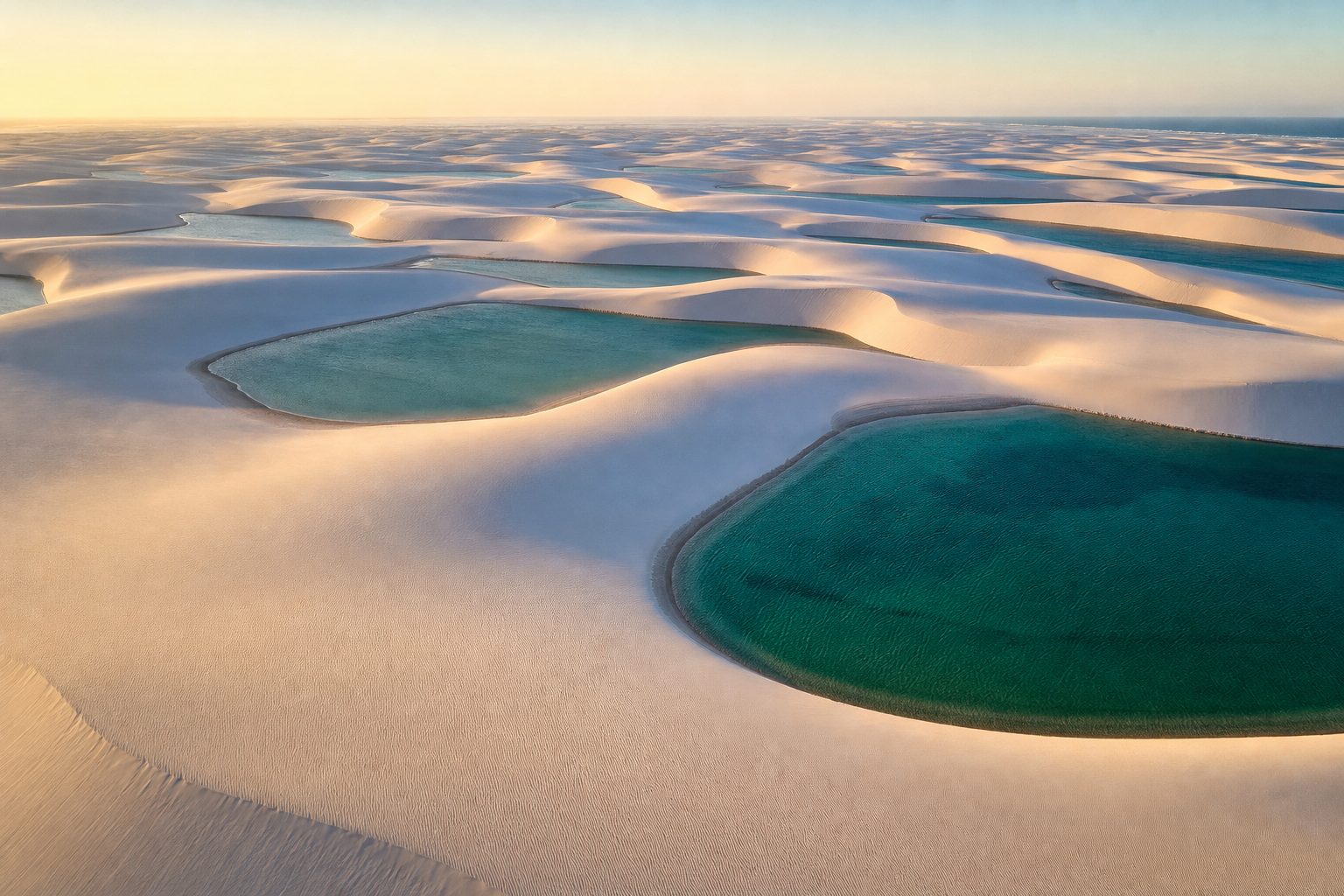
The reel that brings most people to Lençóis Maranhenses shows a swimmer floating in a turquoise pool with nothing but white sand to the horizon. The caption usually says swim here before the desert takes it back, and for once the hook is accurate. These lagoons are filled only by rain, and every year they shrink and vanish before the next wet season rebuilds them somewhere slightly different. The first decision is therefore not which lagoon to see but which month to arrive, because in November the water is simply not there.
The second set of decisions is practical. This is a 156,000-hectare national park on the coast of Maranhão in north-eastern Brazil, managed by the federal conservation agency ICMBio and inscribed on the UNESCO World Heritage List in 2024. It has no entry fee, no roads inside, and a firm rule that only accredited 4x4 vehicles and guides may carry visitors. Choosing a gateway town, a season and a type of tour shapes the whole trip, and a little care with the official rules keeps you on the right side of a park now under real pressure from its own popularity.
What the lagoons are, and why they disappear
Lençóis means sheets, and from the air the dune field looks like linen thrown across the coast. The UNESCO listing describes the largest field of fixed and mobile dunes in South America, roughly 90,000 hectares of them, moving inland up to 20 kilometres in winding barchan chains that can run 75 kilometres long. The lagoons sit in the hollows between those chains, rising with the water table in the rains and emptying as it falls. UNESCO notes that the lakes re-emerge in new locations with altered shapes each year, so the exact pool you saw on a reel may never exist in that form again.
The national park covers 156,562 hectares, of which about 90,000 hectares are dune field, with an 80-kilometre coastline. Dunes migrate at 4 to 25 metres per year, and the temporary lagoons are fed exclusively by rainwater, with no inlet or outlet. [1]
The calendar follows the rain. Between January and roughly May, storms fill the valleys between the dunes. From June the skies clear while the lagoons are still full, which is why June to August is the classic window and July the busiest month. Operators who watch the water levels each year report that September is still generally good, with smaller lagoons beginning to dry, and that from October onwards many evaporate and the field returns to bare sand until the rains restart. In a wet year full lagoons can last into early October; in a dry one, some go in September. The exception is Lagoa do Peixe, which holds water all year and is usually part of the Lagoa Azul circuit.
If swimming is the point of the trip, book between June and September and treat late September as a gamble worth checking with your agency shortly before travel. If the sculpted emptiness of the dunes appeals more than the water, October to December is quieter and cheaper, and the light is just as good. What you should not do is arrive in November expecting the reel.
When to go: month by month
In 2025 the park recorded more than 650,000 visitors, a record, with the heaviest flows in June, July and August. July is also Brazil's school holiday month, so pousadas fill early and shared 4x4 circuits run at capacity. August has the same full lagoons with domestic crowds thinning; June offers settled weather, high water and manageable numbers, though early-month showers are possible.
The wet season is not a write-off. From February to April the lagoons are filling and the margins are green, but rain interrupts tours and the MA-402 from São Luís suffers badly from potholes. ICMBio has long recommended May to September, and that remains sound advice.
In 2025 the park registered a historic record of more than 650,000 visitors, an increase of over 400 per cent on 2019. ICMBio is running a pilot project to define a Número Balizador da Visitação, a maximum visitor number the area can receive without compromising conservation and safety. [6]
As checked in September 2026, no visitor cap or reservation system has been announced for the main day circuits, but ICMBio has said publicly that limiting access when necessary is part of keeping the UNESCO title. Check the ICMBio visitor guidance shortly before you travel rather than relying on advice from an earlier season.
Choosing a gateway: Barreirinhas, Santo Amaro or Atins
Most visitors arrive through São Luís (SLZ), the state capital and the nearest airport with a full range of flights; Parnaíba (PHB) in Piauí serves those coming along the coast from Jericoacoara on the Rota das Emoções. From São Luís the route is the BR-135 to Bacabeira and then the MA-402 to Barreirinhas, about 255 kilometres and roughly four hours by car or shared van. Santo Amaro do Maranhão is a similar four hours over 235 kilometres, with the final stretch on the rougher MA-320. Shared transfers are easy to book for either town.
Barreirinhas is the main hub, on the Rio Preguiças, with the widest choice of pousadas and agencies, the keenest prices and the largest crowds at its lagoons. Its two signature day circuits are Lagoa Azul and Lagoa Bonita. Both involve an hour or more in an open-sided 4x4 on sand tracks before the vehicle stops at the dune edge; from there you walk. Lagoa Bonita requires a climb up a steep dune of around 30 metres with a rope to help, and it is the standard late-afternoon tour for sunset.
Santo Amaro is the quieter alternative on the park's western side. Its advantage is proximity: the dunes begin within minutes of town, the 4x4s drop you beside the water, and the lagoons here are widely reported to hold water later into the dry season. The trade-off is a much smaller choice of accommodation and food, and high-season vehicle access was becoming congested by 2026. As checked in September 2026, the Santo Amaro municipality has also charged a R$10 local access fee since mid-2025; regional press reported it continued despite a court ruling against it. Treat it as a municipal levy rather than a park ticket; ICMBio itself charges nothing.
Atins is the third option: a sand-street fishing village where the Preguiças meets the sea, reached from Barreirinhas by about an hour and a half of boat downriver or two hours of 4x4 across mud and dune. It sits at the park's north-eastern edge, so short tours reach the dunes quickly, and it is the start of the long-distance trek described below. It is the most atmospheric base and the most awkward, since you must synchronise the road transfer from São Luís with the last boat or overnight in Barreirinhas first.
How access actually works: accredited 4x4s, not hire cars
There is no entry fee. ICMBio states plainly that it charges no visitation fee; the money you spend goes to accredited local agencies and drivers for their services. The corollary is the rule that trips visitors most often: you cannot drive yourself in. Transport and guiding must be provided by accredited vehicles, drivers and visitor guides, and carrying visitors in private vehicles is prohibited. Private cars, motorbikes, buggies, quad bikes and UTVs are all named as unauthorised, and motorised traffic over the open dune field is banned outright. Accredited vehicles carry the park logo and an accreditation number, and guides wear identity badges, so ask to see them before you pay.
ICMBio does not charge a visitation fee for Lençóis Maranhenses. Visitor transport and guiding must be carried out by ICMBio-accredited vehicles, drivers and guides, and transporting visitors or running tours in private vehicles is not permitted. [4]
As checked in September 2026, Barreirinhas agencies were advertising shared Lagoa Azul and Lagoa Bonita circuits at roughly R$120 to R$150 per person for a half-day, and boat trips down the Preguiças to Caburé and the Mandacaru lighthouse at a similar price; private 4x4s are priced per vehicle and cost several times more. Confirm current rates with an accredited operator or your pousada. Scenic flights from the small Barreirinhas airstrip run 25 to 40 minutes and need booking well ahead between June and August.
Rules that matter on the dunes
The visiting rules are set by ICMBio Portaria 199/2017 and the management plan,; the agency treats most activity here as adventure tourism in a remote ecosystem. The prohibitions are short and enforceable with fines under Brazil's environmental crimes law: no alcohol sold, carried or consumed inside the park; no illicit drugs; no fires, barbecues or camp stoves; no domestic animals; no unauthorised motor vehicles; no rallies. Glass bottles and containers are banned throughout. ICMBio has also long asked visitors not to use tanning oils, body oils or toiletries in the lagoons, a request worth honouring because the lagoons have no outflow to dilute anything you add.
The softer rules protect the experience. Follow the guide and the signage, keep to the sand rather than trampling the restinga vegetation that holds the dune margins together, take all rubbish out, and keep the noise down. Drone flights inside a federal conservation unit require separate ICMBio authorisation, so do not assume an empty sky is an open one.
- Book only with operators whose vehicles display the park logo and accreditation number and whose guides carry ICMBio badges.
- Bring three litres of water per person per day, sun protection for skin and eyes, and a hat that survives constant wind.
- Leave alcohol and glass at your pousada; both are prohibited inside the park and fines apply.
- Keep toiletries, oils and sunscreen out of the lagoons; rinse before swimming where the guide indicates.
- Pack out everything you carry in, including fruit peel; there are no bins on the dunes.
Beyond the day circuits: the Travessia dos Lençóis
The Travessia dos Lençóis is a long-distance trail from Atins in the north-east to Santo Amaro in the west, passing through the Zona Primitiva, the park's most sensitive zone, which visitors may enter only on foot. The route strings together the inland oasis communities of Baixa Grande, Queimada dos Britos and Betânia, where families offer hammocks and simple meals and which are the only support points inside the dunes. Most groups take three or four days, walking early and late; ICMBio recommends avoiding walking between 11:00 and 15:00.
For the 2026 season ICMBio requires advance reservations at the community support points before starting long-distance trails such as the Travessia dos Lençóis, proof of booking to be carried and shown to inspectors on request, a maximum of 10 walkers per guide, and a human-waste container for any trek involving one or more overnights. [5]
ICMBio has always required an accredited visitor guide for the crossing because of the Zona Primitiva, and the 2026 trekking rules add a compulsory online entry registration, one form per group, and an exit registration when you finish. The route runs east to west so that the wind is at your back and the steep, soft lee slopes are descended rather than climbed. It is a genuine desert walk in equatorial heat, best done between June and September when the lagoons provide swimming stops and rain has packed the sand firmer. Book through an accredited trekking guide in Atins or Santo Amaro several weeks ahead, since the community lodgings are small.
The park is the only place in the world with such an extensive and dynamic system of dunes and lagoons; the landscape is continuously transformed as dunes migrate and temporary lakes appear and vanish, re-forming in new positions with each rainy season.
— Paraphrased from the UNESCO World Heritage listing for Lençóis Maranhenses National Park
How long to stay and how to combine it
Three nights is the honest minimum: an afternoon circuit and a morning circuit from Barreirinhas, a boat day on the Preguiças, and a buffer for weather. Four nights lets you add Santo Amaro or Atins as a second base, the single best upgrade to the trip, because the two sides of the park feel different and crowding at Barreirinhas' lagoons is the most common complaint. Trekkers need six or seven nights to fit the crossing and recovery.
The park was created by federal decree in June 1981 and inscribed by UNESCO on 26 July 2024, joining Brazil's short list of natural World Heritage sites. Travellers on a longer Brazilian coast trip often pair the dunes with the strictly regulated marine park of Fernando de Noronha, where the fee structure is anything but free, or fly on to Rio de Janeiro and Ilha Grande for a very different kind of beach.
Lençóis Maranhenses makes an argument for travelling with the seasons rather than against them. Come when the rain has done its work and go when the guides tell you to; the dunes will still be here in the dry months, but the lagoons will not. For the other great sand landscape that repays the same patience with light, our guide to the red dunes of Sossusvlei in Namibia makes an instructive contrast: the same rule about early and late light applies, but there the water has been gone for a very long time.
Sources & further reading
- 1. UNESCO World Heritage Centre: Lençóis Maranhenses National Park
- 2. Brazilian Government (Secom): UNESCO declares Lençóis Maranhenses a World Heritage Site
- 3. ICMBio: Parque Nacional dos Lençóis Maranhenses (official park page)
- 4. ICMBio: Orientações ao Visitante (visitor rules, fees and access)
- 5. ICMBio: Trekking – Travessia dos Lençóis (2026 season rules)
- 6. G1 Maranhão: ICMBio studies visitor limits after record 2025 tourism
- 7. Rota das Emoções Brasil: distances and travel times between Lençóis bases
- 8. Blumar: until when are the Lençóis Maranhenses lagoons full?