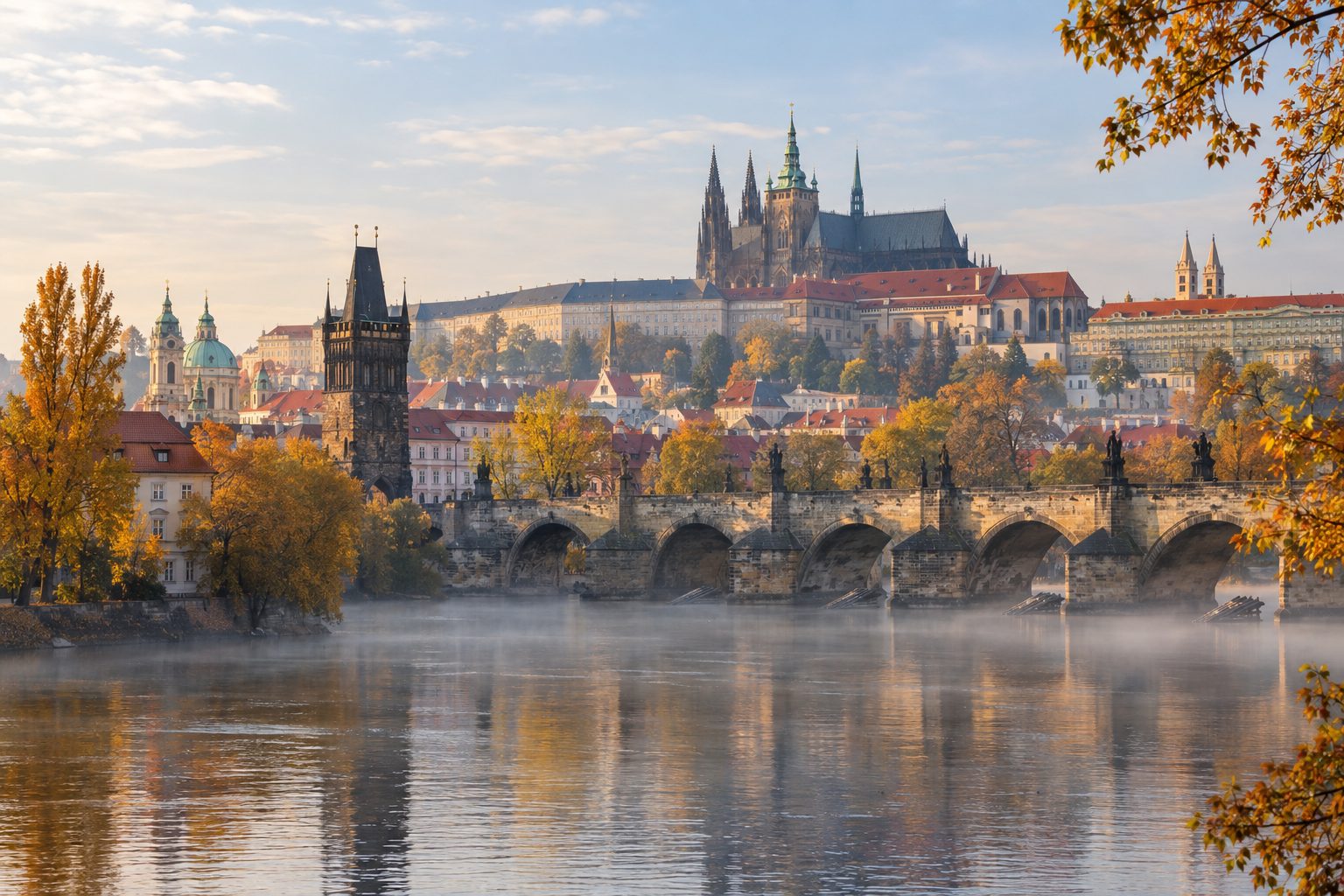
A hundred spires, golden in October: Prague in autumn is the version of the city its own photographers wait for, when the lime trees along the Vltava turn, the summer crowds thin, and the morning mist sits low enough to soften every bridge tower. It is also a city that rewards a little homework, because the three things most first-time visitors come for — Prague Castle, Charles Bridge and the Astronomical Clock — each run on their own logic. The castle sells its interiors by circuit, the bridge is free but has a narrow quiet window, and the clock performs on the hour to a crowd that assembles minutes beforehand.
The decisions, then, are specific. Which castle circuit to buy, and at what hour to walk up. Whether to see Charles Bridge at sunrise or concede it to the daytime crush. How to place yourself for the clock show without losing half a morning to it. And how to move between all of it, which in Prague is the easy part: one 90-minute public transport ticket costs 50 CZK — about two euros — and covers every tram, metro line and bus in the city. This guide takes those choices in order, with October specifics where they change the answer.
How the castle circuits work
Prague Castle is not a single building but a walled complex of courtyards, lanes, palaces and churches above the river's left bank — the castle administration puts its area at almost 70,000 square metres, and asks visitors to leave large bags behind and keep drones grounded, since the whole hill sits in a no-fly zone. The essential planning fact is that the grounds are free: you can walk the courtyards, pass St Vitus Cathedral's west front and take in the city panorama from the ramparts without a ticket. Paid admission applies only to the historic interiors, sold as circuits rather than per building.
Circuit B, at 250 CZK for adults (half price for students and seniors), covers the four principal interiors — the ticketed areas of St Vitus Cathedral, the Old Royal Palace, St George's Basilica and Golden Lane — while the castle grounds and courtyards remain free and open 06:00–22:00. [6]
Circuit B is the right call for most people: it takes two to three hours and includes the cathedral's choir and royal crypt, Vladislav Hall in the Old Royal Palace — scene of the 1618 defenestration that set off the Thirty Years' War — the Romanesque Basilica of St George, founded in 920, and Golden Lane, the alley of miniature houses in the castle wall where Franz Kafka briefly wrote at No. 22. Circuit A, around 450 CZK as checked in October 2026, adds the Treasury, the Powder Tower and the Story of Prague Castle exhibition, and earns its surcharge only if you have four hours and a real appetite for Bohemian history. The western nave of St Vitus is free to enter even without a circuit ticket, which is worth knowing if your interest stops at the Mucha window and the scale of the place.
The castle hill has been the seat of Czech power since Prince Bořivoj founded a stronghold here around 880, and the complex was inscribed as part of UNESCO's Historic Centre of Prague listing in 1992; the full changing of the guard takes place at 12:00 in the First Courtyard. [7]
Timing matters more than the ticket. Interiors open at 09:00 daily (closing 17:00 April to October, 16:00 in winter, last entry half an hour before), and tour groups peak between 11:00 and 15:00. Arrive for opening, do the interiors first and the free courtyards after, and you will have Golden Lane to a handful of people rather than a queue. Getting up the hill is simplest by tram 22 to the Pražský hrad stop, or metro line A to Malostranská followed by a 15-minute climb up the Old Castle Steps. If 19th-century fantasy castles are more your register than a working thousand-year complex, our guide to Neuschwanstein in Bavaria makes a useful contrast — Prague's castle is the real administrative article, lived in by Czech rulers and presidents alike.
Charles Bridge and the sunrise window
Charles Bridge needs no ticket, no booking and no strategy beyond a clock. It is open around the whole day and year, just over 500 metres long, and takes ten to fifteen minutes to cross when it is not busy — which, from mid-morning to mid-afternoon in any season and most of the day in summer, it emphatically is. The quiet window in autumn and winter is sunrise, roughly 07:00 to 08:00, when the only company is photographers and the baroque statues stand in mist off the river. Crowds build from mid-morning; weekends and holidays are the worst of it; and the bridge empties again noticeably after about 17:00 in the darker months once the day-trip groups leave.
In October the arithmetic is kind: sunrise sits at a civilised hour, so the best light on the bridge no longer demands a 05:00 alarm as it does in June. Walk the bridge east to west with the castle ahead of you, then climb one of the bridge towers if you want the postcard angle — the Old Town Bridge Tower's 138 steps are best in the morning, when the sun lights the castle, while the Lesser Town side suits the afternoon; each climb is a separate ticket of under 200 CZK, as checked in October 2026. Cross early, carry on up to the castle for 09:00 opening, and you will have done the two biggest sights before the main crowds arrive.
The Old Town Hall and the hour the clock performs
The Astronomical Clock — the Orloj — has kept its mechanical theatre running on the south face of the Old Town Hall since the 15th century, and the show remains stubbornly brief: the twelve apostles process past two small windows, the skeleton rings his bell, the cock crows, and the hour strikes. The crowd on the square below starts gathering ten minutes before each hour. See it once, from the back of the crowd, and treat it as the overture rather than the event.
The twelve apostles, each carrying his attribute, appear in the two windows beneath the clock's small roof every hour from 8:00 to 23:00, according to Prague City Tourism's official listing for the Old Town Hall. [1]
The Old Town Hall has served as the seat of the Old Town administration since 1338, and its Gothic tower, bay chapel and astronomical clock form the oldest surviving part of the complex; the visitor route covers the chapel, the historic halls, the underground and the tower.
— Paraphrased from the Prague City Tourism listing for the Old Town Hall with Astronomical Clock
The better use of the building is to go inside and up. Basic admission — 350 CZK as checked in October 2026 — includes the Knight's Hall and the 42-metre tower gallery, the best mid-height viewpoint in the Old Town, looking across the square's roofs to Týn Church and the castle beyond. An Early Bird scheme halves the admission during the first hour after opening (09:00 April to December), which pairs neatly with the early loop above; guided circuits of the chapel, state rooms and underground run at announced times for a small surcharge paid on site. From the gallery you can watch the next hour's crowd assemble below the clock, which is the show at its most entertaining.
Getting around for 50 CZK
Prague's public transport is the quiet best-in-class of Central Europe, and its pricing is the hook this guide's title promises. Tickets are time-based with unlimited transfers across trams, the three metro lines and buses; the DPP fare pricelist is the authoritative reference, and the PID Lítačka app undercuts every paper price slightly.
As checked in October 2026, a 90-minute Prague ticket costs 50 CZK on paper or 46 CZK in the PID Lítačka app, a 30-minute ticket 39/36 CZK, and a 24-hour ticket 150 CZK — all valid across trams, metro and buses, with validity based purely on time rather than the number of transfers. [2]
In practice the 90-minute ticket covers almost any single journey a visitor makes, and the 24-hour ticket (which also covers the Petřín funicular) pays for itself on any day with three or more rides. The metro runs every two to four minutes at peak; trams 9, 17 and 22 are the backbone lines, with 22 doubling as an unofficial sightseeing route past the National Theatre, Malá Strana and the castle. Night trams 91–99 take over from about 00:30 to 04:30, all meeting at Lazarská. The rules that catch visitors out are procedural, not financial: buy before boarding, and stamp a paper ticket exactly once, on first use — restamping invalidates it, and plain-clothes inspectors do check. Full network details are on Prague City Tourism's transport pages.
- Buy the 90-minute ticket (50 CZK paper, 46 CZK in the PID Lítačka app) for single journeys; switch to the 24-hour ticket at 150 CZK on any day with three or more rides.
- Validate a paper ticket once, on first boarding or before the metro platform — never restamp it at a transfer.
- Use tram 22 for the castle (Pražský hrad stop) and as a de facto sightseeing line through Malá Strana.
- Airport to centre: public bus plus metro on a standard ticket by day; night bus 910 runs when the metro sleeps.
- Activate app tickets before boarding — validity runs from the moment of activation, not purchase.
Beyond the centre: Vinohrady and Letná
Prague's historic core is compact enough that most visitors never leave it, which is exactly why the neighbourhoods one tram ride out feel like a different, calmer city. Vinohrady, southeast of the New Town, is the elegant residential quarter — Art Nouveau facades, tree-lined avenues and an unhurried café culture — and its Riegrovy sady park has a lawn-side view back toward the castle that locals treat as their own. Letná, on the plateau across the river from the Old Town, offers the single best free panorama of the Vltava bridges from the park's southern edge, plus a famous beer garden under the trees that in a warm October stays open late into the month. Neither needs more than half a day; both are where the 50 CZK ticket earns its keep, and where dinner costs noticeably less than two streets from the Orloj.
When to go: the case for autumn
Summer brings Prague its heaviest crowds — on busy days tens of thousands of people cross Charles Bridge, concentrated between 10:00 and 18:00 — while deep winter brings cold, short days and, from late November, the Christmas-market surge. October is the gap in between: the riverbanks, Petřín hill and the castle's own gardens turn gold, the bridge is manageable even at midday compared with August, and queues for castle circuits shorten appreciably. Autumn city breaks to Central Europe are having a moment in 2026, and Prague is the trend's obvious anchor: it is the rare capital whose signature sights are outdoors and free, so cool, clear weather improves the trip rather than merely surviving it. Pack for single-digit mornings, remember the castle interiors shift to 16:00 closing from November, and book accommodation ahead for golden-October weekends, which have grown popular.
Money: crowns, cards and common overcharges
The Czech Republic is in the EU but not the eurozone: the currency is the Czech crown (koruna, CZK), and while plenty of tourist-facing businesses display euro prices, the exchange rate baked into them is rarely in your favour — pay in crowns. Card and phone payment is near-universal in the centre, including ticket machines and the transport app, so there is little reason to change large sums of cash; when a terminal offers to charge your home currency instead of CZK, decline the dynamic currency conversion and choose crowns. Keep a few hundred crowns in coins and small notes for market stalls, public toilets and the odd beer-garden kiosk, avoid the street exchange offices whose headline rates apply only to sums no visitor changes, and treat any taxi without a meter as a walk. None of this is unique to Prague, but the euro-price markup is the one that quietly costs visitors the most.
Prague's reputation suffers mainly from its own popularity, and the fix is structural rather than secret: come in the shoulder season, spend your early hours on the bridge and the hill, give the clock exactly one hour of your attention, and let the trams do the moving. Done that way, the city of a hundred spires feels unreasonably generous for the money. If the same autumn trip is tempting you deeper into Central Europe, our guide to Hallstatt's lakeside village pairs naturally with Prague — a four-hour run south into the Austrian lake district, and the same advice about beating the day-trip crowds applies.
Sources & further reading
- 1. Prague City Tourism — Old Town Hall with Astronomical Clock (official)
- 2. Prague Public Transit Company (DPP) — Fare pricelist (official)
- 3. Prague City Tourism — Public transport in Prague (official)
- 4. Prague Castle administration — Prague Castle for visitors (official)
- 5. Prague Trip — Charles Bridge: visiting, timing and crowds
- 6. Prague Trip — Prague Castle tickets and circuits explained
- 7. Czech Journal — Prague Castle visitor guide (2026 prices)
- 8. View from Prague — Charles Bridge: a local's guide