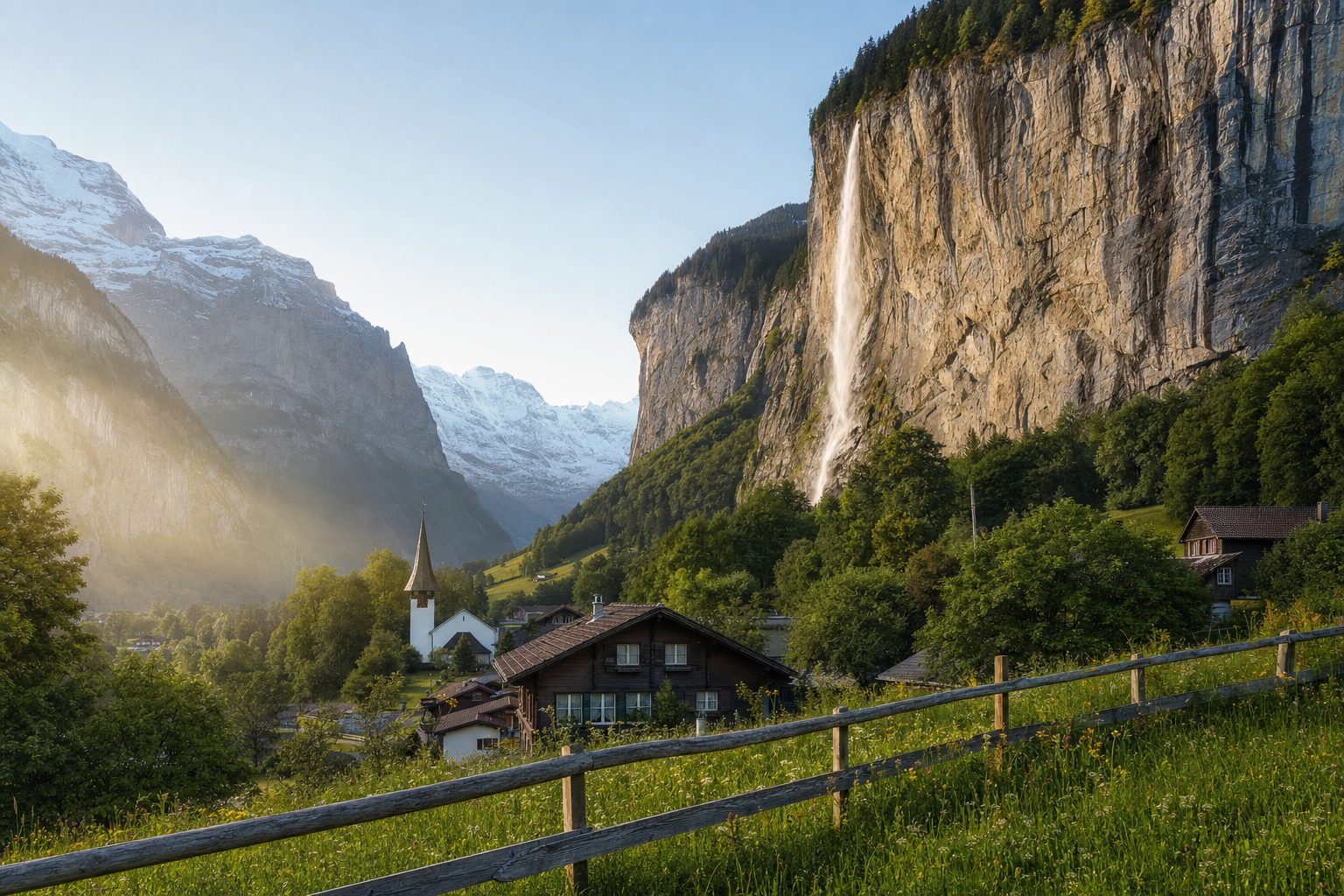
The reel that sends most people to Lauterbrunnen makes a simple count: 72 waterfalls, two car-free villages, one valley. For once the arithmetic holds up. The Lauterbrunnen valley, a dead-straight trench in Switzerland's Bernese Oberland, runs between limestone walls so sheer that streams simply step off them, and the regional tourism office counts 72 falls along its length — from the white ribbon of Staubbach, which drops past the village church, to seasonal threads that appear only after rain. Above the cliffs sit Wengen and Mürren, two villages that cars cannot reach at all, connected to the valley floor by a cog railway on one side and a cable car and panorama railway on the other.
What the reels do not show is the queue of hire cars idling outside a multi-storey car park, or the council debate about charging day visitors who arrive by road. Lauterbrunnen is a small farming village that now absorbs extraordinary summer crowds, and the way you arrive shapes both your day and your welcome. The decisions worth making in advance are few but consequential: whether to come by train or car, which of the two visitable waterfalls to prioritise, whether to ride up to Wengen or Mürren, and whether to stay overnight once the day-trippers drain away. This guide takes them in order, with prices and hours as checked in August 2026.
How the valley is laid out
Orientation is mercifully simple. The valley runs roughly north to south: Lauterbrunnen village sits at its mouth, the road continues along the flat valley floor to Stechelberg at the far end, and everything else is vertical. On the western wall, a cable car climbs from Lauterbrunnen to Grütschalp, where a panorama railway trundles along the cliff terrace to Mürren, at around 1,638 metres. On the eastern side, the Wengernalp cog railway hauls itself from Lauterbrunnen station up to Wengen at 1,274 metres and onwards towards Kleine Scheidegg. The valley floor itself is a 40-minute stroll or a short bus ride end to end, with waterfalls appearing at intervals along both walls.
Of the 72 falls, most are scenery rather than destinations: thin cascades best admired from the valley path between Lauterbrunnen and Stechelberg. Only two are set up for visits. Staubbach Falls, directly above the village, is free and reached in minutes. Trümmelbach Falls, partway along the valley, is a paid attraction of a completely different character — a glacier-fed torrent that has carved its way through the inside of the mountain. Seeing both, plus one of the car-free villages, is a full and unhurried day.
Why the train beats the car
The official advice from every local tourism body is the same: come by rail. Trains run from Interlaken Ost to Lauterbrunnen in about 22 minutes with no change, and the station deposits you 200 metres from the main street with Staubbach Falls already in view. Beyond Lauterbrunnen village and Stechelberg, private cars are not merely discouraged — there is nowhere legal to take them. Wengen and Mürren have no through roads, and Wengen Tourism's arrival page is blunt that the village can only be reached by public transport, on foot or by bicycle.
If you do drive, the realistic option is the multi-storey car park beside Lauterbrunnen station, bookable through the Jungfrau Railways site. It fills in peak season, and local advice is unambiguous: if the garage and the official outdoor spaces are full, turn back, park lower down the valley or at Interlaken, and finish the journey by train. Parking on verges or farm tracks earns fines and local resentment in equal measure. Note too that reserved spaces at the car park carry minimum stays in high demand periods — Mürren's tourist office notes reservations run from three days in summer and five in winter — so casual day parking is a matter of luck.
The Lauterbrunnen multi-storey car park charges CHF 18.00 for one day, CHF 31.00 for two and CHF 44.00 for three, booked in advance through Jungfrau Railways' official parking portal. [3]
Staubbach Falls: the ten-minute icon
Staubbach is the waterfall on every postcard and in every reel: a single free fall of water that turns to spray — Staub means dust — before it reaches the meadow behind the village. It is the highest free-falling waterfall in Switzerland and among the highest in Europe, and it costs nothing to visit at any hour. From the station, walk up the main street and follow the marked path; a gallery cut into the rock lets you stand behind the curtain of water and look out over the rooftops. The fall is at its fullest from late spring through summer, when snowmelt from the plateau above feeds it; by late autumn it can thin to a veil.
Staubbach Falls drops 297 metres in a single free fall and stands about 10 minutes on foot from Lauterbrunnen station, with a rock gallery leading behind the water. Access is free. [1]
Because it is free, unfenced and next to the village, Staubbach absorbs the worst of the midday crush. The classic photograph — the fall framed above the church spire and the main street — is best in early morning light, before the first waves of day visitors arrive from Interlaken. If you are staying overnight, this is your moment; the street empties dramatically after the last afternoon trains.
Trümmelbach Falls: the waterfall inside the mountain
Trümmelbach is the valley's other essential stop and nothing like Staubbach. It is a chain of ten glacier waterfalls that drain the ice fields of Eiger, Mönch and Jungfrau — up to 20,000 litres of water per second — and they run inside the rock, accessible by a lift bored into the cliff and a series of tunnels, galleries and viewing platforms. The noise and force at close range are the point; this is the only place in the valley where the glacier's meltwater can be watched mid-plunge from within the mountain.
Trümmelbach Falls costs CHF 18 for adults and CHF 8 for children aged 6 to 15, opens from early April to early November, 9:00–17:00 daily (8:30–18:00 in July and August), and does not admit children under 4. [1]
Wengen and Mürren: the car-free balconies
The valley's second habit-forming pleasure is riding out of it. Wengen, on the eastern terrace, is the easier trip: the cog railway climbs from Lauterbrunnen in about 11 minutes to a village of hotels and chalets that has never had road access, and continues towards Kleine Scheidegg beneath the Eiger's north face. Mürren, on the western side, takes about 21 minutes — a steep cable car to Grütschalp, then the panorama railway running level along the cliff edge with the Jungfrau massif filling the windows — and feels smaller, quieter and higher, at roughly 1,638 metres.
Wengen is car-free: the village can only be reached from Lauterbrunnen by public transport, on foot or by bicycle.
— Paraphrased from Wengen Tourism's official arrival guidance
Which to choose on a single day? Wengen wins on speed and connections; Mürren wins on drama, and its ride doubles as sightseeing. Both villages reward an hour's aimless walking more than any itinerary. The absence of engine noise is the thing visitors remember — deliveries move by electric cart, and the loudest sound in the lanes is usually a cowbell. If the budget allows, the cable car onwards from Mürren towards the Schilthorn summit adds the region's most famous revolving-restaurant panorama, though it is a significant extra fare and worth checking weather cameras first.
The day-tripper fee debate
Lauterbrunnen's popularity has a price, and the village has been openly debating who should pay it. In May 2024 the local council announced it was studying an entry fee of CHF 5–10 for day visitors arriving by car, to be processed through a smartphone app — explicitly modelled on the pressures that led Venice to trial its own day-tripper charge. Overnight guests, visitors with bookings for accommodation or activities, and anyone arriving by public transport would be exempt. The design is a nudge, not a wall: it targets precisely the drive-in, photograph, drive-out pattern that clogs the valley road in summer.
As checked in August 2026, the fee remains a proposal under discussion and has not been implemented — there is no charge to enter Lauterbrunnen today, however you arrive. But the direction of travel is clear, and the practical reading for visitors is simple: the exemptions describe the trip the village wants you to take. Arrive by train, or stay the night, and any future fee is unlikely ever to apply to you. Check the official Lauterbrunnen visitor pages for the current position before a 2027 trip; similar proposals elsewhere have moved from consultation to pilot within a season, as Hallstatt's crowd-management measures showed in Austria.
Costs, taxes and staying overnight
Lauterbrunnen rewards an overnight stay more than almost any Swiss honeypot, because its crowd curve is so extreme: the valley floor is thronged from late morning to late afternoon and close to empty either side. Overnight guests pay a visitor's tax collected by their accommodation — modest, and worth knowing about so the line on the bill is no surprise. Hotels also issue a guest card at check-in that carries discounts on local attractions and cableways, which claws some of the tax back on the first ride up the valley wall.
The overnight visitor's tax, paid directly to your accommodation, is CHF 3.50 per adult per night in Lauterbrunnen village; in Mürren it is CHF 5.60 and in Gimmelwald CHF 2.10, with children under 6 exempt. [4]
- Come by train: Interlaken Ost to Lauterbrunnen takes about 22 minutes, and public-transport arrivals would be exempt from any future day-visitor fee.
- Do Trümmelbach at opening (8:30 in July–August), then walk the valley floor to Stechelberg before the midday crowds.
- Ride up to one car-free village — Wengen in about 11 minutes by cog railway, or Mürren in about 21 via Grütschalp — rather than rushing both.
- If driving, pre-book the station car park (CHF 18/day) and have a fallback plan at Interlaken if it is full.
- Stay a night if you can: Staubbach at dawn, an empty main street, and the visitor's tax is CHF 3.50 well spent.
Lauterbrunnen sits naturally in a Bernese Oberland rail itinerary: Interlaken is the hub, and the same station connects onwards to the Jungfraujoch excursion or across the Alps entirely. If the car-free village model appeals, Zermatt runs the same idea at larger scale beneath the Matterhorn, reached by its own shuttle-train arrangement. And if this trip is part of a longer European rail loop, our guide to travelling around Europe by train covers the passes and seat reservations that make valley-hopping like this cheap and painless. The 72 waterfalls will still be falling whenever you get there — the only question is how many other people are standing in front of them.
Sources & further reading
- 1. Lauterbrunnen — Interlaken Tourism (official)
- 2. Wengen Tourism — Arrival (official)
- 3. Lauterbrunnen Car Park — Jungfrau Railways (official booking)
- 4. Lauterbrunnen Tourism — Guest Information (official)
- 5. Mürren Tourism — Guest Information (official)
- 6. CNN Travel — Lauterbrunnen entry-fee proposal
- 7. MySwissAlps — Lauterbrunnen