
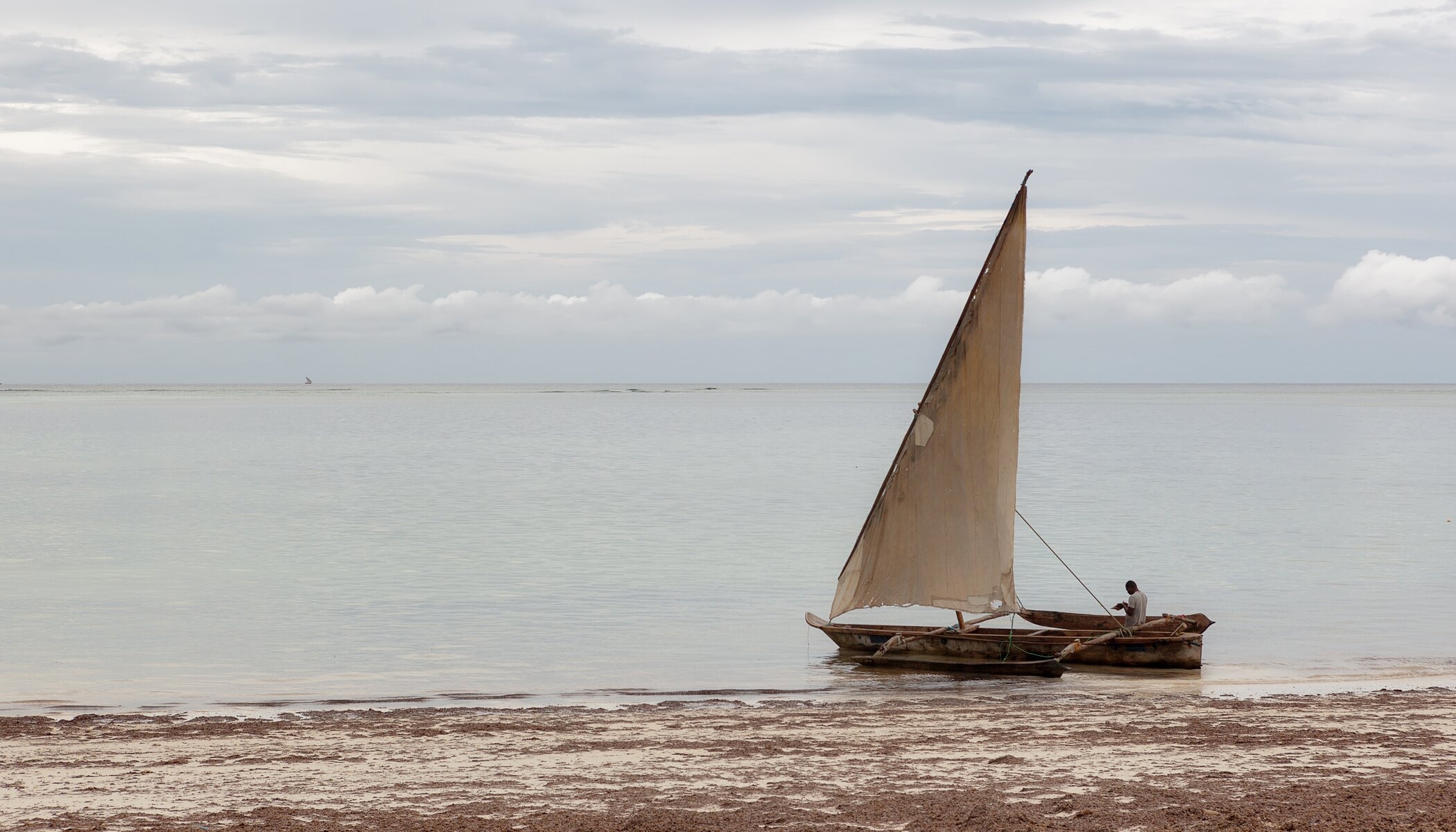
The dhows give it away. Come in off the Indian Ocean toward Unguja — the main island everyone simply calls Zanzibar — and you'll pass the same triangular-sailed wooden boats that have worked these waters for a thousand years, riding the monsoon winds that once carried cloves west and slaves, tragically, in every direction. Zanzibar is a place built by the sea and by everyone the sea brought to it: African, Arab, Persian, Indian, European. You taste it in the food, you read it in the architecture, and you feel it the moment you step into the shaded maze of Stone Town.
Most visitors come for the beaches, and the beaches deliver — powder sand, water in impossible shades of turquoise, reefs teeming with life. But to skip Stone Town for the sand is to eat the dessert and leave the meal. Do both. Give the old town two or three days, then decamp to the coast.
Zanzibar is technically a semi-autonomous archipelago within Tanzania, and it wears that in-between status proudly — African at its core, but seasoned by centuries of Omani rule, Indian commerce and a brief, uneasy period as a British protectorate. The name itself, from a Perso-Arabic phrase, hints at how outsiders once saw this coast. Cloves made it rich in the 19th century, when the island became the world's largest producer of the spice; wander the interior and you can still tour plantations heavy with clove, nutmeg, cinnamon and vanilla, the reason Zanzibar is still called the Spice Island.
Stone Town: A City Made of Coral and Trade
Stone Town — Mji Mkongwe, 'the old town' in Swahili — sits on a promontory on Unguja's western coast, a dense tangle of narrow winding lanes where the buildings lean toward one another and the light falls in slivers. It is one of the finest surviving Swahili coastal trading towns anywhere, and its whole character comes from the way its clustered coral-stone houses, seafront mansions and mosques knit together into a single, almost-intact medieval fabric.

The Stone Town of Zanzibar was inscribed as a UNESCO World Heritage Site in 2000, recognised as an outstanding example of the Swahili coastal trading towns of East Africa and a material manifestation of cultural fusion between Africa, the Arab region, India and Europe over more than a millennium. [1]
The signature detail is the doors. Stone Town's carved wooden doors are famous across East Africa — heavy, studded, some crowned with brass spikes originally meant to deter war elephants in India and later kept purely for show. Rich merchants competed to commission the most elaborate, and reading the doors — Arab-style rectangular frames, Indian-influenced rounded arches — is a lesson in who lived where, and who traded with whom.
The Old Fort, the oldest building in Stone Town, was built by the Omanis in 1699, and in 1840 the Sultan of Muscat and Oman moved his capital from Muscat to Stone Town, cementing the island's role as the hub of the 19th-century spice and slave trades. [2]
That history has a dark heart. Zanzibar was one of the principal slave-trading ports of East Africa, and Stone Town is where the trade was finally ended. The Anglican Christ Church Cathedral stands on the site of the old slave market; a memorial and the preserved holding cells beneath make for a sobering but essential hour. Elsewhere the mood lifts: get lost on purpose in the alleys, watch the sun drop from the terrace of the old Africa House, and time your evening for the waterfront.
Beyond the headline sights, the pleasure of Stone Town is textural. It's the muezzin's call bouncing between coral walls at dusk; the boys playing football in the one open square as swifts wheel overhead; the smell of frying cassava drifting from a doorway; the sudden hush of a mosque courtyard glimpsed through a half-open gate. Set aside an afternoon with no agenda at all. Buy a kanga (the printed cotton wrap women wear, each stamped with a proverb) in the Darajani market, drink cardamom coffee at a hole-in-the-wall, and let the town's slow, salt-worn rhythm reset your clock. Music lovers should note this is also the home of taarab, the hypnotic Swahili-Arab orchestral style, and the birthplace of Freddie Mercury, whose childhood home is marked near Kenyatta Road.
Choosing Your Beach
Not all Zanzibar beaches are the same, and the single most important thing to understand before you book is the tide. On much of the east and southeast coast, the ocean retreats vast distances at low tide, exposing shallow lagoons and seaweed flats — beautiful, but not always swimmable on demand. The north escapes this. Choose according to what you actually want.

Nungwi and Kendwa, on the northern tip about an hour and a half from Stone Town, are the swimming beaches — deep water regardless of tide, sunset views, and the island's liveliest scene of bars, dhow-builders and full-moon parties. Paje, on the southeast coast, is kitesurfing central: a long shallow lagoon and reliable wind draw boarders from around the world. Jambiani, just south, is quieter and more authentically village-paced — pole pole, slowly slowly. Matemwe, on the northeast, is the serene choice, and the launch point for snorkelling and diving the celebrated Mnemba Atoll.
Kendwa Beach on Zanzibar's northwest coast, about 56 km from Stone Town, allows uninterrupted swimming thanks to its tide-free nature — unusual on an island where many beaches empty out dramatically at low tide. [3]
- Nungwi & Kendwa (north, ~56–59 km / ~80 min) — best for swimming any time, sunsets and nightlife
- Paje (southeast, ~50 km / ~75 min) — kitesurfing, diving and a young, active crowd
- Jambiani (southeast, ~56 km) — quiet, village life, cultural immersion, coral rock pools
- Matemwe (northeast, ~40 km) — serene, unspoiled, gateway to Mnemba Atoll snorkelling
On and Under the Water
The sea is the whole point, and there is far more to it than lying on it. The reefs around Mnemba Atoll, off the northeast coast, are the island's diving showpiece — walls of coral, turtles, reef sharks and, if you're lucky, pods of dolphins on the boat ride out. Paje and the southeast lagoon have become one of the Indian Ocean's premier kitesurfing destinations, with schools that will have a beginner up and riding in a few days. Traditional dhow cruises at sunset are the gentler counterpart: a wooden boat, a lateen sail, a bottle of something cold and the sky going molten over Stone Town.
Two experiences reward the effort of getting off the sand. The mangrove channels and sandbanks around the tiny islet of Nakupenda make for a classic day trip, marooned on a spit of white sand at low tide with a grilled-fish lunch. And a spice-farm tour in the island's interior — crushing a clove, scratching a cinnamon bark, tasting a just-picked lychee — turns the abstraction of 'the Spice Island' into something you can smell on your fingers for the rest of the afternoon.
When to Go
Zanzibar runs on the monsoon calendar. The long dry season from June to October is the classic window — hot, sunny, low humidity, and it dovetails neatly with a mainland safari. December to February is another dry, hot stretch, brilliant for the beach. Avoid the long rains of roughly late March through May, when downpours can flatten a beach holiday, and expect shorter rains around November. Whenever you come, the water is warm and the light is extravagant.
The classic East African itinerary treats Zanzibar as a reward — the beach coda after the dust and adrenaline of a Serengeti or Ngorongoro safari, a short flight away on the mainland. It's a near-perfect pairing: you come off the plains sunburnt and over-stimulated and let the island decompress you. But Zanzibar stands on its own two feet, too. Between the reef diving, the spice tours, the dolphins off Kizimkazi and a couple of unhurried days in Stone Town, you can fill a week here without ever wishing you were somewhere else.
One more thing worth building into your plans: Ramadan reshapes the island. During the holy month, most local restaurants close in daylight hours and the whole rhythm shifts to the evening, when the streets fill after the fast breaks. It can be a wonderful, atmospheric time to visit if you go with the flow and eat when the town eats — but if you want long lazy beach lunches and a cold beer at noon, check the dates before you book.
Getting There and Getting Around
Most travellers fly into Abeid Amani Karume International Airport near Stone Town, either direct from hubs like Nairobi, Addis Ababa, Doha or Istanbul, or as a short hop from a Tanzanian safari. There's also a fast ferry across from Dar es Salaam. On the island, taxis and pre-arranged transfers handle the runs between Stone Town and the beaches — reckon on 60 to 90 minutes to most coasts. Negotiate fares before you get in, carry Tanzanian shillings in small notes, and don't expect cards to work outside the bigger hotels.
In Stone Town you don't find your way — you surrender it. The alleys will spit you out somewhere better than where you were headed, usually at a doorway you'll want to photograph and a cup of coffee you'll want to sit with.
— Amina Said
Where to Eat
Zanzibari food is Swahili food — rice and coconut, cardamom and clove, the catch of the day and the spices that made the island rich. Eating well here spans three tiers: the theatre of the Forodhani night market, humble local canteens serving the island's best pilau and biryani, and a small number of atmospheric rooftop dinners. Cash (in shillings) is king; agree prices before you order at the market.

Forodhani Gardens Night MarketSwahili street food
Stone Town's waterfront park transforms every evening around 6pm into a smoky, crowded, joyous open-air food market with dozens of vendors cooking to order.
Why it’s so good: Duma Explorer calls it the flagship and the single best place to sample multiple Zanzibar foods in one evening — the quintessential Stone Town experience.
Top picks: Zanzibar pizza (folded, stuffed and griddled) · Urojo 'Zanzibar mix' soup · Mishkaki grilled skewers · Fresh sugarcane juice

Lukmaan RestaurantAuthentic Swahili, buffet-style
A no-frills, buffet-style Stone Town institution with a rotating daily menu of pilau, biryani, curries and stews at rock-bottom prices.
Why it’s so good: Duma Explorer names it the go-to for affordable, authentic Swahili food, consistently recommended by residents and travellers alike — a full meal runs about US$3–5.
Top picks: Pilau · Friday biryani (go by 12:30pm before it sells out) · Grilled fish

Emerson on HurumziSwahili fine dining (rooftop)
A set Swahili dinner served on a lantern-lit rooftop terrace high above the old town, accompanied by live taarab music.
Why it’s so good: Duma Explorer highlights the rooftop views over Stone Town and the live music; WildToSea notes it runs a single evening sitting, so pre-booking is essential.
Top picks: Set Swahili tasting dinner · Sunset rooftop seating

The Rock RestaurantSeafood
Perched on a lone coral outcrop in the sea off Michamvi Pingwe, reached on foot at low tide or by boat at high tide — as much a photograph as a meal.
Why it’s so good: Duma Explorer flags it as the island's most iconic dining setting and recommends its samaki wa kupaka; solid seafood in an unforgettable location.
Top picks: Samaki wa kupaka (fish in coconut curry) · Grilled seafood platter

Fisherman's Seafood & Grill, NungwiBeach seafood
A beachside grill in the northern resort of Nungwi serving fresh-catch seafood, often on the plate within hours of leaving the water.
Why it’s so good: Duma Explorer notes it holds the top TripAdvisor rating at 4.8 stars from over 2,100 reviews, and singles out its pweza wa nazi.
Top picks: Pweza wa nazi (octopus in coconut) · Daily grilled catch

Jaws CornerSwahili coffee stop
A tiny, storied junction in Stone Town where a coffee-seller pours strong, sweet Arabic-style kahawa and locals gather to argue politics on plastic stools.
Why it’s so good: Duma Explorer calls it the most famous spot on the island for kahawa — the best low-cost way to slow down and sit inside daily Stone Town life.
Top picks: Kahawa (spiced black coffee) · Kashata (coconut sweets)
Whatever you do, seek out the island's coconut-and-spice classics: samaki wa kupaka, grilled fish bathed in a tangy coconut curry, and pweza wa nazi, octopus slow-cooked in coconut milk. Don't overlook the humbler pleasures either — the sticky triangles of Zanzibar pizza folded to order at Forodhani, the tart tamarind punch of a bowl of urojo, the fried dough of mandazi eaten warm from a street cart at dawn. Better still, take a cooking class that begins with a market tour: haggling for the right ripe mango, learning to grate coconut on a wooden stool, watching a Zanzibari cook build a pilau spice by spice. It is the fastest way to understand why a small island off the Tanzanian coast tastes the way the whole Indian Ocean once did — and it sends you home with something more durable than a tan.
Sources & further reading
- 1. UNESCO World Heritage Centre — Stone Town of Zanzibar (inscription, cultural fusion)
- 2. World Heritage Site / Wikipedia — Stone Town (Old Fort 1699, Omani capital 1840)
- 3. Zanzibar.com — A Guide to the Best Beaches of Zanzibar (tides, distances, Kendwa)
- 4. Duma Explorer — Zanzibar Food Guide 2026 (restaurants, dishes, ratings)
- 5. WildToSea — Where to Eat in Stone Town (Forodhani, Emerson, prices)
- 6. UNESCO Silk Roads — Stone Town of Zanzibar (spice trade, Sultanate capital)
- 7. Hero image source — Wikimedia Commons: Dhow boat Zanzibar
- 8. Hero image licence — CC BY-SA 3.0 Unported


