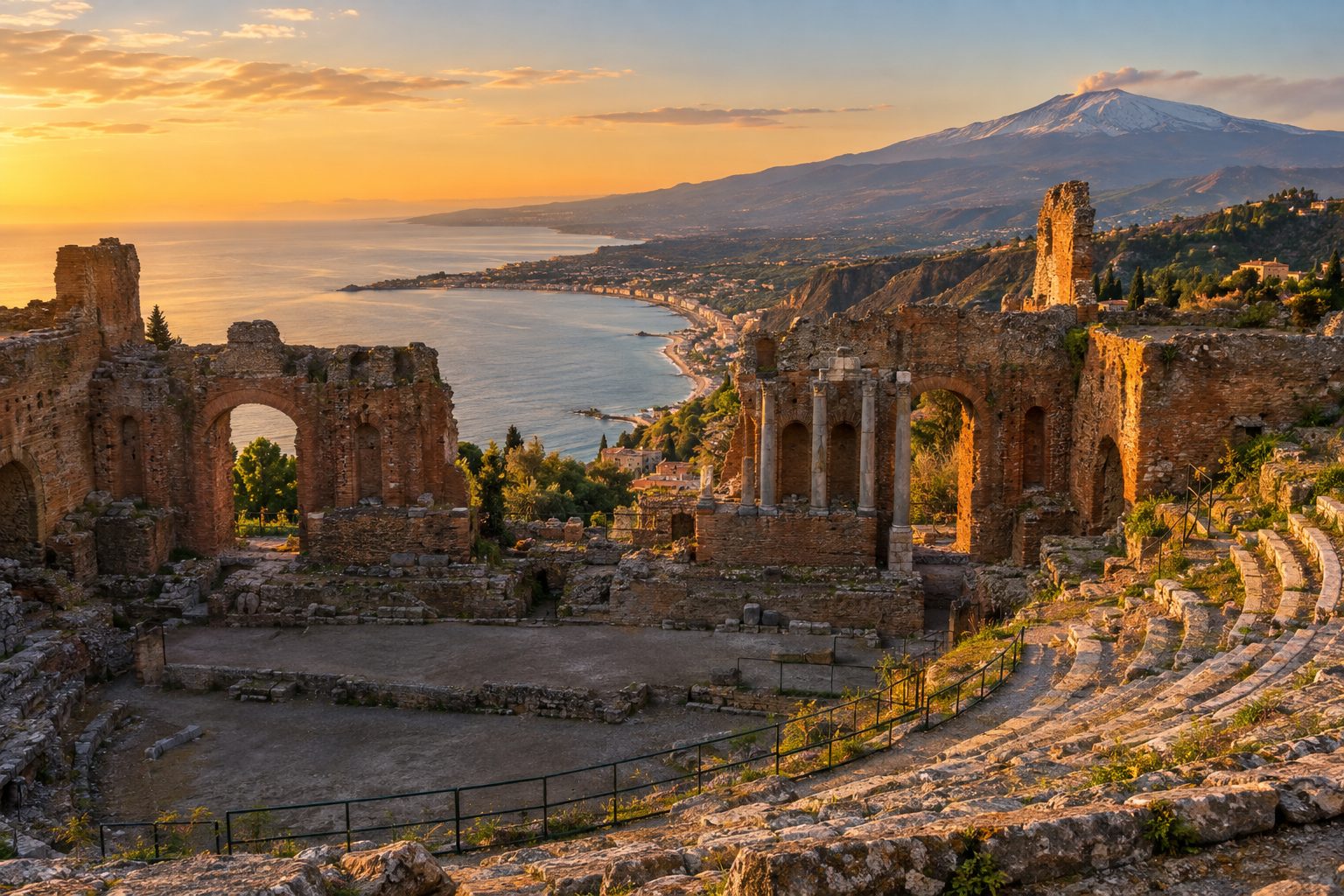
Taormina is a small town asked to do a great deal. It sits about 200 metres above the Ionian Sea on the shoulder of Monte Tauro, with a Greek theatre at one end of its main street, a tiny nature-reserve island at the foot of its cliff, and Etna filling the southern horizon. Almost everyone visiting eastern Sicily comes here, mostly between ten and four.
That is the whole problem and the whole solution. The theatre, Isola Bella and the Corso are all worth the trip; none of them is worth it at midday in August. The decisions that matter are about timing: which hour you give the theatre, whether you sleep in the town or on the shore below, how you move between the two, and whether you fold in Etna.
The Teatro Antico: tickets, hours and the light
The Teatro Antico is the reason Taormina exists as a destination. Greek in origin and rebuilt in brick by the Romans, its cavea opens south-east, so the ruined stage wall frames the coast with Etna behind it. It is run by the regional Parco Archeologico Naxos Taormina as a ticketed monument.
As checked in September 2026, the Parco Archeologico Naxos Taormina lists the Teatro Antico at €14 full price and €7 reduced, open every day from 09:00 to 19:45 with last entry at 19:00 in the high-season timetable. [1]
Those hours are the summer maximum. The official ticket office, Aditus Culture, publishes a timetable that tracks sunset: late September closes at 18:45, and winter shortens it further. The reduced fare is for EU citizens aged 18 to 25 and FAI members; under-18s enter free, but free tickets are issued only at the on-site desk. Admission is also free on the first Sunday of each month, which makes those Sundays the busiest.
Buy a timed online ticket for the first slot. At 09:00 the theatre belongs to a few dozen people; by 10:30 the coach groups and cruise tenders have climbed the hill and the upper tiers are a queue for the same photograph. The light is better early too, with Etna clearest before the afternoon haze.
In 2026 the ticket office also lists a run of evening openings, with the theatre open continuously from 09:00 to midnight on set August and September dates and the four extended evening hours priced at €1 for everyone. Tickets are valid only for the date and time chosen at purchase, and luggage cannot be brought into the theatre.
Check the calendar before you fix a day, because the theatre is also a working venue. The Festival Internazionale Taormina Arte has used it since 1983 and in 2026 runs from 30 June to 10 October, with concerts, opera and dance on the ancient stage. On performance evenings the cavea is set with seating and may close to sightseers early; a concert booking and a morning visit are two different tickets. The festival's site carries the programme.
Isola Bella and the reserve at the foot of the cliff
Directly below the town, in the bay of Mazzarò, sits Isola Bella: a hectare of rock and scrub tied to a pebble beach by a spit of shingle a few metres wide. Bought in 1890 by Florence Trevelyan, the English gardener who also laid out the town's public gardens, it passed to the Sicilian region in 1990 and now operates as the Museo Naturalistico Regionale di Isolabella under the same archaeological park as the theatre.
Isola Bella has been a nature reserve since 1998 and is managed by CUTGANA of the University of Catania. The public beach in front of it is free and always accessible; entry to the islet itself is paid, with visits in groups of 15 and booking advised in high season, and the museum is open every day except Monday from 09:00 until one hour before sunset, with winter hours varying with the weather. [4]
As checked in September 2026, the Parco Archeologico's Isola Bella ticket page lists €6 full and €3 reduced, while other official listings still show €4 or €5: the fee is modest and has moved more than once, so budget under €10 and confirm at the kiosk. Crossing the isthmus depends on the sea: in calm conditions it is a shin-deep paddle over coarse pebbles; in a swell it is submerged and dangerous, and there is no published tide table. Wear water shoes, ask the reserve staff, and do not attempt it when waves are breaking over the shingle.
The path around the island takes 20 to 30 minutes and climbs to a viewpoint over the bay; the seaward side is the clearest snorkelling near the town. This is a protected area: stay on the marked paths, take nothing, leave nothing, do not pick plants or disturb the lizards, and swim only where signs permit. The free beach is small, stony and full by mid-morning in summer; Sundays in July and August are best avoided altogether.
The funivia and the logistics of the beach
The 200-metre gap between the Corso and the sea defines a Taormina day, and the cable car is how most people close it. The Mazzarò funivia, run by the municipal company ASM Taormina, leaves from Via Pirandello, five minutes' walk from Porta Messina, and lands at Mazzarò, two minutes from the beach and ten minutes' walk from Isola Bella.
As checked in September 2026, ASM Taormina charges non-residents €6 one way, €10 return and €20 for a day pass on the Mazzarò cable car; cabins run every 15 minutes and continuously at busy times, the line climbs 170.5 metres over 725 metres of cable, and it operates from 08:00 to 01:30 in summer and 08:00 to 20:00 in winter. [5]
The ride is two minutes; the queue is the variable. Cabins hold roughly a dozen people, so in July and August a 20-minute wait is normal going down between 09:00 and 11:00 and coming up between 17:00 and 19:00. Descend before 09:30 or after 15:00, and come back before 17:00 or eat below and return after 20:00. Only the €20 day pass allows unlimited trips. Winter brings a later Monday start, a maintenance closure of a few weeks in January or February, and stoppages in strong wind.
The alternative is the old stairway beside the cable, about 30 minutes down and 45 up, free and used by almost nobody; down on foot, up by cabin is a fair compromise. A local bus links Mazzarò with the centre in 10 to 15 minutes for about €2, and driving down is pointless: the car park has around 180 spaces and fills by 09:00 in summer. Mazzarò itself is a strip of private lidos, with sunbed packages of €25 to €40 in high season, plus a free section. Either way it is pebbles, not sand: water shoes and a thick towel matter more here than anywhere on the Italian coast.
Corso Umberto, Piazza IX Aprile and the shape of the town
The town's spine is Corso Umberto, a pedestrian street of about 800 metres between two medieval gates: Porta Messina at the north-eastern end, nearest the theatre and cable car, and Porta Catania at the south-western end. Almost everything a visitor wants is on it or a few steps off it: the Duomo by Porta Catania, the Gothic-Catalan Palazzo Corvaja by Porta Messina, the small Roman Odeon behind Santa Caterina, and the pasticcerie between.
Its centrepiece is Piazza IX Aprile, roughly halfway along, a terrace paved in black-and-white chequers that hangs over the coast with the theatre hill on one side and Etna on the other. It is one of Italy's great urban viewpoints and where every group stops, so treat it as two places: a café table at eight with the volcano lit from the east, and a place to cross quickly at noon. The Villa Comunale gardens below the Corso are free, shaded and rarely crowded, and the steps up to Madonna della Rocca give the view of the theatre from above.
The Corso is at its best after the day-trippers have gone. From six to nine the street belongs to people staying in town, the light goes gold on the stone, and restaurants a lane off the Corso are far better value than the piazza terraces. That evening is the strongest argument for sleeping in Taormina rather than visiting it.
The Festival Internazionale Taormina Arte, active in the town since 1983, is described by the regional tourism board as a programme of theatre, music and dance that has accompanied Taormina's cultural life for more than forty years, staged principally at the Teatro Antico and the Odeon.
— Paraphrased from the Visit Sicily (Regione Siciliana) listing for Taormina Arte 2026
Beating the crowds: a timetable that works
Taormina's crowd has a predictable shape. Cruise ships anchor off Giardini Naxos or dock at Messina, coach tours arrive from Catania and the resort hotels, and all of them reach the Corso between about 10:00 and 11:00 and leave between 15:00 and 17:00. The town before nine and after six is a different, smaller place.
- 08:00: coffee on Piazza IX Aprile or a walk up to Madonna della Rocca while the light is on Etna.
- 09:00: the Teatro Antico on the first timed slot, an hour inside, out before the groups climb the hill.
- 10:30: down to Isola Bella by cable car or stairway, the reserve path and a swim before the beach fills; lunch below.
- 15:00 to 17:00: rest, or ride up early and take the Villa Comunale gardens in the shade.
- 18:00 onwards: the Corso from Porta Catania to Porta Messina, dinner off the main street, and the theatre again if a performance is on.
Season matters as much as hour. May, June and late September to October give warm sea, open sites and manageable numbers; July and August bring heat, full beaches and peak rates, but also the festival and the theatre's evening openings. Winter is quiet and often beautiful, with Etna snow-covered, though the cable car closes for maintenance and the theatre shuts by mid-afternoon.
Etna: the pairing that makes a second night worth it
Etna is not a view from Taormina; it is a day from it. Europe's highest active volcano rises to roughly 3,350 metres about an hour's drive south-west, inside the Parco dell'Etna, a regional nature park of some 1,260 square kilometres zoned from a protected summit core down through farmed slopes and 20 hill towns. The upper mountain is a UNESCO World Heritage Site and a live landscape: access above the cable-car and jeep stations depends on activity, and the highest sectors are reachable only with a licensed guide.
The choice is between the south side, via Nicolosi to Rifugio Sapienza at about 1,900 metres, where a cable car and four-wheel-drive buses climb towards the summit zone, and the quieter north side at Piano Provenzana above Linguaglossa, the shorter drive from Taormina and the better base for walks through lava fields and birch woods. Take layers: it can be 30 degrees on the Corso and near freezing at the rims.
Getting there and where to base
Catania Fontanarossa airport is about 60 kilometres and an hour away; the simplest transfer is the direct coach run by Interbus and its sister company Etna Trasporti to the town's terminal on Via Pirandello, a short walk from Porta Messina. The train is scenic but indirect: regional services from Catania and Messina stop at Taormina-Giardini, a handsome station on the shore about five kilometres below the old town, from which an ASM shuttle bus or a taxi completes the climb.
As checked in September 2026, Interbus advertises direct Taormina to Catania Airport coaches running daily every 30 minutes, and Trenitalia sells an integrated Taormina Link ticket in which the ASM bus from Taormina-Giardini station to Taormina Centro adds €2 to the rail fare, bought in one transaction by selecting Taormina Centro as the destination. [7]
Do not bring a car into the town. The old centre is a restricted traffic zone with camera-controlled gates; the Lumbi car park by the motorway exit has a free shuttle, and hotels inside the zone must register your number plate in advance. Where to sleep is a trade-off between altitude and price: the old town gives you the evenings and early mornings; Mazzarò puts you on the water with a cable car to the Corso; Giardini Naxos, the resort town on the bay to the south, is cheapest but a bus ride from everything that makes Taormina itself.
Responsible visiting here is mostly a matter of scale: a few thousand residents host millions of summer visitors. Use the bins, keep to the paths on Isola Bella, do not climb the theatre's ancient masonry for a photograph, and eat and shop off the Corso, where the money stays closer to the people who live here. The crowds are the price of Taormina; timing is the discount.
For more of Italy's sea-and-rock coast, the mainland ferry and a long drive north lead to our guide to the Amalfi Coast road trip and, across the bay from it, the boat queue and tide arithmetic of the Blue Grotto on Capri. Sardinia's booked-in-advance shore at La Pelosa shows what Isola Bella may one day become.
Sources & further reading
- 1. Parco Archeologico Naxos Taormina (Regione Siciliana) — Teatro Antico di Taormina: official ticket prices and opening hours
- 2. Aditus Culture — official ticket office for the Teatro Antico di Taormina: seasonal hours, reduced and free categories, 2026 evening openings, first-Sunday free entry
- 3. Parco Archeologico Naxos Taormina (Regione Siciliana) — Isola Bella: official ticket page
- 4. MyTaormina — Isola Bella: reserve status since 1998, CUTGANA management, the isthmus, groups of 15, beach access and safety notes
- 5. ASM Taormina (Azienda Servizi Municipalizzati) — Mazzarò cable car: official fares, hours, frequency and technical data
- 6. Trenitalia — Taormina Link: integrated train + ASM bus ticket from Taormina-Giardini station to Taormina Centro
- 7. Interbus — Sicilian coach operator: direct Taormina to Catania Airport services every 30 minutes
- 8. Visit Sicily (Regione Siciliana) — Festival Internazionale Taormina Arte 2026: dates, venues and organiser