The clip that brings most people here lasts a few seconds: a wooden rowboat noses up to a hole in a cliff, the passengers lie back flat against the boards, a boatman grabs a chain bolted to the rock, and the boat vanishes into the dark. The cave mouth of the Grotta Azzurra — the Blue Grotto, on the north-west shore of Capri — is about two metres wide and roughly one metre high, and there is no other way in. You do, genuinely, have to lie flat to get in. What the reel rarely shows is what surrounds those few seconds: the queue of boats bobbing at the entrance, the cash changing hands on the water, and the very real possibility that a shift in the wind closes the cave before your turn comes.
So a Blue Grotto visit is less about the five minutes inside than about the decisions around them. Do you come by sea from Marina Grande or overland from Anacapri? Do you aim for the early calm or the midday glow? How much will it actually cost, and what happens if the sea says no? This guide works through those choices in order, using the official Italian sources, so that the strange, luminous blue at the centre of it all arrives as a reward rather than a gamble.
What the visit actually involves
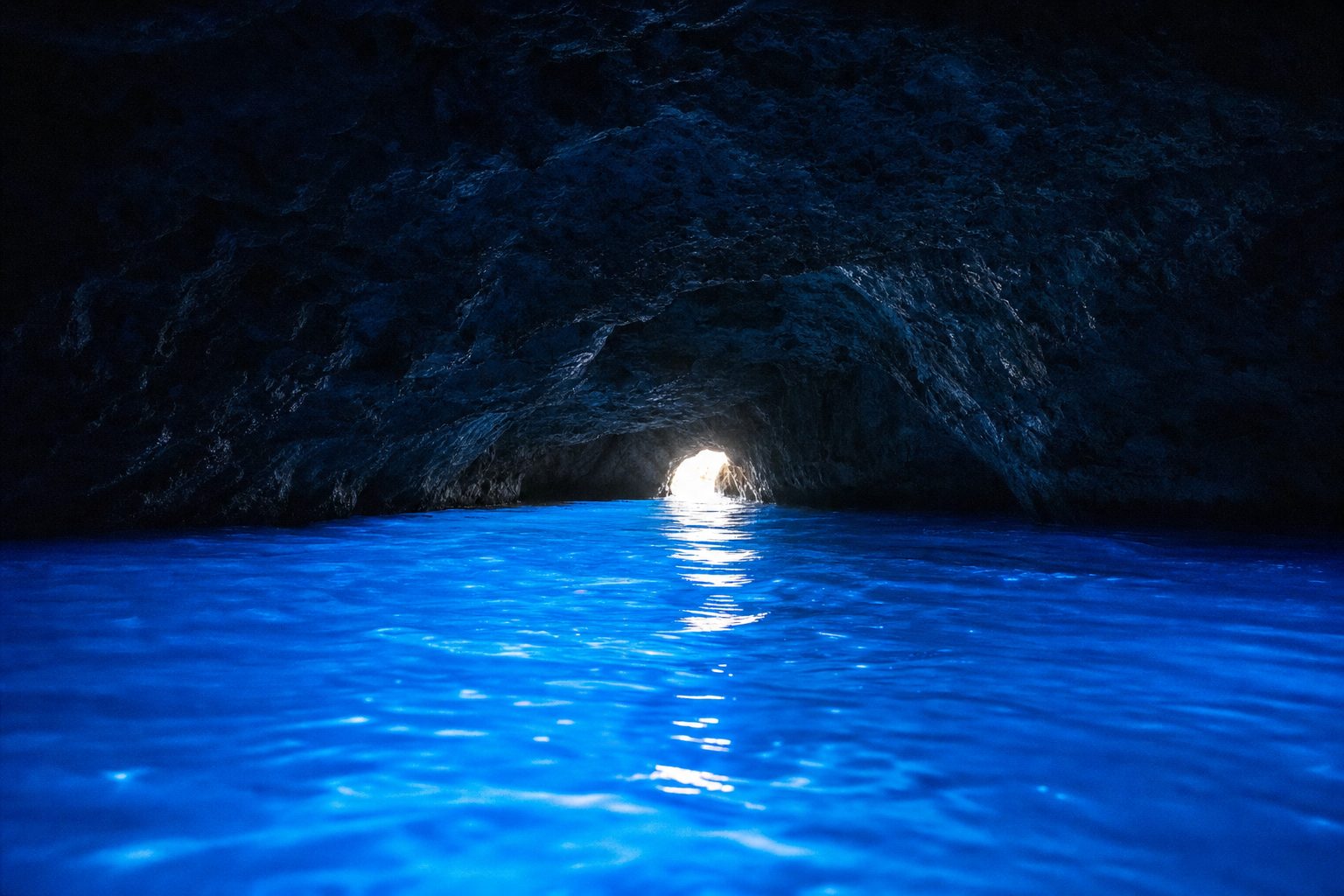
The grotto is a natural sea cave in the cliffs below Anacapri, flooded with an electric blue light that comes from below. Sunlight enters mainly through a second, submerged opening beneath the visible entrance; the water filters out the red end of the spectrum and reflects blue light up into the chamber, so the sea inside appears to glow while the vault above stays dark. Anything dipped into the water — an oar, a hand — picks up a silvery sheen. The chamber itself is far larger than the entrance suggests, opening out to roughly 60 metres long and 25 metres wide.
Entry is only possible in the small wooden rowboats operated at the cave mouth, each carrying a maximum of four passengers plus the oarsman. At the entrance, the skipper waits for the swell to drop, tells everyone to lie back flat along the bottom of the boat, ships the oars and pulls the boat through the gap hand over hand on a metal chain fixed to the rock. Inside, the boat circles the chamber for a short while — the boatmen often sing, a tradition the operators lean into — and then the same manoeuvre in reverse takes you back out into daylight.
The cave mouth measures about 2 metres wide and roughly 1 metre high at low tide, while the chamber inside runs to around 60 metres long and 25 metres wide; the grotto was rediscovered for the wider world in 1826, when local fisherman Angelo Ferraro rowed the German writer August Kopisch and painter Ernst Fries inside. [6]
Manage expectations on time: the visit inside lasts about five minutes, the figure the island's own visitor guidance quotes. The Blue Grotto trades in intensity rather than duration, so plan the rest of the day around it. A simple return transfer from Marina Grande, including waiting, typically absorbs about two hours.
What it costs and where the money goes
The pricing confuses people because two separate things are being paid for. The grotto is a state-owned cultural site, run under the Direzione regionale Musei nazionali Campania alongside the Certosa di San Giacomo and Villa Jovis, so there is a museum-style state entrance ticket. On top of that sits the rowboat service, which has its own ticketing and is never included in the entrance fee — a distinction the Ministry of Culture listing spells out plainly. Boat transfers from Marina Grande are a third, separate cost again.
As checked in August 2026, the all-in price at the cave is EUR 19 per person, covering the state entrance ticket and the rowboat service, paid in cash at the entrance; EU visitors aged 18 to 25 pay EUR 15 in total, EU visitors under 18 pay only the rowboat fee, and the ticket cannot be bought online in advance. [5]
As checked in August 2026, the Ministry of Culture lists the state entrance ticket at EUR 6 full price and EUR 2 reduced, with free optional booking through CoopCulture; core hours run 9:00 to 18:00 from April to October and 9:00 to 14:00 from November to March, and the site stays closed in adverse sea conditions. [1]
Add the approach and the realistic budget from Capri town is around EUR 44 per person: about EUR 25 for the return boat transfer or island tour from Marina Grande, then EUR 19 on the water. Coming overland from Anacapri by bus trims that considerably. Tips for the oarsmen are customary but discretionary. Be aware that tours advertised as an island circuit with a grotto stop frequently skip the stop when the queue is long; if the grotto is your priority, book a dedicated transfer rather than a tour, and treat the free CoopCulture reservation as a courtesy that speeds entry rather than a guarantee.
When to go, and the nine o'clock verdict
The grotto opens daily, weather permitting, and the second half of that sentence does the heavy lifting. Each morning at around 9:00 the skippers assemble at the entrance and judge whether the swell allows safe passage through the one-metre gap; on unsettled days the cave can open and close several times before evening. Northerly winds — the maestrale and tramontana — are the usual culprits, and conditions often deteriorate after mid-afternoon. The only fixed closures are 25 December and 1 January; everything else is decided by the sea on the day.
Within an open day, timing is a trade-off between light and queues. The blue is at its most saturated when the sun is high, roughly noon to two, which is precisely when summer waits are longest — often 60 to 90 minutes, sometimes more than two hours of bobbing at anchor. Early morning brings a softer glow but a much shorter line; by 9:30 the average wait is closer to half an hour. Late afternoon thins out again, at the price of a higher chance the sea has already called time. On overcast days the effect fades badly, and the honest advice is to postpone.
Seasonally, June to September gives the longest hours (9:00am to 6:00pm) and the most reliable calm spells, but also the heaviest crowds. April, May and October keep decent hours with thinner queues. Winter visits are genuinely possible when the sea cooperates — the operators run whenever conditions permit — but the short 9:00-to-14:00 window and frequent closures make the grotto a bonus rather than a plan between November and March.
Getting to the cave: sea or land
There are two fundamentally different approaches, and they shape the whole morning. The classic route is by sea: at Marina Grande, the ticket kiosks of the two licensed operators, Motoscafisti di Capri and Laser Capri, sell direct grotto transfers and round-island tours, and their boats deliver you to the flotilla waiting off the entrance, where you step down into a rowboat directly from the water. The overland route uses Anacapri instead: a public bus runs from Piazza della Pace to the road-end above the grotto in about five minutes, and a staircase drops to a small landing where the same rowboats collect passengers from the rocks.
- Direct transfer boat from Marina Grande — the simplest option; about two hours door to door including waiting, with the grotto fee paid separately on the water
- Round-island tour with a grotto stop — a fine two-hour cruise, but the stop is often abandoned when queues are long; choose it for the coastline, not the cave
- Bus from Piazza della Pace in Anacapri — about five minutes to the stop above the grotto, then stairs down to the landing; the cheapest reliable route
- On foot from Anacapri — a 3.5 km walk down Via Pagliaro and Via Grotta Azzurra, pleasant in the cooler hours, with the same staircase at the end
- Private gozzo with skipper from Marina Grande — from around EUR 300 for three hours; anchor at the buoys and hail a rowboat when your turn nears
The land approach has one under-appreciated advantage: you queue on solid ground rather than in a rocking boat, which matters if anyone in your party is prone to seasickness. It also pairs naturally with a morning in Anacapri itself, where the Casa Rossa displays Roman statues recovered from the grotto floor. If the wait at the cave stretches, Laser Capri notes that its vessels return to port after 45 minutes and honour the same ticket on a later departure.
Rules on the water: why you cannot swim in
Every season, someone asks whether they can simply swim in and skip the queue. The answer from every official quarter is no. Swimming inside the grotto is prohibited, and the operators are blunt about why: during opening hours a steady procession of rowboats is threading a two-metre gap, and a swimmer in that channel is invisible to an oarsman until far too late. The prohibition does not lapse in the evening either — entering after the boats and ticket office have finished for the day is both illegal and dangerous, because any rise in the swell can slam a swimmer against the rock shelf around the low entrance. A visitor was left with life-changing injuries at the cave mouth in 2011; the sea here is not a technicality.
The same respect extends to the boatmen's judgement. If the skippers refuse the entrance, that is the end of the discussion — refunds and rebooking are a matter for your transfer operator, but no ticket buys passage through a gap the sea has closed. Life inside the boat is regulated too: stay lying back until the oarsman says otherwise, keep hands inboard through the entrance, and note that bags stay with you — there is no luggage service, and the boats are small. None of this is onerous; it is the price of visiting a site where the doorway is a metre high.
A Roman nymphaeum behind the light show
The Blue Grotto is a listed cultural site rather than a mere natural curiosity, and the reason predates tourism by two millennia. The emperor Tiberius, who governed Rome from his villas on Capri from AD 27, is traditionally linked to the cave, and the remains of one of the island's twelve Roman villas stand on the slope above it. The Roman historian Pliny the Elder described the grotto as peopled with sea gods, and archaeology has borne him out: statues of Neptune and the Tritons were raised from the cave floor in 1964, statue bases followed in 2009, and further recoveries suggest more sculpture still rests on the sandy bottom.
In Roman times the cave served as a sumptuous nymphaeum, its submerged niches holding a sculptural procession of the sea gathered around Neptune; the statues, recovered from the water between 1964 and 1975, are now displayed in the archaeological museum at the Certosa di San Giacomo.
— Paraphrased from the Ministero della Cultura listing for the Grotta Azzurra
After Rome, the cave fell out of memory. Eighteenth-century islanders knew it as Gradola, after the landing place nearby, and avoided it as a haunt of witches and monsters. Its modern fame dates to August 1826, when Kopisch and Fries were rowed in by a local fisherman and Kopisch published an account that put the blue light in front of a European audience. Within a generation the grotto had become one of the founding sights of Mediterranean tourism — the reason a shade of bright blue is still called capri — and the four-person rowboats of today are the direct descendants of that first crossing.
Fitting the grotto into a Capri day
The early start earns you the rest of the island. From the grotto, boats return to Marina Grande in time for the funicular up to Capri town before the day-trip crowds peak; overland visitors are already positioned for Anacapri, the Monte Solaro chairlift and the Casa Rossa. If you have committed to the midday glow instead, book the first afternoon transfer and hold a fallback — the Gardens of Augustus and the Via Krupp viewpoint reward exactly the hours you would otherwise spend in the queue. Either way, check the sea state before committing your morning: calm, clear days are worth rearranging plans for, and marginal days are worth letting go.
The grotto also slots naturally into a longer Tyrrhenian itinerary. Capri sits an easy ferry hop from Naples and Sorrento, which makes it a natural companion to a drive along the corniches in our Amalfi Coast road trip guide, and the same lie-of-the-land planning — timed access, sea-dependent plans, cash at the gate — will feel familiar to anyone who has tackled the booking systems in our Cinque Terre guide or the daily visitor cap at La Pelosa in Sardinia. Italy increasingly asks its most fragile places to be planned for rather than stumbled upon; the Blue Grotto, with its metre-high doorway and its nine o'clock verdict, has simply been asking longest.
Sources & further reading
- 1. Ministero della Cultura — Grotta Azzurra (official listing)
- 2. CoopCulture — Blue Grotto tickets and opening hours
- 3. Cooperativa Motoscafisti di Capri (official boat operator)
- 4. Laser Capri (official boat operator)
- 5. Capri.com — Blue Grotto visitor guide
- 6. Wikipedia — Blue Grotto (Capri)
- 7. Direzione regionale Musei nazionali Campania — sites of the directorate