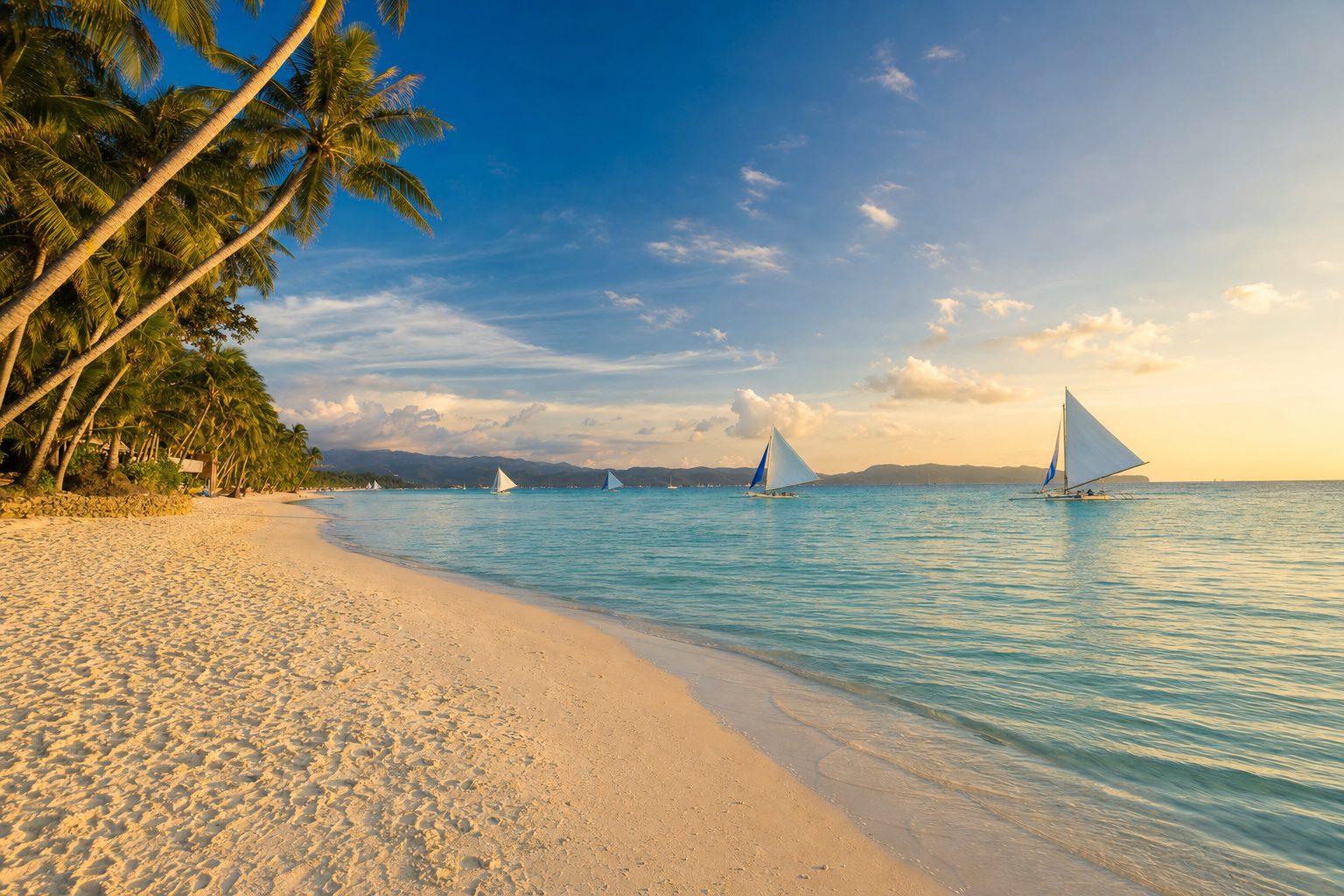
Boracay is easy to picture and less easy to treat as a spontaneous beach break. White Beach is a four-kilometre sweep of pale sand, divided loosely into Stations 1, 2 and 3; Bulabog Bay, on the opposite coast, catches the wind. The useful first-time choices are not about ticking off every beach. They are whether to visit in the calm-water season or the windy one, whether a Station 1, 2 or 3 base fits the trip, and whether the entry documents and port costs are already settled before the airport transfer begins. On an island reshaped by its 2018 rehabilitation, the rules are part of the experience rather than fine print.
That can sound severe beside a sunset reel, especially one showing a sandcastle: Boracay is the rare resort island where even sandcastle building needs permission. The better interpretation is that a stay here works when the beach is treated as a shared, managed space. This guide is for making the necessary decisions in the right order: book an eligible hotel, separate the two QR processes, choose the wind season, budget for the crossing and know where the beach stops and private hospitality begins. As checked in August 2026, entry procedures and charges can change, so confirm the live position before departure rather than relying on an old booking confirmation.
Start with eligibility, not the beach-facing room
Make accommodation the first booking, not the final one. A confirmed booking at a Department of Tourism-accredited establishment is the documented basis for tourist entry, so an attractive villa listing is not enough unless it has the relevant accreditation. Ask the property for its current certificate or accredited booking confirmation before paying a deposit, and keep the confirmation, passport or valid ID, and onward travel details easy to retrieve. Station choice comes after that check. Station 1 is the quieter, broader-sand choice for a more resort-led stay; Station 2 is central to D’Mall, restaurants and the evening bustle; Station 3 generally suits travellers who prefer a lower-key base and do not mind walking or taking a tricycle.
As checked in August 2026, tourists are required to complete the online Health Declaration registration at touristboracay.com before reaching Caticlan Jetty Port, where it issues a QR code; entry guidance also requires a confirmed booking at a DOT-accredited establishment. [2]
Do not merge that arrival QR with Boracay iPass in your planning. The first is the pre-arrival registration described in the entry guidance; Boracay iPass is the Provincial Government of Aklan’s digital option for applying for an entry pass and paying the required port charges online. It is useful when a party wants to avoid the morning payment windows, but it solves a different problem. Save every QR, hotel confirmation and identity document offline, because a low battery or poor signal is an unnecessary way to make a short transfer feel complicated. International visitors should also make sure the national Philippines eTravel requirement is separately in order.
Think of the online steps as a gatekeeping sequence, not as travel admin to complete on the boat: the accommodation booking establishes eligibility, while the digital passes make the entry and payment process easier to verify.
— Paraphrased from Boracay entry guidance and the Boracay iPass service information
Budget the port crossing as a small but real arrival cost
The classic route is deliberately short. From Caticlan Airport, transfer to Caticlan Jetty Port, pay the relevant charges or use your prepayment, then board for Cagban Port on Boracay. It is a compact chain, but queues can make it feel longer than the map suggests. As checked in August 2026, a foreign adult should budget roughly ₱510 one way: ₱300 environmental fee, ₱150 terminal fee and ₱60 for the pumpboat. The environmental fee is lower for domestic travellers at ₱150, so their comparable stack is roughly ₱360 before any transfer service. Treat these as arrival costs, not a surprise hotel extra, and keep a little cash even when the main fees have been prepaid.
The 2026 published fee stack is about ₱510 per foreign adult one way: ₱300 environmental fee, ₱150 terminal fee and ₱60 boat fare. The pumpboat fare rose from ₱50 to ₱60 on 16 April 2026; Boracay iPass can prepay the statutory fees in one QR-led process. [3]
The water crossing itself is not the place to over-engineer the itinerary. A standard pumpboat from Caticlan Jetty Port to Cagban Port takes about 10–15 minutes; the longer variable is the approach, payment and onward transfer to the hotel. If flying into Kalibo rather than Caticlan, add a substantially longer land transfer before this final boat stage. Once on Boracay, a tricycle is the practical default for bags or a journey between stations, while White Beach is best understood on foot. Do not book a dinner reservation for the first island evening so tightly that a delayed flight, weather-related port change or a busy jetty can undo it.
Choose Amihan for White Beach, or wind for a different island
Boracay’s weather choice is really a coast choice. Amihan, the northeast monsoon, runs roughly from November to May and places White Beach on the sheltered side of the island. That is the period for the calm, clear, swimmable water in the familiar photographs, but it also contains the busiest and usually costliest weeks, especially around Christmas through February. For a White Beach-focused first visit, late November, March and April can offer a more balanced version of the trade-off than the peak festive period. Book earlier if a specific station or hotel matters; the island’s compact size means a good base is more valuable than trying to move around it every day.
Amihan generally runs from November to May, making west-facing White Beach calmer and clearer. Habagat runs roughly from June to October, when White Beach can be choppier and seaweed-prone; Bulabog’s kitesurfing season is generally November to April, strongest from December to February. [7]
Habagat, roughly June to October, should not automatically rule out a visit; it changes the purpose of one. Southwest wind can push chop and drifting seaweed on to White Beach, while Bulabog Bay becomes the calmer, more sheltered side. Travellers set on learning to kitesurf should instead look to the Amihan months, when Bulabog receives reliable wind; the strongest, steadiest period is December to February, while the edges of the season can be friendlier for a first lesson. For a simple swim-and-sunset holiday in Habagat, keep the plan flexible, select a hotel with a pool you will genuinely use, and view the calmer east side as a practical alternative rather than a consolation prize.
Read White Beach as a public shore with boundaries
The rehabilitation changed the beach’s social contract. White Beach is public sand, not an extension of every bar or hotel behind it. Smoking and drinking belong in private accommodation or licensed venues, not on the sand or along the public beach. Carrying a beer to the waterline because the bar is nearby is not a harmless version of a beach holiday; it is the behaviour the post-rehabilitation rules were designed to stop. The easy rule is to finish food and drinks at the table, use designated smoking areas if needed, and keep the shoreline clear for walking, swimming and the ordinary rhythm of the beach.
Boracay’s rehabilitation rules prohibit smoking and drinking in public places including White Beach, while private areas remain different. [5]
The 30-metre coastal easement explains much of the newly open feel along the shore: permanent structures are not meant to occupy that protected strip. It also gives a simple test for an activity that appears to have spilled on to the beach from a business behind it. Choose a proper bar, restaurant or hotel area for tables, parties and drinks; choose the sand for a swim, a walk and a towel. This distinction is not about making Boracay joyless. It is what allows Station 2 to be lively without turning the water’s edge into a permanent dining room. For another Philippine beach destination where access rules shape the best day out, compare the planning logic in our El Nido island guide.
- Book only after the hotel can confirm its current DOT accreditation, then save the confirmation, ID and required arrival QR offline.
- Budget the fee stack before landing: foreign adults should allow about ₱510 one way; use Boracay iPass if one digital prepayment is worth more than paying at the jetty.
- Choose late November to May for a White Beach-led holiday, or build a June-to-October stay around flexible beach time and a hotel pool.
- Keep alcohol, meals and smoking in the proper private or licensed area, not on White Beach’s public sand.
- Leave the first evening uncommitted, because the short boat crossing does not remove the chance of flight, weather or jetty delays.
Treat a sandcastle as a regulated activity, not a souvenir photo
The sandcastle rule is Boracay’s most useful reality check. A large castle may look like a casual beach-side prop, but only people permitted by the Malay local government are allowed to carry out sandcastle building. The published rules are specific: permit holders pay for the space used, work outside the protected vegetation setback, must level the sandcastle and clean the area when finished, and cannot use kerosene lamps as decorations. In other words, a visitor should not commission an unregulated structure or assume that a castle maker on the sand is automatically operating legitimately. Ask whether the maker has the appropriate permit, and choose a simple photograph rather than adding pressure for oversized work.
Only Malay LGU permit holders may build sandcastles on Boracay. The permit rules include a ₱100-per-square-metre daily charge, a maximum five-day activity period, a six-metre vegetation setback, clean-up and levelling requirements, and no kerosene lamps. [4]
This is also the right mindset for every beach activity that leaves something behind. Keep rubbish with you until it reaches the appropriate bin, do not take sand or shells as a keepsake, and do not expect an informal vendor arrangement to override the management rules. Boracay still has room for a lively afternoon, a sunset drink in the right setting and an energetic evening around Station 2. The point is to keep the beach itself clear enough that the next person can use it without inheriting the debris, furniture or decoration of the last one. The island’s best version is less about finding a loophole than knowing where the experience properly belongs.
Build an island stay around one clear priority
For a first trip, make one priority do the organising. If it is calm-water swimming, stay close to White Beach in Amihan and give yourself several unstructured afternoons. If it is kitesurfing, choose Bulabog access and plan around lessons and wind rather than trying to force the classic beach routine. If it is food and night-time energy, a Station 2 base cuts down on transport but requires tolerance for noise; if it is rest, Station 1 or Station 3 makes a better counterweight. A short island does not require a packed schedule. It rewards the traveller who has decided what the hotel location is meant to support.
Boracay is not difficult once its order of operations is respected: eligible accommodation first, registration and fees next, weather-led beach choice after that, then the public-beach rules that keep the shore usable. Those details turn the island from a high-maintenance postcard into a straightforward break with a clear rhythm. If this trip prompts a wider beach itinerary, use our Bali beyond the beaches guide for a contrasting island choice, or compare styles in our guide to the world’s best beaches by type.
Sources & further reading
- 1. Boracay iPass — Provincial Government of Aklan
- 2. Respicio — Updated Boracay travel requirements and entry regulations
- 3. PhilippinesTourism.org — Boracay Philippines: The Complete 2026 Travel Guide
- 4. Philippine News Agency — Boracay sandcastle permit rules
- 5. GMA News — Smoking and drinking restrictions on White Beach
- 6. Department of Environment and Natural Resources — Boracay easement enforcement
- 7. PhilippinesTourism.org — Best Time to Visit Boracay