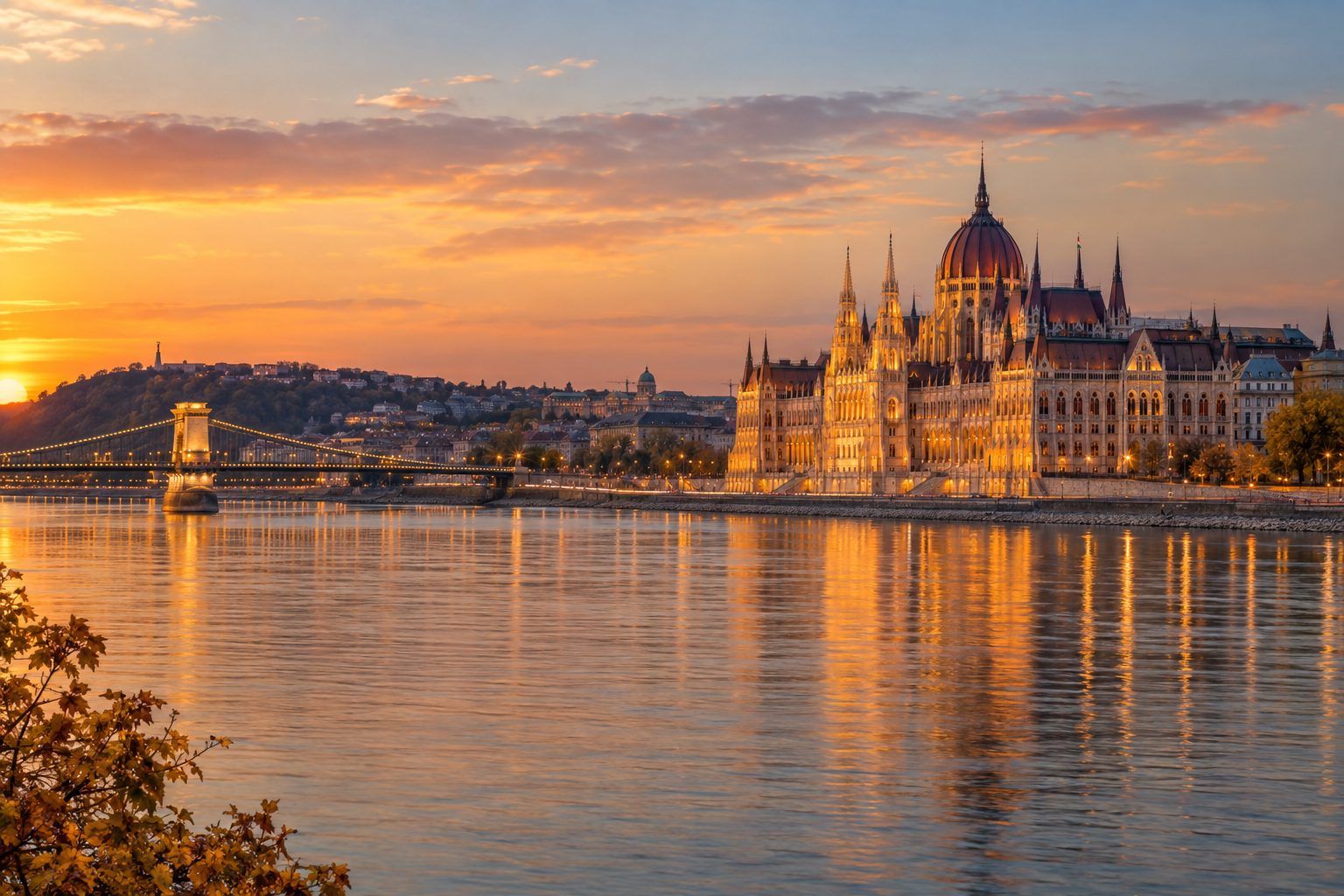
Budapest is the city where you bathe in a palace. The neo-baroque halls of the Széchenyi baths would pass for a royal residence anywhere else in Europe; here they are a municipal spa where locals play chess in 38°C water while steam drifts over the pool terraces. That single image explains the larger bargain: Budapest delivers grand-capital architecture, a river frontage listed by UNESCO and one of the continent's best-value transport networks at prices that still read like a discount on Vienna or Paris, one bridge upstream or one flight west.
Doing it well comes down to a handful of decisions. Which thermal bath, and when in the day to go. How to time the Buda side so the famous viewpoints cost nothing. Whether the Budapest Card earns its keep or a simple travelcard beats it. And how to handle a currency — the Hungarian forint — whose four-digit prices confuse first-time visitors into overpaying. This guide takes those decisions in order, with prices as checked in October 2026.
Why Budapest is the value capital of the European city break
The honest comparison is this: a full day in one of Europe's grandest spa complexes costs around €33 at current rates; seventy-two hours of unlimited metro, tram and bus travel costs about €14; and the city's single best viewpoint is free at the hours when it looks its best. Hungary is in the EU and the Schengen area but not the eurozone, and the forint economy is a large part of why the city undercuts its western neighbours. Prices are quoted in thousands of forints, which looks alarming until you divide by roughly four hundred to get euros.
The one big-ticket indoor sight worth budgeting for is the Hungarian Parliament, the riverfront landmark you will photograph from every angle anyway. The interior — including the Holy Crown of Hungary — is seen on a 45-minute guided or audio-guided tour run by the National Assembly's visitor centre, with tours in English and a dozen other languages. EEA citizens pay a reduced rate and non-EEA visitors pay more; as checked in October 2026 the official site publishes the current tariff, and tours sell out days ahead in season, so book online early rather than queueing for the limited same-day allocation.
The thermal bath decision: Széchenyi first, or somewhere quieter
Budapest sits on a fault line that pushes hot mineral water to the surface, and the city has been building bathhouses over it since the Ottomans. Széchenyi, in City Park at the top of the M1 metro line, is the flagship: a yellow neo-baroque complex of fifteen indoor pools and three big outdoor ones, where the steaming open-air pool in winter is one of the city's defining scenes. It is also the busiest, which is why timing matters more than ticket type.
As checked in October 2026, Széchenyi's official daily ticket with locker costs 13,200 Ft Monday to Thursday, 14,800 Ft on Fridays and weekends, and 15,800 Ft on holidays and in peak season; Fast Track tickets are sold online only, payment at the entrance opposite the Circus is by bank card only, and the Budapest Card is accepted for daily tickets with locker. [1]
If Széchenyi's scale puts you off, the alternatives each have a distinct character. Gellért, across the river by Liberty Bridge, wraps its pools in art nouveau tilework. Rudas, under Gellért Hill, keeps an octagonal Ottoman pool from the sixteenth century and adds a rooftop hot tub facing the Danube; the Budapest Card takes 20 percent off entry there. Lukács, upstream in Buda, is the local option — plainer, cheaper and included free with the Budapest Card. Etiquette is consistent across all of them: swimwear is compulsory, flip-flops are expected, swim caps apply only in the lap pools, and the thermal pools reward short soaks with breaks rather than marathon sessions. For another European trip built around a single palatial set-piece, the timed-entry machinery of Granada's Alhambra is the same decision in a different register: book the headline act properly, then enjoy everything around it for little or nothing.
The Buda side: free viewpoints, if you time them
The postcard panorama of Parliament across the river belongs to Fisherman's Bastion, the white neo-Romanesque terrace of seven conical towers on Castle Hill — built around 1900 purely as a viewpoint, and still the best one in the city. The pricing is widely misunderstood: the lower terraces, which carry most of the view, are free and open around the clock. Only the upper turret terraces charge a fee, and only during daytime hours in season; before the ticket desk opens in the morning and after it closes in the evening, the upper level is free as well. Dawn is the move — the light comes up over the Pest bank, the tour groups are hours away, and the whole structure is yours.
The lower terraces of Fisherman's Bastion are free and open 24 hours a day; only the upper turret terraces are ticketed, during daytime season hours, and the upper sections are free to walk before the morning ticketing starts and again in the evening. [3]
Make a morning of the Castle District around it. Wandering the cobbled streets, the castle courtyards and the ramparts costs nothing; Matthias Church next to the Bastion charges separately for its painted interior. Skip the funicular queue and walk up from Clark Ádám Square in fifteen minutes, or take bus 16 from Deák Ferenc Square on an ordinary transport ticket. South along the river, the Citadella viewpoint on Gellért Hill gives the other great free panorama — Parliament, the bridges and the whole Pest plain — for the price of a half-hour climb.
Getting around: 500-forint rides and the tram 2 trick
Budapest's transport network — four metro lines, including the 1896 M1, the oldest underground railway on the continent after London's, plus trams, buses and trolleybuses — is dense enough that you will rarely wait five minutes, and cheap enough that taxis are a convenience rather than a necessity. Buy tickets in the BKK BudapestGO app or from purple machines, and validate paper tickets in the orange boxes: inspectors are a genuine presence, and the on-the-spot penalty fare runs to 12,000 Ft, more than a week of travelcards.
As checked in October 2026, BKK's single ticket costs 500 Ft (700 Ft bought on the spot), a 24-hour Budapest travelcard 2,750 Ft and a 72-hour travelcard 5,750 Ft, with unlimited travel on metro, tram, bus and trolleybus inside the city. [2]
The network also contains the city's cheapest sightseeing tour. Tram 2 runs the length of the Pest embankment between Jászai Mari Square and Közvágóhíd, and the official tourism board itself promotes the ride: sit on the Danube side and the route rolls past Parliament at Kossuth Square, the Shoes on the Danube memorial, the Chain Bridge and Gresham Palace at Széchenyi István Square, the promenade at Vigadó Square and the Great Market Hall at Fővám Square, with Buda Castle and Gellért Hill filling the far bank — all for a 500 Ft single ticket, or nothing extra on a travelcard.
Tram line 2 is one of the city's most heavily used routes and also one of its most spectacular, running beside the Danube with views of Parliament, Buda Castle and the bridges — the recommendation is simply to sit on the river side.
— Paraphrased from the Budapest tourism board's tram line 2 guide (budapestinfo.hu)
Eating on forints: the Great Market Hall and beyond
The Great Market Hall (Nagyvásárcsarnok), the vast 1897 iron-and-tile hall at the Pest end of Liberty Bridge, is the easiest introduction to Hungarian food and it costs nothing to walk into. The ground floor is the real market — paprika in every grade from sweet to hot, salamis, strudel, seasonal fruit — and the upper gallery is where visitors eat, led by lángos, the fried flatbread loaded with sour cream and cheese. Go in the morning: the stalls are fully stocked, the aisles are navigable and the lángos queue is short. By midday in season the gallery is shoulder to shoulder.
Entry to the Central Market Hall is free; the operator's posted hours are Monday to Friday 06:00–18:00, Saturday 06:00–16:00 and Sunday 10:00–16:00, with the hall closed on public holidays. [6]
One caution: the hall closed on Sundays for most of its recent history, and many guides still say it does, so if a Sunday visit is load-bearing in your plan, check the operator's page that week. Beyond the hall, the budget pattern is consistent: weekday set lunches at étkezde canteens cost a fraction of dinner prices, the kerts — the ruin bars of the old Jewish Quarter, District VII — charge neighbourhood prices for drinks in extraordinary courtyards, and the grand cafés are best treated as architecture with coffee attached: order the cheapest thing on the menu and take your time.
Pay in forints, and do the Budapest Card maths
The single most expensive habit in Budapest is paying in euros. Tourist-area restaurants and shops that accept them set their own exchange rate, never in your favour, and card terminals that offer to charge you in your home currency — so-called dynamic currency conversion — are making the same quiet margin. The rule is simple: always choose to pay in HUF, on a card with no foreign-transaction fee. Cash matters less than visitors expect — this is a card-first city, to the point that Széchenyi's main entrance takes no cash at all — but if you want some, use a bank ATM and decline its conversion offer too.
As checked in October 2026, BKK lists the Budapest Card at 17,990 Ft for 24 hours, 29,990 Ft for 72 hours and 38,990 Ft for 96 hours, with unlimited public transport and more than thirty free attractions — including Lukács Thermal Bath — plus discounts such as 20 percent off Rudas. [2]
Whether the official city pass earns its price depends entirely on your appetite for paid attractions. The 72-hour card costs 29,990 Ft against 5,750 Ft for the plain 72-hour travelcard, so it needs to cover roughly 24,000 Ft of entries to break even — achievable if you combine a Széchenyi day ticket, a Lukács visit, a museum or two and the discounts, but a stretch for the traveller this guide is aimed at, whose best days in Budapest are mostly free. Default to the travelcard; buy the card only after totting up what you would actually visit.
When to go, and whether to sleep in Pest or Buda
The shoulder seasons are the sweet spot. May to June and September to October bring mild weather, long evenings and manageable queues at the baths; high summer is hot, crowded and peak-priced, with the city's festival calendar compressing demand. Winter is the contrarian pick — the thermal baths are at their atmospheric best with steam billowing off the outdoor pools, December adds Christmas markets on Vörösmarty Square and at St. Stephen's Basilica, and flights and rooms are at their cheapest in January and February. Note that Hungarian public holidays, notably 20 August, push the baths onto their highest tariff and close the market halls.
On the question of banks: sleep in Pest, visit Buda. Districts V, VI and VII put the Basilica, the ruin bars, the river promenade and most of the food within a walk, with the airport bus and all four metro lines close at hand. Buda is quieter, greener and lovely at dusk, but you will commute to dinner. The exception that proves the rule is an early-riser's splurge near Castle Hill, which turns the free-dawn-Bastion strategy into a stroll.
A three-day shape for the city
- Day one, Pest: St. Stephen's Basilica and the District V streets in the morning, Parliament tour (pre-booked) at midday, the Shoes on the Danube memorial, then tram 2 end to end in the late afternoon light and an evening in the District VII courtyards.
- Day two, Buda: dawn at Fisherman's Bastion while the upper terraces are free, the Castle District and Matthias Church through the morning, walk down to lunch, cross Liberty Bridge and climb Gellért Hill's Citadella for sunset over the river.
- Day three, the spa day: Great Market Hall at opening for breakfast and paprika shopping, then the M1 metro to Széchenyi for a long soak — or the morning ticket first and the market after — with City Park, Heroes' Square and Andrássy Avenue filling the gaps.
- Rainy-day swap: substitute Rudas or Gellért for the outdoor-pool scene, and the grand cafés and the Parliament interior for the viewpoints.
Three days covers the headline city at an unhurried pace; a fourth adds the quieter pleasures — Margaret Island's running paths, the Lukács baths with the locals, Memento Park's exiled communist statuary. However long you stay, the arithmetic holds: the best of Budapest is either free or priced in hundreds of forints, and the few things worth real money are worth booking properly.
Budapest also pairs naturally with its Habsburg-era sibling three hours up the railway line. If this trip is the start of a Central European circuit, our guide to Prague's old town, castle and timing strategies applies the same logic — free vantage points, early starts and local prices — to the other great capital of the region, and the train between the two is a city break in itself.
Sources & further reading
- 1. Széchenyi Thermal Bath — official 2026 price list
- 2. BKK (Budapest transport authority) — ticket, travelcard and Budapest Card prices
- 3. TheOneToGo — Fisherman's Bastion: how to visit and when it is free
- 4. Hungarian National Assembly (parlament.hu) — visitor ticket prices
- 5. Budapest Info (official tourism board) — Discover Budapest with tram line 2
- 6. Piaconline.hu (Budapest market halls operator) — Central Market Hall
- 7. Budapest Info — Budapest Card, the official city pass
- 8. BKK — Budapest Card overview and inclusions