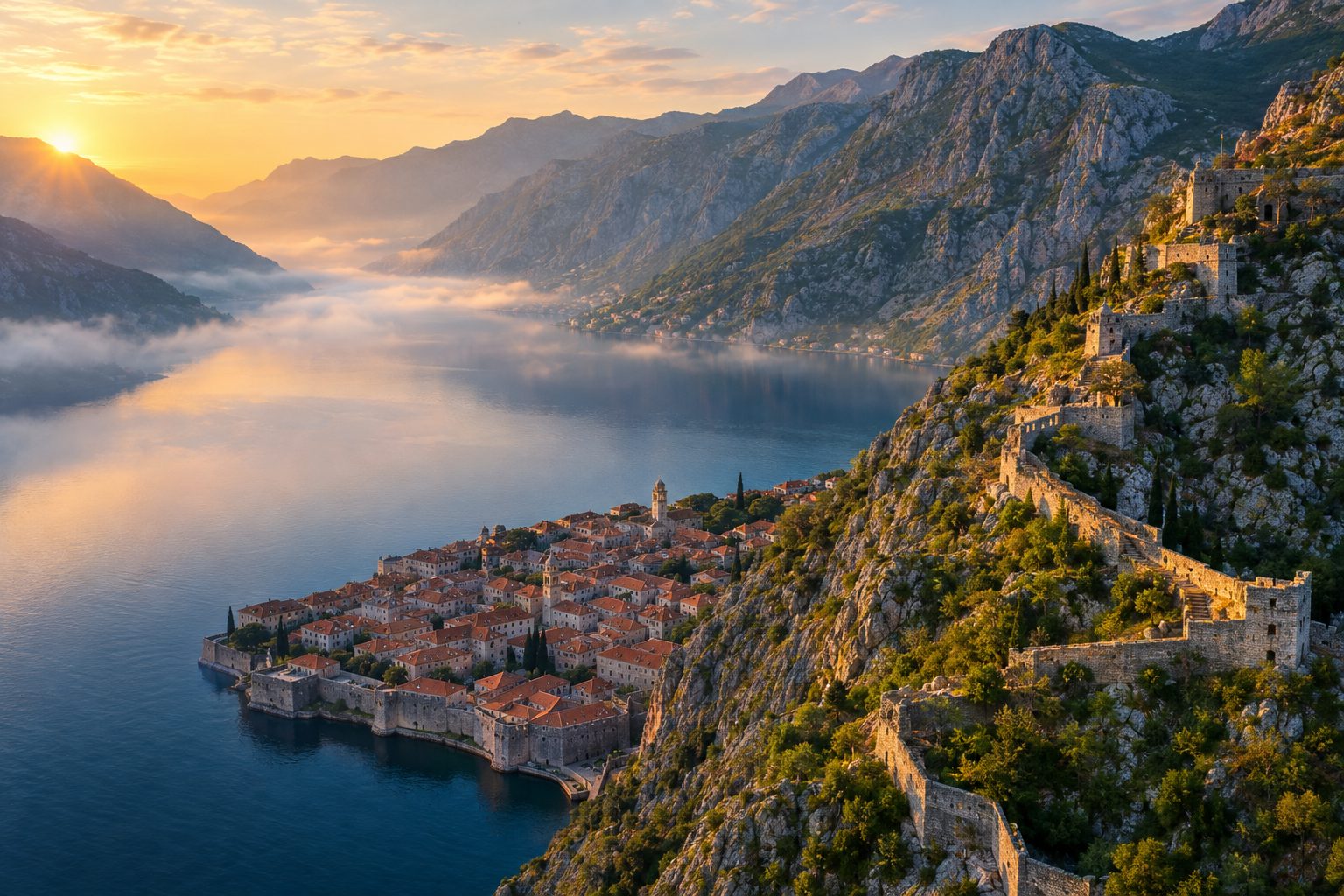
Kotor sits where the Bay of Kotor runs out of water: a triangle of Venetian stone and terracotta roofs pressed against a limestone wall that rises almost sheer behind it. What sets it apart from every other town on the Adriatic is that the fortifications do not stop at the shore. They climb, in a zigzag of ramparts and steps, some 260 metres up the mountainside to the ruined Fortress of San Giovanni, and anyone with reasonable legs can follow them. Around the bay, Perast and its island church and the serpentine road up to Lovćen complete a landscape UNESCO has protected since 1979.
The decisions are simpler than they look: whether to pay for the official walls route or take the free caravan trail outside them; when to climb, given that cruise ships empty several thousand people into the Old Town by mid-morning; how to fit Perast and the mountain road into a stay; and how to behave on a fortification the municipality is now protecting from its own visitors.
What the walls are, and what UNESCO protects
The fortifications are mostly the work of Venice, which held Kotor from 1420 to 1797, built on defences well over a thousand years old. Two arms run up the slope from the town walls, meet at the Church of Our Lady of Remedy about halfway, and continue as one line to San Giovanni, Sveti Ivan to locals and St John's in English: a roofless ruin rather than a restored museum, which is much of its appeal.
The World Heritage listing is not for the walls alone: the Natural and Culturo-Historical Region of Kotor covers the inner, best-preserved part of the bay, with Kotor, Perast, Risan and the terraced slopes between them. UNESCO inscribed it in 1979, the year an earthquake wrecked much of the town, and it stayed on the List of World Heritage in Danger until 2003.
UNESCO's Natural and Culturo-Historical Region of Kotor covers 14,600 hectares of two interrelated bays surrounded by mountains rising rapidly to nearly 1,500 metres, inscribed under criteria (i), (ii), (iii) and (iv); a buffer zone defined in 2011 takes in the whole of Boka Kotorska Bay. The 1979 earthquake seriously damaged four Romanesque churches and the town walls, which were restored largely with UNESCO's help. [5]
As the main Venetian bridgeheads on the southern Adriatic, Kotor and its neighbouring towns of sea captains and ship-owners were for centuries the creative heart of the region, and their schools of art, goldsmithing and architecture had a deep and lasting influence on the whole Adriatic coast.
— Paraphrased from the UNESCO World Heritage listing for the Natural and Culturo-Historical Region of Kotor
The climb to San Giovanni: route, steps and timing
The official route starts inside the Old Town at two ticketed entrances: Parilo, behind the Church of St Mary Collegiate near the River Gate at the northern end of town, and Škaljarska pjaca, in the lanes near the southern Gurdić gate. Both join the same stepped path within minutes, and from there the way is unambiguous: a single stone staircase switchbacking through bastions, the town shrinking and the bay opening with every turn.
Count on roughly 1,350 steps and 260 metres of climbing. The Church of Our Lady of Remedy, a votive chapel from the plague years, sits on a terrace near step 650 and is the sensible turnaround for anyone short of time or breath. The upper half is steeper, rougher and without shade. A steady walker reaches the fortress in 45 minutes to an hour; with photographs and rests, allow 1 to 1.5 hours up and 45 minutes down. The descent is the hazardous half, on steps worn smooth by centuries of feet.
Tickets, hours and the rules on the walls
Access is managed by the Municipality of Kotor, which runs an official online ticketing site alongside the booths at the two entrances. The price rose from 8 euros to 15 under a municipal assembly decision of October 2023, and the older figure still circulates online.
As checked in September 2026, the Municipality of Kotor's official ticketing terms set the individual ticket for the city walls and Fortress of St John at 15 euros, with residents of Montenegro, children under 12, people with disabilities and organised school groups exempt; every visitor, exempt or not, must hold a ticket issued through the authorised system, delivered as a QR-coded e-ticket shown on a phone or on paper. [2]
The ticket is valid all day, so a dawn climb and a return for sunset is a legitimate plan. Before the booths open the gate is often already unlocked; the honest course is to pay on the way down, since the ticket condition applies regardless of the hour.
The official Kotor City Walls site sets gate and booth hours of 7 am to 8 pm daily from 1 May to 30 September, 8 am to 6 pm from 1 March to 30 April and 8 am to 5 pm from 1 October to 30 November; from 1 December to the end of February the booths are closed and the climb is open at the visitor's own risk. Staying on or climbing the walls after 10 pm is prohibited throughout the year because the terrain is steep and unlit. [1]
Winter is not off limits, then, but it is unsupervised: rain makes the steps treacherous and snow is possible at the top. In any season, descend in full daylight.
The Ladder of Kotor, and the back doors that no longer exist
The free alternative is the Ladder of Kotor, the Kotorske serpentine: an old caravan trail that leaves the road just outside the River Gate and climbs the mountainside in long, graded switchbacks between the Škurda canyon and the fortress ridge. It is a hill path of dirt and loose rock, gentler than the walls but longer, with no shade, water or signage. Around 1 to 2 hours of steady walking reaches the saddle above San Giovanni, beside the abandoned hamlet of Špiljari, with the whole inner bay below; the trail continues, for those with a full day, to Krstac pass at about 940 metres.
For years the trick was to drop from the Ladder into the ticketed fortifications through a gun-port opening near St John's. Treat that route as history: in May 2026 the municipality announced that it had walled up the two most-used openings after repeated injuries, and it does not recommend informal access anywhere along the walls.
In a statement dated 8 May 2026 the Municipality of Kotor said it had temporarily sealed two artillery-position openings at Renijer and Batalja that had become irregular entrances to the fortifications, reached with ladders and ropes from five or more metres above difficult ground; several tourist injuries had been recorded there, and continual use was weakening mortar and destabilising vaults. The infill in stone and lime mortar is described as reversible, with reopening tied to safe, controlled use. [3]
So the Ladder is now a walk in its own right, with a better view of the fortress than the fortress gives of itself; to stand inside San Giovanni you buy a ticket. Take published trail descriptions as guidance, not gospel, and check the start on a map.
When to go, and how to dodge the cruise crowds
Kotor's problem is arithmetic. Ships berth on the quay outside the Sea Gate, and on a busy day between April and October two to four of them can put several thousand passengers into a walled town a few hundred metres across, roughly from 9 am until late afternoon. By early evening the town belongs to the people staying in it.
September is the month the bay works best: the sea is still warm enough to swim, the air is in the mid-twenties rather than the mid-thirties of August, and the Old Town is busy but not wall-to-wall. Late May and June are the other sweet spot; from November to March many boat operators and Perast restaurants close. Whatever the month, the rule is the same: climb at first light or in the last 90 minutes before the gate closes, spend the middle of the day on the bay or up the mountain, and walk the lanes after 6 pm. Published port schedules show which days to avoid altogether.
The Old Town, where to base yourself and how to arrive
Inside the walls the town is small enough to cross in ten minutes. Enter through the Sea Gate, Venetian work of 1555, into the Square of Arms and its clock tower. The Cathedral of St Tryphon, consecrated in 1166 and rebuilt after every earthquake since, is the one interior worth paying a few euros for; beyond it, St Luke's Square has a Catholic and an Orthodox church side by side, and the Maritime Museum explains how a town this size produced so many sea captains.
A room inside the Old Town puts the walls entrance and the dawn climb at your door, at the price of noise until midnight and luggage over cobbles. Dobrota, the ribbon of stone houses and swimming platforms along the shore to the north, is quieter and a 15 to 30 minute walk in; Perast, 20 minutes up the bay, suits a slower stay with no ships at all. Montenegro uses the euro despite not being an EU member; cards are common in town, but boats, kiosks and taxis prefer cash.
Tivat airport is the obvious door: about 8 kilometres and 15 to 20 minutes from the Old Town, with taxis at a negotiated 15 to 25 euros and a local bus for pocket change. Podgorica is around 90 kilometres away. Dubrovnik, about 70 kilometres north, often has the cheapest fares but adds a border that can take anything from ten minutes to over an hour; our guide to driving from Dubrovnik to Kotor covers the crossing, the coast road and the ferry shortcut.
Out on the bay: Perast, Our Lady of the Rocks and the Lovćen road
Perast is a single street of Baroque palaces facing the narrowest point of the bay, and its fame sits a few hundred metres offshore. Our Lady of the Rocks, Gospa od Škrpjela, is an artificial islet built up over centuries of sailors dropping stones on a reef where, tradition holds, two brothers found an icon of the Virgin in 1452. The Venetian-built church on it is almost 400 years old and holds the tapestry Jacinta Kunić wove from 1803 to 1828, working in strands of her own hair, while waiting for her husband to return from sea. Small boats shuttle from the Perast waterfront through the day in season, about five minutes for a few euros return, and the church and museum charge a small fee. The wooded neighbour, Sveti Đorđe, is a monastery island closed to visitors.
The Blue Line bus, a taxi of 20 to 30 minutes, or a boat from Kotor's harbour all reach Perast; bay tours typically bundle the islet with a swim in the Blue Cave on Luštica. Driving the loop of the inner bay via Risan and the Kamenari to Lepetane ferry takes half a day, past the shellfish farms whose mussels turn up in buzara sauce in every konoba.
The other classic excursion is up rather than out. The old Kotor to Cetinje road climbs behind town in some 25 hairpins, each pull-off framing more of the bay, to the village of Njeguši and the edge of Lovćen National Park. At the top, a tunnel and 461 steps lead to the Njegoš Mausoleum on Jezerski vrh at 1,660 metres; as checked in September 2026, the National Museum of Montenegro opens it daily from 11 April to 15 November, 9 am to 5 pm, for 8 euros, with a small park fee at the gate below. The hairpins are narrow and shared with coaches, so drive them early.
- Climb at opening time or in the last 90 minutes of the day, in proper shoes with a litre of water each; turn back at the Church of Our Lady of Remedy if the heat has built.
- Buy the 15 euro ticket online or at the Parilo or Škaljarska pjaca booths, keep the QR code for a same-day return, and pay on the way down if you went up before the booth opened.
- Treat the Ladder of Kotor as a separate, free hill walk; the gun-port back doors were sealed in May 2026 and improvising a way in is dangerous and damaging.
- Check the cruise schedule before choosing your Old Town day and go to Perast or Lovćen on the heavy days.
Kotor's fortifications survived Ottoman sieges and a major earthquake; the current threat is footfall, and the ticket revenue pays for the paths you climb on. Stay on the stepped route, keep off parapets and unrestored walls, and drop nothing over the edge, since the Old Town's lanes are directly below. Churches are places of worship first: cover shoulders and ask before photographing.
Once you have seen the bay from San Giovanni, the rest of the eastern Adriatic makes more sense. To the north, Dubrovnik's walls offer the polished, level, more expensive version of the same idea. Inland, the limestone behind Kotor runs on to the Accursed Mountains of northern Albania, a day's drive and a world away from cruise timetables. And for a very different kind of water, Plitvice is a long day north through the Dalmatian hinterland.
Sources & further reading
- 1. Kotor City Walls — official visitor and ticketing site of the Municipality of Kotor (seasonal gate hours, two official entrances, night prohibition)
- 2. Kotor City Walls — Terms of use (official individual ticket price, exempt categories, ticket requirement for all visitors)
- 3. Municipality of Kotor — Statement on the temporarily sealed openings in the Kotor fortifications, 8 May 2026
- 4. Municipality of Kotor, Secretariat for Local Revenues — Public notice on charging for the city walls and Fortress of St John (from 1 March 2025)
- 5. UNESCO World Heritage Centre — Natural and Culturo-Historical Region of Kotor (listing 125)
- 6. National Tourism Organisation of Montenegro — Bay of Kotor (official bay facts, Perast and Our Lady of the Rocks)
- 7. National Museum of Montenegro — Njegoš Mausoleum, Lovćen (official opening dates and admission)
- 8. Montenegro Guidebook — Kotor City Walls and Fortress of San Giovanni (step count, height, route landmarks; details checked July 2026)