Venice is at its best when treated as a compact, lived-in lagoon city rather than a checklist between train and airport. The practical questions are unusually important here: whether your date falls inside the Access Fee calendar, whether to sleep in the historic city, how many boat rides you will genuinely take and which famous experiences are worth paying for. Solve those before arrival and the city becomes more legible: churches, workshops, markets and neighbourhood bars fit into a walkable day rather than a race through bottlenecks.
The 2026 access-fee trial has already finished. As checked in August 2026, the official portal says visitors may enter without payment or an exemption request from 27 July. This guide still matters for anyone interpreting a spring or early-summer 2026 booking, and it offers a useful model for future rules: check the official Access Fee page shortly before travel instead of relying on an old social post. Prices and operating arrangements in Venice move more quickly than the city itself.
Start with the access fee and your overnight status
For the 2026 trial, the Contributo di Accesso was aimed at day visitors entering the Ancient City on selected dates. It was not a general tourist tax or a museum ticket. The choice that changed everything was whether you were making a day trip or staying in registered accommodation in Venice. Overnight guests were exempt from paying, but were expected to complete the exemption process and carry the resulting access code or QR confirmation. That administrative distinction is reason enough to keep accommodation confirmation and registration details accessible on your phone.
The 2026 Access Fee calendar covered 60 designated days between 3 April and 26 July, running from 8.30am to 4pm. That was six more fee days than the 54 used in 2025. [4]
For a fee day, booking mattered. The official guidance set the charge at €5 per person when paid by the fourth-last day before entry and €10 after that; it also excluded the minor lagoon islands in 2026. In practical terms, do not assume a mainland booking or a stop at Santa Lucia station answers the question. Check your route, the city-zone definition and your exemption category in the municipal portal. The fee is designed around access to the Ancient City, not the romance of arriving by train.
On applicable 2026 dates, the official Access Fee was €5 when paid at least four days ahead and €10 when paid later; the 2026 rules excluded the minor islands of the Venice Lagoon. [1]
Choose where to sleep for time, not just a lower room rate
A bed in the historic city buys early and late hours, when the lanes are quieter and the light on the canals is gentler. It can also remove the need to time a last mainland train or boat. Choose Cannaregio if you want a more residential rhythm near the station, Dorsoduro for a museum-and-café base, Castello for room to wander east of St Mark’s, or San Polo if the Rialto side is the priority. None is empty; the difference is how much of your day is spent crossing the busiest core.
Mestre and the airport mainland may suit a late arrival, a car hire hand-off or a tighter room budget, but count the return transport and the loss of morning and evening Venice before deciding. A first visit rarely needs a room directly beside St Mark’s Square. A short walk from a vaporetto stop is usually more useful than an address that looks central on a map but requires luggage over several bridges. For the wider route, use a Europe itinerary that leaves space for Venice rather than squeezing it into a single transit day.
Treat the Access Fee as an advance-access process for selected days, not as a ticket that replaces normal travel or accommodation arrangements.
— Paraphrased from the City of Venice Access Fee guidance
Do the vaporetto maths before buying a pass
Walking is the default way to understand Venice. It is also the cheapest and often the quickest option once you are inside a sestiere. The water bus, or vaporetto, is most valuable for the Grand Canal, the outer edges of the city and trips to places such as Murano, Burano or Lido. The mistake is buying a multi-day pass from habit and then spending the trip walking. Count the journeys you expect to make, including arrival and departure only where the ticket covers them; airport connections are a separate consideration.
ACTV lists a 75-minute vaporetto ticket at €9.50, with passes at €25 for 24 hours, €35 for 48 hours, €45 for 72 hours and €65 for seven days. Children under six travel free. [6]
A single ticket can be the sensible choice for a walker who only wants one slow Grand Canal ride. A 24-hour pass becomes easier to justify when it covers several longer hops and an island outing, while a 48- or 72-hour pass rewards a stay that deliberately uses water transport instead of treating it as scenery. Validate every ticket before boarding and confirm current coverage on the ACTV fare page. The passes run for their stated duration from validation, so activate them for a full day of travel rather than at the end of an arrival evening.
Use the canals as transport, then choose one paid flourish
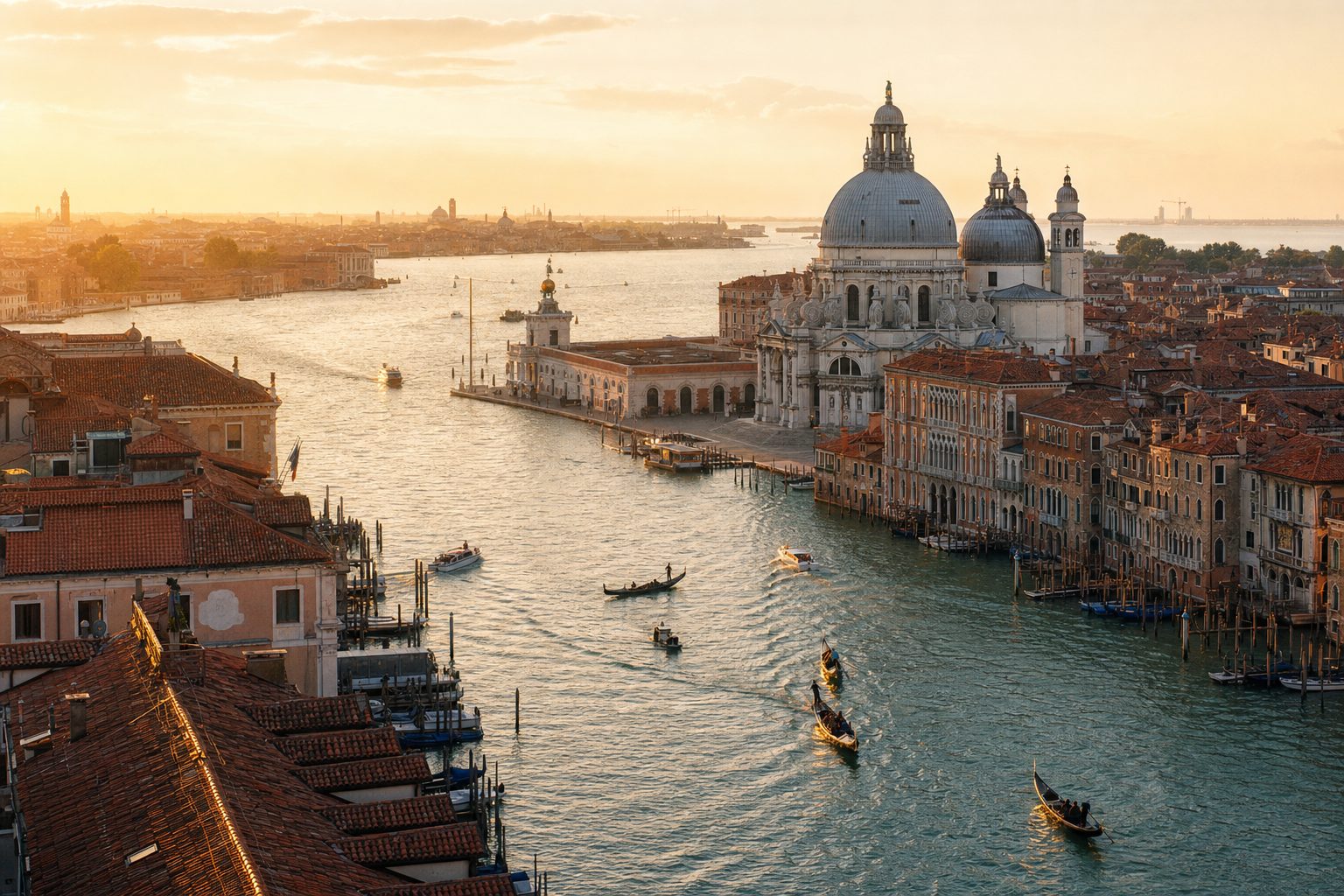
The Grand Canal divides the city more sharply than a street map suggests. When a bridge is far away, a traghetto is the low-cost, local-scale answer: a standing gondola ferry that crosses directly rather than turning a simple errand into a long detour. It is not a substitute for a sightseeing gondola and it should not be treated as one. It is a quick crossing with a practical purpose, which is precisely why it feels so Venetian.
A traghetto crossing costs tourists €2. Common crossings include Santa Sofia, Riva del Carbon, San Tomà, Santa Maria del Giglio and Punta della Dogana; services are roughly 9am to 6pm and can vary by landing. [8]
For a classic gondola ride, decide whether it is a shared memory or a visual box to tick. The customary daytime rate is €90 for 30 minutes and around €110 after 7pm, charged per boat rather than per passenger; a boat can take up to five or six people, and an extra 20 minutes is around €40. Agree the duration, route and total price before stepping in, especially if a singer, musician, waiting time or a longer circuit is mentioned. The transport overview is a useful cross-check for crossings and water options, but ask the gondolier to state the price in full before departure.
- Take one vaporetto ride along the Grand Canal when you can sit or stand by the rail, rather than using it for every short hop.
- Use a €2 traghetto when it solves a real crossing, and check the landing hours before building it into a timed reservation.
- Share a gondola only with people you are comfortable travelling with, then agree the route, time and price as one group.
- Keep large luggage off narrow bridges where possible; use a water-taxi or porter service only when the saved effort is worth the premium.
See the famous places without living inside the queue
St Mark’s Square, the Basilica, the Doge’s Palace and the Rialto Bridge deserve their reputation, but Venice becomes more interesting when each is paired with a nearby counterweight. From St Mark’s, walk east through Castello towards the Arsenale and the quieter waterfront. From Rialto, make time for the market side in the morning, then cross into San Polo rather than immediately following the densest lane south. In Dorsoduro, use the Accademia bridge as a route into smaller canals, not merely a photo stop.
Build your day around two anchors, not six. One could be a timed interior or museum; the other could be a long neighbourhood walk, a church, a market or a cicchetti stop. Reserve advance-entry attractions when the official operator offers timed tickets, then leave the rest of the map loose enough to follow a closing time, rain shower or interesting side street. This is also a city where the wrong turn is usually a ten-minute correction, not a failure of the itinerary.
Water is part of the street network, so ordinary courtesy has an outsized effect. Keep bridge landings clear, step aside rather than stopping in the narrowest passage, dress respectfully for religious interiors and avoid turning private doorways into photo sets. On a packed vaporetto, move away from the entrance after boarding and let passengers disembark first. These small choices make the city easier for residents and for everybody travelling behind you.
Eat and drink with a realistic Venice budget
The reliable savings in Venice are behavioural rather than magical. Stand at the counter for coffee when that is the local format, treat cicchetti and a drink as a flexible lunch, carry a refillable bottle, and choose one sit-down meal you genuinely want rather than several expensive terrace pauses. A menu displayed outside should show the cover charge and service terms; read it before sitting down. The closer a table is to a headline view, the more carefully it deserves comparison.
Seek food where the day already takes you: Cannaregio for evening canalside wandering, the Rialto area earlier in the day, San Polo for an unhurried lunch, Dorsoduro after a gallery or the university quarter. The aim is not to hunt for a secret address but to avoid eating only at the point of maximum footfall. Book dinner in peak periods if there is a particular place you care about, then leave room for a simple bar stop rather than filling every hour with reservations.
Give Venice enough time to become a place, not a backdrop
One overnight is the practical minimum for a first encounter: arrive, orient yourself, see a major landmark early or late, and take one water journey with intent. Two or three nights let you separate the core sights from the island question and leave space for neighbourhoods. Murano suits travellers interested in glassmaking; Burano is better treated as a longer, colourful lagoon outing than an add-on between two fixed appointments. Neither needs to be compulsory if the historic city itself is your priority.
If Venice sits inside a larger Italian journey, protect its walking time from your arrival logistics and let the next destination change the tempo. The mountain contrast in the Dolomites makes a thoughtful continuation, while planning rail and regional connections across Europe helps keep transfers from consuming the days you meant to spend outdoors. Venice will always reward a plan, but it is the unplanned hour after the plan that tends to stay with you.
Sources & further reading
- 1. Venice Access Fee official guidance
- 2. City of Venice Access Fee portal
- 3. The Independent: Venice entry fee in 2026
- 4. InTrieste: Venice expands entry fee to 60 days
- 5. Lonely Planet: Venice booking system and entry fee
- 6. ACTV/AVM vaporetto fares
- 7. Lonely Planet: getting around Venice
- 8. Venice for Visitors: traghetto gondola ferries