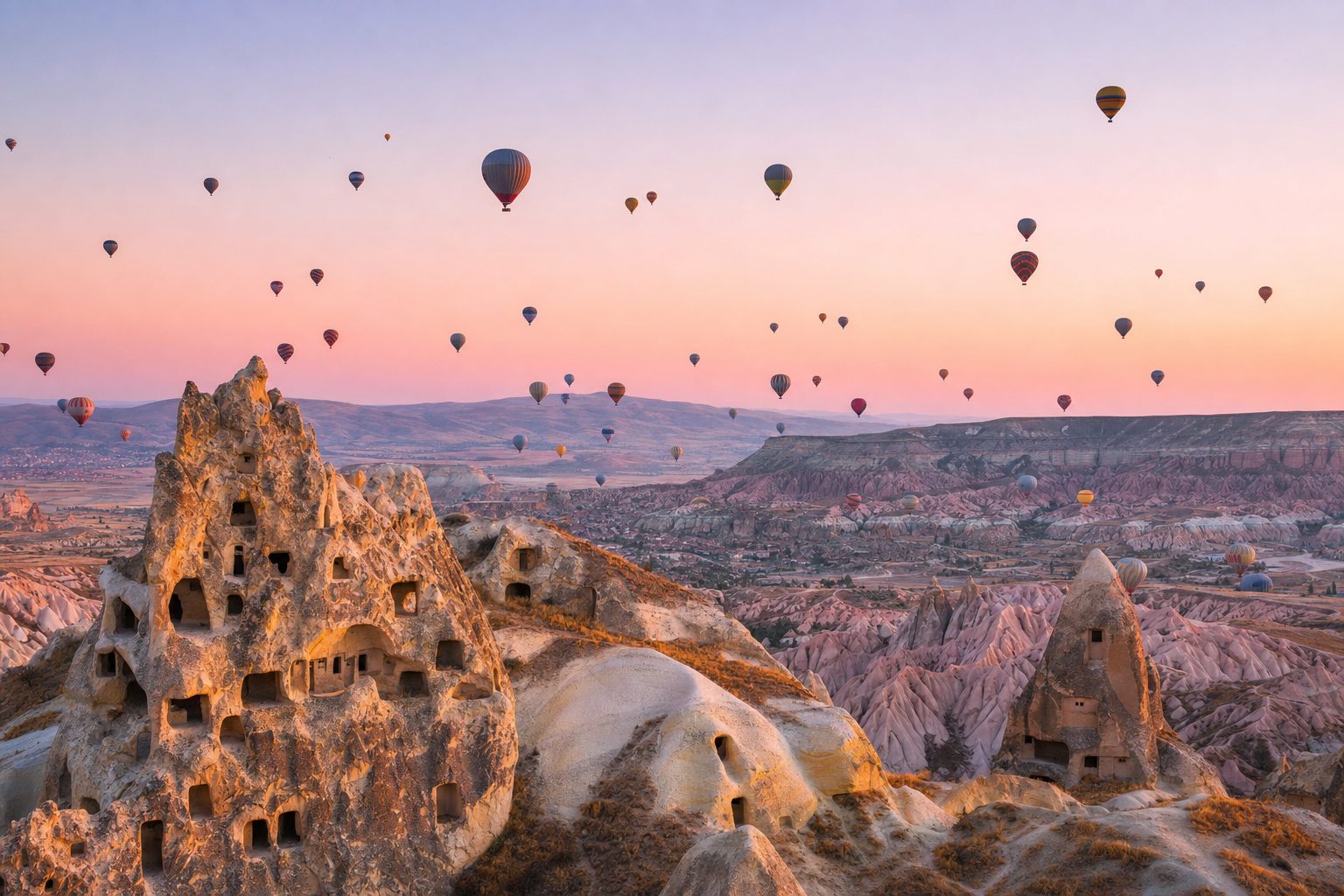
The image that pulled you here — hundreds of balloons drifting over fairy chimneys at sunrise — is genuine, but it is also weather-dependent in a way most Instagram captions do not mention. The decisions that actually shape a Cappadocia trip are: how many mornings you give the balloon before you need a guaranteed outcome, which base town you sleep in, whether you pay for an underground city or a valley hike or both, and which season you accept as a trade-off between stable skies and crowds. Get those right and the rest of the region — rock-cut churches, canyon trails, cave hotels — falls into place around them.
This is not a script for a single sunrise. It is a framework for building slack into a trip whose signature experience is cancelled on a meaningful share of mornings, and for making sure that when it is cancelled, you still have somewhere worthwhile to be at 5 a.m.
Why balloon mornings need a backup plan
Commercial balloon flights over Cappadocia are only legal when flown by operators authorised by Türkiye's Directorate General of Civil Aviation (SHGM), which maintains a dedicated representative office in the region specifically to oversee balloon safety. SHGM's own page on air operators states plainly that any commercial balloon transport requires its authorisation, and that Cappadocia's flight-intensive traffic is why it keeps staff embedded locally rather than managing it from Ankara alone.
As checked in July 2026, SHGM (Turkey's civil aviation authority) maintains a dedicated representation office for balloon operations inside Cappadocia Vocational High School in Mustafapaşa, Ürgüp — set up specifically because flights are operated so intensively in the region. [2]
The go/no-go call is made on wind, visibility and precipitation, not on how many bookings an operator has that morning — when conditions fail, every licensed operator in the valley is grounded simultaneously, not just one company trying to save a launch. Multiple operators and independent trackers converge on the same seasonal pattern: cancellations run roughly 5-15% on a given morning through the peak May-to-October window and climb sharply in the shoulder and winter months, when fog and cold fronts settle over the valleys. Treat any single figure quoted online with some scepticism — the exact percentage varies by source and year — but the direction is consistent enough to plan around: no month is cancellation-proof, and winter is meaningfully worse than summer.
Booking the flight itself
Standard shared-basket sunrise flights run roughly EUR 150-200 per person in the current season, with private or small-basket charters priced well above that; expect the figure to shift with fuel costs and season, so treat any quote as a starting point rather than a fixed number. Book 4-6 weeks ahead for summer dates, since capacity per operator is limited by basket count and airspace slots, not just demand. Lonely Planet's practical guide to the region recommends scheduling the flight for your second day specifically because rescheduling for a cancelled flight is only useful if you still have mornings left, and it also notes that early pre-sunrise departures have a better completion record than the later second wave of the day, since conditions tend to shift as the morning goes on.
Book your hot-air balloon flight for your second day in Cappadocia: flights are subject to cancellation if weather conditions aren't right, and although all companies will reschedule your trip for the following day, that's no good if it is your last day in the region.
— Paraphrased from Lonely Planet's Cappadocia travel guide
Ask any operator, before paying, what happens in three specific scenarios: a weather cancellation the morning of your only remaining day, a cancellation after you have already checked out of your hotel, and a partial refund versus rebooking preference. Written terms vary by company, and the SHGM's role is limited to the safety decision, not to consumer refund policy — that obligation sits with the operator or the platform you booked through.
Choosing a base: Göreme or Uçhisar
Göreme is the region's tourism hub: dense with cave hotels, restaurants and balloon-pickup logistics, and it sits inside the boundary of Göreme National Park itself, so you can walk out of many hotels directly into valley trailheads. Uçhisar, a short drive away, is quieter, built around a dramatic rock citadel, and gives arguably better wide-angle views of the balloon fleet at dawn precisely because you are watching from outside the launch zone rather than in the middle of it. Neither is a wrong choice — Göreme suits a first visit built around walkability and convenience, Uçhisar suits travellers who want a calmer evening base and don't mind a car or taxi for site-hopping.
Göreme Open-Air Museum and the rock-cut churches
Göreme National Park and the Rock Sites of Cappadocia were inscribed on the UNESCO World Heritage List, recognised for a landscape entirely sculpted by erosion that preserves more than 200 individual rock-hewn churches, many carrying Byzantine frescoes from the post-Iconoclastic period onward. The Göreme Open-Air Museum, the most visited cluster of these churches, sits within the park and is run as a Ministry of Culture and Tourism site.
As checked in July 2026, Göreme National Park and the Rock Sites of Cappadocia were inscribed by UNESCO under criteria (i), (iii), (v) and (vii), covering more than 200 individual rock-hewn churches including Tokalı Kilise, El Nazar Kilise and Karanlık Kilise (the Dark Church). [1]
As checked in July 2026, the Göreme Open-Air Museum's official page on muze.gov.tr lists standard opening hours as 08:00 to 18:45, open every day, with a separate evening 'night museum' slot from 19:00 to 23:00 priced at 200 TL for eligible MuseumCard holders; general admission and the separate Dark Church (Karanlık Kilise) fee are set by the Ministry and are best confirmed on that page directly, since both are revised periodically. [3]
Because both the general fee and the Dark Church supplement are revised periodically and change with currency movements, confirm the current figures on the official museum listing before you go rather than relying on any third-party quote, including this one. Arrive at opening or in the last two hours before close to avoid the coach-tour crush that fills the site mid-morning.
Underground cities: Derinkuyu and Kaymaklı
South of Göreme, the underground cities of Derinkuyu and Kaymaklı are carved multi-level complexes that sheltered residents and livestock during periods of conflict, with ventilation shafts, wells, and rolling stone doors still visible today. Derinkuyu is the deeper and more elaborate of the two open to visitors, while Kaymaklı is more compact and slightly easier underfoot, so pick one rather than trying to rush both back-to-back with a hike also on the day's list. Both sites are managed under the same Ministry of Culture and Tourism system as the Göreme museum, with seasonal hours that typically run 08:00-19:00 in summer and shorter days in winter — confirm the current schedule directly before visiting, since ticket-office closing times are usually earlier than the stated closing hour.
The valley hikes: Rose, Red, Love, and Ihlara
Cappadocia's valley network is largely free to walk and arguably the best way to see the fairy-chimney landscape at eye level rather than from a basket. Rose Valley and Red Valley form a connected loop near Göreme, popular at sunset for the way the iron-rich rock face turns colour, with a mix of easy sandy paths and a few steep, loose-gravel sections that reward slower footing over speed. Love Valley, named for its distinctive tall rock formations, and neighbouring Pigeon Valley are gentler walks suited to a shorter morning or late-afternoon outing, both reachable on foot or by a short taxi from central Göreme.
Ihlara Valley is a different undertaking altogether: a roughly 14-kilometre river canyon around 80 kilometres from Göreme, cut by the Melendiz River, lined with dozens of rock-cut churches and running 100-150 metres below the surrounding plateau. Most visitors do not walk the full length — the standard stretch from the main entrance down a long staircase to the riverside village of Belisırma covers roughly 3-4 kilometres and takes about 90 minutes to two hours at an easy pace, ending at streamside restaurants serving trout. It requires a car or an organised tour, since public transport connections from Göreme are indirect.
- Rose Valley and Red Valley loop — 1-2 hours, moderate, best near sunset, reachable on foot from Göreme
- Love Valley and Pigeon Valley — under an hour each, easy, good for a cancelled-flight morning
- Göreme Open-Air Museum churches — half a day, paid entry, arrive at opening to beat coach groups
- Ihlara Valley main section (entrance to Belisırma) — 3-4 km, 1.5-2 hours, requires a car or tour, roughly 80 km from Göreme
- One underground city (Derinkuyu or Kaymaklı) — 1-1.5 hours, paid entry, cool and level underfoot year-round
When to go
April through June and September through October are generally treated as the more settled windows for balloon flying, sitting between winter's fog and wind and summer's heat, though no month is guaranteed and even peak-season mornings are cancelled with some regularity. Midsummer offers long daylight for valley hikes and the most reliable flying conditions of the year, at the cost of higher midday heat on exposed trails like Ihlara's staircase descent and busier museum queues; winter brings a genuine chance of snow-dusted fairy chimneys and thinner crowds, paired with the highest chance of a grounded balloon and shorter museum hours. If the balloon is the priority, shoulder and summer months narrow the odds in your favour; if quiet trails and cave-hotel fires matter more, winter has its own appeal.
Watching for free, and what to do with a grounded morning
You do not need a basket to see the spectacle. Sunrise viewpoints around Göreme — hillside terraces near Sunset Point, the ridges above Love Valley, and rooftop terraces on many cave hotels — put you above the launch field with a clear view of the fleet rising, at no cost and with no weather dependency, since the balloons that do fly are visible from the ground regardless of which morning it is. If your own flight is cancelled, this is the natural fallback: watch from a viewpoint, then use the freed-up morning for one of the valley hikes above, or an early, quiet run at the open-air museum before the coach groups arrive.
Cappadocia rewards travellers who treat the balloon as a highlight rather than the entire itinerary. Build the extra mornings in, choose a base that suits your pace, and the rest of the region — canyons, cave churches, underground refuges — fills the time whether or not the sky cooperates. Travellers weighing other iconic-but-weather-or-crowd-dependent European destinations against Cappadocia might also compare notes with our guide to Santorini and the Greek Islands, or look further afield for other adventure-driven trips on our adventure travel bucket list.
Sources & further reading
- 1. UNESCO World Heritage Centre — Göreme National Park and the Rock Sites of Cappadocia
- 2. SHGM (Turkish Directorate General of Civil Aviation) — Air Operators
- 3. T.C. Kültür ve Turizm Bakanlığı — Göreme Open-Air Museum official listing
- 4. Lonely Planet — Things to know before travelling to Cappadocia
- 5. Go Türkiye — Official Cappadocia travel guide
- 6. Frommer's — Planning a trip to Ihlara Valley