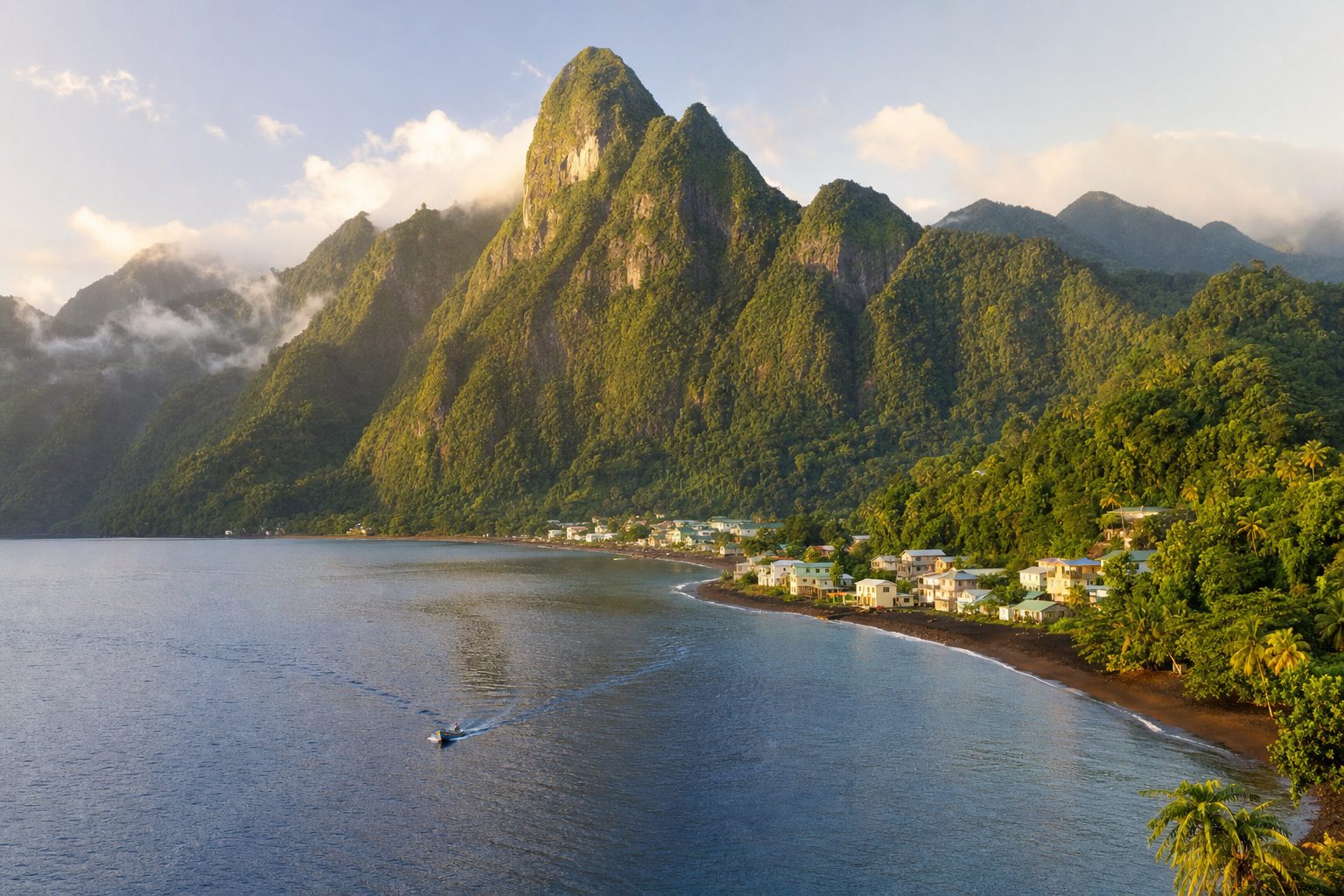
Dominica is the Caribbean island most people have not been to, and many confuse with somewhere else. It is the Commonwealth of Dominica, a small volcanic nation between Guadeloupe and Martinique, not the Dominican Republic. There is no white-sand resort strip. What the island offers instead is a rainforest interior that steams, a hot lake at the end of a hard day's walk, and deep water off the west coast where sperm whales live all year and where, since 2025, swimming with them is a legal, permitted and tightly rationed activity.
That combination shapes the decisions a first-time visitor faces: when to go, how to arrive without losing a day, whether to see whales from a boat or from the water, and how to handle the island's pass and permit system. This guide works through those choices in order.
Why the sperm whale reserve changes the trip
Dominica's west coast drops steeply into deep, sheltered water that a resident population of sperm whales, mostly females and calves, uses as a nursery. The government announced plans to protect it in November 2023, and Parliament gave them legal force with the Sperm Whale Reserve Bill in October 2025. The reserve is the first anywhere created for this species, and it governs tourism as well as fishing and shipping: whale watching, diving and in-water encounters inside its boundary are now regulated activities with a dedicated office, rangers and permits.
The Sperm Whale Reserve Bill was approved by Dominica's Parliament on 14 October 2025. The reserve covers approximately 1,231 square kilometres of territorial sea and exclusive economic zone along the western coast, and the Act creates a Sperm Whale Reserve Office with a Chief Whale Officer and Reserve Rangers to enforce it. [1]
Boat-based whale watching continues much as before, with two to four hour trips from Roseau and Castle Comfort under codes of conduct that forbid luring or chasing animals. In-water encounters, which for years operated under research permits, now sit inside a formal framework. As checked in September 2026, the Act allows no more than two operators to work the same whale at once, requires certified operators on locally registered vessels, and caps vessel speed inside the reserve at ten knots. The Chief Whale Officer post was still being recruited in mid-2026, with interim permits issued by the Fisheries Ministry, so confirm an operator's permit status before paying a deposit.
Costs reflect the scarcity. Licensed swim operators run small groups, typically six guests with three in the water at a time alongside a guide, and the government permit fee they carry was reported at around US$6,000 for 2026. Expect a week-long swim programme to cost several thousand US dollars per person with no guarantee; operators quote daily sighting odds of roughly one in two. A half-day boat trip costs tens of dollars, and the whales are the same animals.
When to go and what the seasons actually mean
The dry season runs roughly from December to April, with February to April the most reliable window for hiking: trails are firmest, river crossings on the Boiling Lake route are manageable, and the leeward sea is usually calm enough for daily whale trips. It is also high season for accommodation and the period when cruise ships call at Roseau most often, so Trafalgar Falls and Emerald Pool fill between mid-morning and mid-afternoon on ship days.
The wet season begins around June and overlaps with the Atlantic hurricane season, June to November. The forest is at its greenest, but the Boiling Lake trail becomes dangerous after heavy rain and ferry and flight schedules are more often disrupted. Between August and October, buy insurance that covers weather cancellation.
Whales are the exception to seasonal logic. Dominica is the only country where sperm whales are resident all year, and while sightings are most common from November to March, the animals do not leave in summer. If whales are the primary reason for the trip, November and early December combine good odds with lower prices.
Getting there without losing a day
Douglas-Charles Airport (DOM) on the north-east coast is the main gateway and the only one with a nonstop link to the mainland United States, an American Airlines service from Miami several times a week. Everyone else connects through Antigua, Barbados, San Juan or St Lucia, so allow half a day to a full day. The drive to Roseau takes around an hour and a quarter; hire a car for stays of more than a few days, since minibuses stop early and rarely reach trailheads. Drive on the left and expect steep, narrow roads.
If you are already in the French Antilles, L'Express des Îles runs fast ferries from Guadeloupe, Martinique and St Lucia into the Roseau Ferry Terminal all year, with crossings of two to four hours. It is the cheapest way in, but frequencies vary from three to seven round trips a week by season, so confirm with the operator.
A new international airport at Wesley and Woodford Hill in the north-east has been under construction since 2022, with a 2,850 metre runway for wide-body aircraft. As checked in September 2026, the completion target had moved to 2027, with runway works around 60 percent complete in mid-year. Plan as if it does not exist.
The Boiling Lake, Morne Trois Pitons and the site pass
Most of what visitors come to see lies inside Morne Trois Pitons National Park, a UNESCO World Heritage Site since 1997. Its headline walk is the Boiling Lake: roughly 13 kilometres return from the Titou Gorge trailhead above Laudat, six to eight hours, with more than 700 metres of climbing, river crossings and a descent through the Valley of Desolation, a scarred bowl of sulphur vents and bubbling mud. The lake itself sits under a permanent veil of steam.
Morne Trois Pitons National Park covers 6,857 hectares, around nine percent of Dominica's land area, and contains five live volcanic centres, some 50 fumaroles, hot springs and mud ponds. Its Boiling Lake holds water at around 95 degrees Celsius and is described by UNESCO as one of the largest of its kind in the world. [5]
A licensed guide is required for the Boiling Lake under national park rules, and this is not a formality: the route is unmarked in places and cloud can cut visibility to a few metres in the Valley of Desolation. As checked in September 2026, guides were quoting roughly US$80 to 120 per group through operators listed by the Discover Dominica Authority. Start before 7 am, carry at least three litres of water, and do not attempt it after heavy rainfall.
The park and most other managed natural sites sit under a single fee system run by the Forestry, Wildlife and Parks Division, with passes sold at visitor centres, the Division's Roseau office and vendors near the sites.
As checked in September 2026, the Eco-tourist Site User Fee programme charges non-residents US$8 (EC$21.74) for a single visit to one site, US$20 (EC$54.39) for a day pass covering all eco-tourism sites, and US$50 (EC$135.85) for a week pass allowing repeat visits. Covered sites include the Boiling Lake, Emerald Pool, Middleham Falls, Trafalgar Falls, Freshwater and Boeri Lakes, Cabrits National Park, the Syndicate Nature Trail, Indian River and Soufriere Sulphur Springs. [3]
Beyond the Boiling Lake, the park rewards easier days. Trafalgar Falls is a ten-minute walk to a platform facing two falls, one cold and one geothermally warmed. Middleham Falls is a two-hour round trip to a single high drop. Titou Gorge, a slot canyon you swim through to a small waterfall, pairs naturally with the Boiling Lake trailhead. Emerald Pool, near Pont Casse, is the most accessible and therefore the busiest.
Walking the length of the island on the Waitukubuli National Trail
Waitukubuli is the Kalinago name for the island, usually translated as tall is her body, and the trail that carries it is the Caribbean's first long-distance footpath, running from Scotts Head in the south to Cabrits National Park in the north through rainforest ridges, farm tracks, the Kalinago Territory and villages with guesthouses. A full traverse takes around two weeks; most visitors sample two or three segments.
The Waitukubuli National Trail is 184 kilometres (115 miles) long in 14 segments and was declared an eco-tourism site on 10 May 2013. As checked in September 2026, non-residents need a trail pass: US$12 for a day pass covering one or more segments, or US$40 for a fifteen-day pass covering all 14 segments, sold at Douglas-Charles Airport, in Roseau and at points along the route including Kalinago Barana Aute and the trail management unit at Pont Casse. [4]
Segment choice matters more than distance. Segments 1 and 2 climb from Scotts Head with sea views; segment 4 crosses the interior from Wotten Waven to Pont Casse; segments 5 and 6 drop to the wild Atlantic coast around Castle Bruce; segments 11 to 14 are the most remote, through Syndicate's parrot forest to the fort ruins at Cabrits. Register with the management unit before setting out and hire a guide for interior segments.
Reef, coast and the Kalinago Territory
The south-west corner is where volcanic geology meets the sea in ways you can snorkel. Champagne Reef, below Pointe Michel, takes its name from streams of warm bubbles rising from vents in the seabed; you swim through them from a shingle beach. A few kilometres south, the bay between Soufriere and Scotts Head is a partly submerged crater protected since 1998 as the Soufriere Scotts Head Marine Reserve, with drop-offs within metres of shore. A small reserve contribution is collected on site and anchoring is banned. Diving here is among the best in the Eastern Caribbean and rarely crowded.
On the opposite coast, the Kalinago Territory is home to the Caribbean's last substantial community of Indigenous Kalinago people, on rugged Atlantic shoreline formally set aside in 1903. Kalinago Barana Aute, a model village above the Crayfish River, has a small museum, traditional buildings, craft demonstrations and a short walk to a waterfall; as checked in September 2026, entry was around US$10 in cash. Visit with someone from the community and buy basketwork directly from the makers. Allow half a day from Roseau.
The park's luxuriant tropical forest, unusually rich in endemic plants and animals, is combined with volcanic features of exceptional scientific interest, including the Boiling Lake, hot springs, fumaroles and freshwater lakes, giving it the most diverse and dramatic landscape of any comparable area in the Lesser Antilles.
— Paraphrased from the UNESCO World Heritage listing for Morne Trois Pitons National Park
Where to stay, what it costs and how to behave
Accommodation is small-scale by design: a handful of eco-lodges and villa resorts, several rebuilt to stricter standards after the 2017 hurricane, and guesthouses in Roseau, Wotten Waven and the south-west villages within twenty minutes of Titou Gorge and the marine reserve. Book early for February to April. The Eastern Caribbean dollar is pegged at roughly EC$2.70 to US$1 and US dollars are widely accepted, but cards fail at trailhead vendors and in the Kalinago Territory, so carry small notes; ATMs cluster in Roseau and Portsmouth. Mobile coverage is unreliable inland, so download offline maps first.
- Complete the online immigration form at edcard.dominica.gov.dm before you fly and save the QR code to show with your passport.
- Carry a passport valid for six months beyond arrival; as checked in September 2026, the EC$86 (US$33) departure tax is usually built into air fares but paid separately at the ferry.
- Buy the Forestry Division week pass (US$50) and, if walking the trail, the Waitukubuli fifteen-day pass (US$40) on your first day.
- Book a licensed Boiling Lake guide and any whale trip before arriving in high season.
- Pack walking shoes with grip, a light waterproof, reef-safe sun protection and a dry bag.
Etiquette on the water is now written into law: inside the reserve you do not touch, chase, feed or block whales, and you do not enter the water except with a permitted operator. On land, ask before photographing people in the Kalinago Territory, stay on marked trails and keep away from fumaroles.
Dominica's tourism authority describes the island as the only country in the world where sperm whales reside all year round, with sightings most common from November to March in the deep, sheltered bays off Scotts Head, Roseau, Layou and Point Round. Operators follow codes of conduct that forbid luring the animals. [6]
Dominica is not for a beach week, and pretending otherwise leads to disappointment. It is for people who want to walk hard, swim in cold rivers and warm sea, and see the largest toothed predator on earth from a small boat. Give it a week in the drier months, base yourself in the south-west with a car, and split your days between one big hike, two or three easy park sites, a morning on the reef and a whale trip. If the in-water encounter is the dream, plan a year ahead and accept the odds.
If the appeal is regulated access to wildlife, Dominica sits alongside a small group of places that have chosen limits over volume. Our guides to the Galápagos Islands and Raja Ampat cover two more, Fernando de Noronha shows how a daily visitor cap works on a smaller island, and our adventure travel bucket list has the wider field.
Sources & further reading
- 1. Office of the Prime Minister, Dominica — Parliament approves Sperm Whale Reserve Bill (October 2025)
- 2. Travel Noire — How Dominica's Sperm Whale Reserve regulates whale tourism
- 3. Forestry, Wildlife & Parks Division, Dominica — Eco-tourist Site User Fee programme
- 4. Waitukubuli National Trail — Fees and FAQ
- 5. UNESCO World Heritage Centre — Morne Trois Pitons National Park
- 6. Discover Dominica Authority — Whale Watching
- 7. GOV.UK — Dominica entry requirements
- 8. Facts From Upstairs — How to get to Dominica: flights, ferries and the new airport