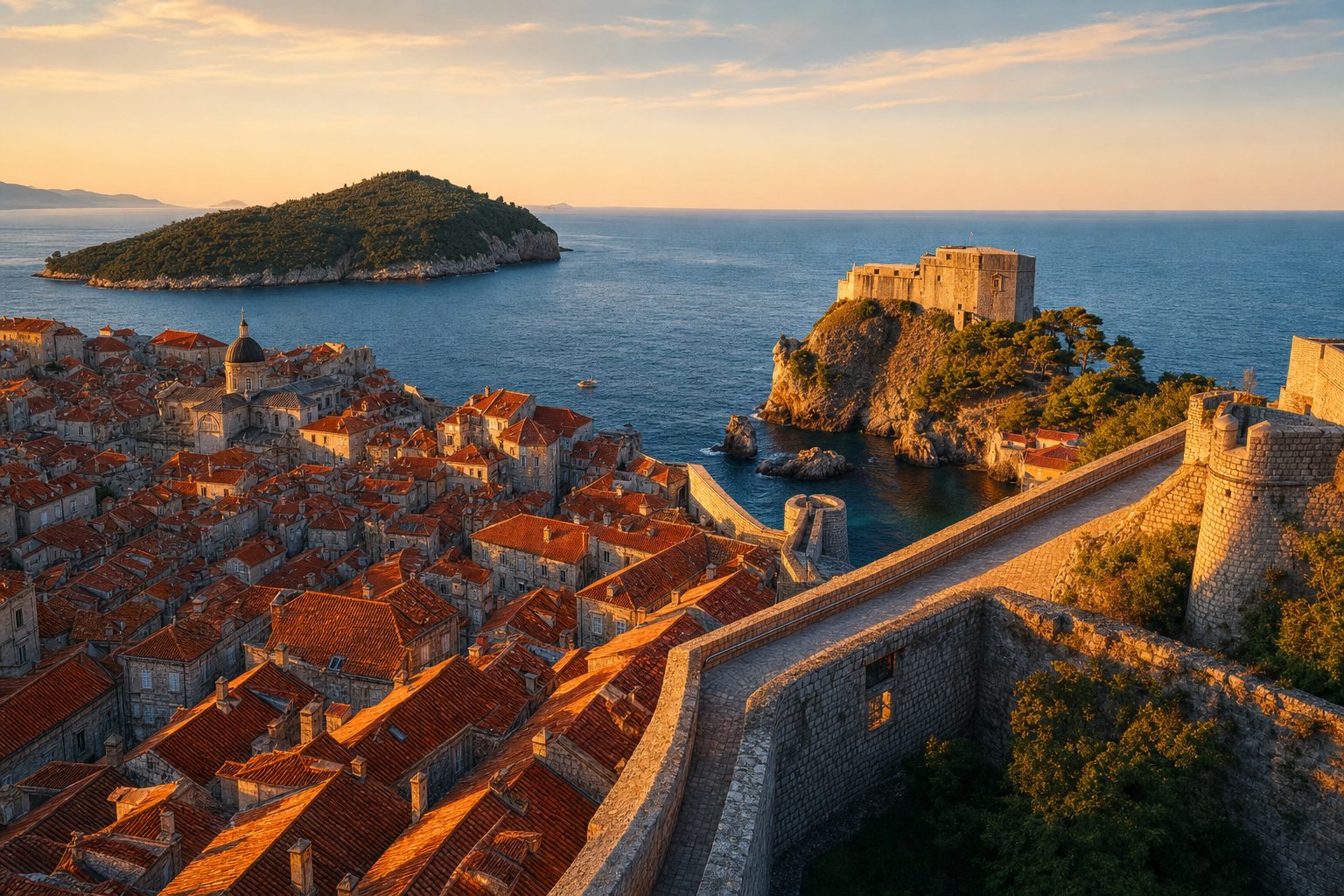
Dubrovnik’s Old Town is compact enough to look manageable on a map and consequential enough to punish an improvised visit. The principal decision is not whether to see the walls, Stradun or the Rector’s Palace; it is how to arrange them around the hours when ship passengers, coach groups and independent visitors all arrive at once. The right plan begins with the city’s crowd-management rules, then fixes a wall slot, a base and a small number of priorities rather than trying to consume the historic core between a breakfast and a flight.
This guide is for the first visit that arrives via the familiar reel of terracotta roofs, pale ramparts and the Adriatic beyond them, but wants a workable day beneath that image. It uses official visitor information and the 2026 measures reported by El País, checked in August 2026. Prices, opening hours, sailing and access arrangements change; before paying, recheck the linked official pages and build the Old Town portion around the live port calendar rather than a generic “best time to visit”.
Start with the city’s crowd rules, not the postcard
The practical backdrop is Respect the City: Dubrovnik is managing not only how many people come ashore but how long a ship remains. That matters to an independent traveller because a port call can still concentrate its guests around Pile Gate, the walls and Stradun. Treat a calendar showing ships as a signal to move a museum, Lokrum or a late lunch outside the walls into that period, not as a reason to abandon the city. The old core has depth when it is given time: side streets, the harbour edge and the small civic buildings become easier to read once the immediate flow has thinned.
As reported in February 2026, Dubrovnik allows only two cruise ships to dock simultaneously each day. Ships must stay at least eight hours; for vessels carrying more than 4,000 passengers, the minimum stay is 12 hours. [8]
The same policy is a reminder that a cruise schedule is not a headcount of people in front of you. A ship may berth while visitors are distributed between tours, meals and transport, and a ship-free morning can still be busy with hotel guests. Use the calendar as a planning tool rather than a promise. The Port Authority’s arrivals and departures page publishes the schedules; check it when choosing your wall time, then check again shortly before travelling in case calls have moved.
A 4,000-person cap on simultaneous cruise visitors inside the walls of the Old City has been established, according to El País’s February 2026 reporting on Dubrovnik’s measures. [8]
There is a heritage reason to make this more than queue avoidance. UNESCO describes the Old City as a major Mediterranean sea power from the thirteenth century that retains Gothic, Renaissance and Baroque churches, monasteries, palaces and fountains despite the 1667 earthquake and 1990s conflict. Walk with that sequence in mind: the wall circuit gives the perimeter and waterline; the streets and civic rooms explain the republic that made them useful. A rapid lap followed by a hurried Game of Thrones stop misses the relationship between fortification, port and town.
See the Old City as a fortified Mediterranean civic ensemble: its walls, religious buildings, palaces and fountains belong to a place that developed as a sea power and has been repeatedly conserved after damage.
— Paraphrased from the UNESCO World Heritage listing for the Old City of Dubrovnik
Choose the ticket that makes the walls worth the cost
As checked in August 2026, an adult City Walls ticket is €40 from March to October and €15 from November to February. It includes Fort Lovrijenac, the cliffside fort outside Pile, and is run by the Society of Friends of Dubrovnik Antiquities. Buy only through the Society’s official ticket shop or the official pass site; do not let a search advert turn a simple admission into a marked-up bundle. The Society’s guidance also makes clear that a walls ticket is for one circuit, not a ticket to hop on and off during the day.
The important 2026 change is not merely a recommendation to buy early. El País reports that access to the walls may only be booked online. Choose a date and time before you have committed a hotel night or a transfer around it, save the confirmation offline and arrive with water and proper footwear. The parapet route is exposed to sun and has steps; it is a walk with a view, not a smooth promenade. Check the Society’s visitor FAQ and sales page close to the visit, because its opening hours and operational advice are the pages that matter on the day.
The Society of Friends of Dubrovnik Antiquities says its heritage sites require a purchased ticket; for the City Walls, the ticket is valid for one tour and re-entry is not possible. [2]
For most first-time visitors, the one-day Dubrovnik Pass is the better calculation. It is about €45 as checked in August 2026 and includes the walls, the Cultural-Historical Museum in the Rector’s Palace, participating museums and galleries, plus city buses for its validity period. Paying roughly €5 above the high-season wall ticket alone turns one museum and even a simple transfer into value rather than an extra decision. Buy the official Dubrovnik Pass only after checking its live list of inclusions and activation rules, then use it deliberately: walls first, Rector’s Palace when the centre is busiest, and the bus for the hotel or Gruž.
Time the wall circuit around ships and heat
Aim for the published 08:00 opening in the main season or the late afternoon, while treating neither as a guarantee of solitude. The first option protects the cool part of the day and puts the main attraction ahead of the port rhythm. The second can work when day visitors have begun returning to ships or hotels, but only if the official closing time leaves a generous margin for a complete circuit. Do not arrive at the last-entry time imagining a quick loop: stairs, narrow points and stops for the sea-facing towers slow everyone down.
The strongest version of the strategy combines both clocks. First inspect the Port of Dubrovnik cruise calendar, note the dates and hours with no large calls or a quiet gap, and put the walls there. On a crowded ship day, make the early wall slot the only fixed Old Town commitment, then step away from the central lane for the Rector’s Palace, a slow lunch or a bus ride back to the hotel. If the calendar is quiet later, reverse the order and use the afternoon light on the ramparts.
Enter with the route in mind rather than following the densest queue by reflex. Pile is convenient from the western approach; travellers staying by Ploče or arriving from the eastern side may find the eastern approach more sensible. Whichever entrance you use, accept that the circuit is a one-way commitment once scanned. Bring a refillable bottle, sun protection and a small bag, pause where the path widens, and keep phones and elbows out of the narrowest stretches. The best photograph is not an entitlement to block the route.
- Check the Port Authority’s arrival schedule before selecting the wall slot, and recheck it in the final days before travel.
- Walk the walls at the published 08:00 opening in season or late afternoon, with enough time to finish before the official closing time.
- Choose the one-day Dubrovnik Pass if you will also use the Rector’s Palace, another included museum or the city buses.
- Keep the busiest midday hours for a shaded museum, a meal outside Stradun or a return to the hotel rather than a second queue.
Give the Old Town a measured middle, not a checklist
After the walls, choose one interior anchor. The Rector’s Palace is the natural counterpart to the ramparts because it moves the story from defence to government; the pass is particularly useful here. Then let geography do the work: walk Stradun once in each direction, turn uphill or downhill for a few lanes, and stop at the Old Port without trying to convert every church facade into a timed attraction. This is a better use of a shorter stay than adding a string of paid sites that forces a return to Pile just as the crowds are peaking.
Fort Lovrijenac deserves its own hour even though it rides on the walls ticket. It is not on the main circuit, and separating it gives the western defences a clearer shape. Go before or after the walls according to light and energy, rather than forcing it into the middle. The Society’s Lovrijenac page is useful context for the fort; recheck access details before setting out. A visitor who only wants the wall view can skip it, but a first visit with the pass or combined ticket should not mistake “included” for “automatically visited”.
Avoid turning the Old Town into a film-location hunt. Screen history can be a useful prompt to notice the stairs, gates and fortifications, but the city works better as a lived heritage centre with its own current rules. Keep voices low in residential lanes, do not sit or stage elaborate shoots in doorways, and make room on steps and at fountains. This is not etiquette as performance; it is the practical contribution an individual visitor can make to a heritage place that is being actively managed for residents and visitors alike.
Use Srđ or Lokrum to create breathing space
Mount Srđ and Lokrum solve different problems. Choose the cable car when the aim is orientation: a short ascent shows the walls, Old Town, harbour and islands in one frame and works particularly well after a first walk through the streets. The operator says the lower station is on Petra Krešimira IV, a short uphill walk from the Old City; the ride takes about four minutes, departures start at 09:00 and the last ascent is 30 minutes before closing. Buy from the official cable-car operator and check weather and the month-specific timetable, especially if a sunset ride is important.
Choose Lokrum when the real need is a pause from stone and traffic. Dubrovnik Tourist Board information says the boat from the Old City Harbour takes about ten minutes; in its regular-season guidance, boats run every half hour and do not operate in bad weather or during winter. That makes it a useful midday reset on a multi-night stay, but not a dependable last-minute escape in shoulder-season weather. Confirm the day’s departure and return pattern with the tourist board’s Lokrum information or the reserve before buying anything.
Arrive simply and sleep where the day begins
Most international visitors arrive at Dubrovnik Airport. The Tourist Board says an organised airport bus runs after regular flights, dropping first at Ploče and then at the main bus station; for departures it leaves the station 1.5 hours before domestic flights and two hours before international flights. Its stops include the cable-car area, and tickets are sold at the airport, bus station, by the cable car and through the carrier. That makes the bus a credible choice if your accommodation is near Ploče, but check the live departure before relying on it after a late flight.
For bases, choose according to the early wall plan. Inside the walls is compelling for an overnight or two because the first and last hours become simple on foot, though steps, luggage and evening noise make it a poor match for everyone. Ploče suits the eastern approach, airport-bus stop and a view-facing stay; it is a sound compromise for a first visit. Lapad works for a calmer beach-and-hotel rhythm, while Gruž is practical for ferries, the bus station and a more local logistical base. None removes the need to travel to the Old Town at peak hours, so price the time and transport honestly.
If Dubrovnik is the beginning rather than the whole Croatian trip, keep the city night before a wider southbound route instead of treating it as a cruise-port detour. The walls, Rector’s Palace and one well-timed escape to Srđ or Lokrum make a complete first encounter; a second morning adds depth without forcing it. From there, our Dubrovnik to Kotor coastal drive helps turn the Adriatic edge into a journey, while the Plitvice Lakes guide is a useful counterpoint for travellers continuing north through Croatia.
Sources & further reading
- 1. UNESCO World Heritage Centre — Old City of Dubrovnik
- 2. Society of Friends of Dubrovnik Antiquities — City Walls FAQ
- 3. Society of Friends of Dubrovnik Antiquities — official ticket shop
- 4. Official Dubrovnik Pass
- 5. Dubrovnik Port Authority — arrivals and departures
- 6. Dubrovnik Tourist Board — arrival by plane
- 7. Dubrovnik Tourist Board — Lokrum information
- 8. El País — Croatia tackles the growing problem of mass tourism