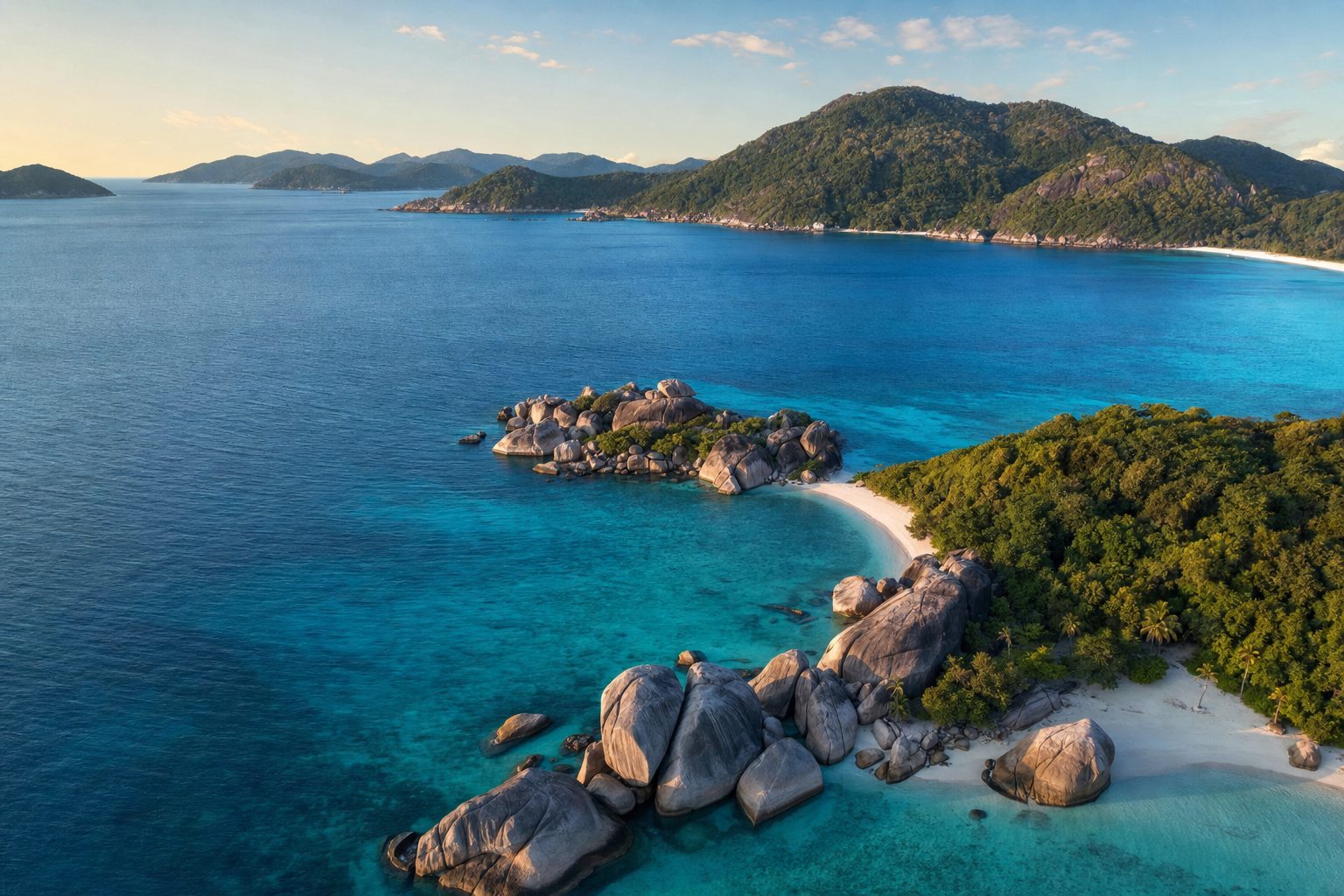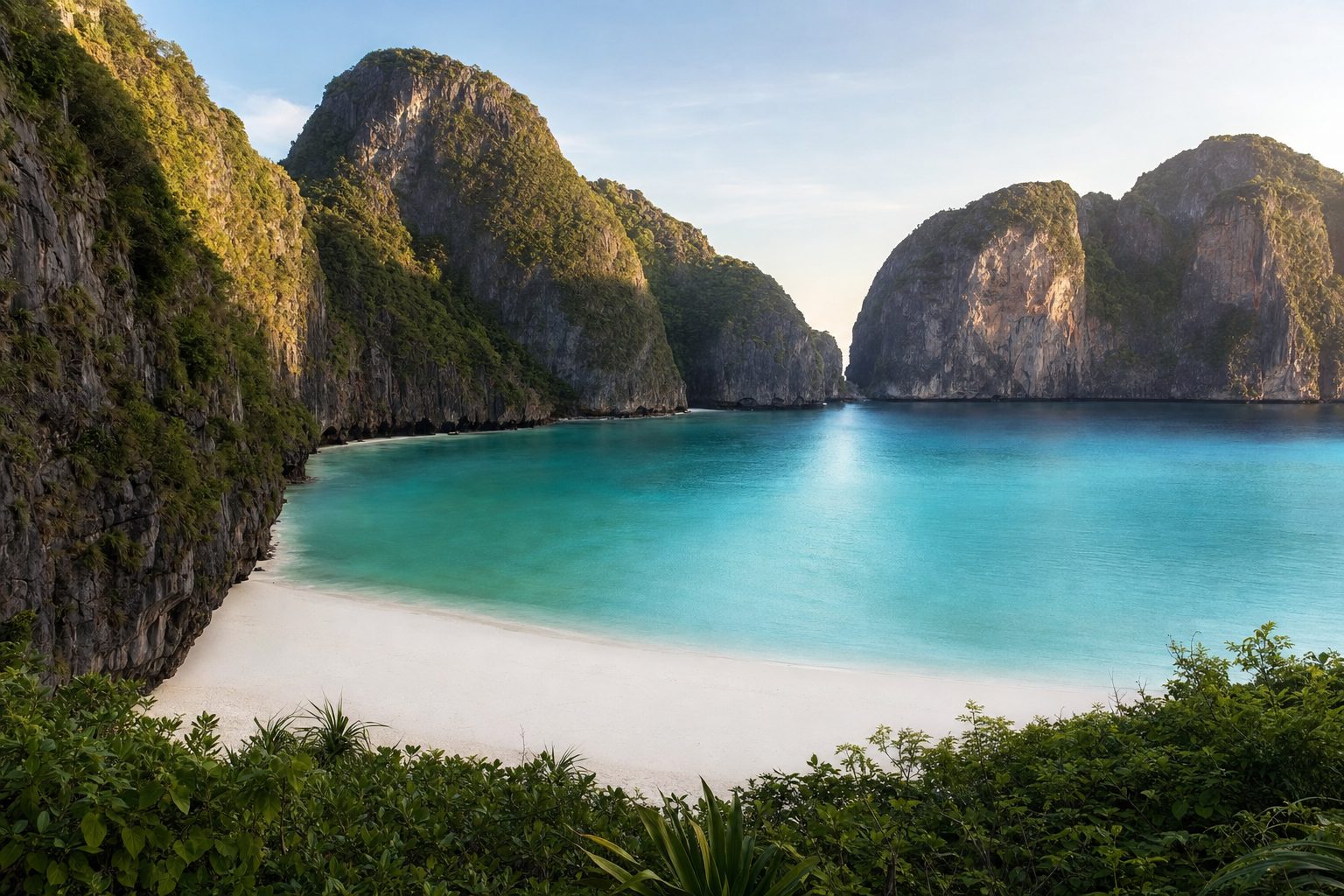
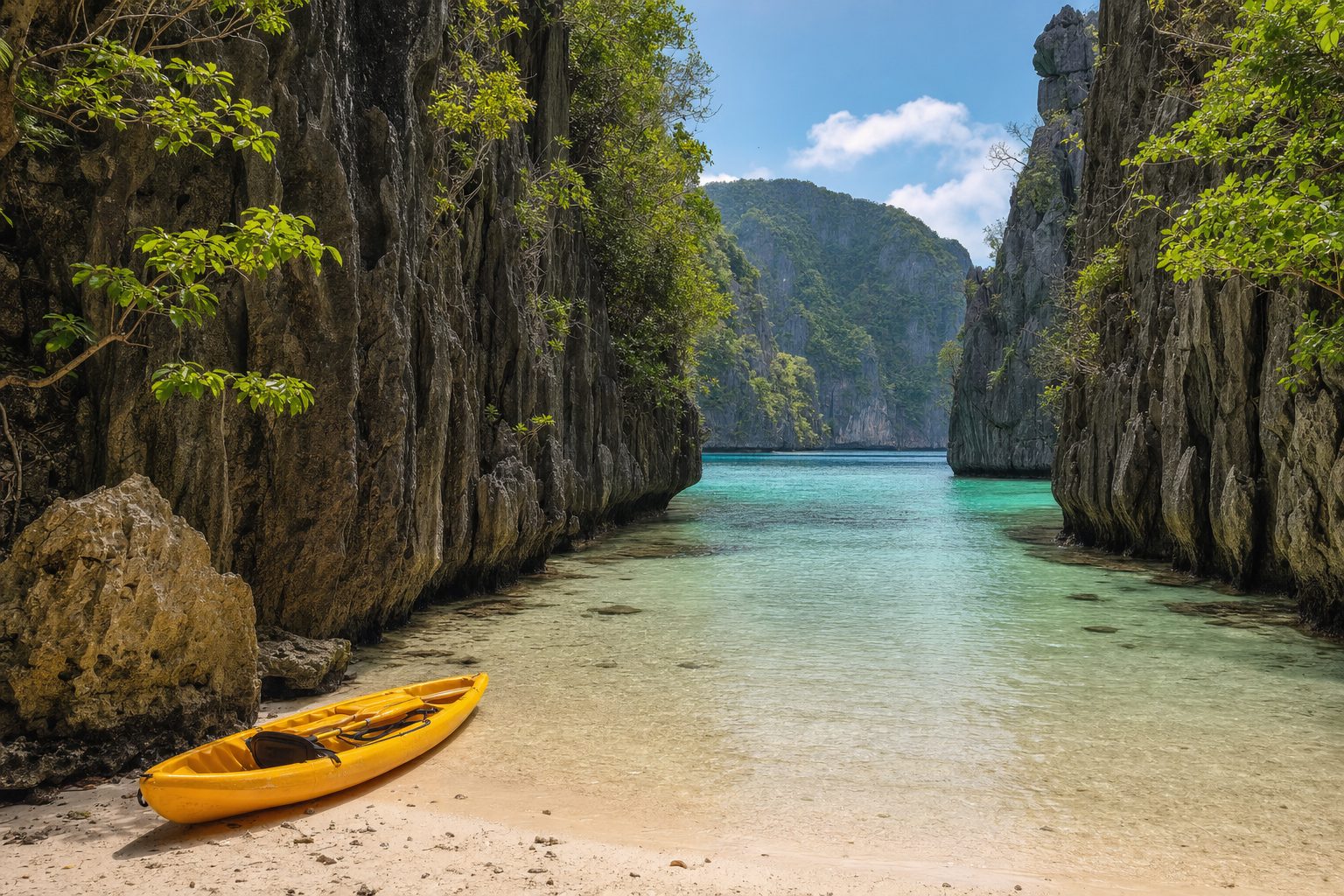
The lagoons that made El Nido a fixture of travel feeds are no longer the free-for-all they were a decade ago. Big Lagoon and Small Lagoon, the two turquoise pools carved into Bacuit Bay's limestone karst, now sit inside a managed protected area with visitor caps, timed entry, and a rule barring motorised boats from entering the water at all. The decisions a first-time visitor needs to make are less about which beach photographs best and more about which numbered tour to book, when in the year to go, and how to budget for a stack of small, mandatory fees that add up before a single boat leaves the pier.
This guide works through those decisions in order: how island hopping is structured into Tours A through D, what the lagoon rules actually restrict, the fees to budget for and how they are collected, when the weather makes or breaks a trip, and how to get to a town with no commercial seaport and one small airport.
Why the lagoons now require a kayak, not a boat
El Nido and neighbouring Taytay sit inside the El Nido-Taytay Managed Resource Protected Area, and the karst lagoons at its centre were showing the wear of rising visitor numbers: dying coral from repeated anchoring, birdlife disturbed by boat noise and cooking smoke, and floating rubbish from vendors working the anchorage points. The area's protected area management board responded with a carrying-capacity policy that changed how the lagoons are entered rather than whether they can be visited at all.
As checked in August 2026, motorised tour boats are barred from entering Big Lagoon and Small Lagoon and are confined to designated anchorage areas at each entrance; visitors transfer to kayaks or paddle boards to go inside, under a resolution adopted by the El Nido-Taytay Managed Resource Protected Area board. Confirm current entry hours and caps with the El Nido Protected Area Office before travelling. [4]
The same rule set caps how many people can be inside each lagoon at once and limits the total daily throughput, with rangers stationed at the entrances to manage the flow. Big Lagoon and Small Lagoon were also split apart. Under Municipal Ordinance 101 of 2018, the two sites were pulled out of the original combined route and placed on separate island-hopping tours specifically to reduce the crush of boats converging on both in a single day, which means a visitor can no longer see both lagoons on the same outing.
The municipal government separated the lagoons to address carrying-capacity concerns directly, reasoning that consolidating both sites on one tour route would keep pushing visitor numbers past what the ecosystem could absorb, even as the town worked with DENR to confirm formal capacity limits for the wider bay.
— Paraphrased from a Philippine News Agency report on El Nido's 2018 tourism ordinance amendments
Tours A to D: the town's answer to island-hopping chaos
El Nido standardised its boat tours years ago into four fixed routes, each covering a different cluster of islands in Bacuit Bay at a set town rate, largely to stop operators competing on price by cutting corners on safety or crowding into the same few spots. Tour A is built around Big Lagoon, together with Secret Lagoon, Shimizu Island, and Seven Commandos Beach, and stays inside sheltered water the whole way, which makes it the usual first choice for anyone doing only one tour. Tour B runs to Snake Island's sandbar, Entalula Beach, and a set of caves, including Cathedral Cave, which since around 2024 can only be viewed from the boat rather than entered. Tour C is the snorkelling-heavy route to Hidden Beach, Secret Beach, and Helicopter Island, and Tour D now carries Small Lagoon alongside Cadlao Lagoon and Pasandigan Cove.
As checked in August 2026, joiner (shared-boat) island-hopping tours in El Nido run at roughly PHP 1,200 to 1,500 for Tour A, PHP 1,300 to 1,500 for Tour B, PHP 1,400 to 1,800 for Tour C, and PHP 1,200 to 1,400 for Tour D, typically including a guide, lunch, and drinking water but not entrance or kayak fees. Rates are reviewed periodically by the tourism office and are worth reconfirming close to travel. [3]
Private charters cost several times more per boat but let a small group set its own pace and skip the joiner-tour queue at popular stops. Whichever route is chosen, El Nido's tour desks sell fixed itineraries rather than a-la-carte stops, so the practical decision is simply which letter to book first, and most repeat visitors end up doing two or three across a stay of four to five nights rather than trying to compress everything into one exhausting day.
The fees: ETDF, entrance charges, and kayak hire
Beyond the tour price itself, El Nido layers on a handful of mandatory charges that catch first-timers off guard if they arrive expecting an all-in package. The largest is the Eco-Tourism Development Fee, a town-wide levy on anyone joining an island-hopping tour, collected by the booking office or tour guide and passed on to the municipality to fund reef monitoring, mangrove rehabilitation, and coastal clean-ups.
As checked in August 2026, the Eco-Tourism Development Fee (ETDF) is PHP 400 per non-Palawan-resident tourist, doubled from PHP 200 in June 2024 under Municipal Ordinance 01-2024, with reduced rates for Palawan residents, Filipino students, and senior citizens. It is valid for 10 days from payment, so keep the receipt for use across multiple tours during a single stay. Verify the current rate at the El Nido Tourism Office before booking, since rates have been revised more than once. [1]
On top of the ETDF, Big Lagoon and Small Lagoon each charge a separate entrance fee, and kayak hire (mandatory for entering either lagoon, since walking or swimming in is not an option) is billed on top of that again. A 2026 Palawan fees guide lists Big Lagoon and Small Lagoon entrance at roughly PHP 200 each, with kayak rental running PHP 300 to 350 per set, meaning a visitor doing both Tour A and Tour D should budget for two lagoon entries and two kayak hires in addition to the ETDF and both tour prices. None of these fees is usually included in the advertised joiner-tour rate, and none is refundable except in cases such as a coast guard-ordered cancellation for weather.
- Confirm the current ETDF rate at the El Nido Tourism Office and keep the receipt; it covers every tour taken within its 10-day validity.
- Budget separately for lagoon entrance fees (about PHP 200 each) and kayak hire (about PHP 300 to 350 per set) on top of the tour price.
- Decide which lagoon matters more if time is short, since Big Lagoon (Tour A) and Small Lagoon (Tour D) require separate days.
- Bring cash in pesos for on-the-day fees; card payment is not reliably available at tour desks or lagoon entrances.
- Ask the tour operator directly which fees are and are not included before paying for a joiner slot.
When to go: amihan calm versus habagat rain
Palawan sits on the western side of the Philippine archipelago, which the national weather service classifies as a region with two sharply divided seasons rather than the more even rainfall patterns found on the Pacific-facing east coast. That divide is the single biggest factor in whether a lagoon visit turns out calm and clear or choppy and cancelled.
As checked in August 2026, PAGASA (the Philippine Atmospheric, Geophysical and Astronomical Services Administration) classifies the Philippines into a rainy season running roughly June to November and a dry season from December to May, the latter split into a cool-dry stretch (December to February) and a hot-dry stretch (March to May); western islands such as Palawan follow this pattern closely. Conditions vary year to year, so check PAGASA's seasonal outlook close to travel dates. [6]
In practice, that means December through April is when Bacuit Bay's water is at its calmest and clearest, which matters directly for lagoon kayaking and the swim-through entrance at Hidden Beach on Tour C. From June through October, afternoon downpours and the occasional typhoon can cancel boats outright or force operators to substitute a calmer route, and rough crossings are more common even on days that do run. None of this rules out a rainy-season trip: prices and crowds both drop, and mornings are frequently clear even in the wettest months, but it does mean building slack into a short itinerary rather than assuming every booked tour will run as planned.
Getting there: fly to Lio, or take the long road from Puerto Princesa
El Nido has no commercial seaport and only a small regional airport, so the getting-there decision is really a choice between speed and cost. The direct option is a turboprop flight to El Nido's own Lio Airport, roughly 20 kilometres north of town; the alternative is flying into Puerto Princesa, Palawan's main airport, and continuing by road.
As checked in August 2026, the direct flight to Lio Airport takes about one hour fifteen minutes, while the road alternative from Puerto Princesa runs five to six hours by shared van or bus; a scheduled airline relocation from Manila's Ninoy Aquino International Airport to Clark International Airport, announced for March 2026, changes the departure point for that direct route, so confirm the current departure airport when booking. [7]
Flying direct saves the better part of a day but costs more and runs a limited daily schedule that fills up in the December-to-April peak, so booking six to eight weeks ahead is worth it in high season. The overland route through Puerto Princesa costs a fraction of the airfare and lets travellers combine El Nido with Puerto Princesa's own attractions, such as the Underground River, but it means committing to a long van or bus ride at both ends of the trip. A slower third option, the passenger ferry from Coron, takes three and a half to five hours depending on operator and is worth considering for anyone already working through the wider Palawan archipelago rather than flying in and out once.
Fitting it together: a realistic first-time plan
A first visit of four to five nights gives enough room to do two island-hopping tours with a weather buffer, rather than trying to cram all four routes into a rushed week. Booking the flight or transport, the accommodation, and at least the first tour ahead of arrival matters more here than in destinations with looser capacity rules, since both the ETDF and the lagoon slots run on caps rather than open access. Travellers weighing El Nido against other Southeast Asian island stops with their own protected-area rules might find it useful to compare notes with a guide to Bali beyond the beaches, while anyone building a longer Pacific or Atlantic island-hopping trip around booked, capacity-limited natural sites can draw parallels with the timed-ticket hot springs covered in the São Miguel, Azores guide or the trail-permit system detailed in the Madeira levada walks guide. The common thread across all three is the same: book the regulated highlight first, then build the rest of the trip around it.
Sources & further reading
- 1. El Nido Paradise: Eco-Tourism Development Fee (ETDF)
- 2. Van Hire Palawan: Palawan Travel Fees Guide 2026
- 3. Philippines Tourism Guide: El Nido Island Hopping (Tours A-D)
- 4. Rappler: El Nido to Impose Daily Visitor Limits in 3 Iconic Sites
- 5. Philippine News Agency: Getting Tourism Management Better in El Nido
- 6. PAGASA: Climate of the Philippines
- 7. IN El Nido: Getting to El Nido - Routes and Transport Options