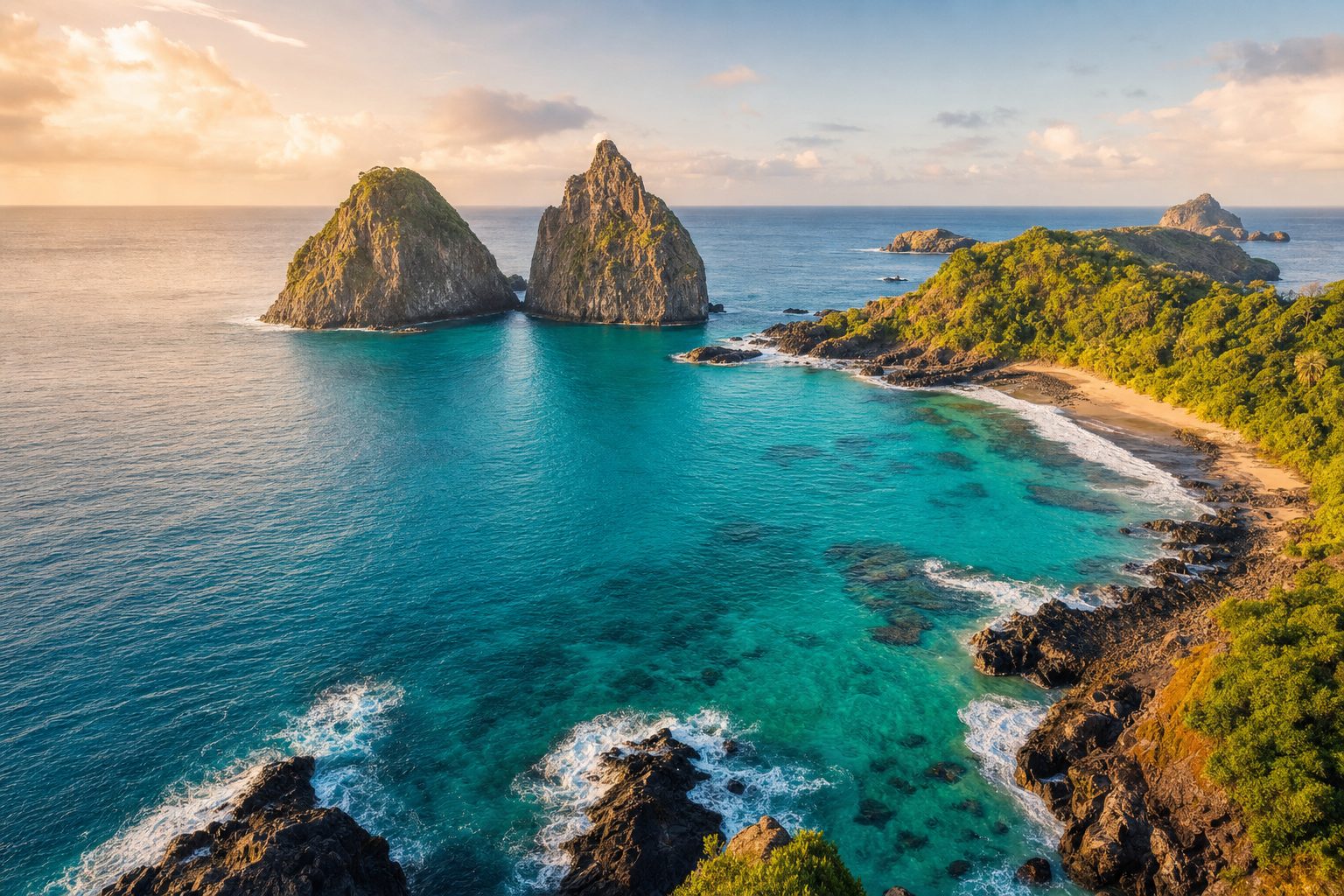
Fernando de Noronha is the Brazilian island escape that looks simple on a reel: a ladder through a cliff crack, clear water below, and the Dois Irmãos rock stacks beyond the sand. The real trip is governed by a more useful set of questions. Which fee pays for which protected area? Does the beach you want require a park ticket or a timed reservation? Are you coming for calm water and a mask, or for Atlantic swell? The answers affect the budget before the first flight is booked.
This volcanic archipelago lies off Brazil’s north-eastern coast and asks visitors to fit themselves around a conservation system, rather than the other way round. That is the point. A sensible first visit is not a race to collect beaches: it is a short, carefully timed stay with room for weather, tide windows and the occasional fully booked activity. Start with the two compulsory charges, then choose a season and a base that let the protected coastline set the pace.
Understand the two charges before you book
The first cost is the Taxa de Preservação Ambiental (TPA), an environmental preservation tax levied on non-residents visiting the archipelago. It is separate from admission to the Marine National Park. As checked in August 2026, the one-day TPA is R$105.79 per person; the official administration says it is calculated by length of stay and rises progressively on longer visits. It is therefore not wise to estimate the total by multiplying a headline daily rate by every extra day without checking the current table.
As checked in August 2026, Fernando de Noronha’s official TPA table lists R$105.79 for one day in the archipelago; two days cost R$211.59, while the stepped schedule rises to R$901.36 for ten days. [1]
Pay or arrange the TPA before travelling if possible. The administration permits online payment by card or a bank slip generated through its site, although it notes that cards issued outside Brazil must be handled at the airport counter. Keep the payment confirmation with your travel papers and allow a margin if an onward plan changes: an unplanned extension can attract a higher charge. The reported 2026 adjustment was 4.4% from R$101.33, effective 1 January, so even a figure from last year is not a safe budgeting number.
The second charge is the entrance ticket for the Marine National Park, often called PARNAMAR. This is the ticket that unlocks many of the celebrated beaches, trails and marine areas; it is not a replacement for the TPA. As checked in August 2026, the park’s ticket page lists R$384 for the general public and a 50% Brazilian discount. Foreign visitors should budget the R$384 rate. The ticket lasts ten days from the arrival date supplied for an online purchase, or from purchase for a physical ticket.
As checked in August 2026, the Marine National Park visitor ticket costs R$384 for the general public, is valid for ten days and can be bought online for QR-code access or in person at the Boldró Visitor Center. [3]
Choose a season for water, not just sunshine
For snorkelling and diving, the decision is fairly direct. August to January is the dry-season window associated with calmer inside waters, more settled beach days and reported diving visibility of roughly 30 to 50 metres. September to November is the strongest overlap for visitors who want the clearest conditions while avoiding the late-December holiday pressure. This is also the period in which the classic blue-water footage is most likely to resemble the reel that brought you here, though a weather buffer remains prudent on any island itinerary.
The Latin Memories destination guide describes August to January as Fernando de Noronha’s dry season, with calm inside seas and diving visibility from 30 to 50 metres; it identifies September to November as the peak period for divers. [7]
For surfing, reverse the emphasis. From December to March, Atlantic swell reaches the northern side, especially around Cacimba do Padre, changing the character of the trip from protected-water swimming to surf watching or surfing. Cacimba do Padre is not a casual substitute for a calm-water beach in that season: reef, current and wave strength deserve local judgement. A traveller wanting both reliable surf and unhurried beach access should build in rest days rather than assuming every shore will be swimmable.
The wetter months, broadly February to July, are not a reason to rule Noronha out, but they are a reason to plan less tightly. Rain and sea state can redistribute the good hours of a day. Book accommodation and flights around the dates you actually want, then leave the most tide-dependent or boat-dependent activity flexible. The island is small, so a lost morning is not a ruined itinerary if the rest of the plan is not overfilled.
Know where the protected park begins
Noronha is divided between two management realities. Around 70% of the archipelago is the fully protected Marine National Park; the Environmental Protection Area, or APA, includes the settled part of the main island, with homes, shops and much of the everyday infrastructure. This is why an itinerary can feel simultaneously village-scale and closely regulated: groceries, restaurants and lodging belong to a working community, while a large share of the coastline is accessed under national-park rules.
The ICMBio park FAQ says the fully protected Fernando de Noronha Marine National Park represents about 70% of the archipelago, while the APA is the sustainable-use area that contains shops and residences. [5]
Base yourself according to the kind of day you want, not the fantasy of staying directly beside every beach. Vila dos Remédios and the central road network keep food, services and the Boldró Visitor Center relatively convenient; moving around the island still takes coordination, whether by buggy, taxi, bus or walking short coastal stretches. Do not treat a hired buggy as permission to improvise on sensitive ground. Park only where permitted, carry water, and ask locally about conditions rather than following a pin down an unmarked track.
The park’s visitor guidance makes the division clear: the national park is an integral-protection area, while the APA permits sustainable use and is where the island’s residences and shops are located.
— Paraphrased from ICMBio Fernando de Noronha’s common-questions page
That distinction also helps decide what needs booking. The park ticket covers access to many recognised attractions, but it does not mean unrestricted arrival at every pool or trail. Some places operate according to carrying capacity and low tide. Others require a reservation or, for certain routes, an accredited guide. Build the day around the rule, not around an optimistic map route.
See Sancho and the coast without forcing the day
Baía do Sancho deserves its reputation, but it rewards patience more than a checklist mentality. The view from above explains why it is repeatedly ranked among the world’s best beaches: an enclosed sweep of pale sand and clear water framed by forested dark rock. The memorable approach is part of the access: a series of ladders descends through a narrow crevice in the cliff. Take only what can be managed safely through the passage, wear footwear with grip, and be prepared to reverse the plan if conditions, queues or comfort with heights make the descent unappealing.
Pair Sancho with nearby viewpoints rather than attempting to bolt every famous bay onto one afternoon. Baía dos Porcos offers the classic view towards Dois Irmãos, while Cacimba do Padre shows a much rougher face of the same coast when the swell is up. On a calm-weather visit, Sueste is a more practical choice for a protected-water session than trying to manufacture a swim at a surf-facing shore. Each park beach deserves a look at the day’s notices and access status before you set off.
- Buy the park ticket before committing to a national-park beach day, and keep the QR code accessible on your phone.
- Make Baía do Sancho the main event of one flexible half-day; travel light for the ladder descent through the cliff crevice.
- Choose Sueste or another sheltered option when the northern coast has surf, rather than entering a beach simply because it is famous.
- Carry refillable water, reef-safe habits and footwear, then take all litter back to the settled area for disposal.
The island’s formal ceiling is another reason not to expect limitless spontaneity. A reported limit of 11,000 visitors per month, or 132,000 per year, has been in place since May 2023. Whether your dates fall in the dry, surf or holiday season, reserve flights and a modest, well-located place to stay early. The cap is not a guarantee of empty beaches, but it underlines that Noronha’s finite land and water access are managed resources, not an open resort promenade.
Reserve Atalaia before you plan the rest of the day
Atalaia is the clearest example of why Noronha planning cannot be left to the night before. At low tide, its natural pool gives a close, controlled look at marine life in very shallow water. The experience is deliberately brief: visitors have about 30 minutes in the pool, and no sunscreen is allowed. A free advance reservation is required through the ICMBio visitor centre, and high-season slots disappear quickly. Put this request at the top of the first day’s administrative tasks, not at the end of the stay.
Arrive ready to float, rather than stand. The official park guidance explains that sensitive pools have daily capacity limits, that visitors must not touch the bottom, and that a life jacket, mask and snorkel are required for entry. Timings change with the low tide, itself shaped by the lunar cycle. That is not bureaucratic fussiness: coral can sit concealed under sand, so a group treating the pool like a normal swimming area would damage exactly what people came to see.
Build a short stay that leaves room for the island
For a first visit, four nights is a practical minimum: an arrival and administration window, one park-beach day, one tide-pool or boat day, and one buffer for conditions. Five nights makes the trip markedly less brittle. There are scheduled flights from the mainland, but travel planning should start with the timetable that exists for your dates, not an assumed connection. Book return flights before treating Noronha as an easy add-on to a mainland itinerary, and keep the final night close enough to your departure logistics that a changed plan does not become a long island transfer.
The broader Brazilian contrast can help frame the trip. A few days in Rio de Janeiro and Ilha Grande bring a very different balance of city, ferry connections and beach life; Noronha is the smaller, regulated counterpoint where the logistics sit in front of the scenery. Visitors who arrive chiefly for sea-colour and access rules may also recognise a familiar rhythm in El Nido’s lagoon restrictions, while a comparison with Praslin’s protected landscapes makes the point that prized islands work best when the visitor adjusts to the place.
Leave Noronha with that adjustment in mind. Pay the two charges correctly, choose the season for the water you actually want, take reservations seriously and accept that the finest beach may need a ladder, a weather check or a change of plan. Those are not obstacles to the visit. They are the structure that keeps a small archipelago visitable, and the reason its shoreline still feels worth planning for.
Sources & further reading
- 1. Fernando de Noronha Administration: Environmental Preservation Tax (TPA)
- 2. G1 Pernambuco: 2026 Fernando de Noronha tourist-tax adjustment
- 3. ICMBio Fernando de Noronha: Marine National Park tickets
- 4. Lonely Planet: Fernando de Noronha Marine National Park
- 5. ICMBio Fernando de Noronha: Common questions and visitor rules
- 6. L’Heure du Voyage: Fernando de Noronha beaches, fees and Atalaia tips
- 7. Latin Memories: Fernando de Noronha travel and season guide
- 8. Topologica: Fernando de Noronha surf guide